Observations from the ongoing study of Japanese painting — where brushwork, seals, history, and intuition meet, and where authenticity is tested against the act of seeing.
Journal
8 September 2026
Someone Ancient
This morning I was thinking about contact.
About those unusual moments when another person seems suddenly very close, not because we know everything about one another, or even because we spend much time together, but because something in us seems to recognise something in them.
Sometimes the feeling is almost physical. A resonance. Two lives briefly vibrating at a similar frequency.
I have been thinking about this increasingly in nature too.
Walking in the mountains has begun to feel less like moving through a landscape and more like entering into relationships. Water tumbling down a ravine, moss growing beside a path, an old tree, an animal watching from somewhere nearby. The world seems less composed of things and more full of presences.
Perhaps nothing outside me has changed. Perhaps I am simply learning to pay attention.
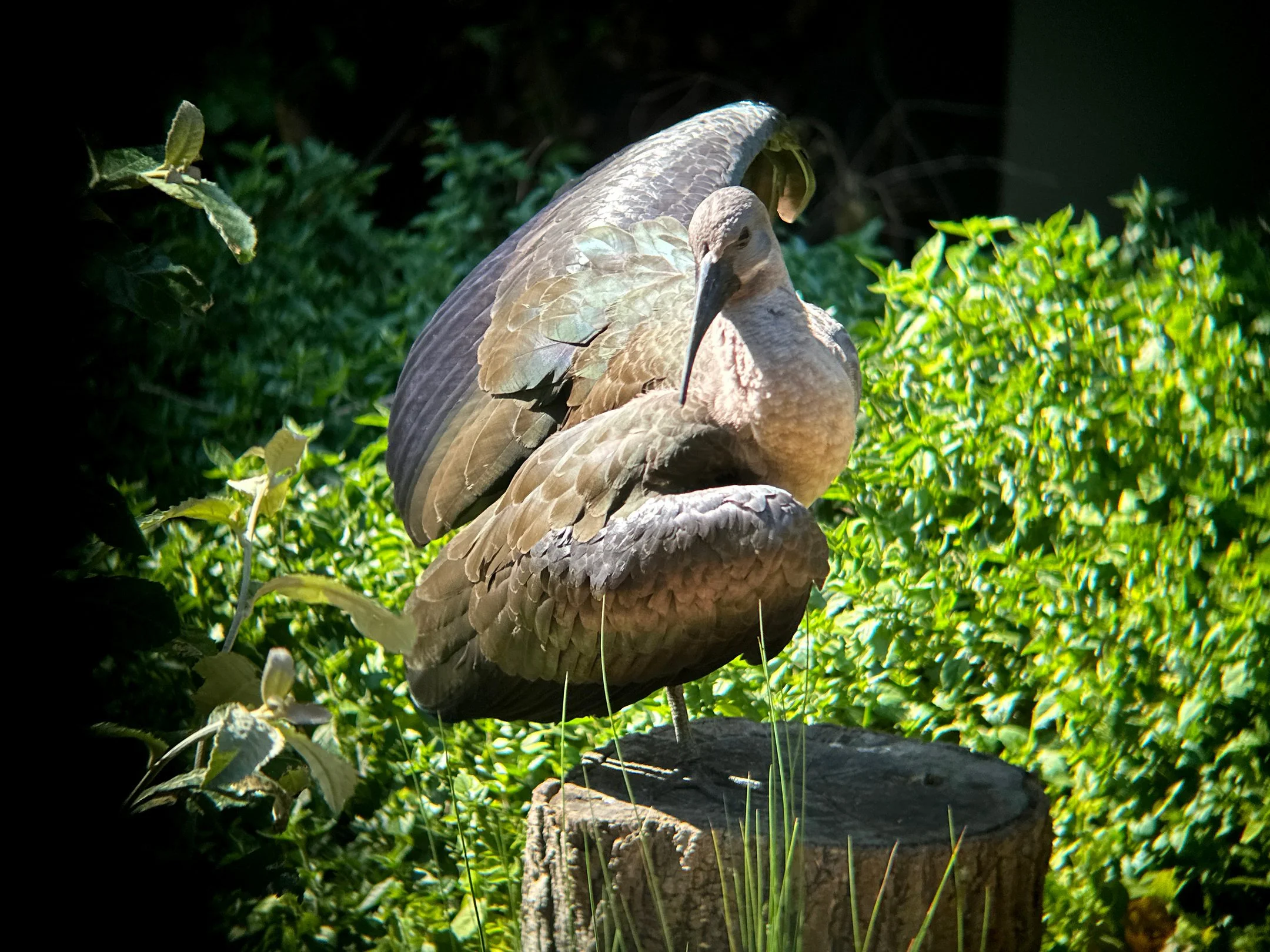
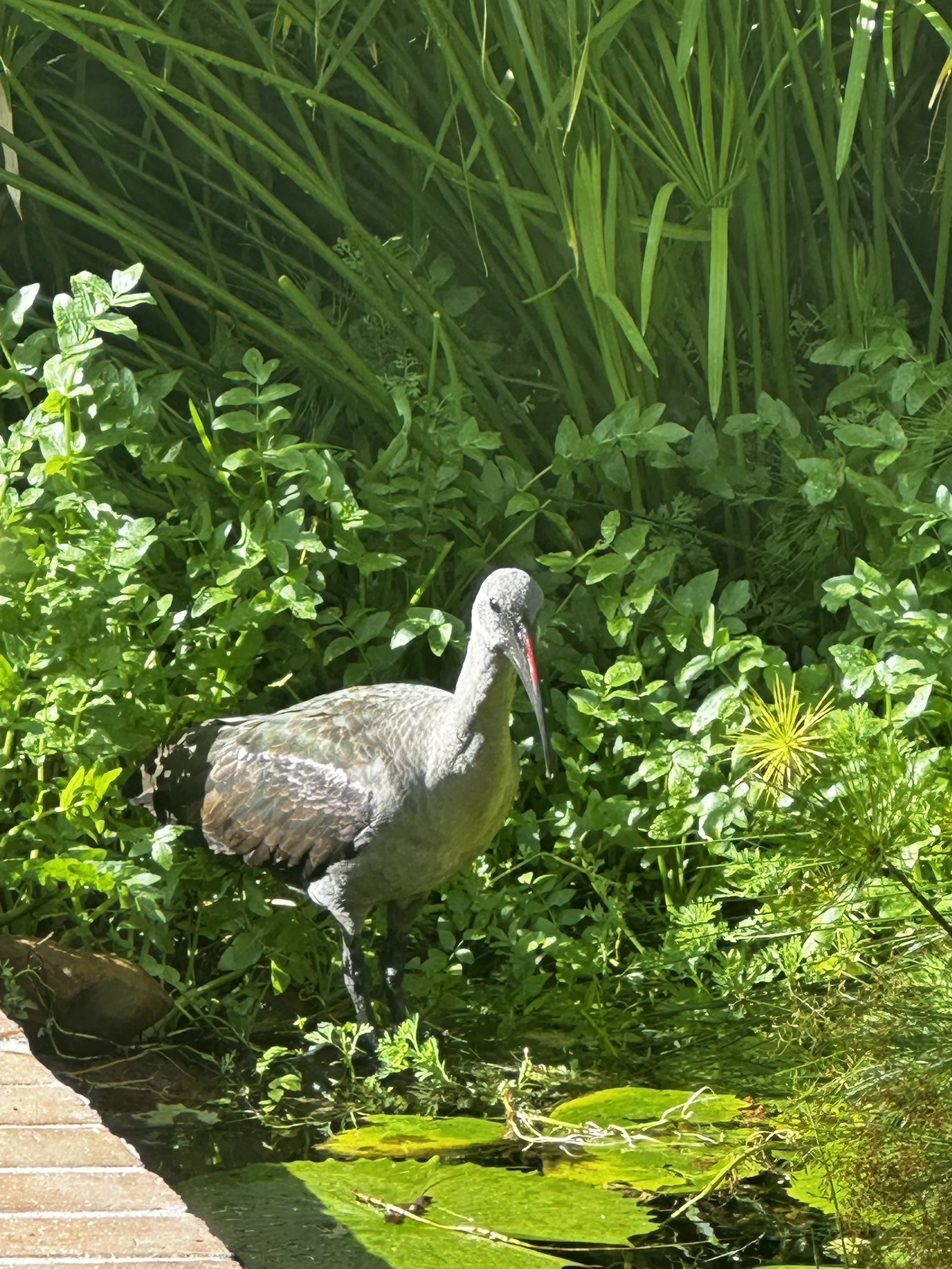
And then today I met this ibis.
Only two months old, apparently.
It was difficult to reconcile this information with the creature looking back at me. Everything about the body was new: young feathers, enormous wings still being negotiated, a life barely begun. And yet the face seemed ancient.
I know that this is projection. I know that human beings are wonderfully capable of finding ourselves reflected everywhere.
But I am becoming less interested in immediately explaining these experiences away.
There was an intelligence in that encounter that felt older than the bird. For a few moments the categories became pleasantly uncertain. Young and ancient. Human and animal. Self and other. Observer and observed.
Perhaps attention does this. When we look long enough, the boundaries we normally depend upon become a little more permeable.
The mountain can do it. Water can do it. Another person can unexpectedly do it.
And sometimes, apparently, it takes the form of a two-month-old ibis standing in the sunlight.
3 August 2026
Cha Qi
Yesterday a friend invited me for tea.
Not just a cup of tea, but an afternoon of tea. A tiny packet of Da Hong Pao, the famous Big Red Robe oolong from China’s Wuyi Mountains, emerged from an astonishing sequence of elaborate presentation boxes. The packaging was almost theatrical, until eventually all that remained was a handful of dark, twisted leaves.
Those same leaves were infused again and again.
Ten times.
Perhaps fifteen.
Each little cup tasted familiar, yet different. The roasted notes softened into fruit, then minerals, then sweetness. Eventually the tea seemed almost transparent, and yet somehow still present.
ere’s how I’d rewrite that section:
During our conversation there was an extraordinary energy. Not jittery like too much coffee, but bright, expansive and intensely alert. Time seemed to slow down while our thoughts became clearer and more animated. Later, as I read about Da Hong Pao and other great Chinese teas, I came across the term Cha Qi.
Tea energy.
It is a curious expression because it doesn’t refer simply to caffeine or chemistry, although both undoubtedly play their part. Instead it describes the distinctive state that many tea drinkers recognise: a gentle exhilaration, heightened awareness and a feeling of calm clarity that seems to arise after sharing exceptional tea.
Whether Cha Qi exists as something measurable is almost beside the point.
Many worthwhile things resist measurement.
The atmosphere of an old forest.
The calm that follows a walk through mountains.
The feeling of sitting with someone whose company asks nothing of you except your presence.
Perhaps tea simply creates the conditions in which those things become easier to notice.
I left not thinking about expensive leaves or famous tea bushes, but about time itself. How extraordinary it is that a few grams of carefully made tea can slow an afternoon down enough for fifteen tiny cups, an unhurried conversation, and the quiet discovery that some of life’s richest experiences reveal themselves only through repetition.
Perhaps that is the real meaning of Cha Qi. Not something contained within the tea, but something that quietly emerges between the tea, the place, and the people sharing it.
12 July 2026
Rediscovering the Hearth
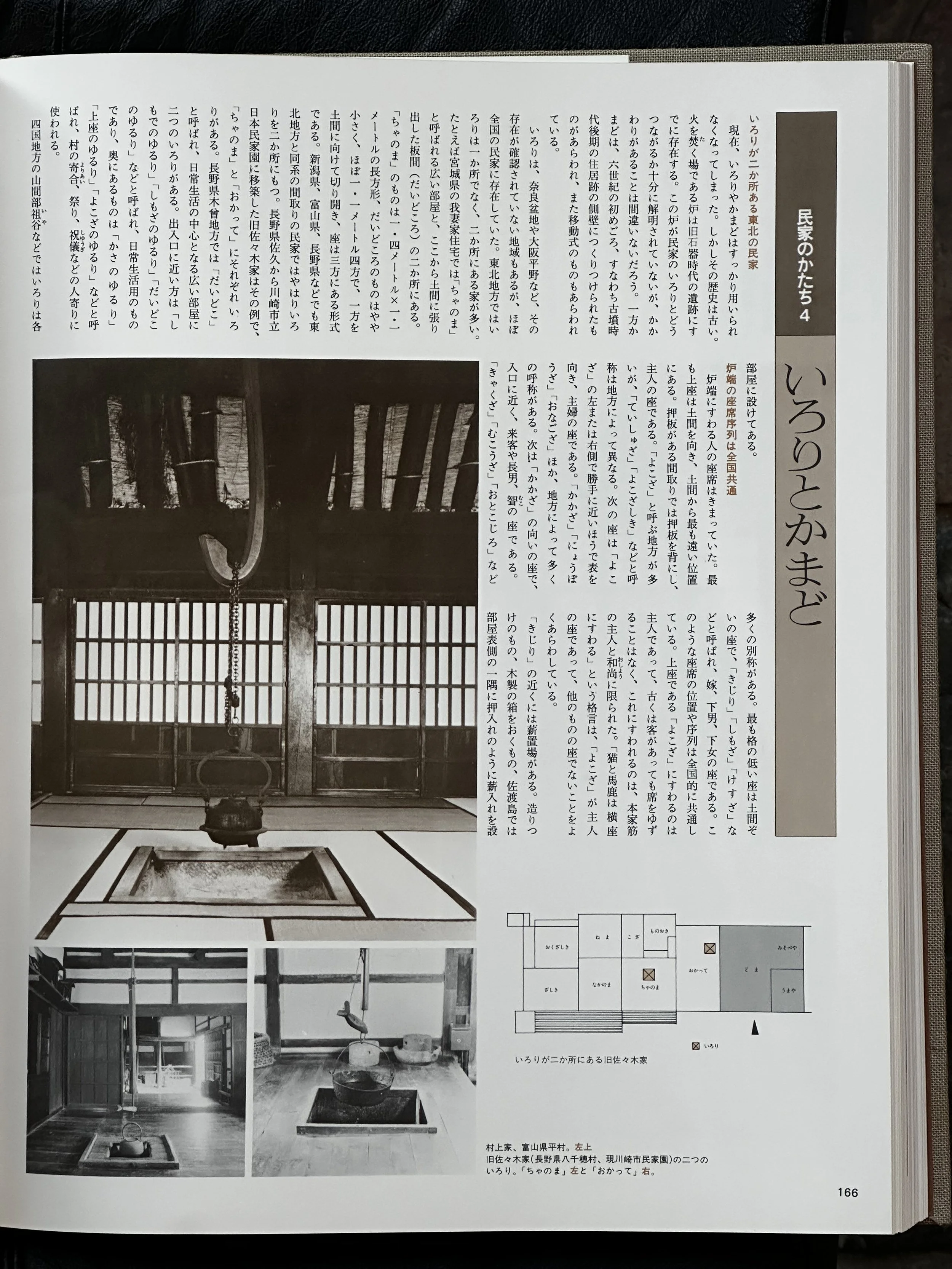
The authors describe the jizai kagi as one of the visual centres of the farmhouse interior and note that older generations often felt a deep attachment to it.
I found myself wondering whether the attachment was ever really to the hook itself.
Perhaps it was to everything that repeatedly happened beneath it.
Meals prepared.
Children growing.
Conversations unfolding.
Grief shared.
Laughter returning.
Entire lives quietly accumulated around a single place.
Objects become saturated with meaning because they stand witness to ordinary life.
Perhaps that is why these old hearth tools continue to resonate so deeply today.
They are not invitations to romanticise the past, nor arguments against modern convenience.
Rather, they remind us that technology has transformed almost every aspect of domestic life in remarkably little time. The ancient relationship between body, fire and home has largely been replaced by efficiency.
Japan, perhaps more than anywhere else, preserved enough of that older world for us still to glimpse it.
Through old books.
Through farmhouse architecture.
Through soot-darkened beams.
Through a cast-iron kettle suspended above glowing charcoal.
Through an old rice pot whose surface still carries the marks of generations of use.
I have gradually realised that I am not really collecting Japanese objects.
I am collecting reminders.
Reminders that there may be forms of attention, patience and belonging that are far older than any one culture.
Perhaps that is why these objects feel strangely alive.
Not because they possess some mysterious power.
But because they invite us to remember something our bodies may never have entirely forgotten.
Sometimes an old book does more than explain an object.
Sometimes it reminds us that beneath the speed of modern life there are older rhythms, still waiting patiently beside the fire.
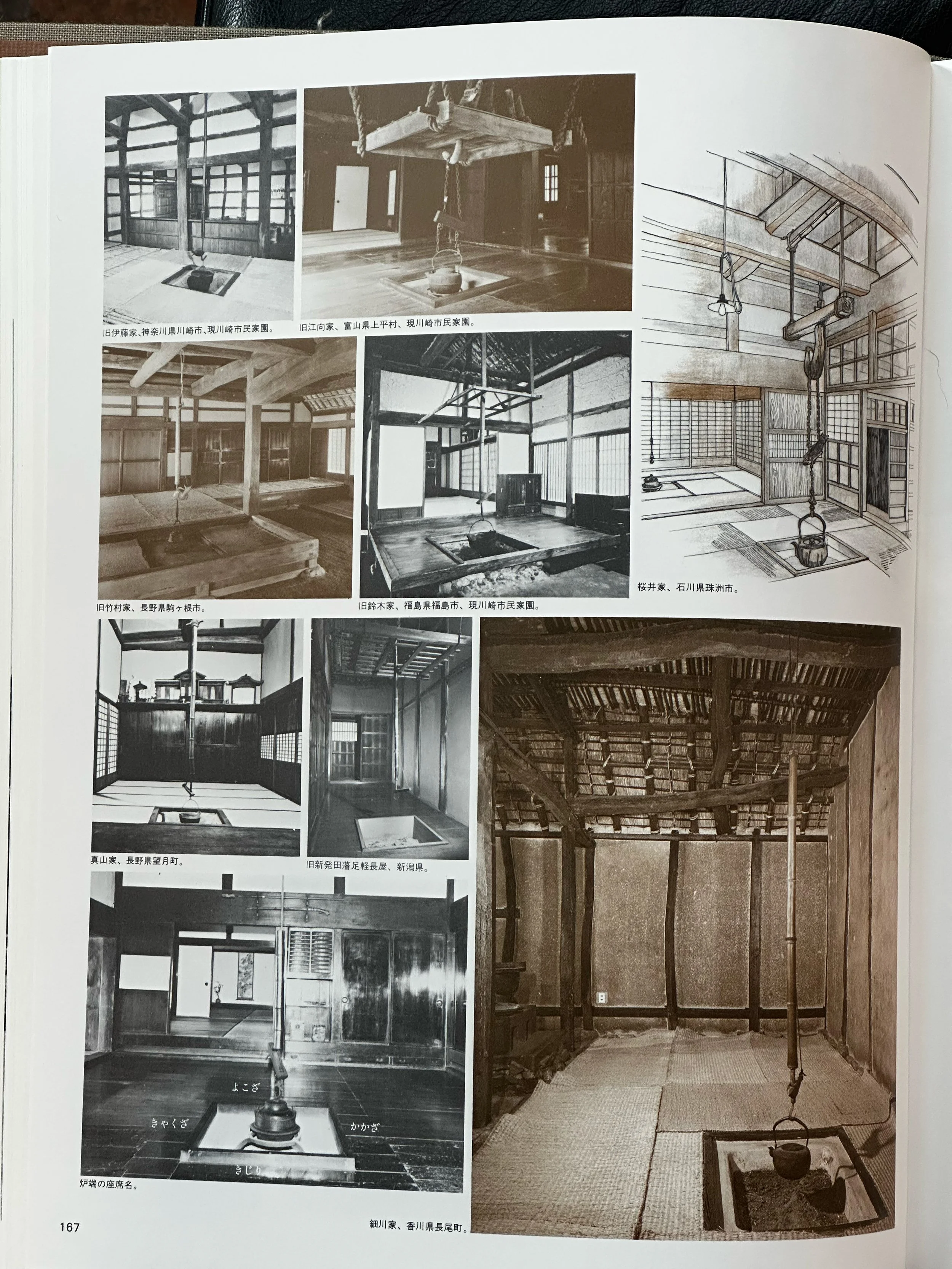
One of the unexpected pleasures of collecting is discovering that an object can eventually lead somewhere entirely different.
For me, that journey has recently been guided by Japanese Traditional Houses, Volume I, published by Gakken in 1980. What began as curiosity about old Japanese hearth hooks and cast-iron kettles slowly became something much larger. As I read, I found myself becoming less interested in the objects themselves and increasingly fascinated by the world they once belonged to.
The book traces the origins of the irori, the traditional Japanese sunken hearth, back to the pit fires of prehistoric Japan.
That thought stopped me.
For thousands of years, despite extraordinary changes in architecture, society and technology, people continued gathering around a shared fire. Long before electric light, before kitchens became collections of appliances, before cooking became something to complete as efficiently as possible, there was simply a fire in the centre of the home.
It is tempting to think of the irori as uniquely Japanese.
In one sense, of course, it is.
But in another, it feels profoundly universal.
Almost every culture on earth once organised itself around a hearth. Whether in Europe, Africa, Asia or the Americas, generations cooked, talked, repaired tools, cared for children, welcomed visitors and sat quietly beside firelight. Only relatively recently have most of us exchanged that ancient rhythm for kitchens filled with switches, induction plates, microwaves and extraction fans.
Modern life is astonishingly efficient.
Yet something subtle seems to have disappeared.
One word in particular stayed with me.
In several regions of Japan, the area surrounding the hearth was known as yururi. Today the word suggests living gently or taking life at an unhurried pace, but its older meaning described the place around the fire where everyday life unfolded naturally. It was not merely a location within the house. It was almost a state of being.
The more I thought about it, the more I found myself wondering whether places like this leave traces within us.
Not in any way that science can yet fully explain, but perhaps in quieter ways.
If human beings have spent tens of thousands of years gathering around fire, preparing food, watching flames, listening to stories and sharing silence, it seems almost inevitable that those rhythms would become deeply familiar to body and mind.
Perhaps that is why so many of us feel ourselves relax beside a fire without quite knowing why.
Perhaps the attraction is older than memory itself.
Reading this chapter made me realise that what attracts me to old Japanese kettles, jizai kagi, rice pots and hearth tools is not simply their craftsmanship.
They are reminders of an older conversation between people and materials.
Wood.
Iron.
Clay.
Water.
Fire.
The sequence itself matters.
Gathering wood.
Lighting charcoal.
Adjusting the height of a suspended kettle.
Waiting patiently for water to come gently to the boil.
None of these actions can be hurried without changing their nature.
The fire asks for attention.
The kettle asks for patience.
The day quietly slows to meet them.
10 July 2026
Ebisu, the Irori, and a Giant Jizai Kagi
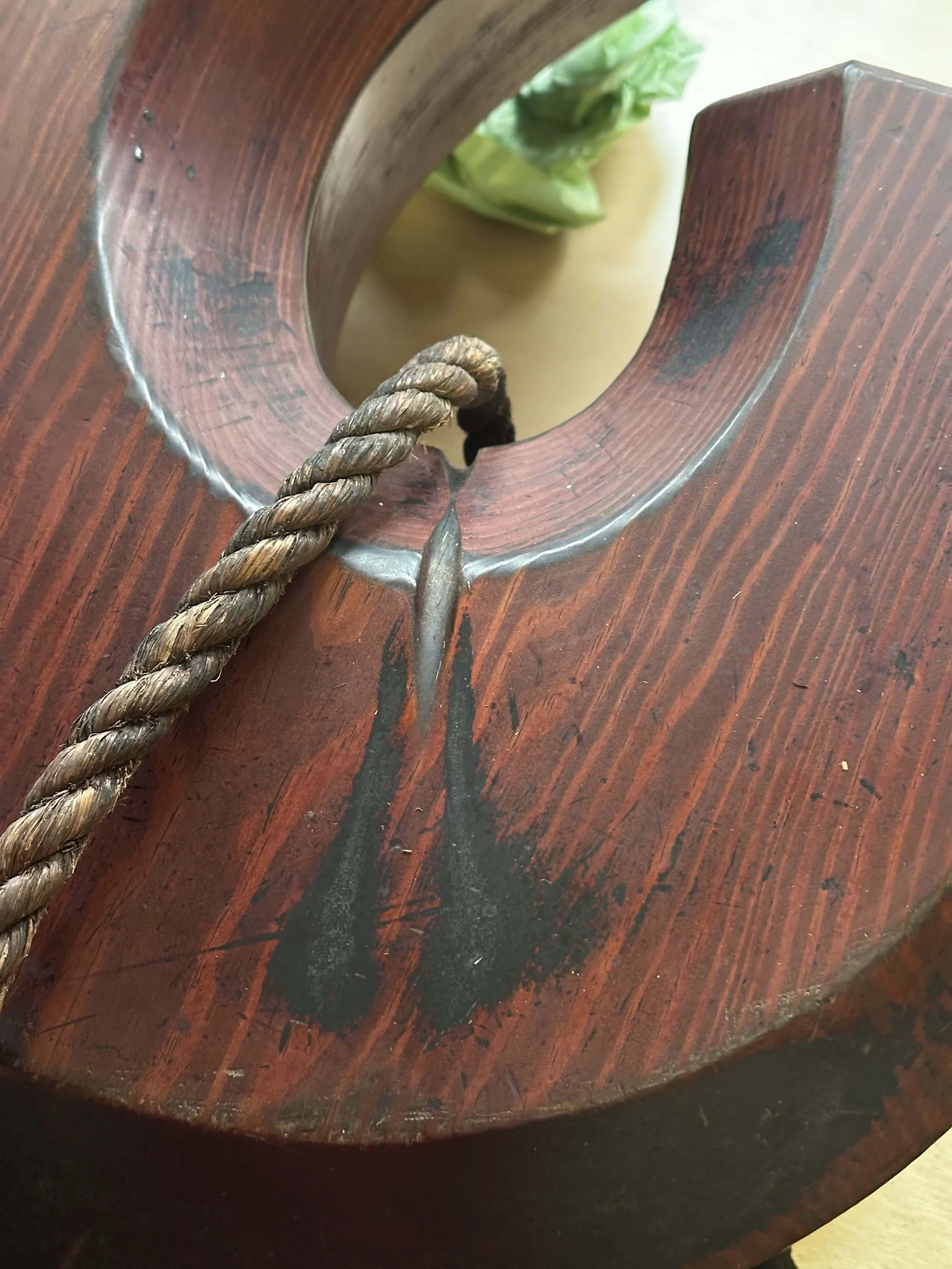
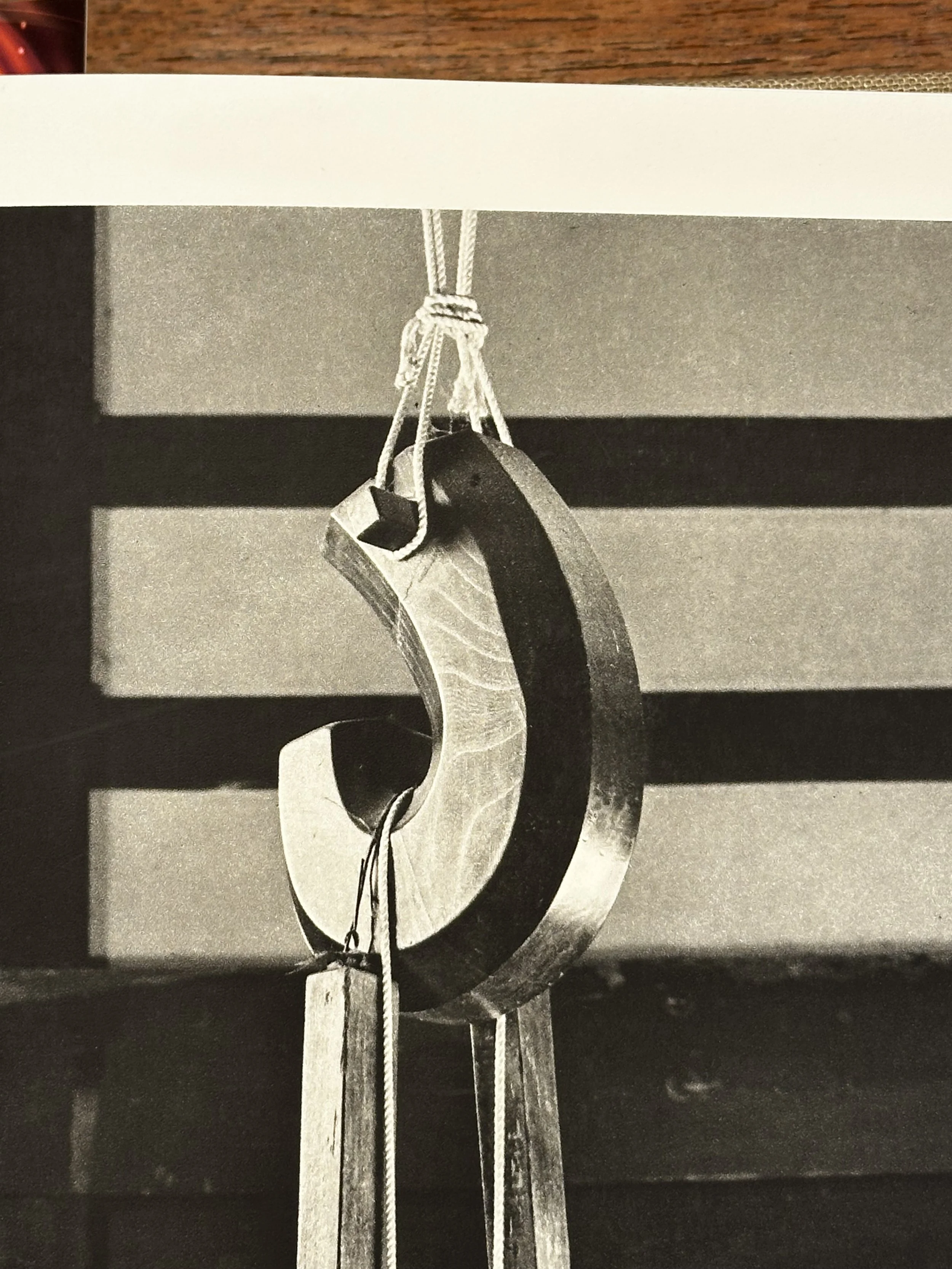
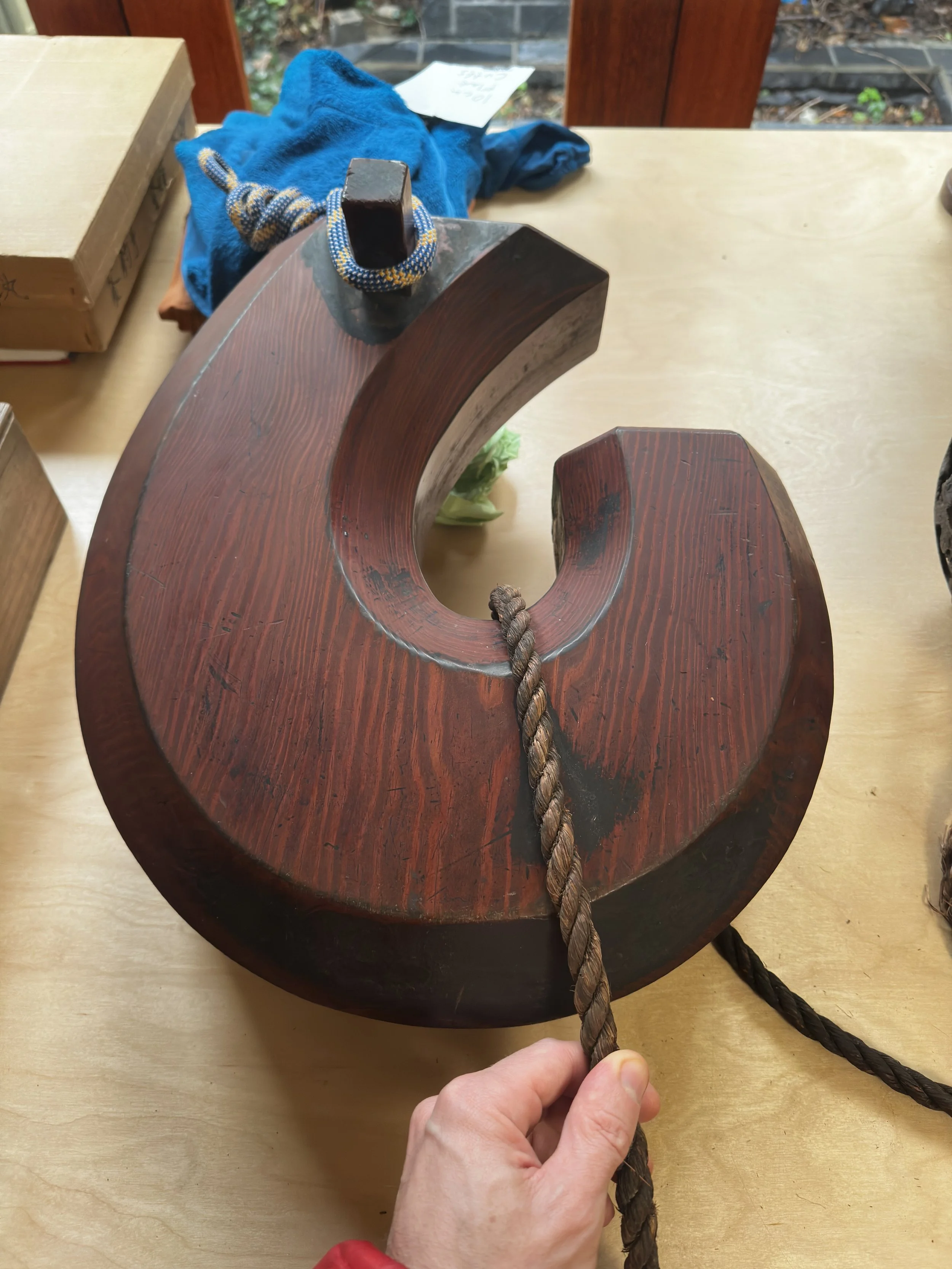
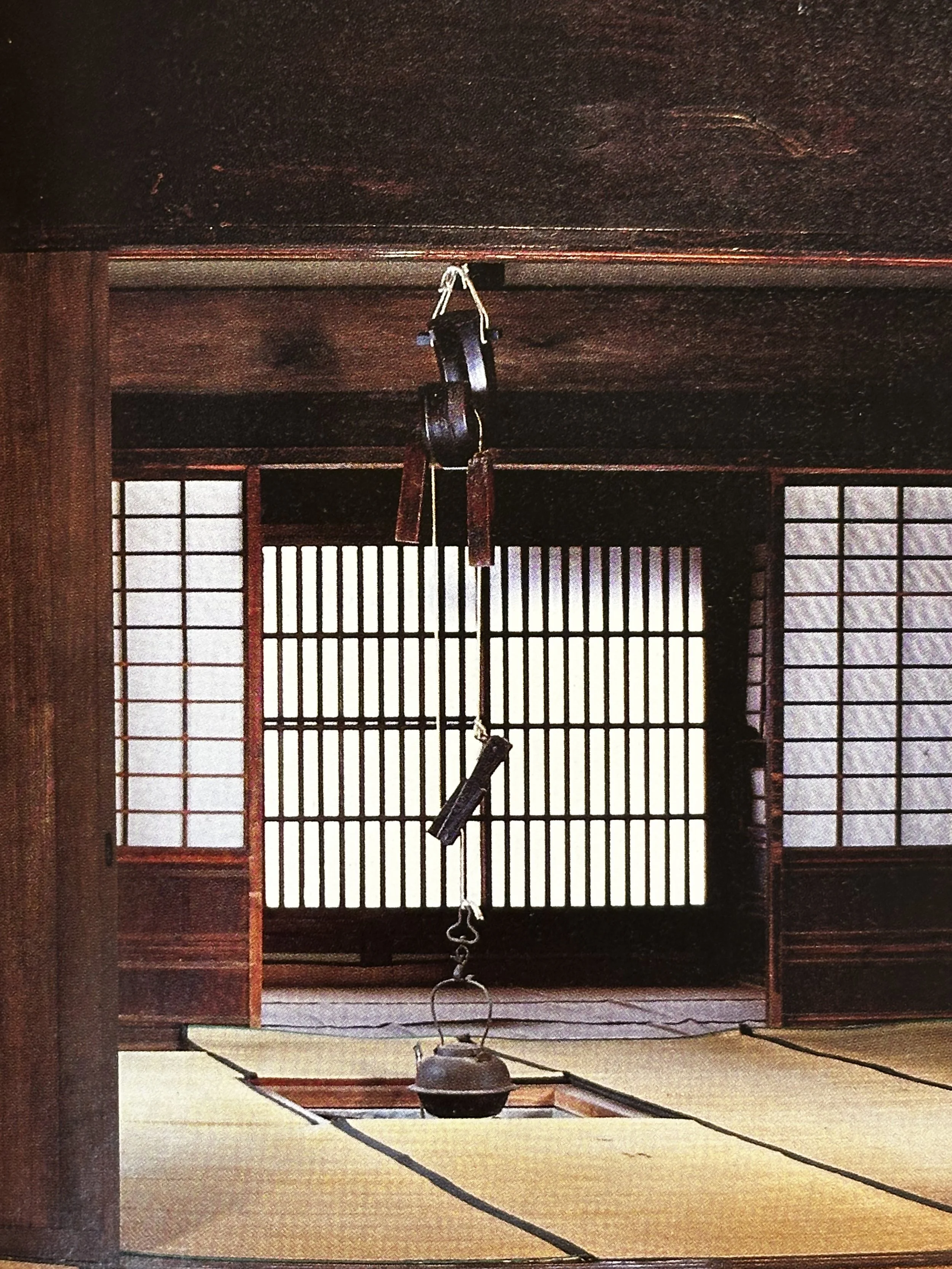
Among the many objects associated with the traditional Japanese irori, or sunken hearth, few are as striking as the great wooden jizai kagi.
Suspended above the fire, the jizai kagi allowed a cooking pot or iron kettle to be raised or lowered simply by pulling a rope attached to the wooden body. Although entirely practical, these devices gradually became an important form of regional folk craftsmanship, with each village and each carpenter bringing slightly different proportions and details to an otherwise familiar form.
Some were left almost completely plain. Others became increasingly sculptural.
Many were paired with carved wooden fish, known as yokogi, which acted as breaking devices, holding the rope fixed in place once the adjustment is made. The fish carried several layers of meaning. Carp have long represented perseverance and determination in Japanese culture, while fish themselves also became associated with protection against fire, belonging to the world of water rather than flame. Some surviving examples are explicitly linked with Ebisu, the smiling god of fishermen, prosperity and good fortune. In these, the great hook becomes known as Ebisu’s hook, while the suspended fish recalls the sea bream that Ebisu traditionally carries beneath his arm.
I find that association rather wonderful.
Once it has been pointed out, it becomes difficult not to imagine the enormous curved hook descending from above as though it were being lowered from another world. It is an ordinary household object, yet it possesses something unexpectedly mythical, as though Ebisu himself has reached down into the farmhouse to suspend the evening kettle above the fire.
Whether or not that was ever the intention scarcely matters. The image lingers.
The present example belongs to a quieter tradition.
Rather than elaborate carving, its appeal lies almost entirely in proportion and material. Carved from a single monumental piece of keyaki, Japanese zelkova, it weighs approximately ten kilograms. The broad sweeping curve is remarkably simple, yet it possesses an unexpected sculptural presence. Looking at it today, it is easy to forget that this was once simply part of an ordinary farmhouse kitchen.
What particularly attracted me was the restraint of its design. There is almost no ornament. Instead, the beauty comes from the flowing curve, the generous thickness of the timber, and the surface that has slowly matured through decades of exposure to smoke and cooking. The soft reddish finish has worn gently, allowing the grain of the keyaki to remain visible beneath the colour.
This example appeared almost by chance on the Japanese auction market, where such objects still occasionally emerge from old houses and rural collections. Only after comparing it with many examples offered by specialist dealers in Japan, Europe and America did I begin to appreciate how varied these great hooks can be. Some are heavy and angular, others more decorative, while a small number seem to possess an elegance that comes simply from confident proportion and fine timber.
That may be one of the quiet pleasures of collecting Japanese folk art.
The objects reveal themselves slowly. A form that first appears purely functional gradually begins to speak of regional traditions, anonymous craftsmanship and the rhythms of daily life around the hearth. The more one looks, the less these objects seem like tools and the more they seem like companions to generations of ordinary families.
Today, the irori has largely disappeared from everyday life, but the great wooden jizai kagi remains a reminder of a household centred around warmth, conversation, tea, cooking and family. Removed from its smoke-darkened farmhouse and standing quietly on its own, it still carries something of that history.
And perhaps, just a little, it still feels as though it belongs to Ebisu. Not because it is grand or precious, but because it quietly bridges the worlds of hearth, good fortune, craftsmanship and the sea. That seems an entirely fitting legacy for such a simple and beautiful object.
29 June 2026
Listening for the Wind
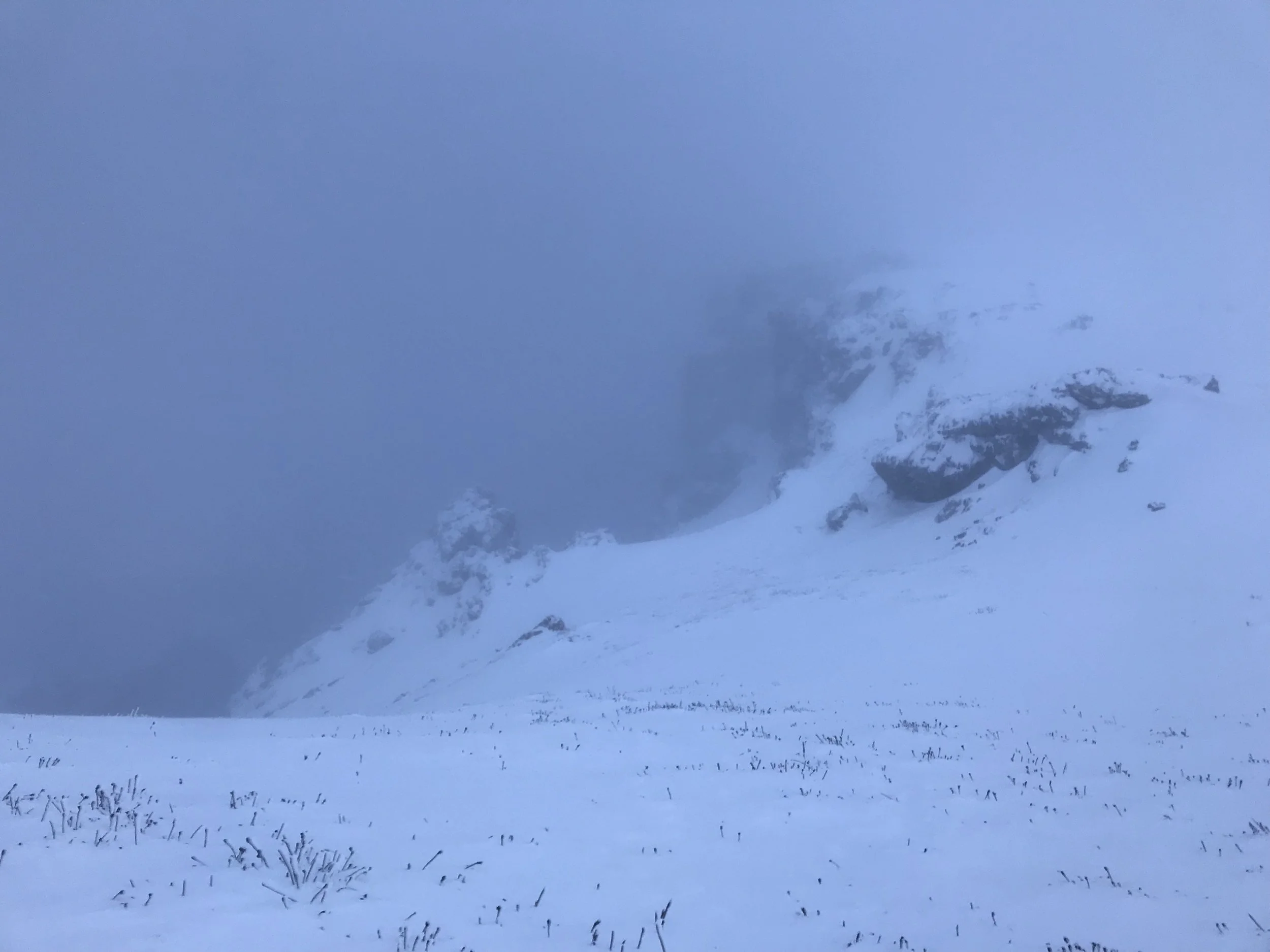
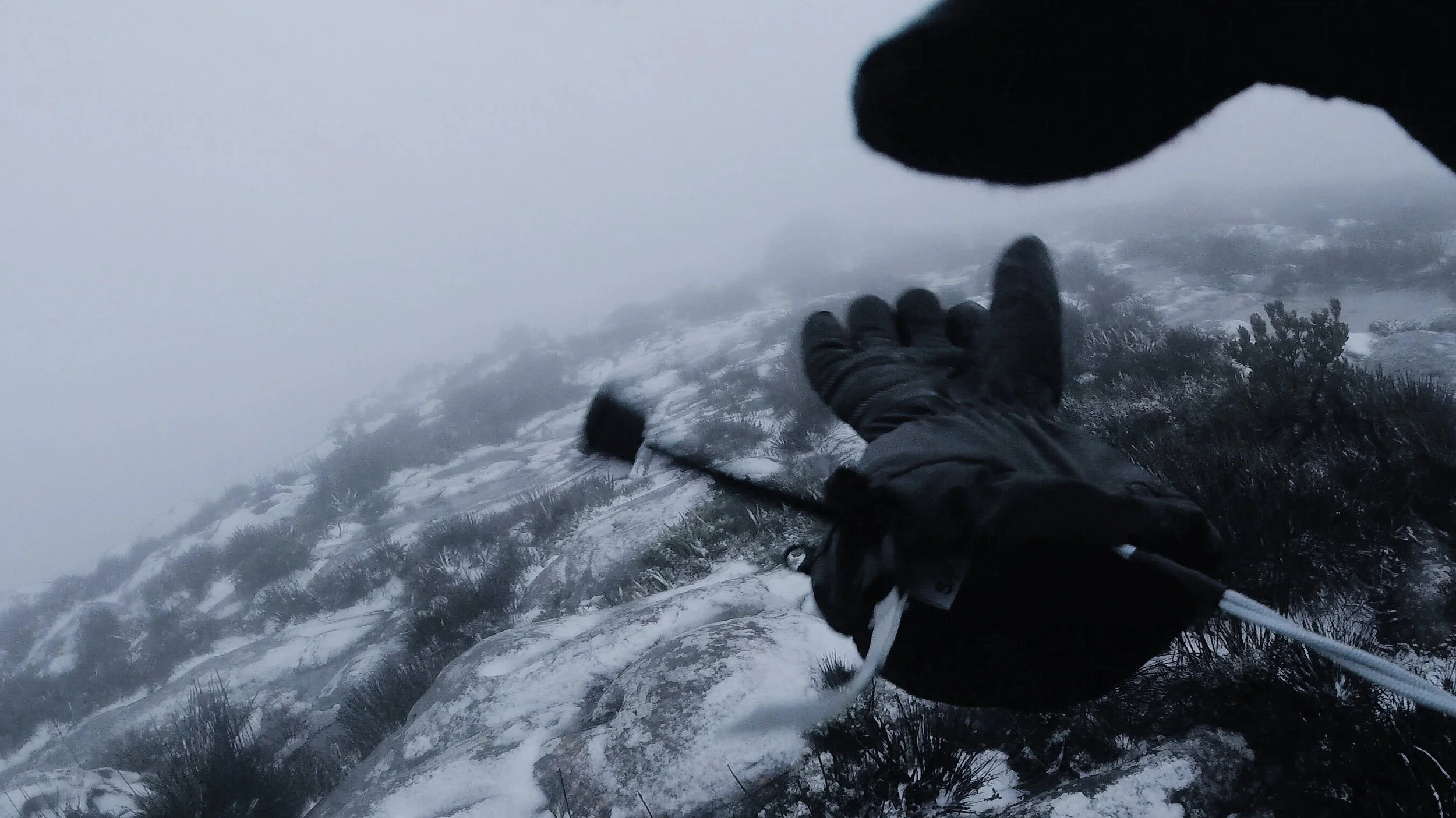
There was a time in my life when I believed I climbed mountains to escape.
Escape the city.
Escape work.
Escape noise.
Sometimes, if I am honest, escape myself.
Looking back now, I think I misunderstood what the mountain was offering.
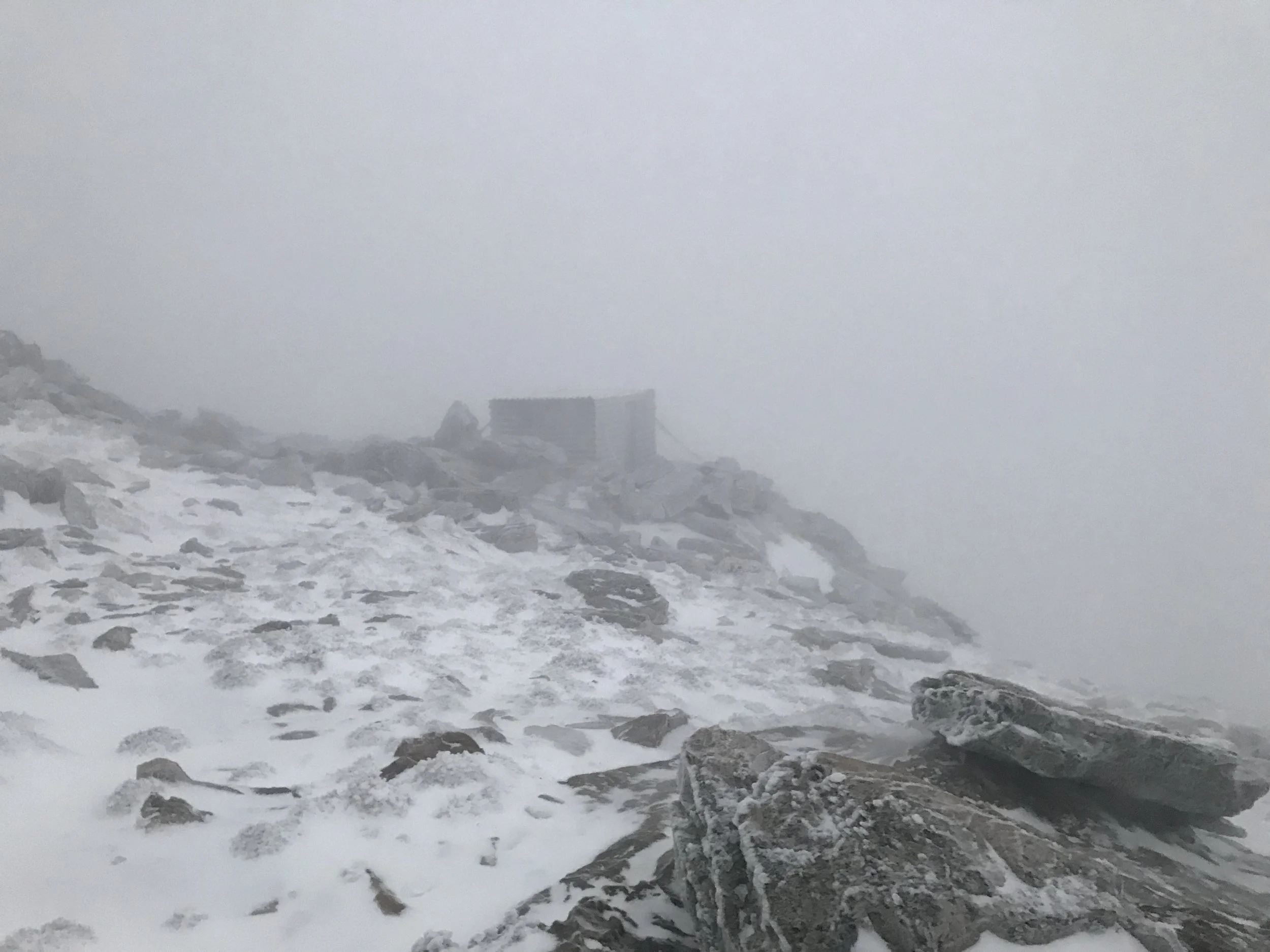
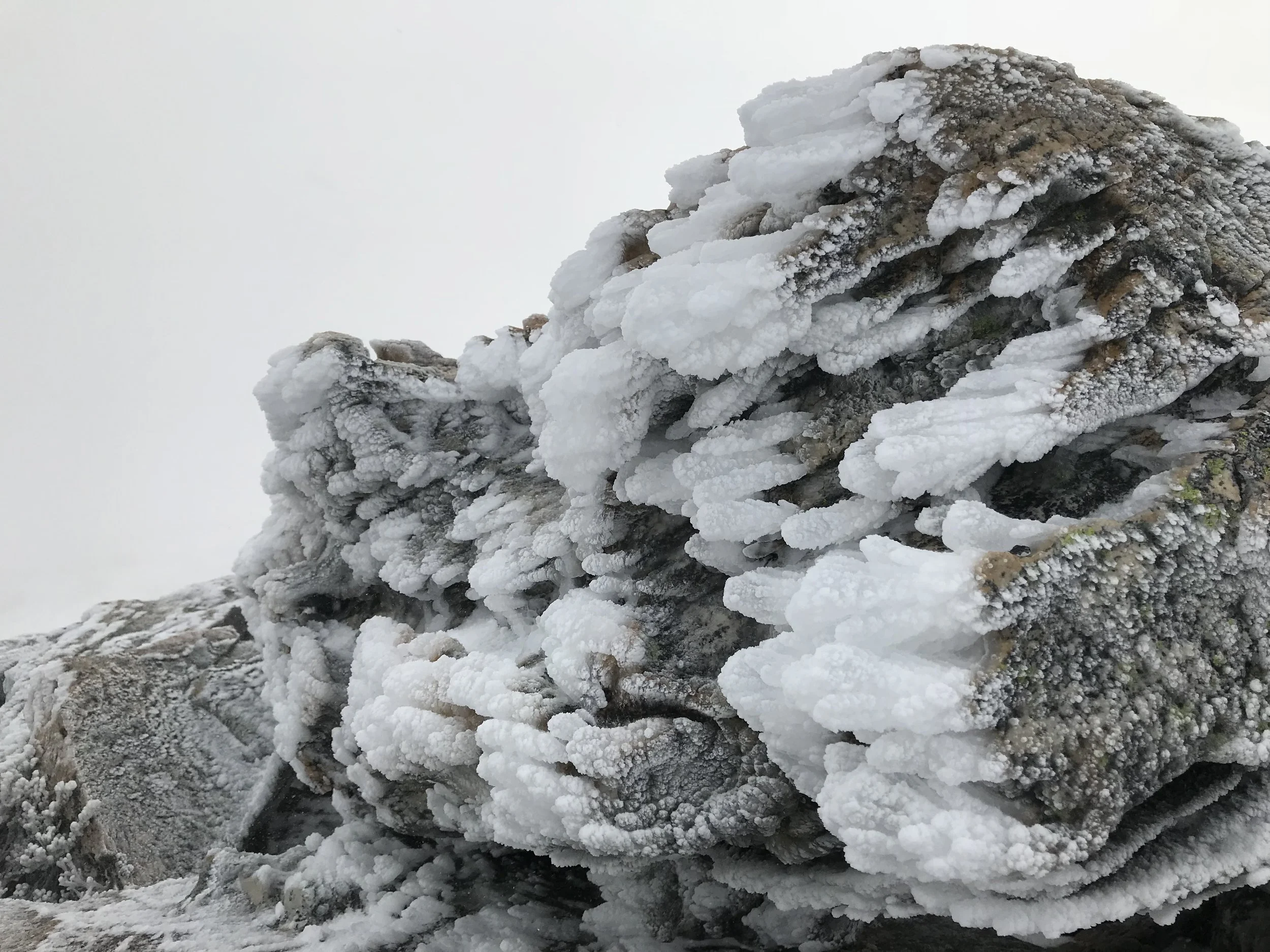
After my father died, I made a journey into a winter storm in the high mountains. I packed carefully, carried enough food for several days, and walked into strengthening wind towards a small emergency cabin on the summit.
By the time I reached it, the world had almost disappeared.
Snow, cloud and wind erased the landscape until there was almost no distinction between earth and sky. I remember struggling simply to unlock the cabin door with frozen hands.
For several days I sat there alone while the storm surrounded the little hut.
At the time I thought I had gone there to face death.
Now I wonder if I had really gone there to discover whether life could still hold me.
Eventually I had to leave.
On the summit the storm had eased just enough to tempt me into believing the descent was possible. The air temperature hovered around minus three degrees C, while a wind of roughly sixty kilometres an hour drove the wind chill down towards minus fifteen or seventeen. Yet the stronger wind had one unexpected gift: it swept much of the loose snow from the ridge. I could still make out the winding mountain road thirty or forty metres ahead.
It seemed enough.
Within minutes of descending, everything changed.
Lower down, the wind eased slightly, but that small difference allowed the snow to settle much more heavily across the trail. Visibility collapsed to only four or five metres. The winding track disappeared beneath fresh drifts and, before I realised it, I had stepped off the trail into snow that reached above my knees.
I was carrying a pack weighing around sixteen kilograms.
The wind was still driving hard across the slope.
I remember becoming acutely aware that time had changed its meaning. If I remained lost for even an hour or two, or if I was forced to stop moving, there was a very real possibility that I would simply not get off the mountain.
Every unnecessary decision became a luxury.
There was room only for the next correct step.
There was no path.
No horizon.
No certainty.
It remains one of the most consequential moments of my life.
What I remember most clearly, though, is not the fear.
It is how I found my way again.
I stopped trying to see.
Instead I felt the wind.
I knew which direction it should have been blowing from, so I turned ninety degrees and simply walked.
For what may have been six or seven minutes—though it felt outside time—I pushed through deep snow with almost no sense of where I was or what lay ahead.
Then, almost unexpectedly, my boots found the buried trail again.
The relief is almost impossible to describe. It arrived all at once, not as excitement, but as a deep, physical understanding that I was probably going to make it home.
Only recently have I realised how much that moment has become a metaphor for my life.
Whenever I have lost direction, it has rarely been thinking that has guided me home.
It has been paying attention.
Feeling.
Listening.
Trusting something quieter than certainty.
For many years I also believed that my love of mountains depended upon sharing them with other people. Wonderful companions came and went through different seasons of my life, and each of them illuminated something different about the landscape.
But another understanding has been growing, slowly and almost invisibly.
Perhaps the mountain itself has always been the companion.
Life has changed too.
Years ago I lived in a place that often felt cramped, noisy and restless. It taught me many things, but spaciousness was not one of them.
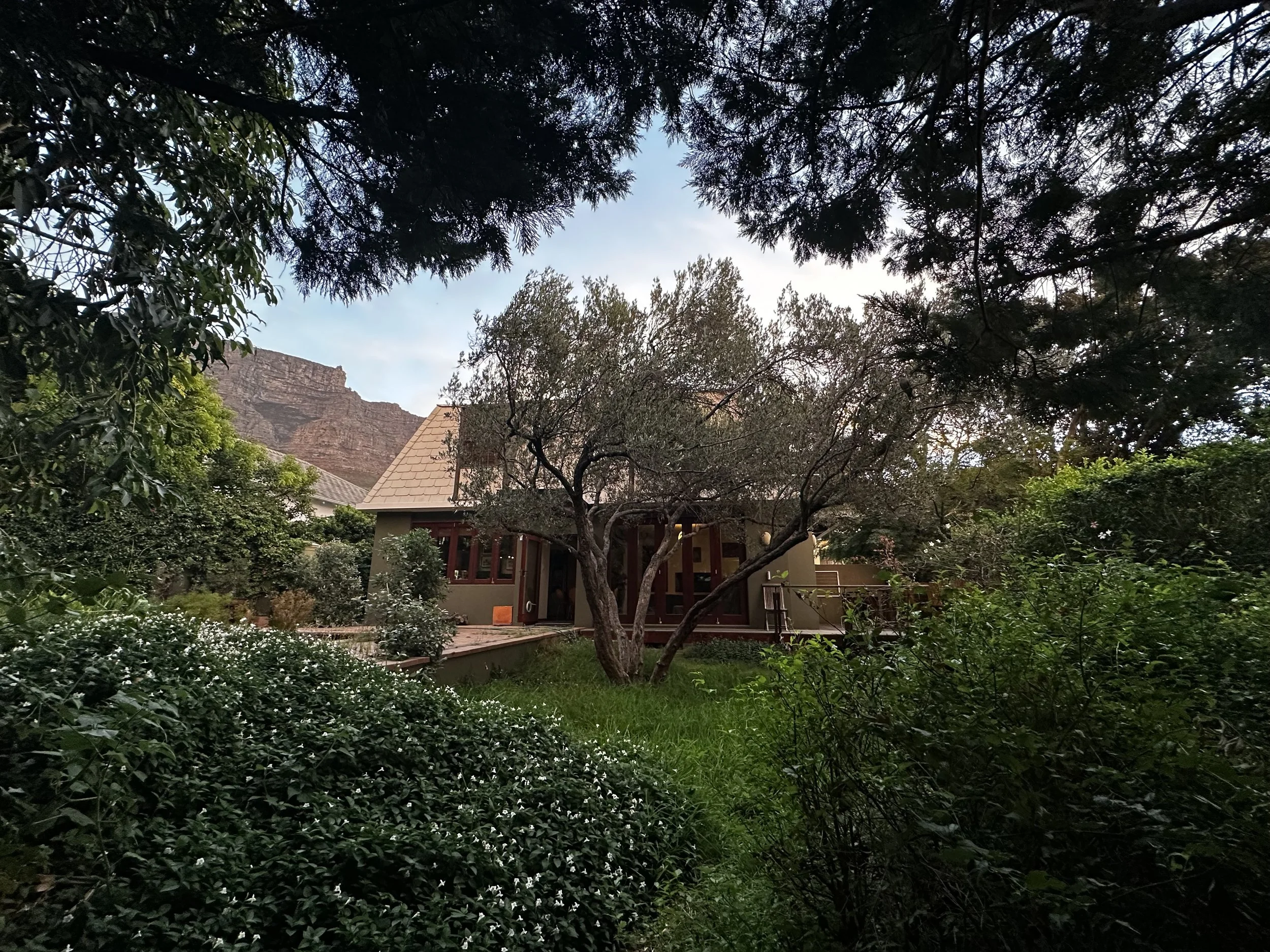
Today I wake among old oak trees, birds, squirrels, bees and an untidy garden that seems determined to become a small piece of wilderness.
Without noticing it, I have begun bringing the mountain home.
Perhaps that explains why I no longer feel the same urgency to flee into it.
The longing remains, but it has softened.
The mountain is no longer somewhere I need to escape to.
It has become somewhere I visit.
The same quietness now appears while making tea, watching a robin from the kitchen window, lighting the fire, or rolling out a yoga mat as dawn arrives.
Collecting Japanese art has slowly revealed itself to be part of this same journey.
For years I thought I was collecting paintings, tea bowls, lanterns and old iron.
Now I suspect I have really been collecting places.
A Hakuin scroll.
An old cast-iron kettle.
A weathered lantern.
A simple tea bowl.
Each carries the same invitation the mountain offered all those years ago.
Be here.
Nothing more is required.
Perhaps that is why so much Japanese art feels alive to me.
It does not shout.
It waits.
Like a mountain in mist, it asks us to become quiet enough to hear what is already present.
I still love walking high ridges in winter.
I still find something deeply nourishing in wind, cloud and open country.
But if the mountain has taught me anything, it is this:
When the path disappears, do not panic.
Stop searching for certainty.
Listen for the wind.
Then take one careful step.
The road has a remarkable way of finding your boots.
25 June 2026
The Things We Gather
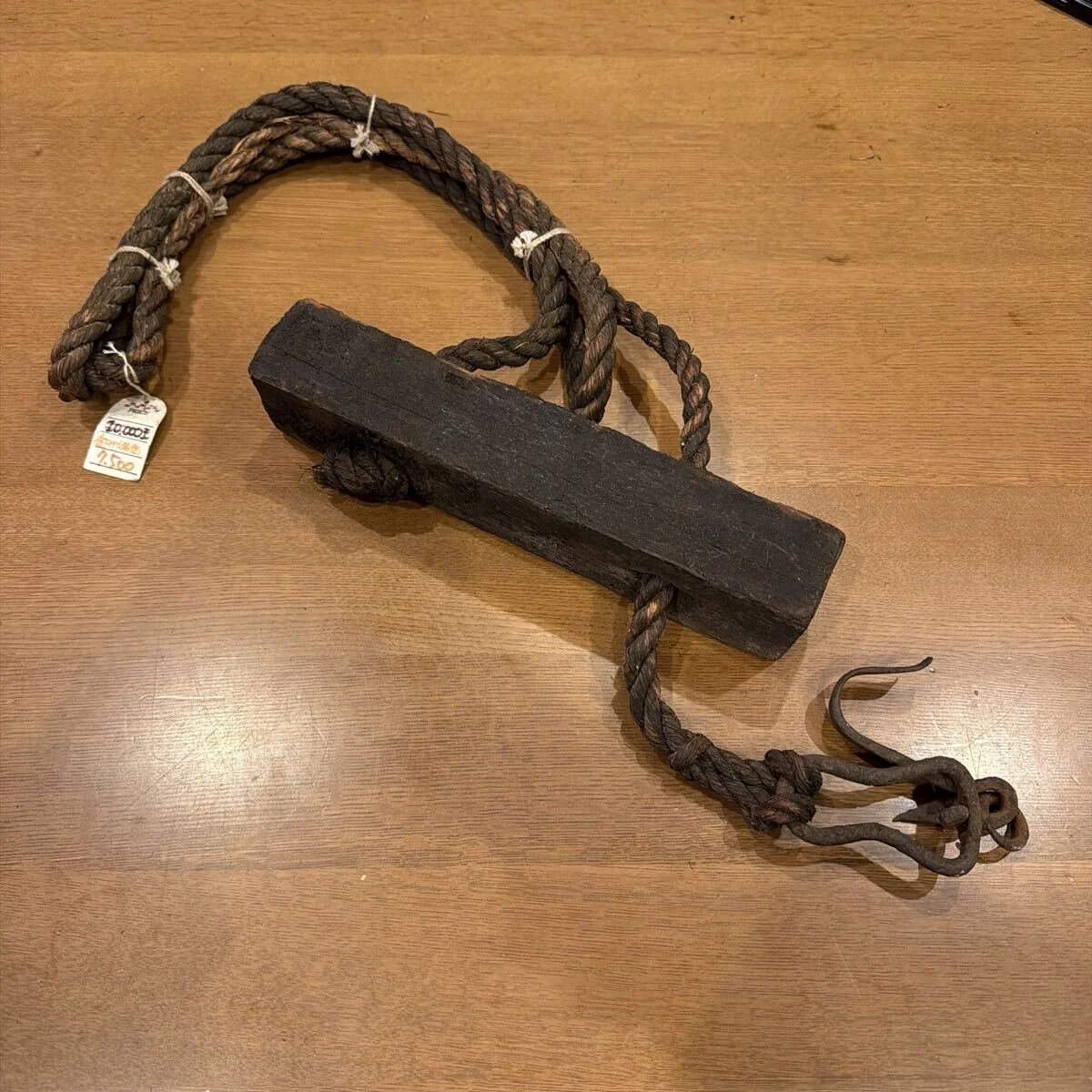
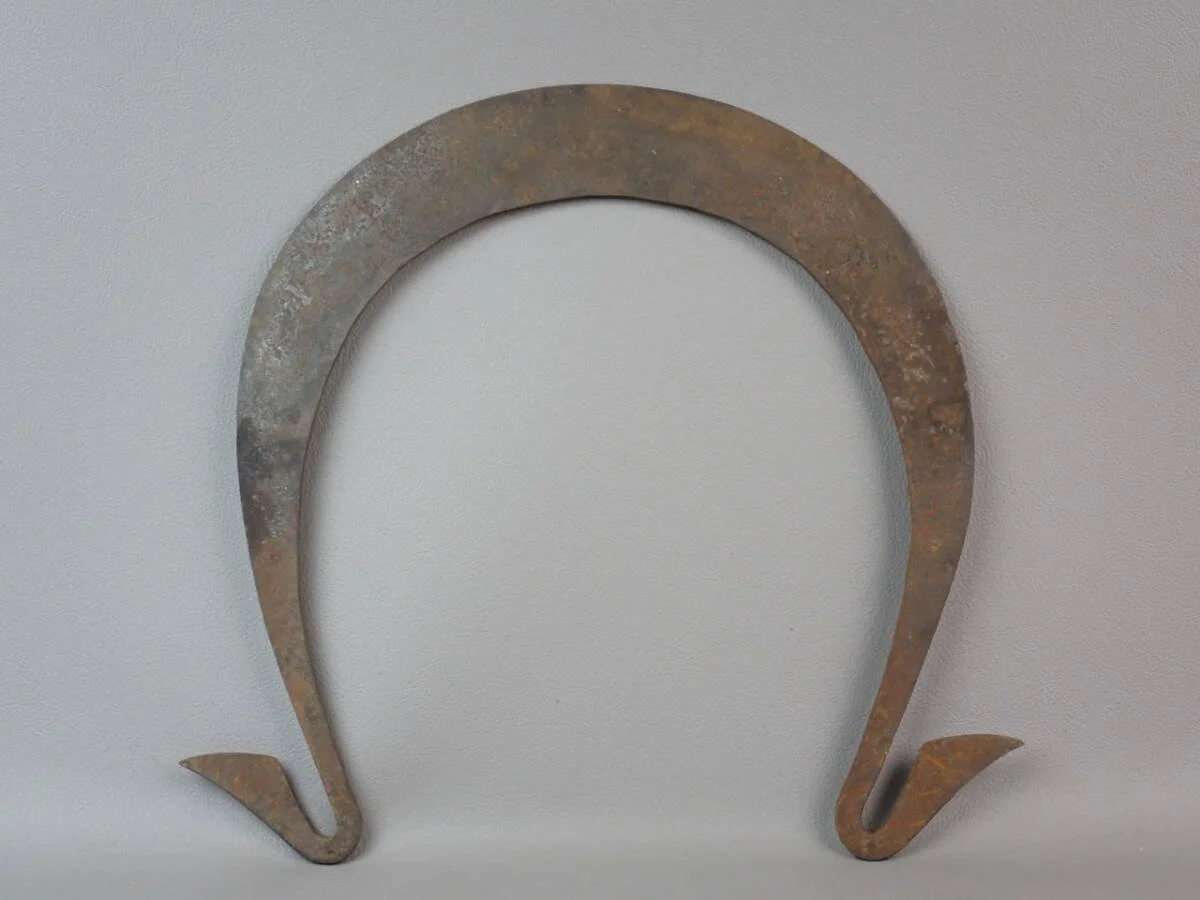
Lately I’ve been thinking less about collecting and more about gathering.
There is a difference.
Some objects seem to arrive simply because they are beautiful. Others seem to arrive because they quietly recognise the life that is waiting for them.
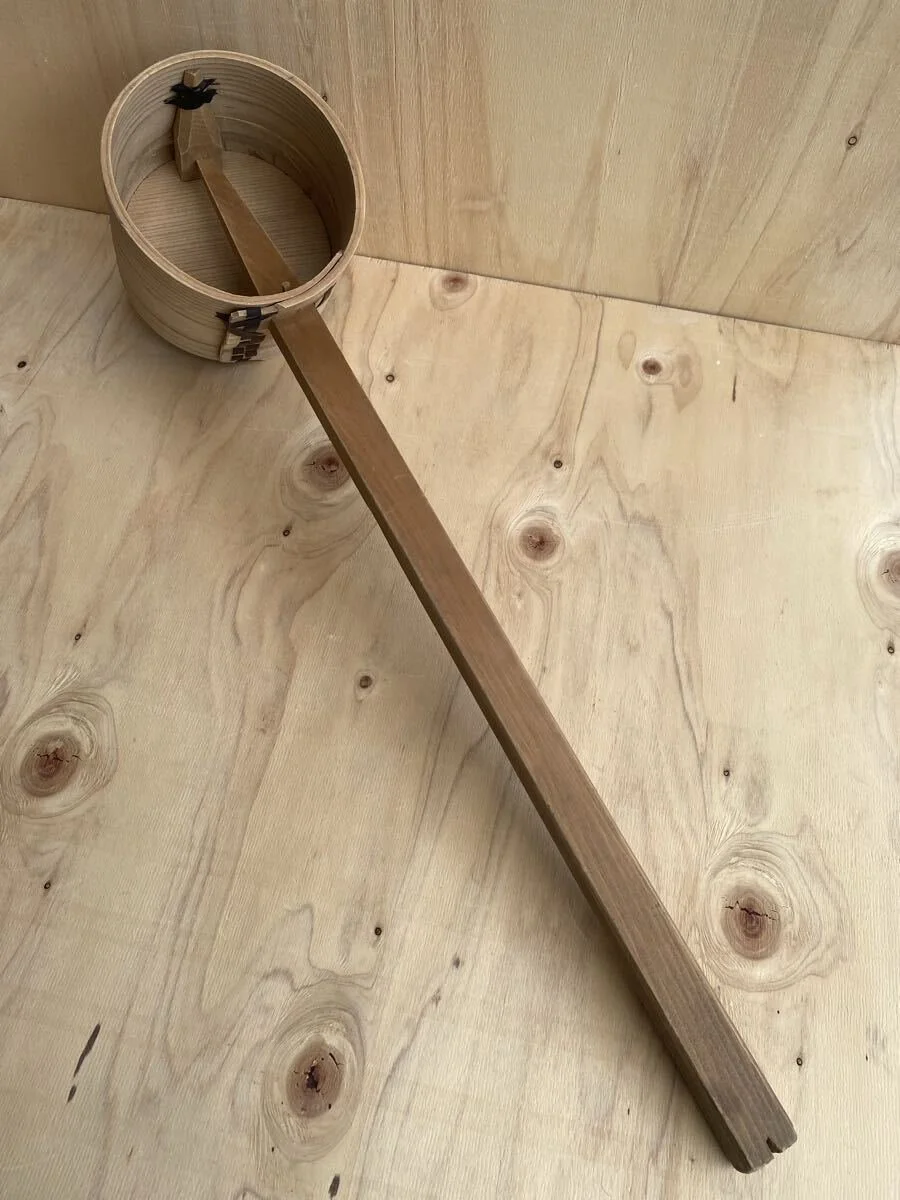
An old water ladle, polished smooth by countless hands. A smoke-darkened tenbin, once balancing an iron kettle above the fire. Books whose pages still seem to carry the scent of old paper and timber, preserving the quiet intelligence of Japanese farmhouses. Lengths of rope darkened by smoke and time. Fragments of iron shaped not for display, but for daily use around the hearth.
Individually they are modest things.
Together they suggest a way of living.
For years I assumed that what drew me to Japanese objects was history or craftsmanship. Both are certainly there. But increasingly I suspect it is something more elusive.
They seem to point toward lives built around slowness.
Around fire.
Around tea.
Around shared meals.
Around the patient repetition of ordinary rituals until they become almost sacred.
Perhaps that is why these objects have begun to matter differently.
Not because they are rare.
Not because they complete a collection.
But because they quietly encourage a certain quality of attention.
I sometimes wonder whether the most meaningful collections are never really collections at all.
Perhaps they are simply the visible traces of an invisible life gradually taking shape.
A life measured not by what it possesses, but by how gently it is lived.
And perhaps that life, more than any object within it, is the thing worth preserving.
22 June 2026
Midwinter Reflections
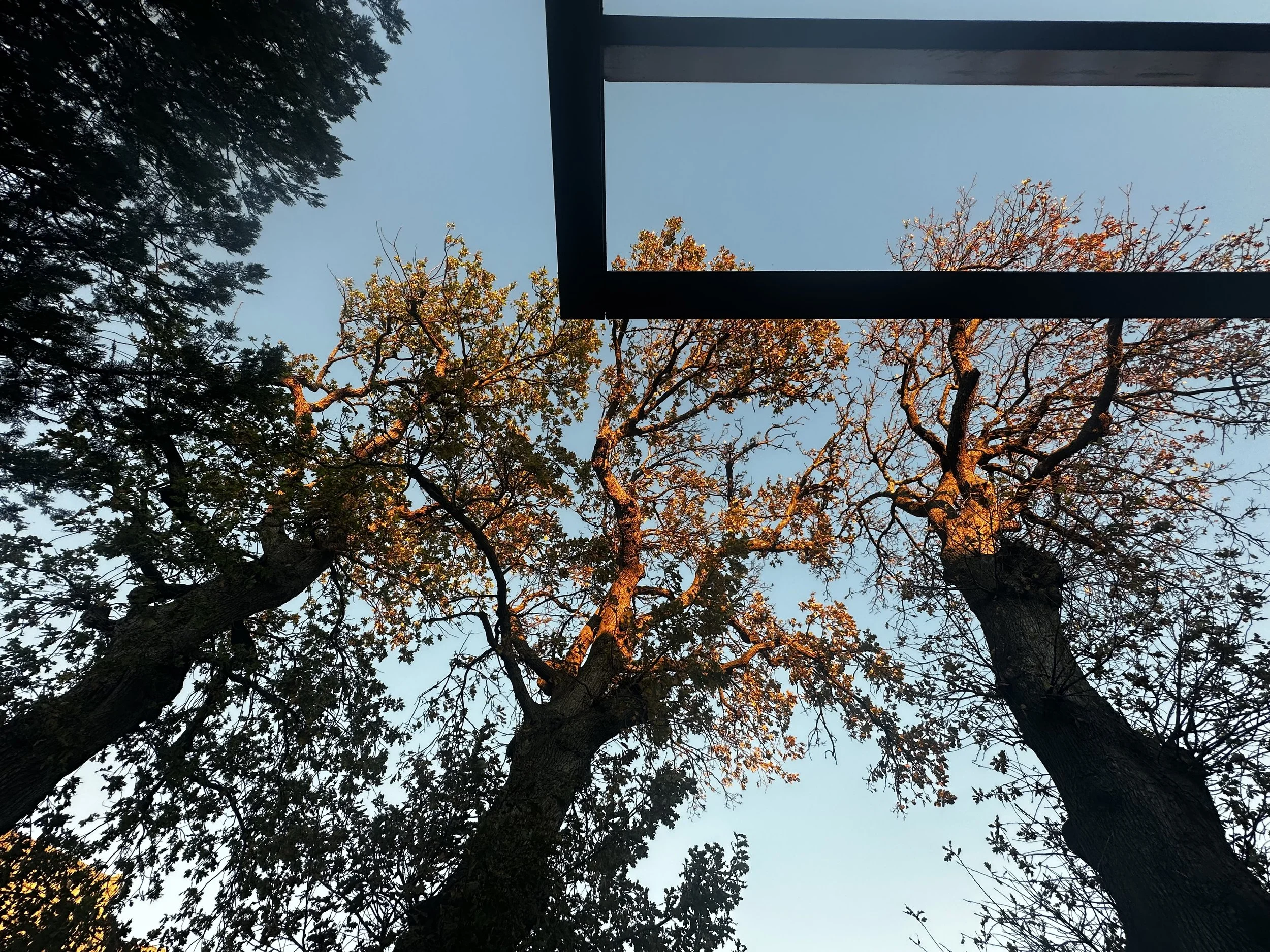
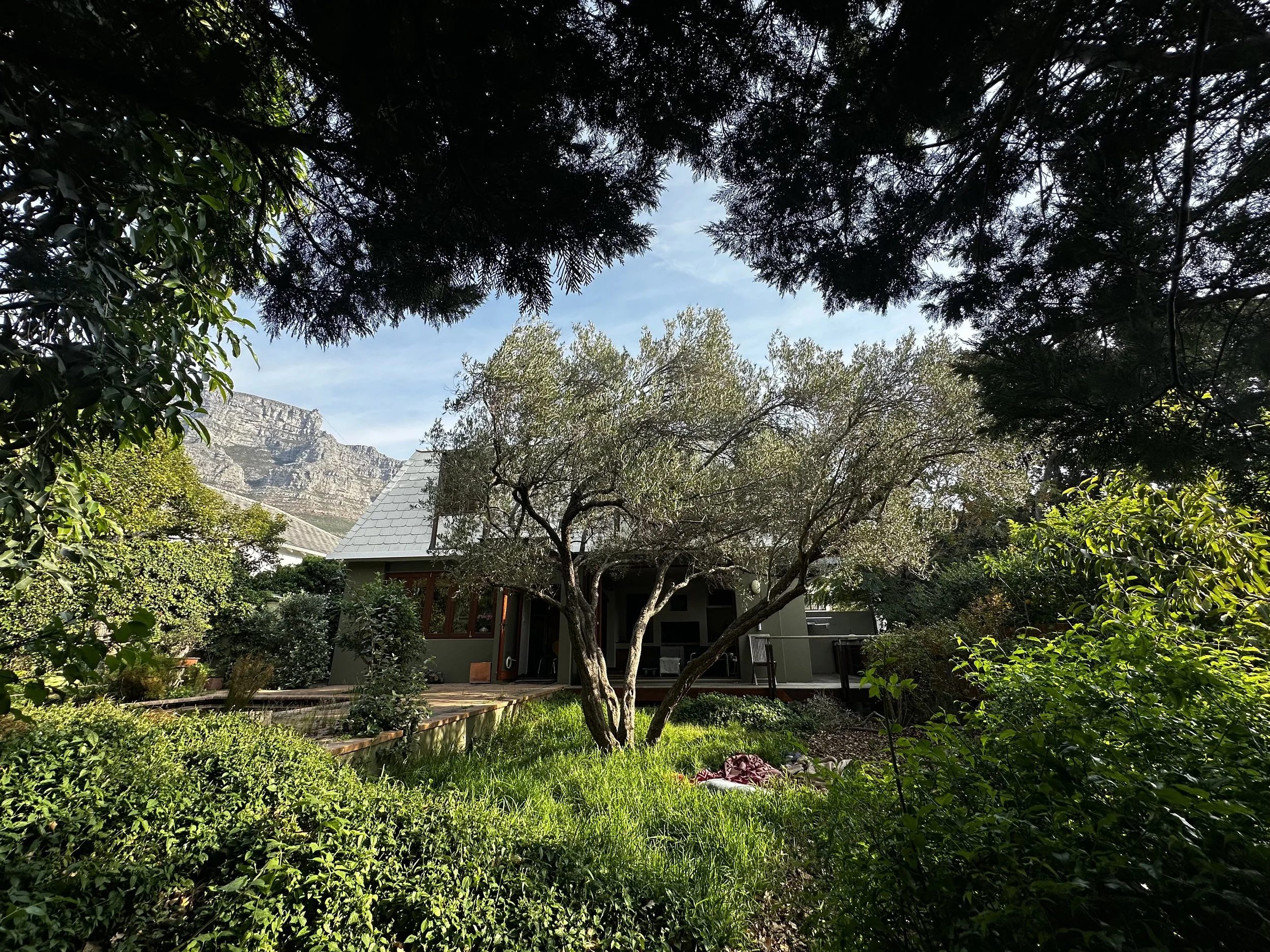
Yesterday I spent much of the day lying beneath the old olive tree in the garden. The winter grass was long and soft, the air completely still, and the mountain stood watch beyond the trees. It felt less like being in a garden and more like being in a small clearing at the edge of something much older.
For a time I found myself imagining a forest world. Not a historical place and not a memory, but a feeling. The people I love seemed present there. Sophie especially, but others too. We were not separated in the way modern life often makes us feel separated. We were distinct, like individual blades of grass, yet connected beneath the surface by something hidden and shared.
The experience carried a strong sense of deep time. Not personal memory, and not ancestral scenes unfolding like a film, but rather the feeling that certain human experiences have been repeated for so long that they have become part of our very structure. Belonging. Grief. Care. Companionship. Shelter. Fire. Landscape. Touch. Looking up into trees. Sitting quietly among trusted people. Watching the sky.
It occurred to me that perhaps life writes itself into us. Not only through our own experiences, but through countless repetitions of what it means to be human. The body seems to remember things that the conscious mind does not know how to describe.
Later, resting quietly indoors, this idea deepened. I became aware of how powerfully experiences can accumulate within us. Joys, fears, losses, loves, habits, injuries, triumphs, relationships. The body carries them all. Some remain visible, while others settle quietly into posture, breath, movement, tension, and feeling. It seemed possible that healing is not always the addition of something new, but sometimes the gentle reading and releasing of what is already there.
Today brought a powerful bodywork session. Particular attention was given to my pelvis, neck, and the area surrounding an old surgery. There was a sense that something was unwinding. Whether physical, emotional, or both hardly seemed to matter. The distinction felt less important than usual.
One thing that has become clearer is how much I enjoy sharing experiences rather than simply accumulating them. My love of the mountain is not only about fitness or views. It is also about companionship. Walking with another person seems to brighten the experience. Attention becomes amplified when it is shared. There is a particular energy that emerges when two people move through a landscape together, noticing the same light, the same clouds, the same flowers, the same changing weather.
At the same time, I am beginning to appreciate that there are seasons for solitude as well. The olive tree asked nothing of me. It did not require effort, achievement, or adventure. It simply provided a place to rest and listen.
Perhaps that is the lesson I wish to carry forward for now.
Not to chase the next experience.
Not to force meaning.
Not to climb every mountain simply because it is there.
Instead, to walk, to breathe, to practice, to rest, to spend time with those I love, and to allow whatever has begun to unfold to continue unfolding in its own time.
The great trees outside the house have stood through countless winters. They do not hurry their growth. They simply remain rooted while the seasons turn around them.
For now, that feels like enough.
14 June 2026
Winter Fire, Wetlands, and the Shape of Feeling Safe
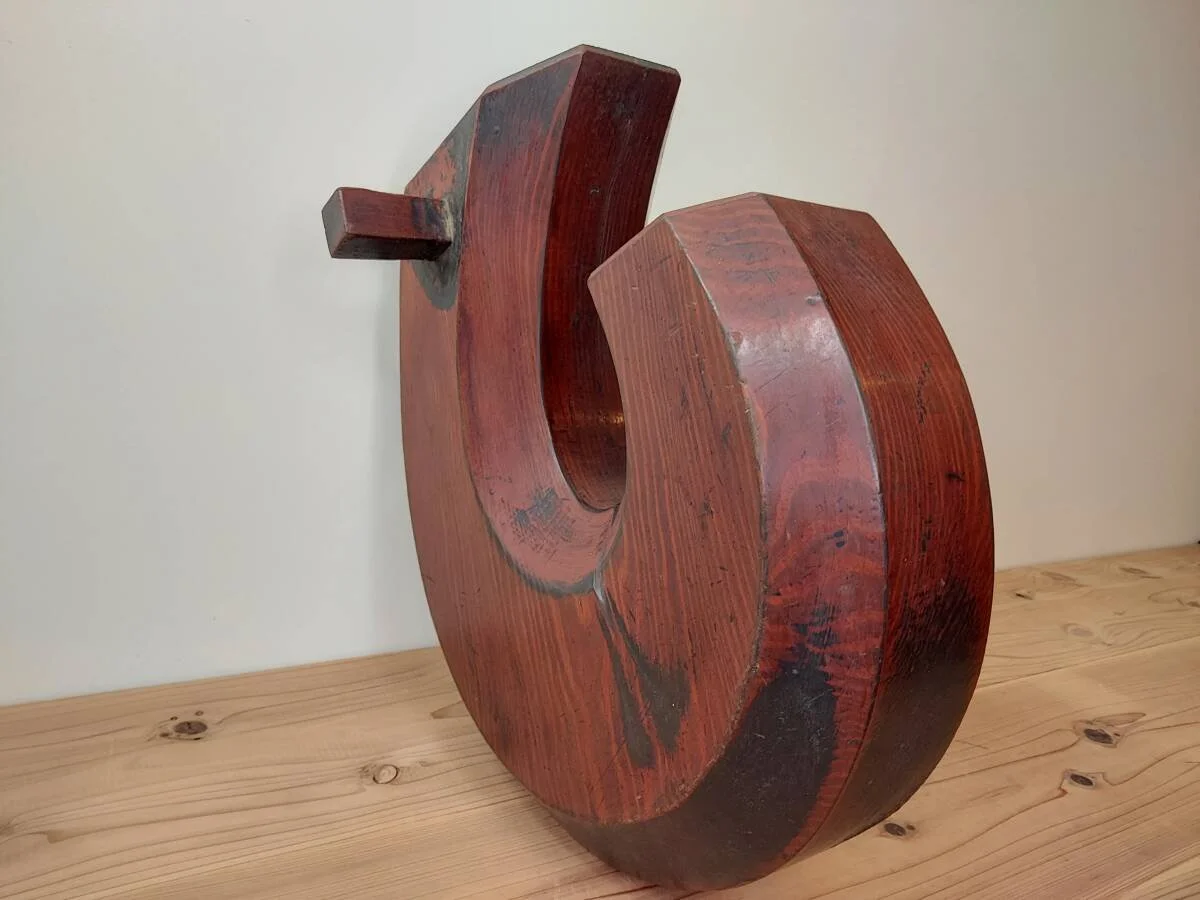
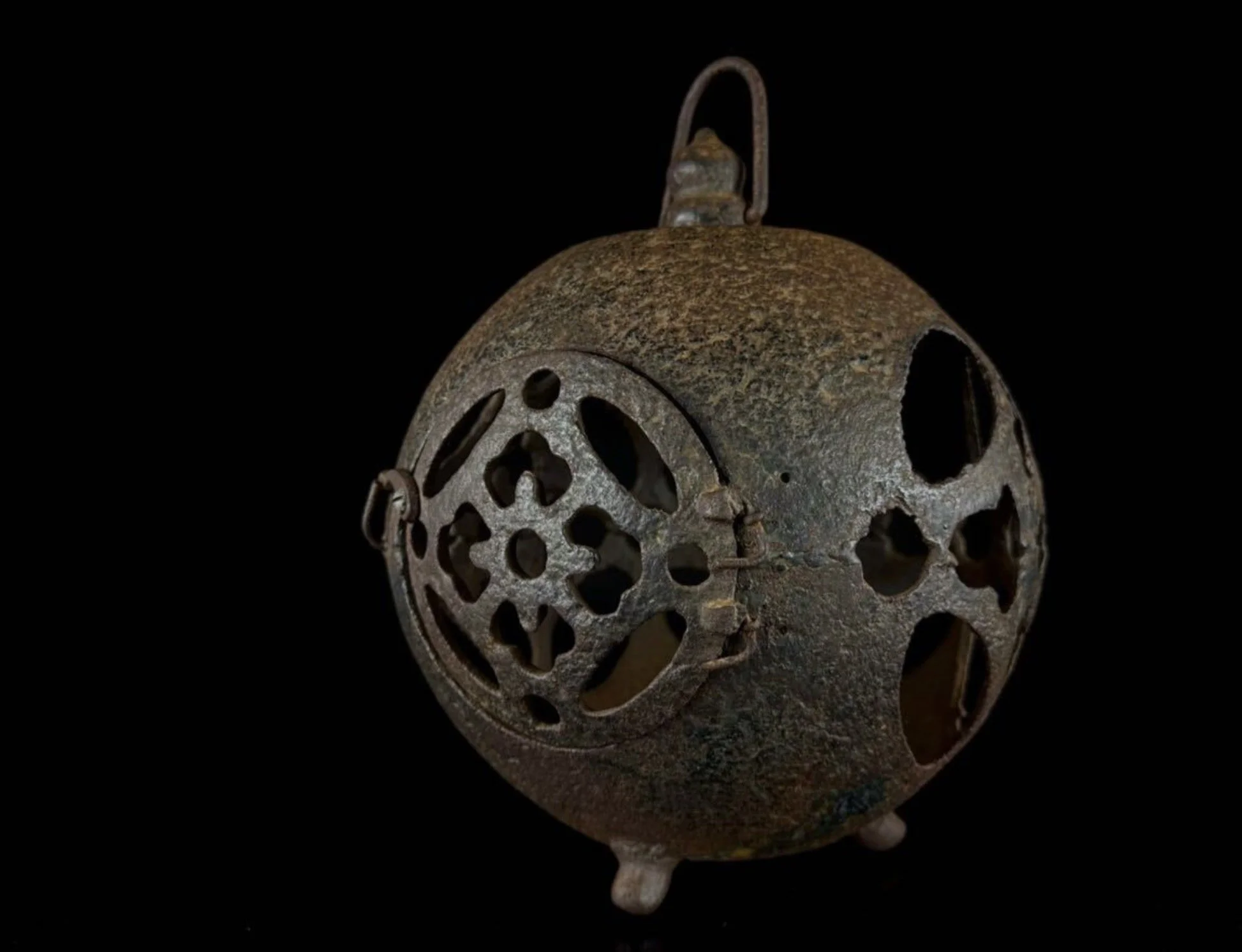
This week my attention has wandered, quite happily, away from paintings and into the world around them: old iron, suspended kettles, winter light, smoke, wood, hooks, lanterns, and the strange happiness of imagining a hearth.
Perhaps this is still Japanese painting research in another form. A painting is never only a painting. It belongs to rooms, weather, rituals, seasons, and objects. It belongs to the temperature of a house. It belongs to the way a pot hangs above fire, or the way a small lantern holds darkness around itself.
As we prepare for Japan later this year, I find myself looking more and more closely at the domestic world behind the image: the old farmhouse, the irori hearth, the blackened beam, the suspended kettle, the adjustable hook, the place where warmth gathers. These objects are practical, but they are never merely practical. A hook holds weight, but it also holds time. A lantern gives light, but it also teaches restraint. Wood records touch. Iron remembers fire.
In Cape Town winter, this all feels especially alive. The house becomes a place of inwardness again. The fireplace is lit. The rooms grow darker earlier. A cup of tea, a lamp, a piece of old wood, a line of smoke, all begin to feel important. I have been thinking about what it means to feel safe, not as an idea one convinces oneself of, but as a quiet physical recognition. The body softens. The room receives you. The fire asks nothing. The old objects sit in their places and do not hurry.
Eckhart Tolle often returns us to this simple threshold: the difference between the story of danger and the fact of the present moment. So much of life is spent defending against imagined futures, while the present quietly offers itself. Here is warmth. Here is breath. Here is the chair, the kettle, the sound of water, the winter garden, the animal at the pond. Safety, perhaps, is not something we finally achieve. It is something we notice when thought becomes still enough.
A small episode in the garden gave me the week’s most perfect teaching.
During a brief spill of winter sun, I went outside and found Henning, our chief male ibis, standing in the overgrown wetland. He was trying, with some frustration, to bathe among the thick rushes and water plants. The pond had become too tangled for him to move properly. I approached carrying my Japanese sickle, and, because he is Henning and deserves ceremony, I bowed deeply.
Amazingly, this time he bowed back.
I asked him, politely, to move aside. Then I stepped into the wetland and cut a clearing for him: reeds, stems, and long green tangles opening into water again. When I left, he walked straight in and began the most magnificent, noisy, splashing ibis bath. Wings, water, sunlight, complete delight. It felt absurdly magical, and also completely ordinary. A bird needed a place to bathe. A human with a sickle could help. The world briefly arranged itself into courtesy.
That moment seemed to contain everything I have been looking at this week. The old Japanese hearth, the hook, the lantern, the winter fire, the idea of home, the feeling of safety, the pleasure of making space. Sometimes the work is not to acquire more, know more, or become more. Sometimes the work is simply to clear a place where life can move again.
A hearth is a clearing. A garden pool is a clearing. A painting, too, can be a clearing. So can a breath.
And in the middle of winter, that feels like enough.
26 May 2026
Beneath the Navel
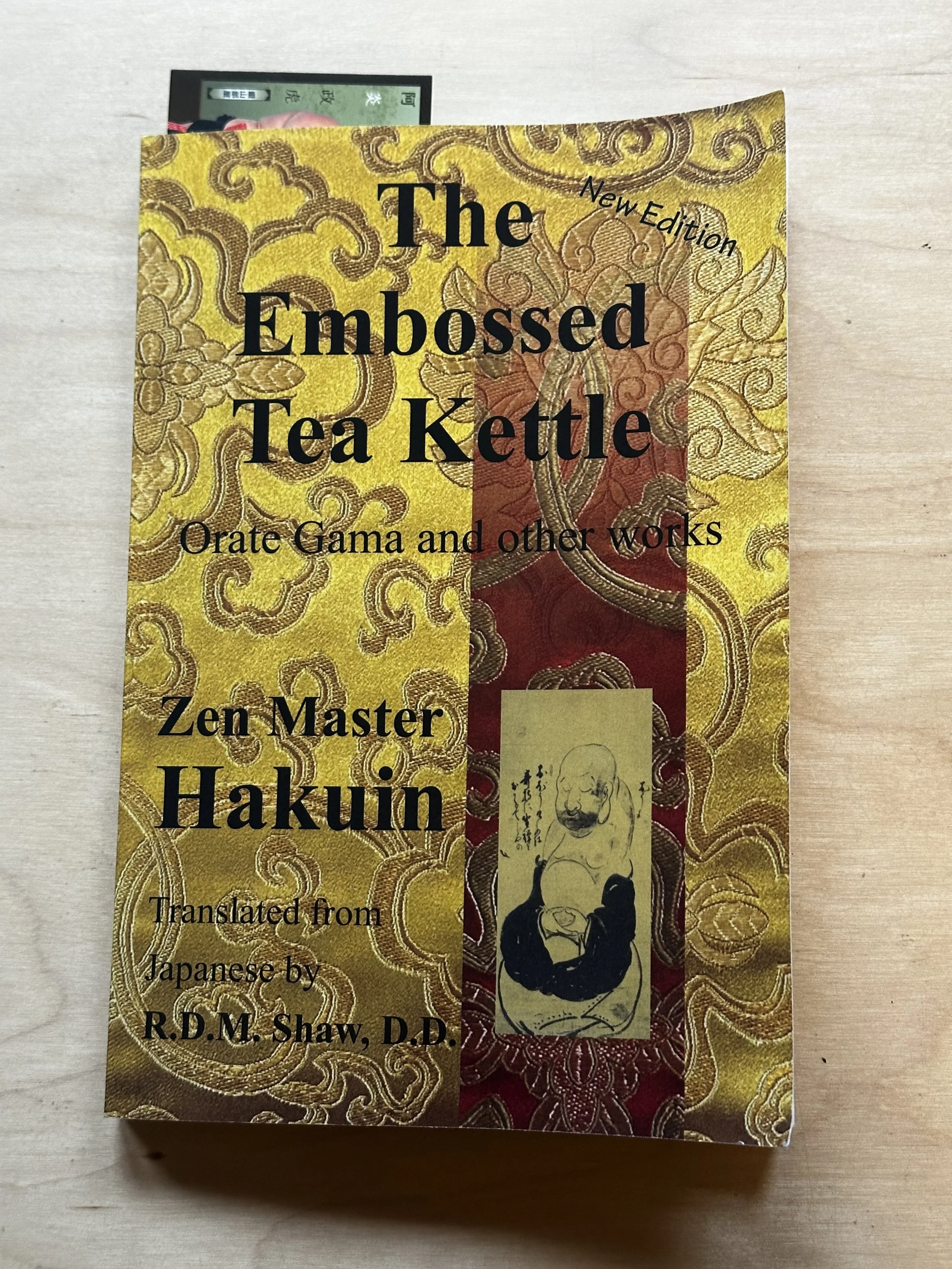
Hakuin’s writing in The Embossed Tea Kettle becomes increasingly striking the longer one sits with it, not because it offers abstract philosophy, but because it repeatedly returns the reader to the body itself — to breath, posture, attention, and the quiet cultivation of energy below the navel. Again and again, he insists that clarity is not achieved through intellectual brilliance or religious performance alone, but through a disciplined settling of the mind into the lower body, into what he calls the “elixir field.”
What is fascinating is how closely these passages resonate with practices that developed along parallel paths elsewhere in Asia: the grounding of breath in yoga, the circulation of energy in Daoist cultivation, the rooted stillness of Tai Chi. Hakuin does not describe awakening as escape from the body, but as a deeper inhabiting of it. The distracted mind rises upward into agitation and fantasy; the settled mind descends and becomes stable, quiet, and enduring.
Particularly moving is his repeated warning that people exhaust themselves through constant outward movement. They chase status, wealth, distraction, and stimulation while neglecting what he calls the “inner fortress.” The consequence, for Hakuin, is not merely spiritual confusion but physical depletion itself. His language moves fluidly between metaphysics and practical observation: breath affects mind; mind affects body; attention affects the quality of one’s entire existence.
At moments, the writing becomes almost hypnotically repetitive, circling the same images again and again — the lower abdomen as a reservoir, the cooling of the upper body and warming of the lower, the preservation of inner vitality through restraint and inward calm. Yet this repetition feels deliberate. Hakuin is not trying to impress the reader with complexity. He is attempting something more difficult: to return attention continuously to a single essential principle until it becomes lived rather than merely understood.
Read today, these passages feel unexpectedly contemporary. In a culture increasingly shaped by overstimulation, speed, and fragmentation, Hakuin’s insistence on grounding awareness in breath and bodily stillness carries a renewed force. His teaching is austere, but not abstract. One senses a man who pushed himself into exhaustion and gradually discovered that clarity required not transcendence of ordinary life, but a more stable and embodied way of inhabiting it.
What emerges from these pages is not mysticism in the theatrical sense, but a sustained philosophy of composure: a life built from repeated acts of returning — breath by breath, day by day — to the quiet centre beneath thought itself.
17 May 2026
Water from Under the House
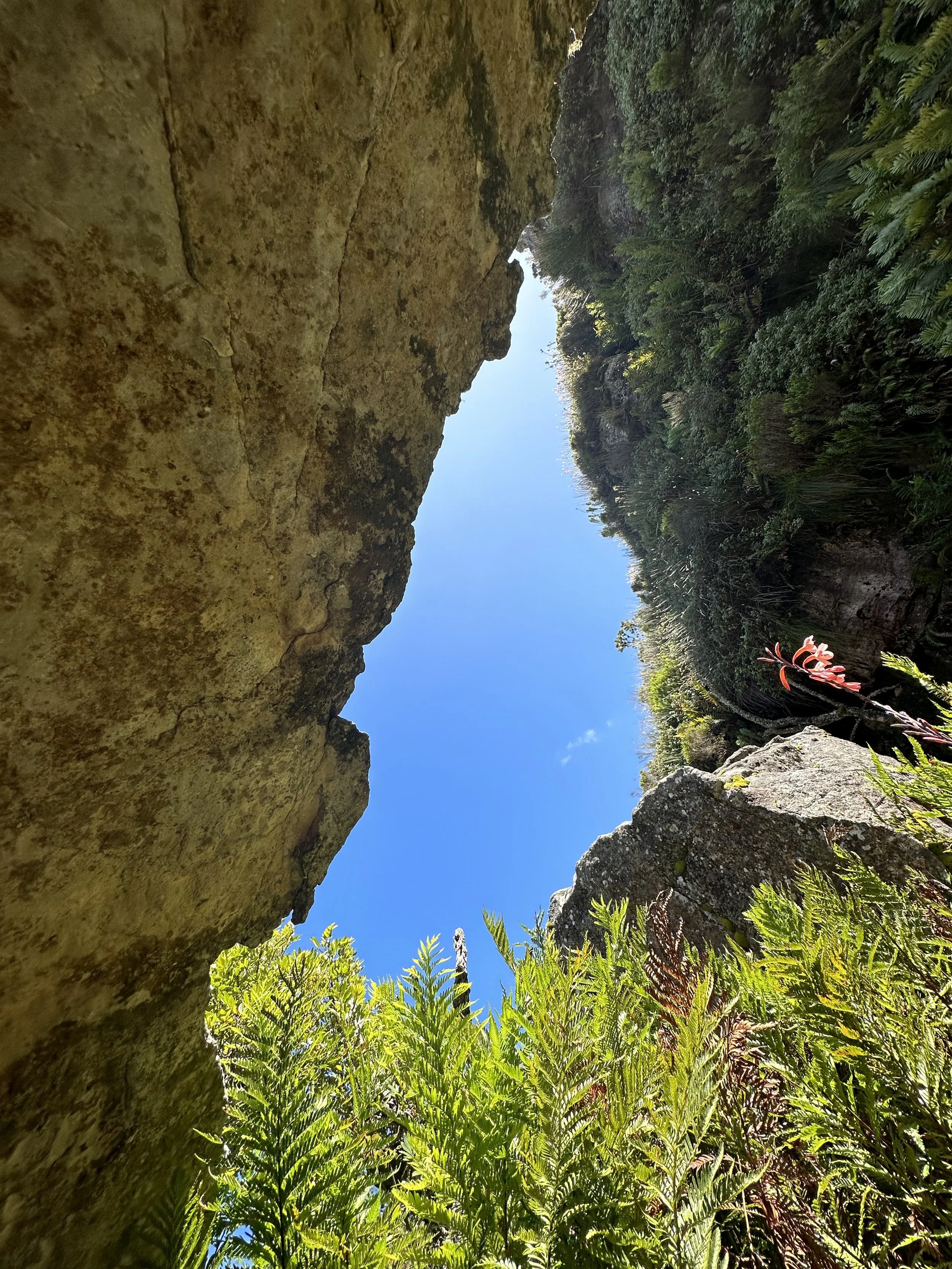
There are days when the mind lives in fragments.
One object calls from one direction, another from another. A painting, a purchase, a regret, a possibility, a future self, an imagined loss. The mind moves between them like a bird striking at windows, convinced each surface is an opening. We know this state well. It is not evil. It is not even especially foolish. It is part of being alive, part of having eyes, memory, taste, longing, and a heart that recognizes beauty. But it is restless. It is tiring. It divides the world.
Then, sometimes, without warning, the division falls away.
Yesterday, after thinking about Fūgai and his cave, about rice exchanged for Daruma, about the difficult peace that comes when desire loosens its grip, I found myself holding a glass of water. Not rare water. Not symbolic water. Just water from under the house, drawn from deep beneath the ground, filtered through stone, darkness, pressure, and time.
And suddenly it was not just water.
It was mountain. It was rain. It was buried cloud. It was stone remembering the sky. It was the body of the earth entering my hand in a clear glass. It had been hidden below the house, below the rooms, below the ordinary business of life, moving in its own ancient silence. To drink it was not to consume something separate from myself, but to receive a message from the deep body of things.
This is the kind of clarity that cannot really be manufactured. We can make conditions for it. We can walk. We can sit. We can read Zen stories. We can put the phone down. We can stand among trees. We can look at paintings until the desire to own them begins to become something quieter, something closer to gratitude. But the moment itself arrives by its own path.
Hakuin knew this rhythm of obscuration and sudden brightness. His life was not a smooth ascent into calm. It was a storm, again and again. He strained, doubted, collapsed, recovered, pushed too hard, misunderstood, was corrected, returned, and returned again. His awakening stories are not tidy stories of a saint gliding into wisdom. They are stories of a fierce, vulnerable person being cracked open by the world.
One of the great Hakuin moments comes through sound. After long struggle, he hears a bell. Something ordinary crosses the threshold in an extraordinary way. The sound does not bring him a new philosophy. It breaks the shell of separation. The bell is no longer out there and the listener in here. Sound, body, world, mind: for one instant the old categories fail. The bell rings, and everything rings with it.
That is why these stories remain alive. Not because bells are magical, or because one must copy Hakuin’s hardship, but because they point to the way ordinary phenomena can become gates. A bell, a broom, a cry, a stone, a cup of tea, a glass of water. The world is always offering itself. Most of the time we are too busy arranging our preferences to receive it.
Fūgai’s cave and Hakuin’s bell belong together in this way. One is silence, one is sound. One is stone enclosure, one is vibration travelling through air. But both ask the same thing of us. Can the mind stop grasping long enough to meet what is already present?
The cave is not an escape from the world. At its deepest, it is a way of removing the unnecessary until the world can be encountered more directly. Fūgai’s cave was narrow, austere, almost absurdly reduced. He had little. He gave paintings away for rice. He lived with stone, weather, hunger, visitors, birds, and his own mind. It would be sentimental to imagine that such a life was always peaceful. Solitude does not instantly purify anyone. It can intensify the mind’s demons as much as quiet them. But perhaps that is the point. In the cave there is less room to hide.
The cave brings one face to face with wanting.
Not only wanting objects. Wanting comfort. Wanting recognition. Wanting certainty. Wanting to be seen as spiritual, artistic, intelligent, discerning, safe, loved. Even wanting not to want. The mind is endlessly clever in making new possessions out of renunciation itself.
And yet, in wild nature, there are moments when the game becomes visible. The mountain does not ask to be possessed. The tree does not seek approval. Water does not hurry toward meaning. Light falls, shadows move, roots drink, leaves open, stone warms, and the entire world continues without requiring our management.
To sit under trees after such a moment is to feel the old division soften.
There is the body, yes. There is the person named Mario, with his history, his loves, his anxieties, his collection, his house, his memories, his future travel plans, his works bought and not bought, sold and not sold. But there is also the other truth, the larger truth: that this person is not separate from the trees, the water, the mountain, the mineral darkness below the house, the sunlight moving through leaves, the breath entering and leaving without ownership.
Everything is one is a phrase that can become vague if repeated too easily. But when it is seen, even for a moment, it is not vague at all. It is intensely specific. This glass. This water. This tree. This hand. This mountain. This breath. Nothing abstract. Nothing mystical in the theatrical sense. Just the impossible fact that everything is already participating in everything else.
The mind often loses this. Of course it does. Hakuin lost and found, lost and found. Most of us do. Perhaps everyone does. We move in waves. Separation, unity. Anxiety, clarity. Desire, release. Then desire again. Then perhaps release again, deeper or softer than before.
There is no need to turn one clear afternoon into a permanent achievement. That may be another trap. The mind loves to frame experience, to turn even grace into a certificate. I had clarity. I reached something. I must keep it. I must describe it correctly. I must not fall back.
But the sunlight does not need us to preserve it. It only asks to be received while it is here.
This is where Hakuin can be such a good companion. He is not merely serene. He is volcanic. His art is full of comic force, scolding, tenderness, grotesque bodies, laughing Buddhas, stern patriarchs, impossible faces, and wild pedagogical energy. He knows that human beings are not smooth stones in a temple garden. We are tangled, comic, frightened, desirous, sincere, ridiculous, and luminous. The path is not to pretend otherwise. The path is to use everything.
Even delusion becomes material.
The desire for an object can become a teacher. The ache of wanting reveals the structure of attachment. The pleasure of beauty reveals the heart’s capacity for reverence. The pain of not having reveals the illusion of lack. The moment of release reveals that the world was not withheld after all.
A painting can be loved without being possessed. A scroll can be studied, honoured, desired, released. A cave can be entered without remaining there forever. A bell can ring once and continue ringing inwardly long after the sound is gone. A glass of water can open the mountain.
This is why the experience of clarity often feels like joy. Not excitement exactly, though it may arrive with great energy. Not happiness in the ordinary sense, though it may be deeply happy. It is closer to the joy of things no longer having to argue their existence. The tree is entirely tree. The water entirely water. The mountain entirely mountain. The self, for a moment, is not trying to stand apart and manage the scene. It belongs.
And belonging is rest.
The deep water under the house is a beautiful image for this. We live on top of hidden sources. Beneath our floors, beneath our habits, beneath the daily room of mind, something clear continues to move. We forget it. We build above it. We worry above it. We compose messages, make documents, consider prices, study seals, fear mistakes, desire paintings, and grow tired. Then one day we lift a glass and remember: the source was already here.
Perhaps practice is not the creation of peace, but the repeated rediscovery of what has not stopped flowing.
Fūgai’s cave reminds us of reduction. Hakuin’s bell reminds us of suddenness. The trees remind us of continuity. Water reminds us of hidden connection. Light reminds us that revelation is not always inward; sometimes it falls openly on everything.
And the wave will move again. There will be another morning of confusion, another object that burns in the mind, another practical worry, another little theatre of self and world. That is not failure. It is weather. The important thing is not to demand permanent clarity, but to remember the path back to seeing.
A glass of water. A tree. A mountain. A cave. A bell.
The world keeps placing gates in front of us.
Sometimes, wonderfully, we walk through.
16 May 2026
Fūgai’s Cave
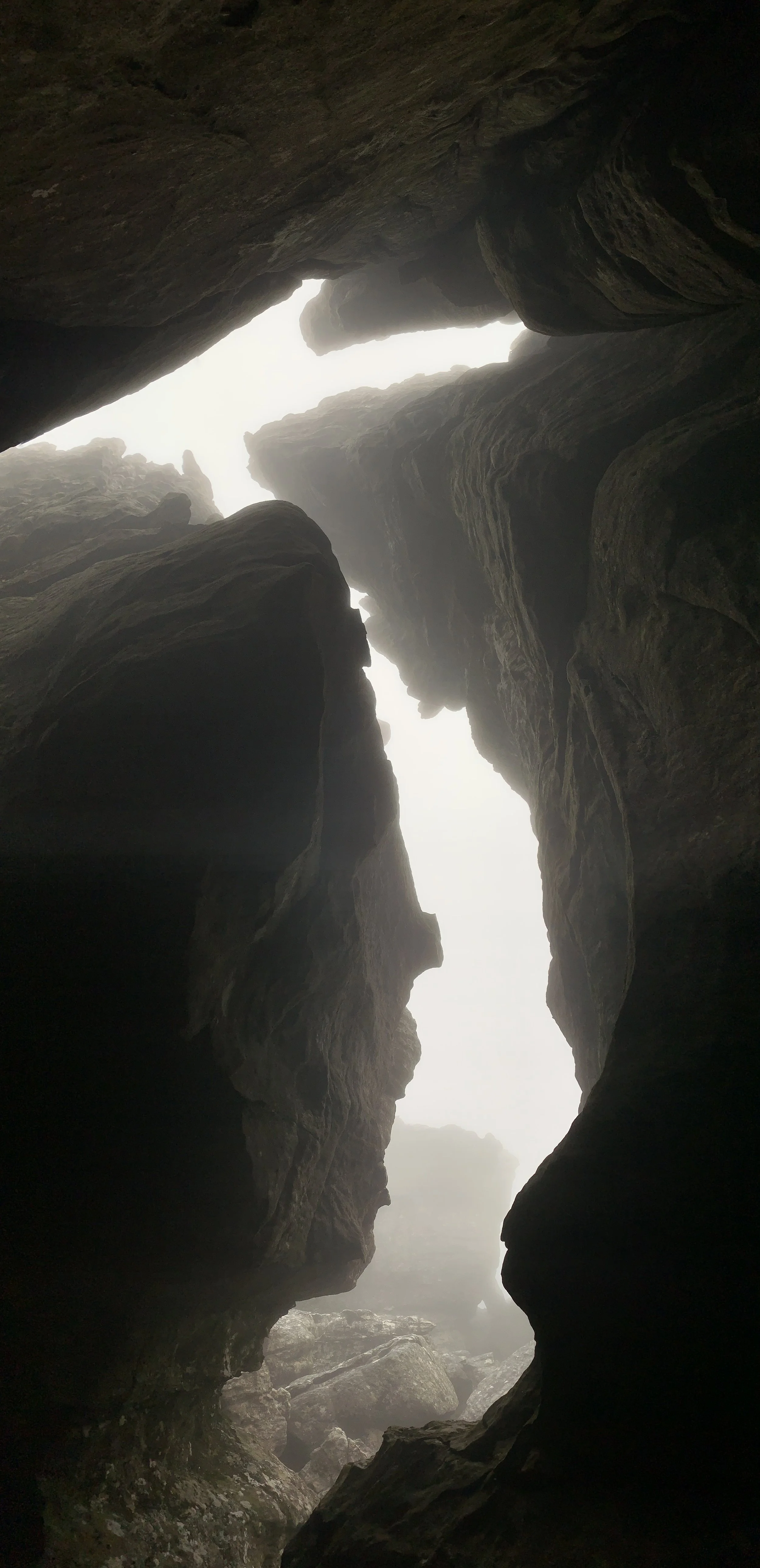
Fūgai Ekun, the seventeenth-century Zen monk and painter, became known as Cave Fūgai after leaving temple life to live in mountainside caves. When he needed rice, he is said to have brushed paintings of Daruma and hung them outside the cave entrance, allowing villagers to leave food and take the paintings home.
It is a story that feels almost impossibly pure from our own age of restless looking, collecting, wanting, comparing, and keeping.
I have been thinking about this difficult tension: the desire one can feel for objects, especially beautiful old objects, and the very different peace that comes when desire loosens its grip. These two feelings are not easily reconciled. A painting can call to us with real force. It can seem to contain history, spirit, weather, touch, and the trace of another life. Wanting such a thing is not always shallow. Sometimes it begins in reverence.
And yet Fūgai’s life points in another direction. He left position, comfort, and recognition behind. He chose the cave, the mountain, the narrow space where the senses quieten. His art seems to come from that place: not from possession, but from release. Not from accumulation, but from attention.
A cave is not emptiness in the negative sense. It is shelter, reduction, concentration. It removes the unnecessary. It returns the mind to stone, breath, shadow, weather, and time. In such a place, one begins to understand how little is needed, and how much of our agitation comes from reaching outward.
Perhaps this is why Fūgai’s paintings feel so alive. They are not polished treasures asking to be owned. They are traces of a life lived close to hunger, solitude, humour, and mountain silence. Rice for Daruma. A bowl for a painting. The exchange is simple, almost severe.
Looking at caves on Table Mountain, I feel a faint echo of this. The city falls away. The stone holds its old stillness. Desire does not disappear, but it becomes quieter. It can be seen more clearly. And in that seeing, something softens.
To love an object deeply, and still not be ruled by wanting it: perhaps that is one of the more difficult forms of practice.
08 May 2026
After the Master
Over the past months, a growing series of questions surrounding authorship within the collection gradually began to accumulate. Certain paintings previously discussed in strongly authenticating terms now seem more appropriately understood within the long and complex tradition of Japanese copies, followers, and devotional repetitions after major masters such as Itō Jakuchū and Hakuin Ekaku.
This shift did not emerge suddenly. It followed months of uncertainty, comparison, and quiet suspicion, together with repeated attempts to contact museums, institutions, dealers, and private collections in Japan and abroad, most of which received little or no response. Then, unexpectedly, a long and extraordinarily generous exchange with a Japanese dealer and connoisseur brought many of these underlying questions sharply into focus. What had previously remained vague intuitions began to acquire clearer technical and historical contours.
From the outset, I was fully aware that I was not purchasing professionally authenticated masterpieces carrying the kinds of prices associated with major auction houses, museums, or established international dealers. Many of the works entered the collection openly carrying terms such as copy, follower, or attributed. The ambiguity was therefore never hidden. What proved genuinely surprising, however, was something else entirely: when comparing certain paintings carefully against published museum examples, university catalogues, and authenticated works in major collections, my own inexperienced eye often struggled to perceive any decisive difference in quality, vitality, or apparent fluency of execution.
That experience slowly opened onto a deeper realization. Japanese painting culture, particularly in the Edo and Meiji periods, appears to have sustained traditions of copying and transmission at a level of sophistication far beyond what many Western collectors initially imagine. Certain followers and later painters were capable of reproducing aspects of a master’s brush rhythm, compositional logic, seal usage, and even psychological atmosphere with astonishing refinement. The deeper one looks, the more unstable supposedly fixed boundaries sometimes become.
At first this felt destabilising. Western collecting culture often treats attribution as the central axis upon which value, meaning, and legitimacy depend. One either possesses the authentic masterpiece or one possesses failure. Yet the deeper I enter the world of Japanese painting, the less convincing that binary begins to feel.
Again and again, Edo painting reveals itself not as a culture obsessed with singular originality, but as one grounded in transmission. Students repeated teachers. Followers inherited brush languages. Workshops sustained motifs across generations. Collectors preserved admired compositions through copying not always as deception, but often as admiration, practice, study, or continuation.
At the same time, the process has not simply moved in one direction toward skepticism. One of the most meaningful outcomes of these recent conversations was the strong affirmation by the same Japanese connoisseur that a major Hakuin calligraphy in the collection appeared entirely convincing and authentic in his eyes. That response carried particular weight precisely because it emerged within a broader conversation marked by seriousness, caution, and critical scrutiny. In an unexpected way, the experience shifted the collection away from the fantasy of discovering hidden treasure and toward something quieter and more durable: the pursuit of clarity itself.
What has become increasingly striking is that this uncertainty appears not to belong only to small private collections such as my own. Again and again, one encounters examples in major museums, university collections, and internationally respected holdings where attribution remains fluid, contested, revised, or quietly unresolved. Japanese scholarship itself continues to reassess long-accepted works, and paintings once treated confidently as autograph are sometimes reconsidered decades later, while others move unexpectedly in the opposite direction. The instability is therefore not an embarrassment peculiar to inexperienced collectors, but part of the condition of the field itself — though it is perhaps discussed more openly in private than in public institutional language.
This does not mean distinctions disappear. They matter profoundly. The hand of a master remains unique. Connoisseurship remains essential. A genuine Hakuin calligraphy possesses a concentration and inevitability difficult to imitate fully. A true Jakuchū carries within it an extraordinary internal coherence and pressure born of long experience. But between masterpiece and forgery lies a far richer and more complicated terrain than I had first understood.
What has emerged instead is a renewed respect for the paintings themselves as objects of looking.
Some of the works now understood as later or follower pieces remain astonishingly beautiful paintings. In several cases, their quality is precisely what makes them historically and psychologically interesting. They reveal how deeply certain visual languages were absorbed, transmitted, and sustained across generations of artists working in admiration of earlier masters.
Rather than diminishing the collection, these revisions have clarified its purpose. The Myōan Collection is not an attempt to assemble trophies of certainty. It is an ongoing study of brush language, transmission, Zen thought, visual memory, and the fragile continuity through which cultural forms survive.
In Zen painting especially, the boundary between repetition and originality can become strangely porous. A follower painting a Hotei after Hakuin may still transmit something real: not the master’s hand, perhaps, but an atmosphere, a rhythm, a disciplined attempt at clarity. The brush becomes less a signature than a conversation across time.
The collection therefore continues, but now with a quieter posture. Less acquisitional myth-making. More looking. More listening. More willingness to remain within uncertainty.
An empty bowl is useful precisely because it is not already full.
06 May 2026
Hakuin on the Unruly Mind
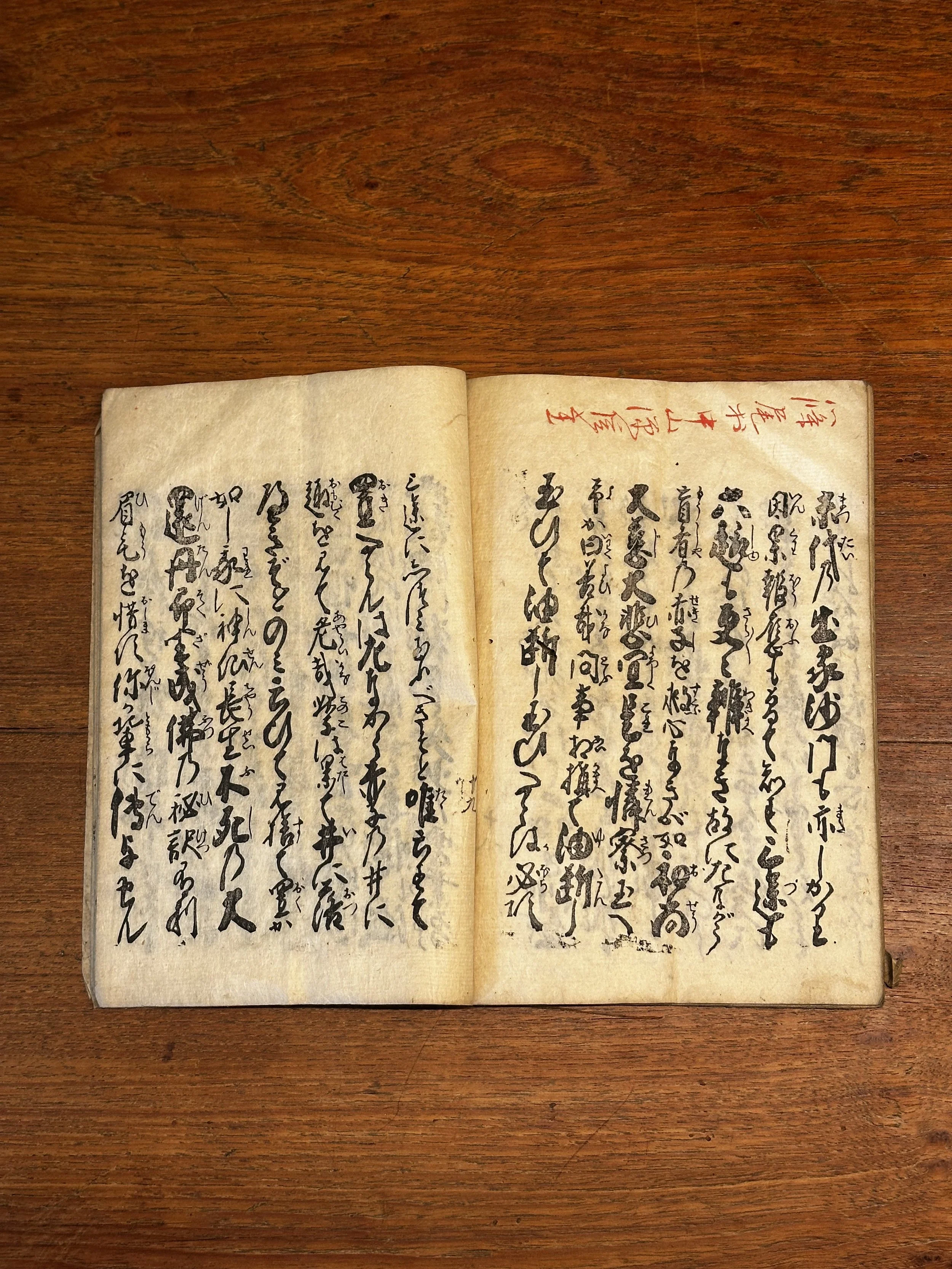
Having recently finished translating a small Edo-period printed handbook attributed on its cover to Hakuin Oshō, titled Instruction for Beginners, Later Volume – Essential Mirror-Hymn on Sowing the Seeds of Good and Evil, and printed in Edo by Suwaraya Mohē in the mid-18th century, preserved in what appears to be an early woodblock edition produced during or shortly after Hakuin’s lifetime.
What strikes the modern reader most forcefully is its severity. The text is unapologetically moralistic—relentless in its warnings against greed, vanity, laziness, pride, self-deception, and spiritual pretence. Hakuin directs these criticisms not only at lay parishioners, but repeatedly at Zen monks themselves, turning his scrutiny back upon the clergy with equal sharpness.
To modern sensibilities such language can feel shockingly direct. Yet there is something valuable in that severity. It is easy to recognise hypocrisy and delusion in others; far harder to submit oneself honestly to the same examination. However stern its tone, the text’s deeper demand is precisely that: to turn the spotlight inward.
Read through a contemporary lens, one begins to sense beneath the religious moralism an early and penetrating analysis of ego, compulsion, and the mind’s endless capacity for self-justification.
Particularly moving are the traces left by later readers. The book bears ownership marks linking it successively to Tokugawa Munenao (1682–1757), lord of the Kii Tokugawa house, to a later Buddhist owner signing as the monk Jūō, and later to the Hirayama collection. Elsewhere, additional rough library marks and provincial place names quietly inscribe further layers of custodianship into the volume’s long life.
These marks transform the book from historical object into something more human. One can imagine generations of readers pausing over these same severe passages on greed, death, hypocrisy, and self-examination, adding their own names in passing as though entering, however briefly, into conversation with Hakuin himself. The text survives not merely because it was printed, but because it continued to matter to the people who carried it forward.
Perhaps most remarkable of all is that this small volume survives at all—nearly three centuries later—still crisp, still legible, and still capable of speaking with unsettling clarity.
26 April 2026
On Longevity and the Half-Dead Old Man
A further reading from Hakuin
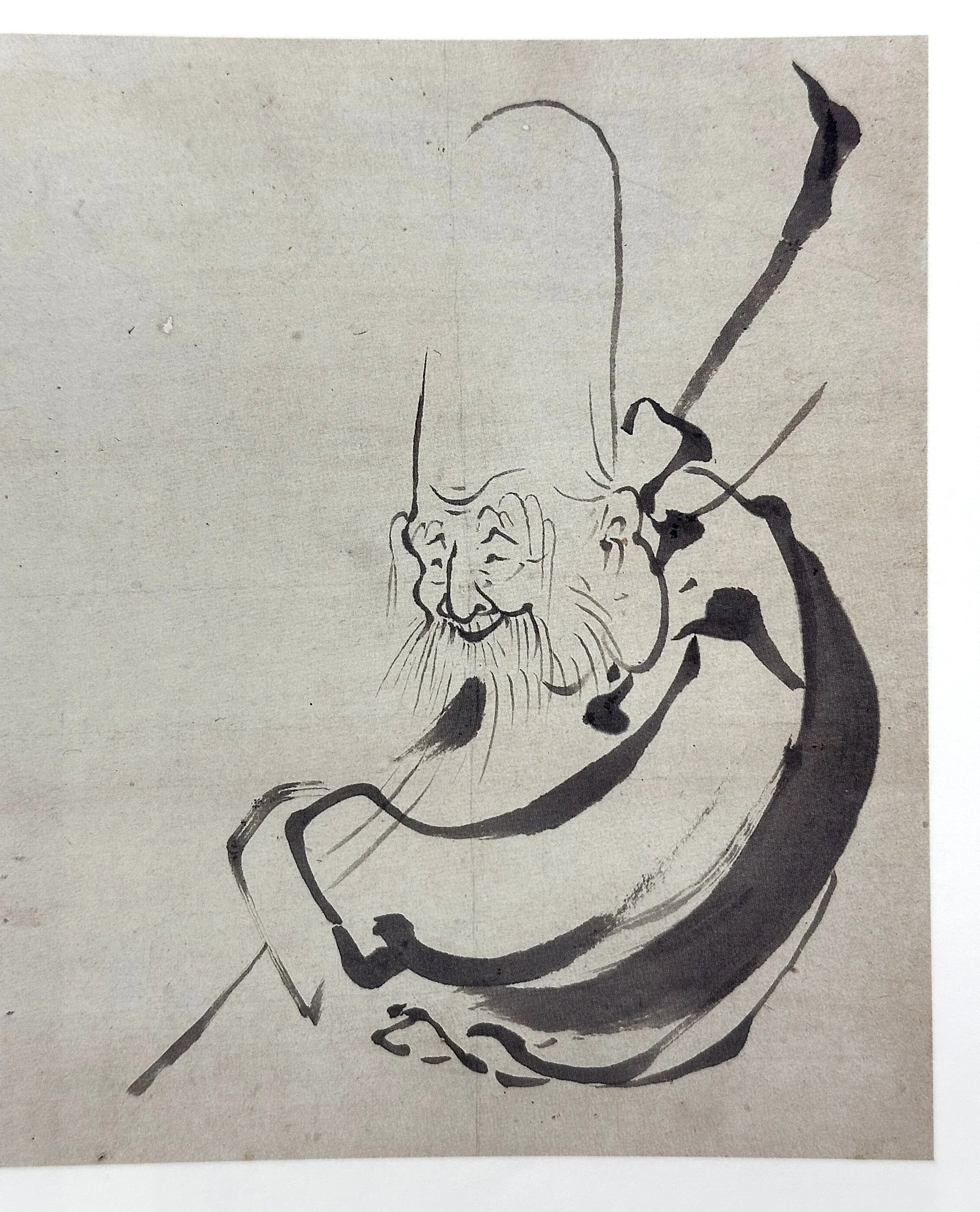
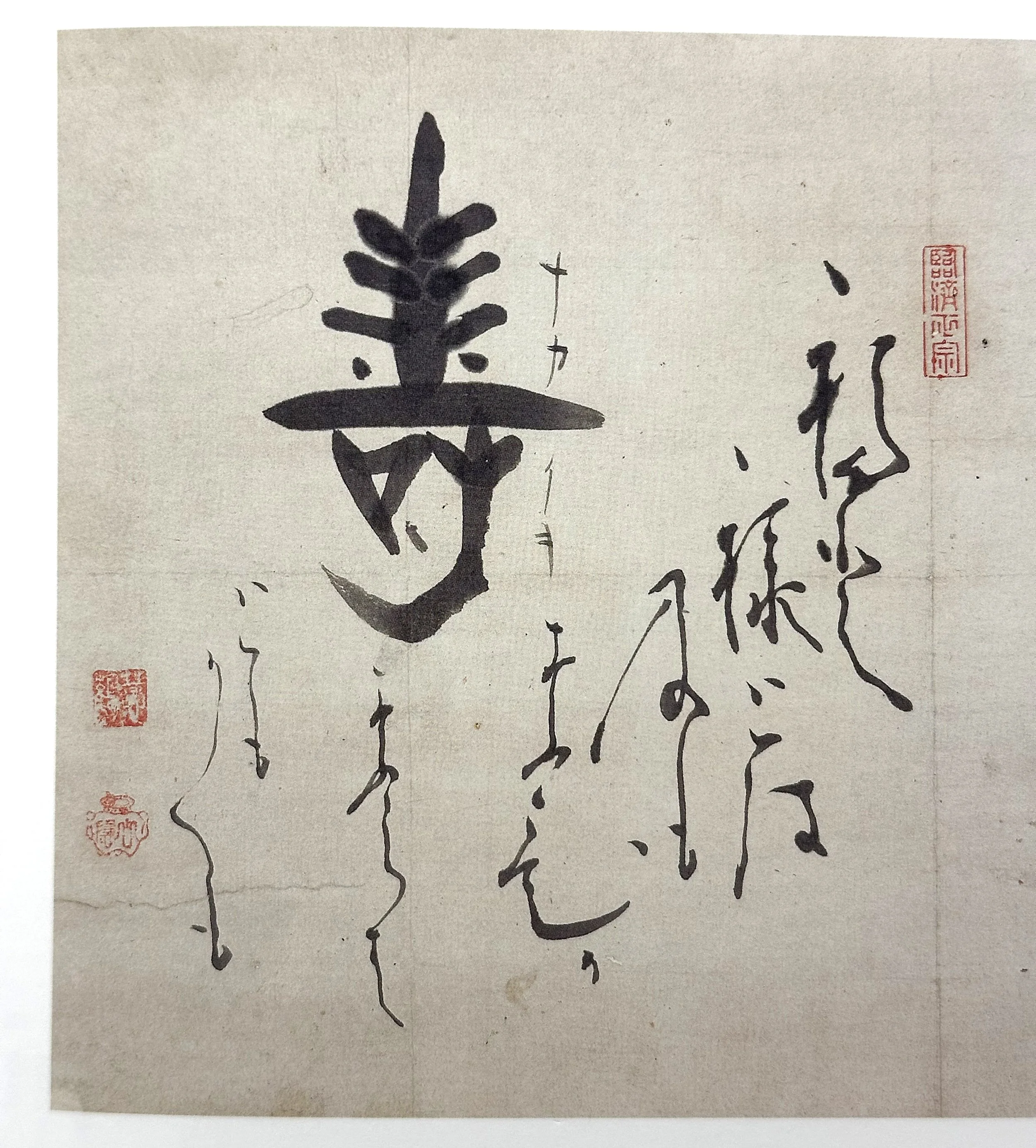
Continuing my reading through the individual works in the catalogue examined in the previous journal entry, I found myself especially taken by Hakuin’s treatment of Jurōjin, the old sage of longevity.
The accompanying text preserves a striking verse associated with Hakuin’s reflections on health, vitality, and long life:
Other than “longevity,” there is no poem for blessing.
If one wishes the cinnabar field full, let the qi be full.
If the qi is full, the cinnabar field becomes full;
if the cinnabar field is full, the essence becomes firm.
If the essence is firm, then the spirit is complete.
If the spirit is complete, then the heart is present.
If the heart is present, the qi-sea opens.
If the qi-sea opens, the cinnabar field fills.
If the cinnabar field fills, longevity is attained.
There is something unexpectedly moving in this.
Very early this morning—rather lazily lying awake before dawn—I found myself practising low diaphragmatic breathing, attempting to quiet the mind and settle the breath into what these traditions variously call the dantian, the elixir field, or the cinnabar field. Whether one takes such language literally or metaphorically hardly matters. The intuition remains recognisable: that breath, awareness, vitality, and mental clarity are somehow one process.
And yet clarity itself is fleeting.
There are moments when the mind falls silent and one glimpses a strange underlying coherence in things—an interconnectedness so obvious it seems absurd ever to have missed it. But as soon as compulsive thought returns, the whole vision begins to cloud again. To hear that quieter register of mind requires immense stillness. More and more, I find myself thinking of such moments not as discoveries but as acts of remembering—as if clarity were less the acquisition of something new than the recovery of something ancient and half-forgotten.
Hakuin, characteristically, balances such seriousness with humour. Alongside the lofty rhetoric of cultivated breath and longevity, the same essay preserves his description of an elderly mountain recluse:
When one enters through the gate and into the bamboo grove,
there sits the elder, cross-legged within his basket-chair.
His knees droop low,
his face red and shining like vermilion.
He wears a large cloth robe loosely draped over him,
sitting in a small chair of rattan and cane.
A small table stands before him.
He first completes the formal bows and then slowly speaks of his ailments and asks for help.
The elder opens his dim eyes and gazes intently,
then slowly raises his mouth and says:
“I am but a half-dead old man of the mountains,
picking up chestnuts and eating them,
sleeping beside deer—
what more do I know beyond that?”
It is difficult not to love this passage.
The ideal of longevity here is not polished immortality, nor some triumphant conquest of age. It is something gentler: a weathered old eccentric, half comic and half sage, living beyond urgency.
What emerges from these texts is not a doctrine of mere life-extension, but a broader reflection on how one ought to inhabit the body and mind while one has them. Longevity is not something to grasp at directly. It appears instead as the by-product of alignment—breath settled, heart present, spirit unforced.
The anxious preservation of the self, the constant tightening of mind around fear, outcome, and control—these seem very far from the spaciousness Hakuin gestures toward here. If his old mountain recluse embodies anything, it may be a mode of being I admire far more readily than I can claim to inhabit.
Still, perhaps that is precisely why such figures matter.
They do not merely reflect what one already knows,
but remind one of what, somewhere deeper,
one has perhaps always known.
23 April 2026
Reading Hakuin Through the Grain of Unlearning
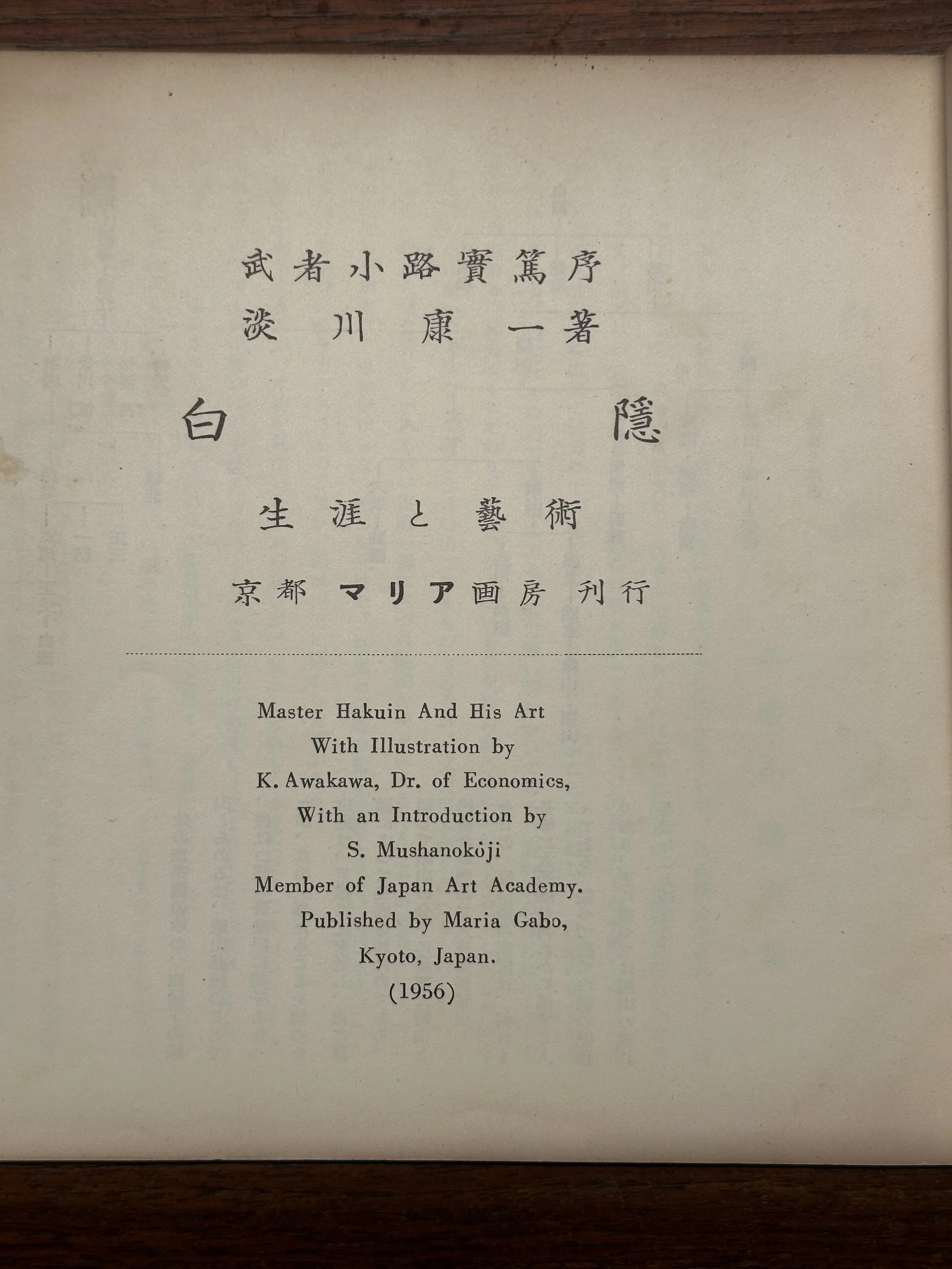
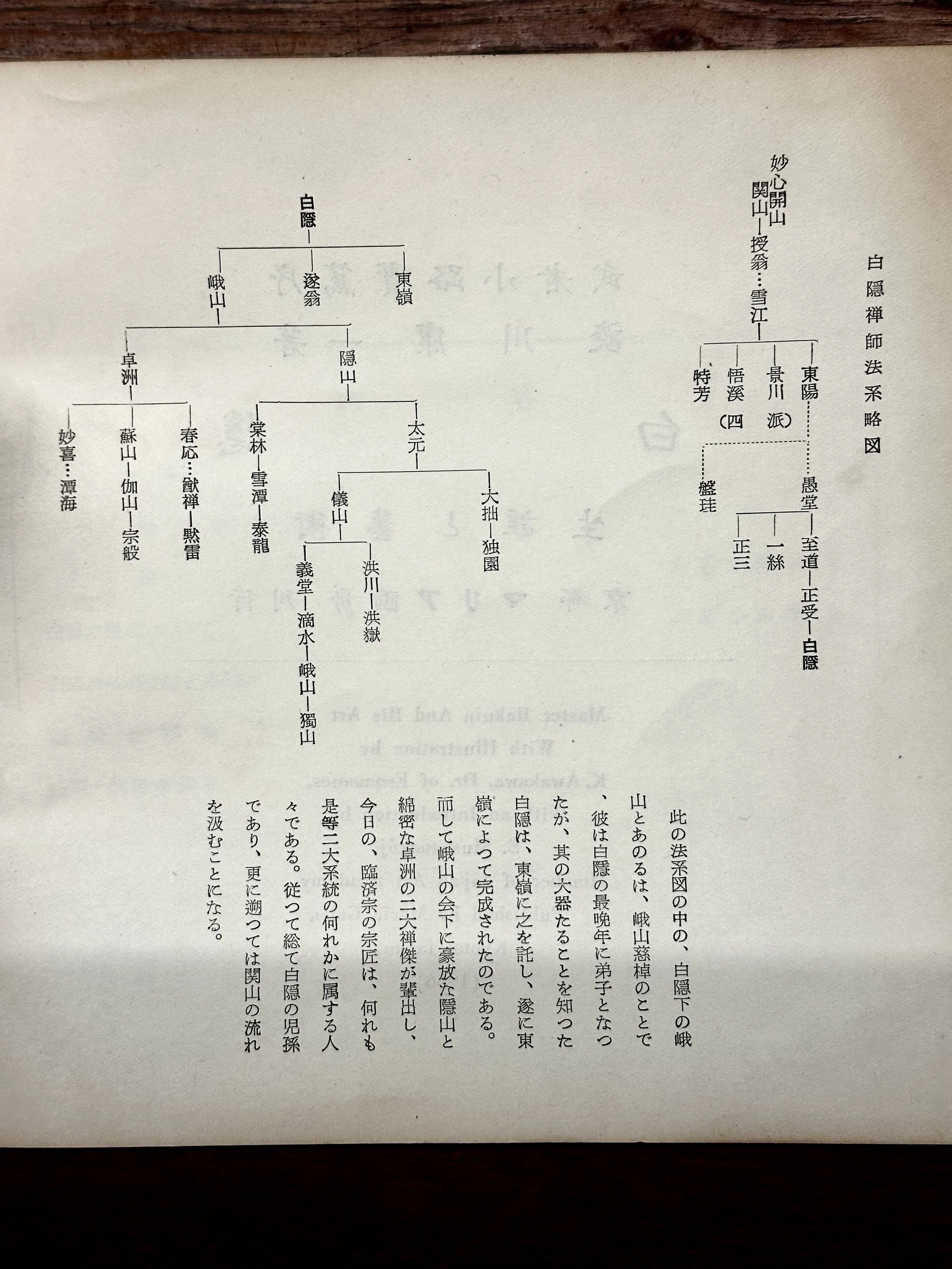
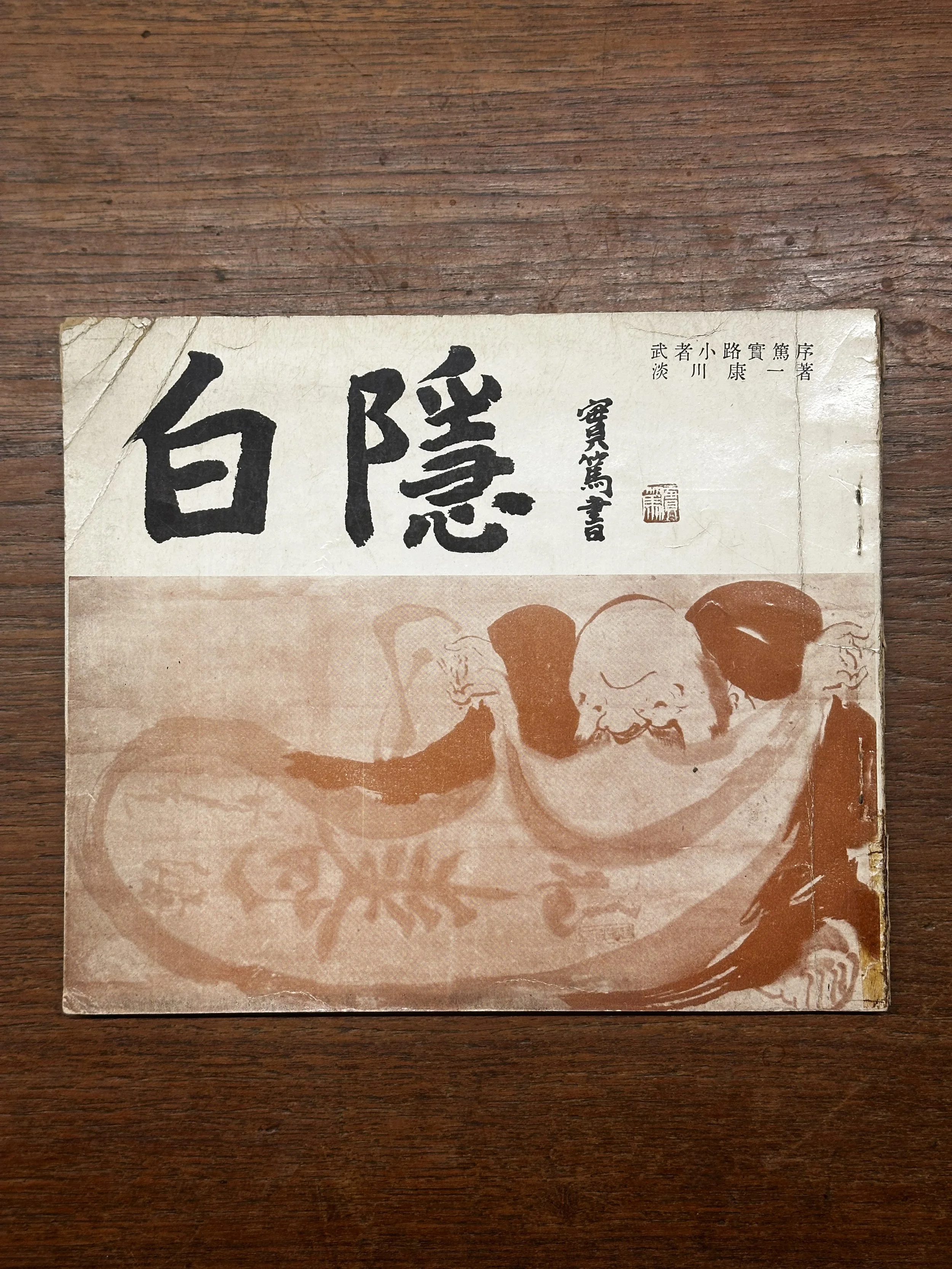
The opening essay in Master Hakuin and His Art (Kyoto, 1956) approaches Hakuin not as an artist in the Western sense, but as a practitioner whose images arise from lived necessity. It reflects on his life, discipline, and transmission rather than formal qualities, gently resisting aesthetic analysis. The tone is remarkably calm, measured, and assured, especially given the historical moment of its writing. What emerges is a quiet insistence that these works are not objects to be interpreted, but vehicles through which understanding is enacted.
There is something deeply affecting in the stillness of that voice. The book itself—small, modest and fragile—feels inseparable from the essay’s tone, as though both belong to a world in which nothing needs to be overstated. Written barely a decade after the war, it carries none of the urgency one might expect, but instead a kind of settled clarity, as if the author is speaking from a place that has already passed through upheaval and come to rest.
At the same time, one senses an awareness—never stated outright—that these works were beginning to travel, to be seen elsewhere, and perhaps to be misunderstood. In the West, Zen painting has often been absorbed into a language of aesthetics: spontaneity, abstraction, expressive freedom. But here, the ground is entirely different. These images are not expressions in that sense; they are instruments. They are made to function—to point, to disrupt, to teach.
This is the difficulty, and the fascination. To approach them requires a kind of unlearning—not the rejection of what one knows, but a softening of it, a willingness to set it aside. Concepts like composition, authorship, even originality begin to lose their centrality. What remains is something quieter, but more exacting: the question of whether one can meet the work without immediately translating it into familiar terms.
Perhaps that is why the essay feels so generous. It does not argue or correct. It simply holds its position, allowing the reader to come closer in their own time. And in doing so, it suggests another way of looking—one that does not begin with interpretation, but with attention.
19 April 2026
Shakyamuni Emerging
The figure emerges again and again, unchanged in form yet deepening in presence. Across these works, Hakuin returns to a single image, refining not the design but the act of its making. What follows is a brief reflection of that repetition—of a form remembered.

Over the past week, I have begun assembling a small visual sequence of Hakuin’s depictions of Shakyamuni emerging from the mountains.
Seen together, even in rough form, certain shifts begin to appear. The earlier works—particularly those from the 1720s—retain a looser, more linear character. The figure is still being found. The hair falls longer, less systematised, and the body has not yet compressed into the powerful, calligraphic form that would later define the mature works. Yet the essential structure is already present: the angle and posture of the body within the cloak are established early and change very little thereafter. What evolves is not the design itself, but the brush—the growing confidence with which this form is repeated and realised.
Across the sequence, a quiet tension becomes visible. The body, wrapped and partially obscured, carries the austerity of prolonged isolation—the harshness of exposure, the weight of the mountain. And yet the face resists this condition. It is not anatomically gaunt, but composed, even full—marked by acceptance, generosity, and gratitude. Most moving are the clasped hands, held together in front of the body, hidden within the cloak, sheltered from the freezing wind as he descends.
The example in this collection appears to sit between these states. It does not have the exploratory looseness of the earliest works, nor the highly elaborated character of the later ones. Instead, it occupies a middle ground, but with a striking confidence of execution. The brush moves without hesitation; not a single line appears to be redrawn. It suggests a form already fully held and realised in the mind, brought forward in a single, continuous act.
What gives the work its particular resonance, however, is its condition. It appears to have remained outside the usual circuits of private collecting—preserved instead within a temple context, mounted but neither remounted nor restored for perhaps a century or more. In that sense, it feels less like an artwork shaped by connoisseurial handling, and more like one that has simply remained, held in place over time.
There is a quiet anticipation in approaching its conservation. Not in the sense of correction, but of revelation—of allowing the work to emerge more clearly, much as its subject does, step by step, from the mountain.
10 April 2026
The Weight of Things: Hokuba’s Documentary Vision of the Floating World
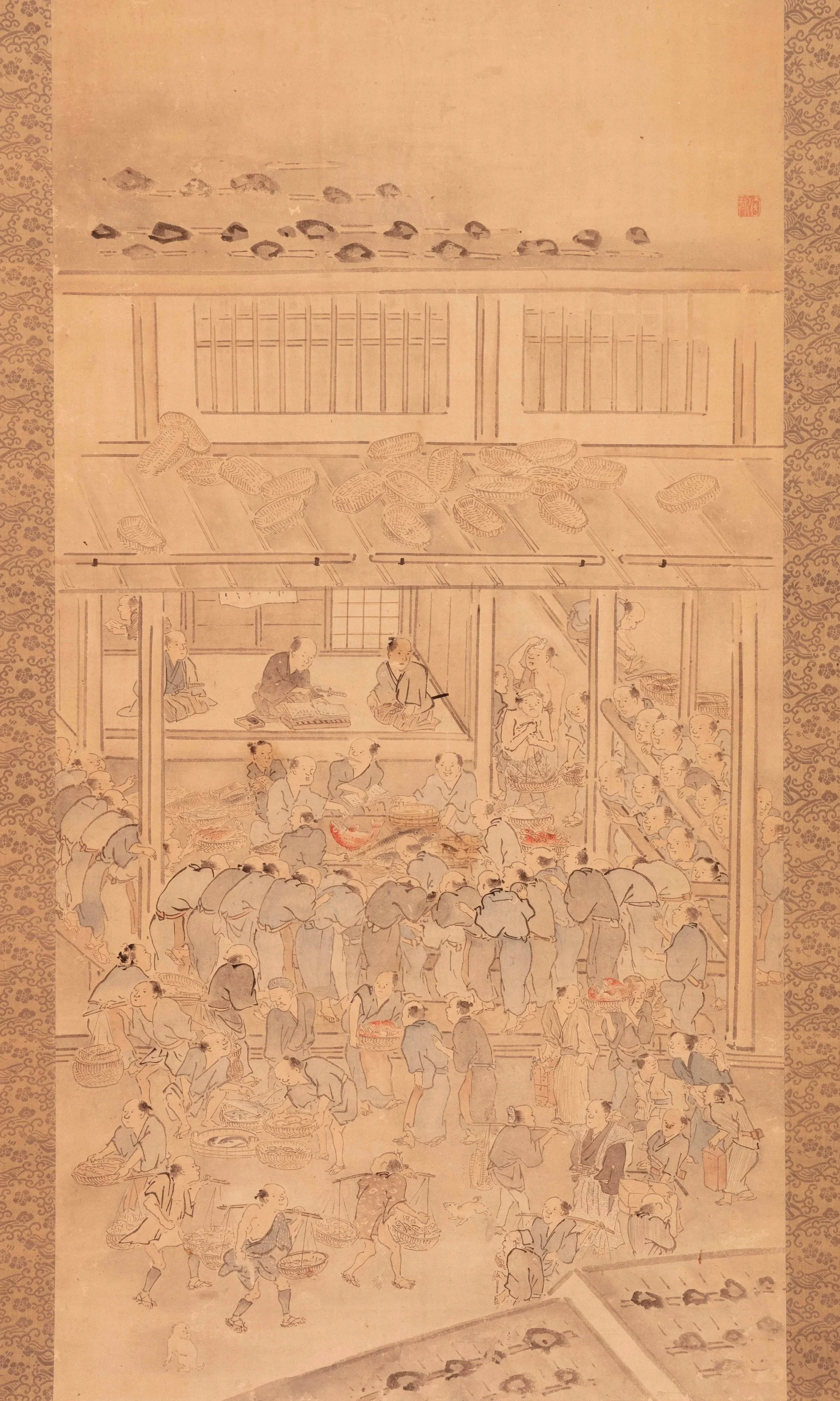
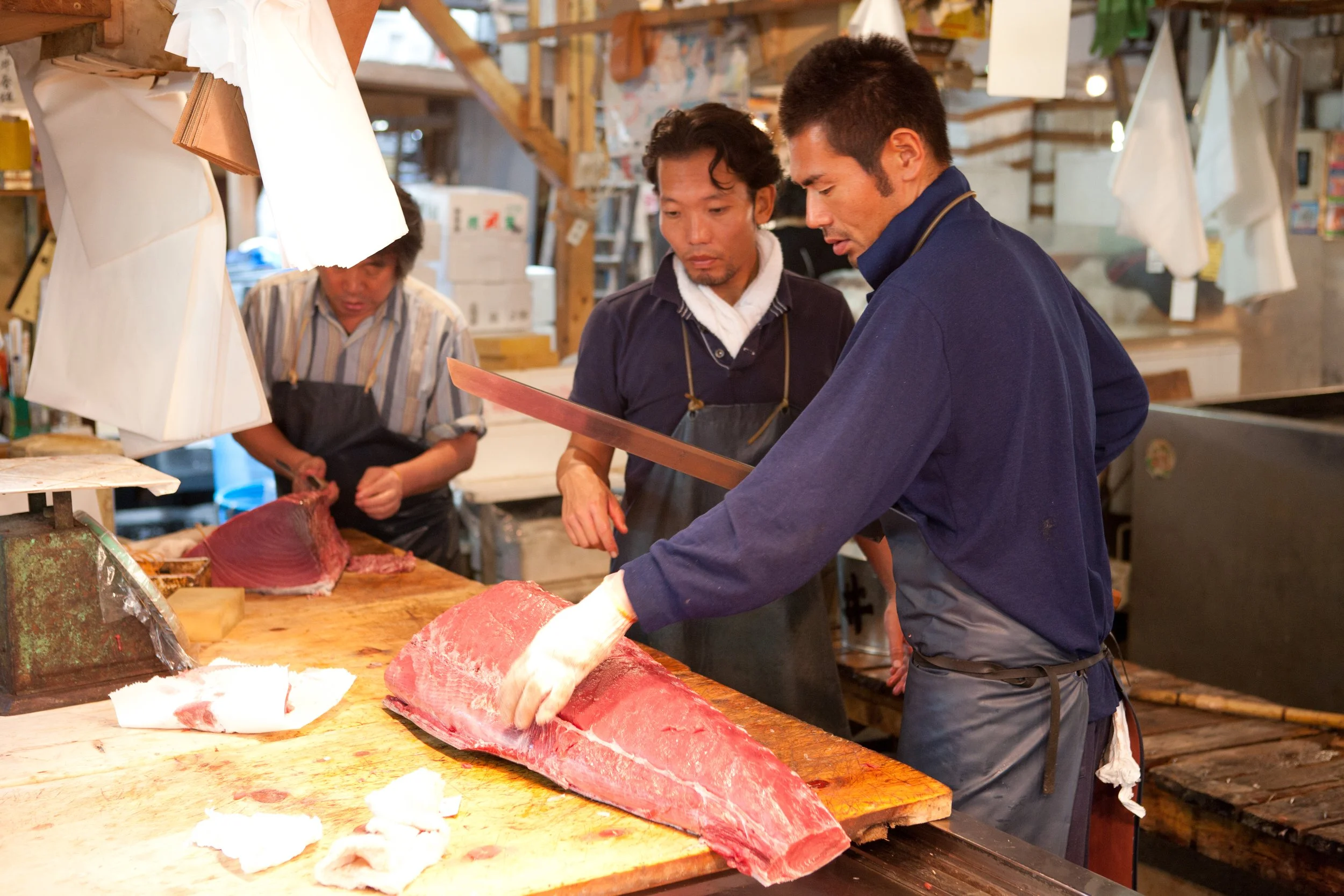
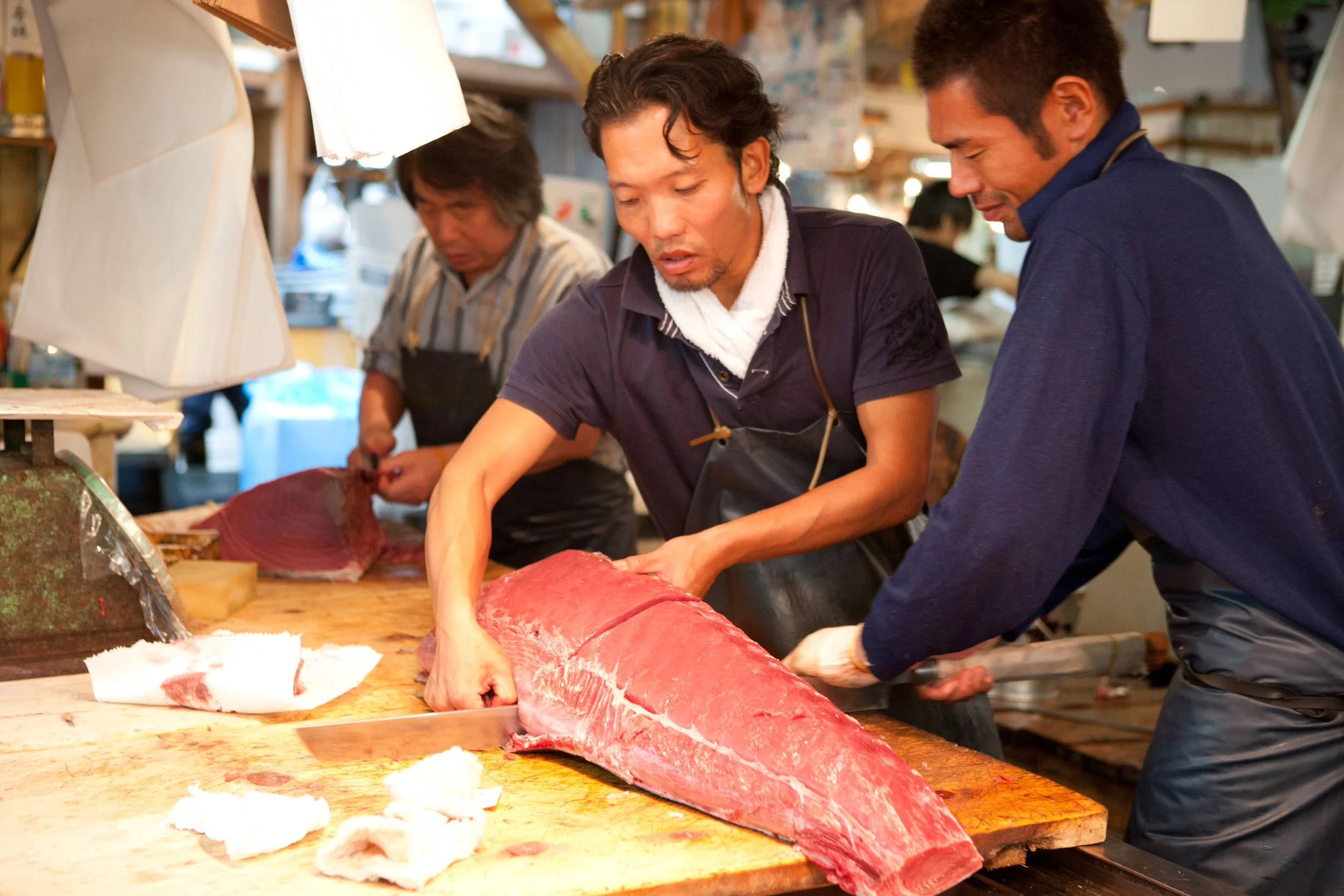
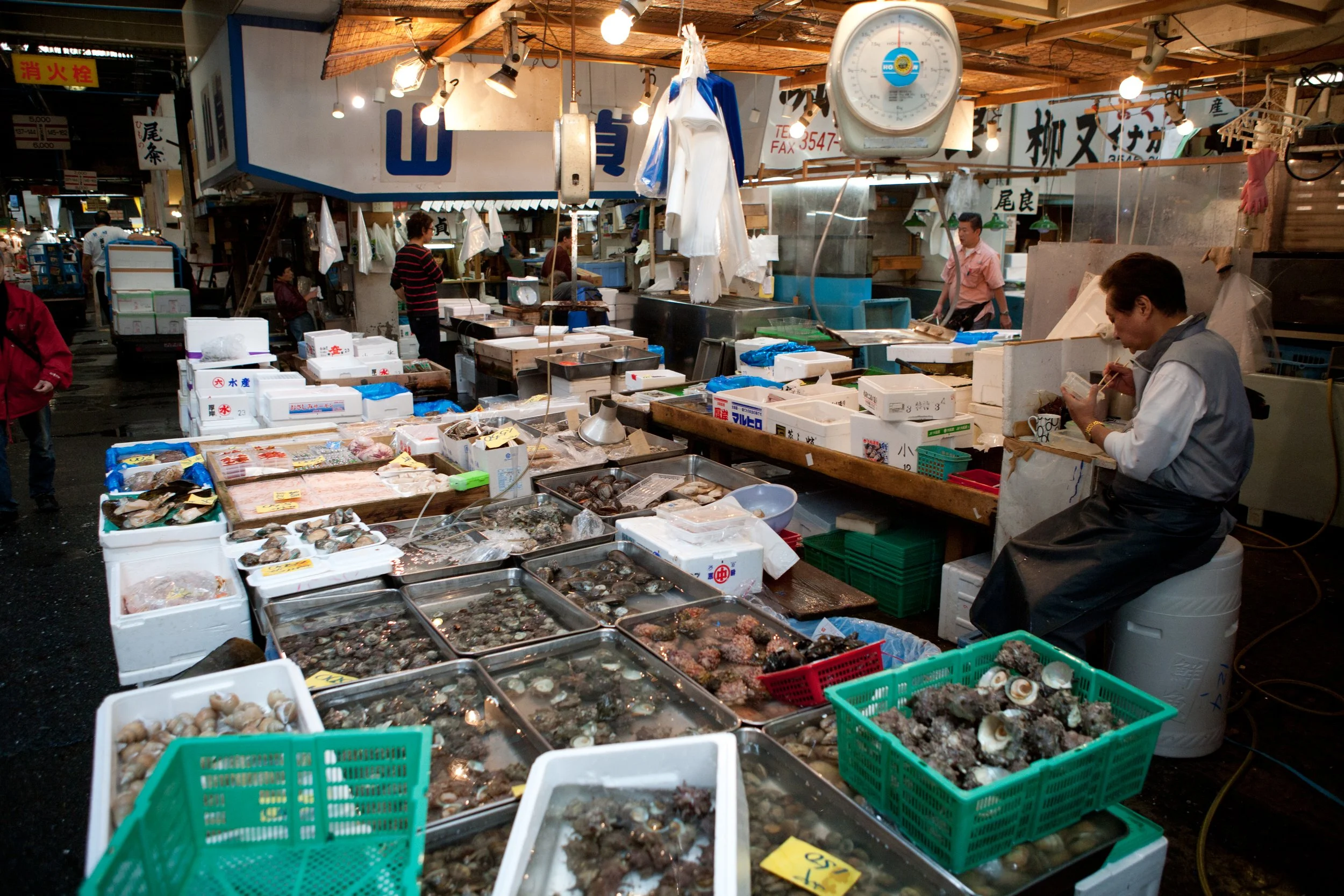
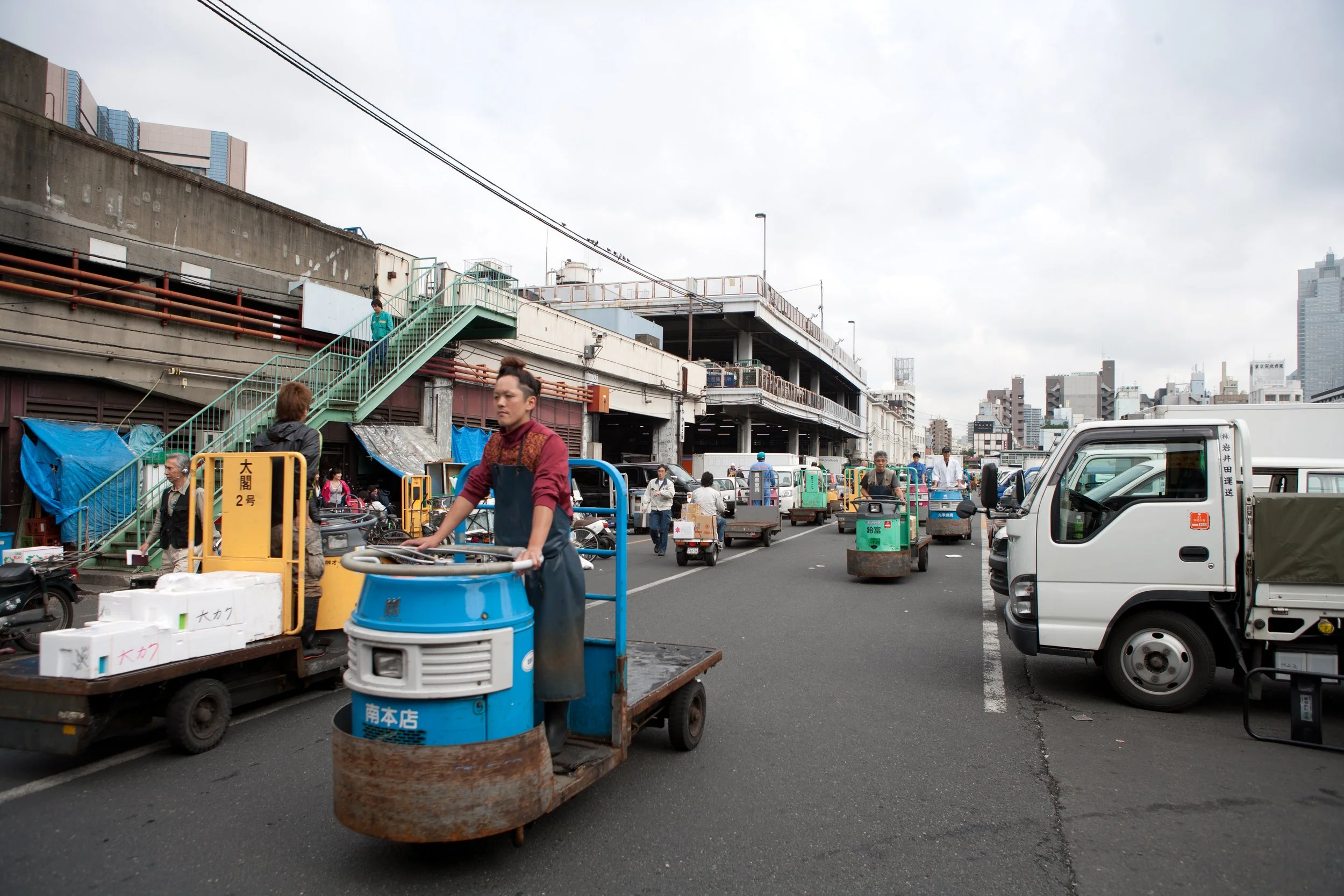
Fish markets are among the few places where life and death are held openly in view. The fish and shellfish laid out on ice or carried through the crowd are unmistakably recent presences — their forms intact, their surfaces still luminous. But this immediacy extends beyond the catch itself. The people who move through the space — buyers, sellers, porters — are equally bound into this cycle of exchange, labour, and time. One becomes quietly aware that the same forces of arrival, duration, and departure apply to all.
Fish markets are places where nothing is concealed. In contrast to the abstracted systems of modern commerce — where goods arrive cleaned, packaged, and detached from their origins — the entire process is visible. One sees the labour, the handling, the negotiation, and the product in its raw state.
It is not simply noise, though the air is full of it. Nor is it only movement, though everything seems to shift and flow. Rather, it is a density of lived experience — a place where abstraction falls away, and the world presents itself as weight, body and time.
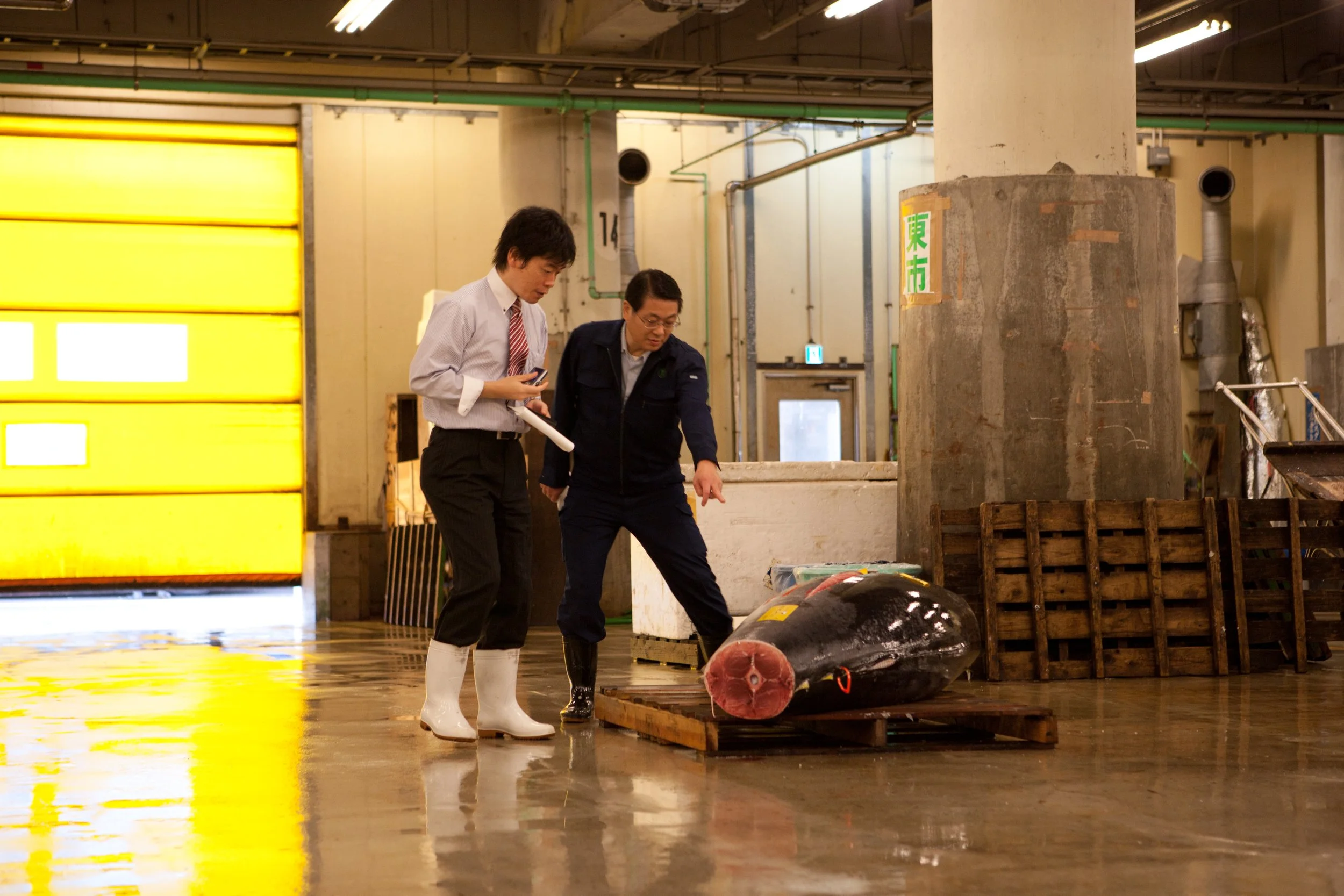
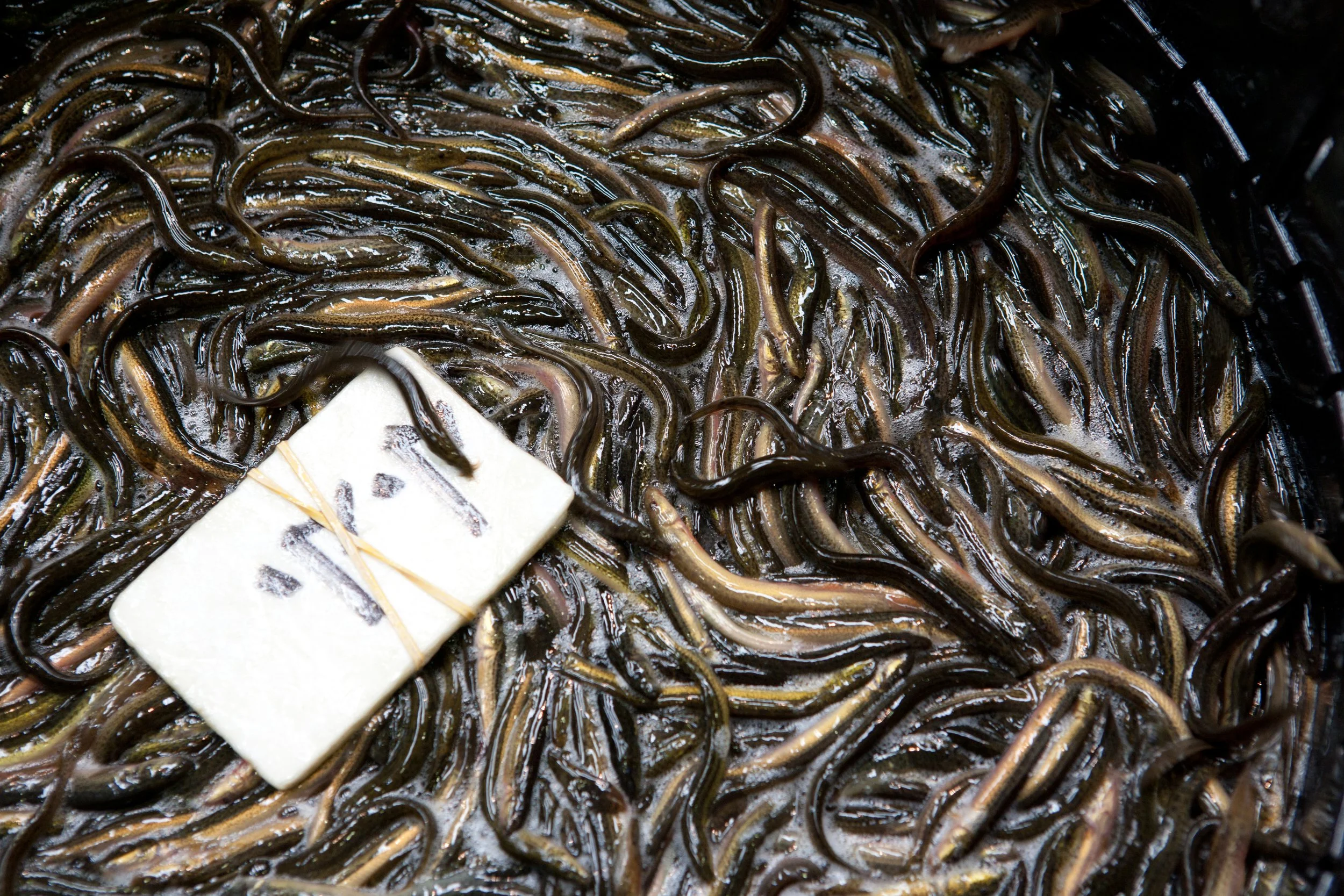
Standing in the early morning at Tsukiji, one becomes aware of a choreography that feels both improvised and ancient. Tuna lie like dark, glistening forms against the wet floor, their interiors revealed in sudden fields of red. Eels gather in restless, calligraphic knots. Knives move with an economy that borders on ritual. Everywhere there is water — held, spilled, evaporating — catching the light in brief, shifting flashes.
What is most striking is the absence of separation.
One does not observe the market; one is absorbed into it. Buyers lean in, bodies compressed forward. Porters pass through narrow openings with practised ease. Transactions occur in gestures as much as in words. The senses are not detached — they are implicated.
It is here that the world of Edo begins to emerge with unusual clarity.
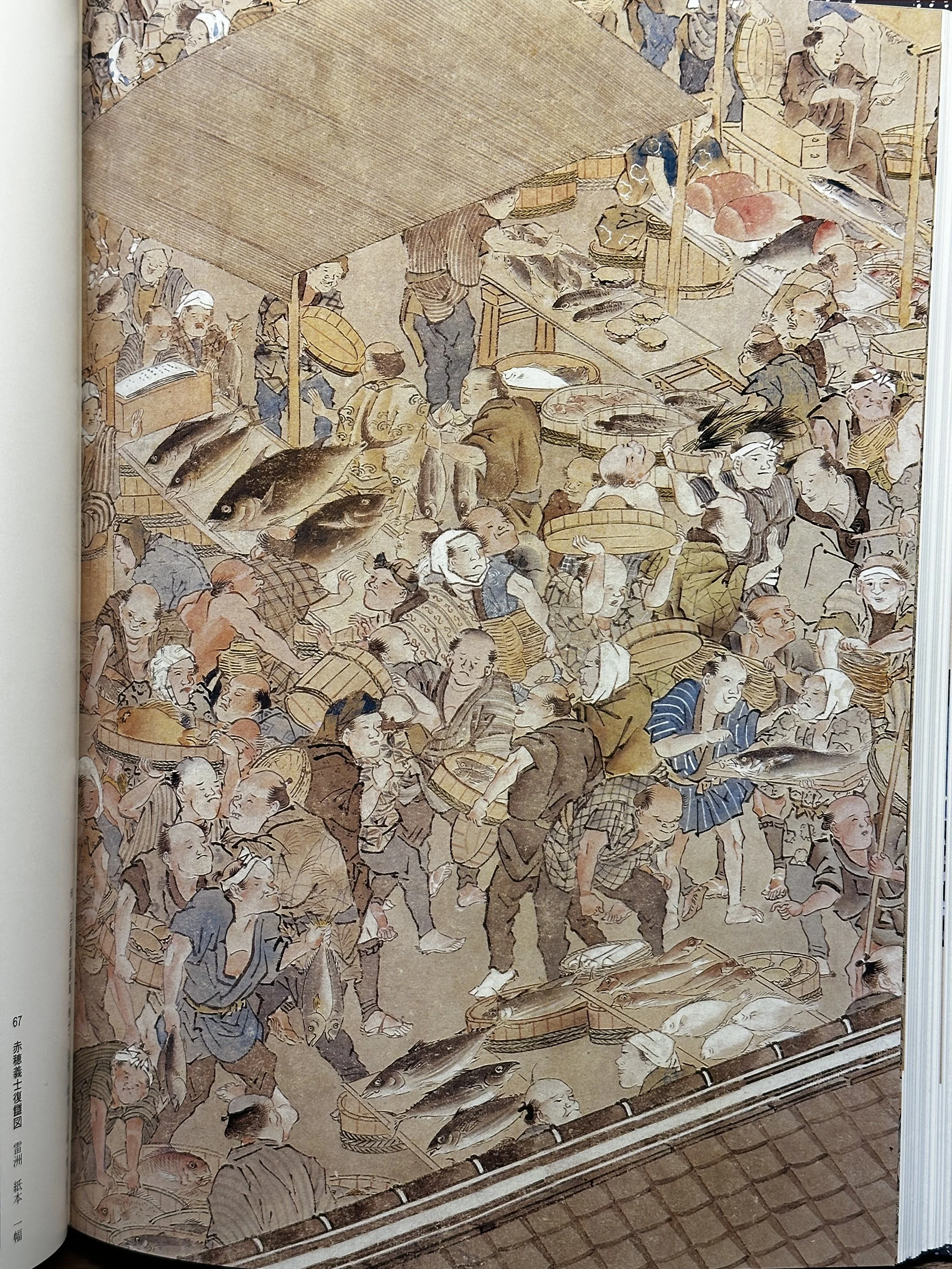
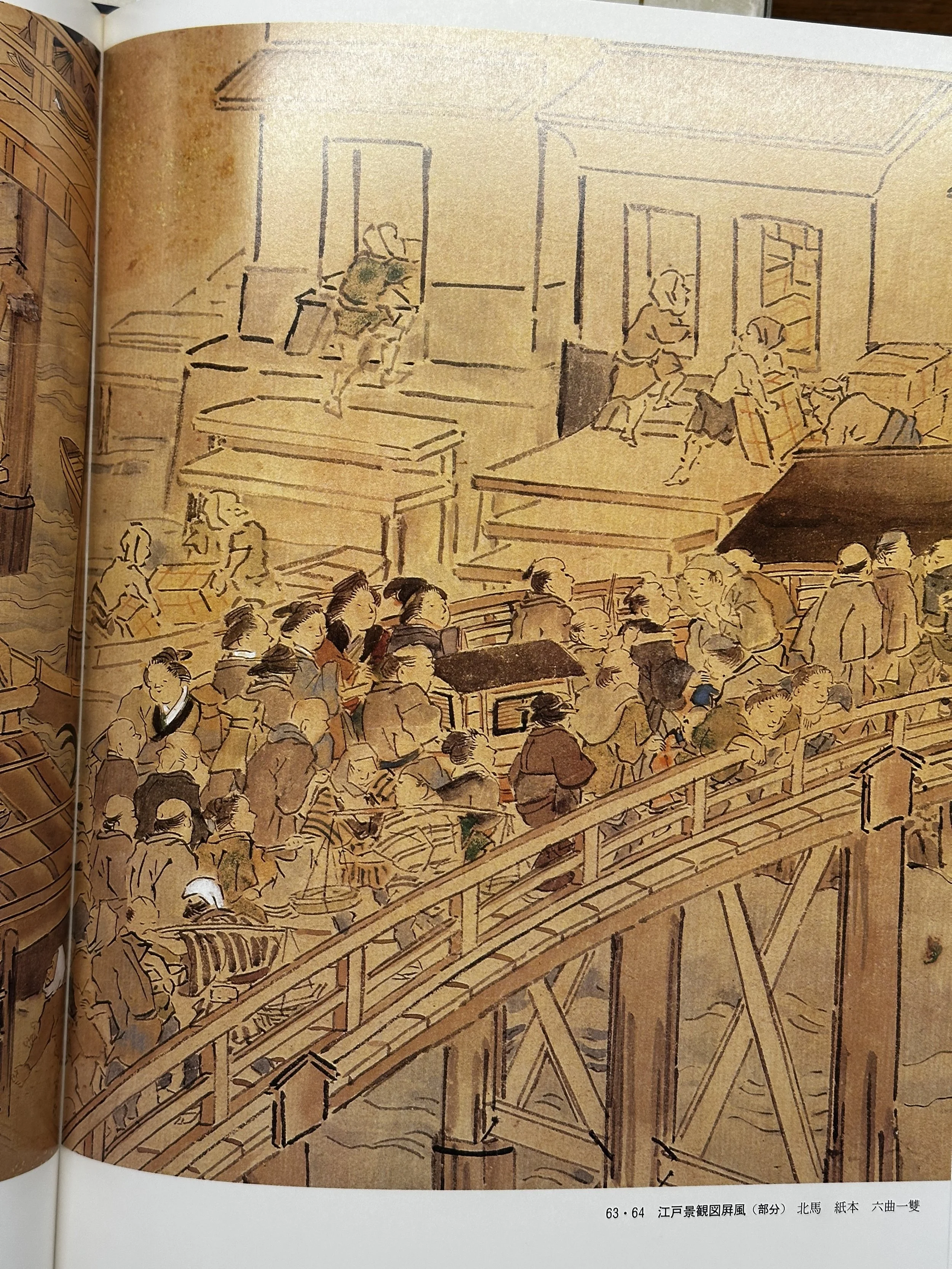
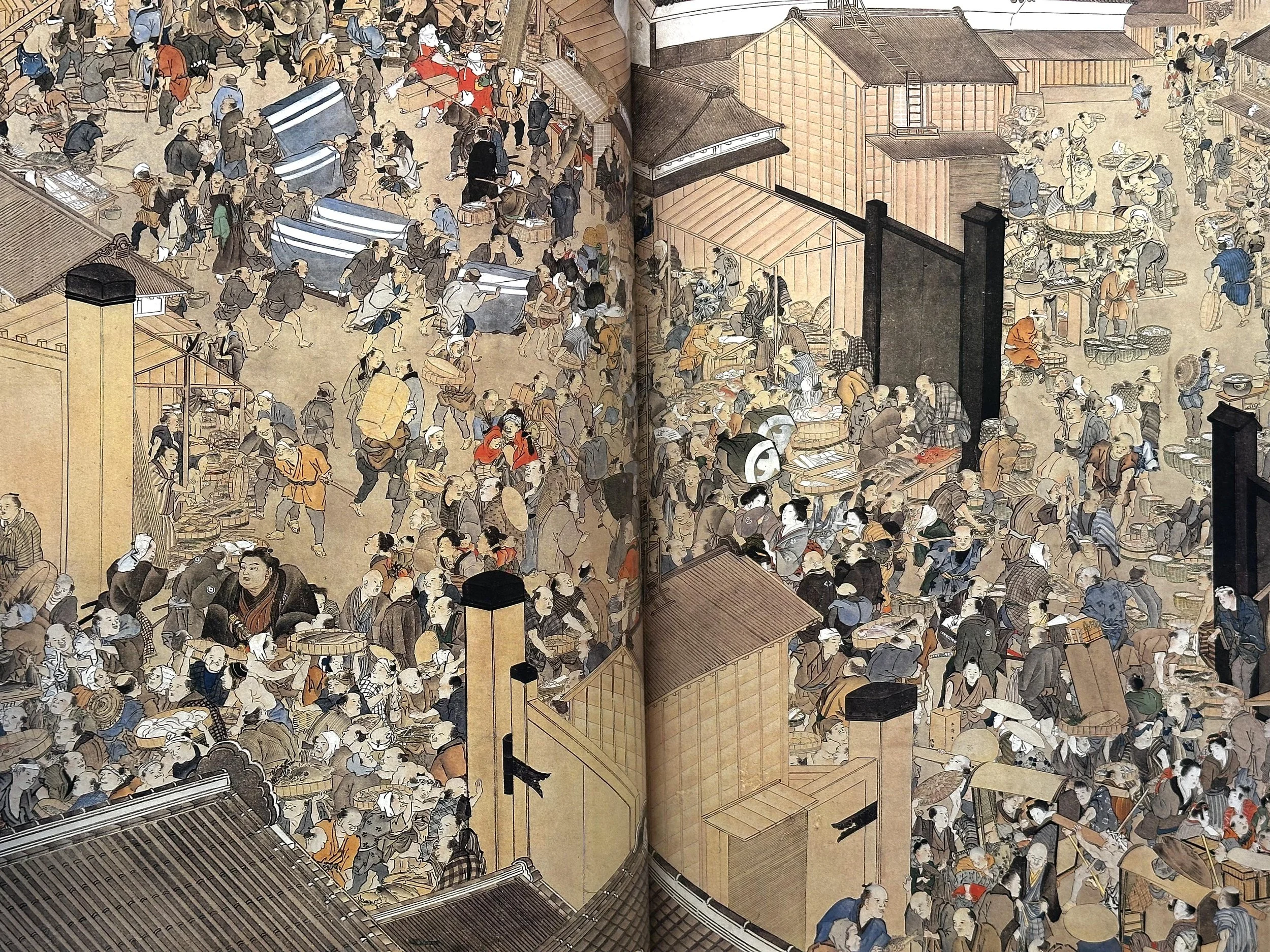
In the great folding screen views of Edo painted by Teisai Hokuba, the same compression of life unfolds. These works belong to a broader tradition of urban panorama painting — large-scale images that attempt to grasp the city as a total environment. Yet unlike earlier, more formalized screen traditions, these are not distant or ceremonial views. They are inhabited. The city is not arranged; it is in motion.
The texts in Nikuhitsu Ukiyo-e, Vol. 7: Hokusai (Shueisha, 1982) describe these works as part of the flourishing culture of genre painting — fūzokuga — in the late Edo period, when the daily life of townspeople became a subject of sustained artistic attention. This was not incidental. By the late eighteenth and early nineteenth century, Edo had become one of the largest cities in the world, and its commercial districts — including the great fish market at Uogashi — formed the beating heart of its economy. What we see in these paintings is not anecdote, but structure: the circulation of goods, labour, and attention within an increasingly complex urban system.
Within this context, Hokuba’s position is particularly compelling.
A direct pupil of Hokusai, he inherits the master’s fluid line and compositional energy. Yet his sensibility is notably different. Where Hokusai often pushes toward invention, compression, and imaginative force, Hokuba tends toward observation. His work carries a distinctly documentary impulse — a desire not simply to transform the world, but to record it with fidelity and breadth.
This quality is especially evident in the treatment of the fish market.
The scenes do not isolate dramatic moments. Instead, they accumulate detail. Figures press inward, overlapping, bending, negotiating space. Porters carry loads suspended from shoulder poles; clerks lean over ledgers; buyers crouch to inspect the catch. Fish appear not as symbols, but as objects of weight and exchange — laid out, handled, assessed. The crowd itself becomes a kind of organism, structured yet fluid, dense yet legible.
The texts note a key characteristic of these screens: their ability to combine scale with precision. From a distance, the composition resolves into a vast panoramic field — a sweeping vision of Edo’s built environment, with bridges, riverbanks, and market halls arranged across the surface. But as one moves closer, that field dissolves into innumerable small acts, each rendered with quiet attentiveness. The grandeur of the whole is sustained by the exactness of the parts.
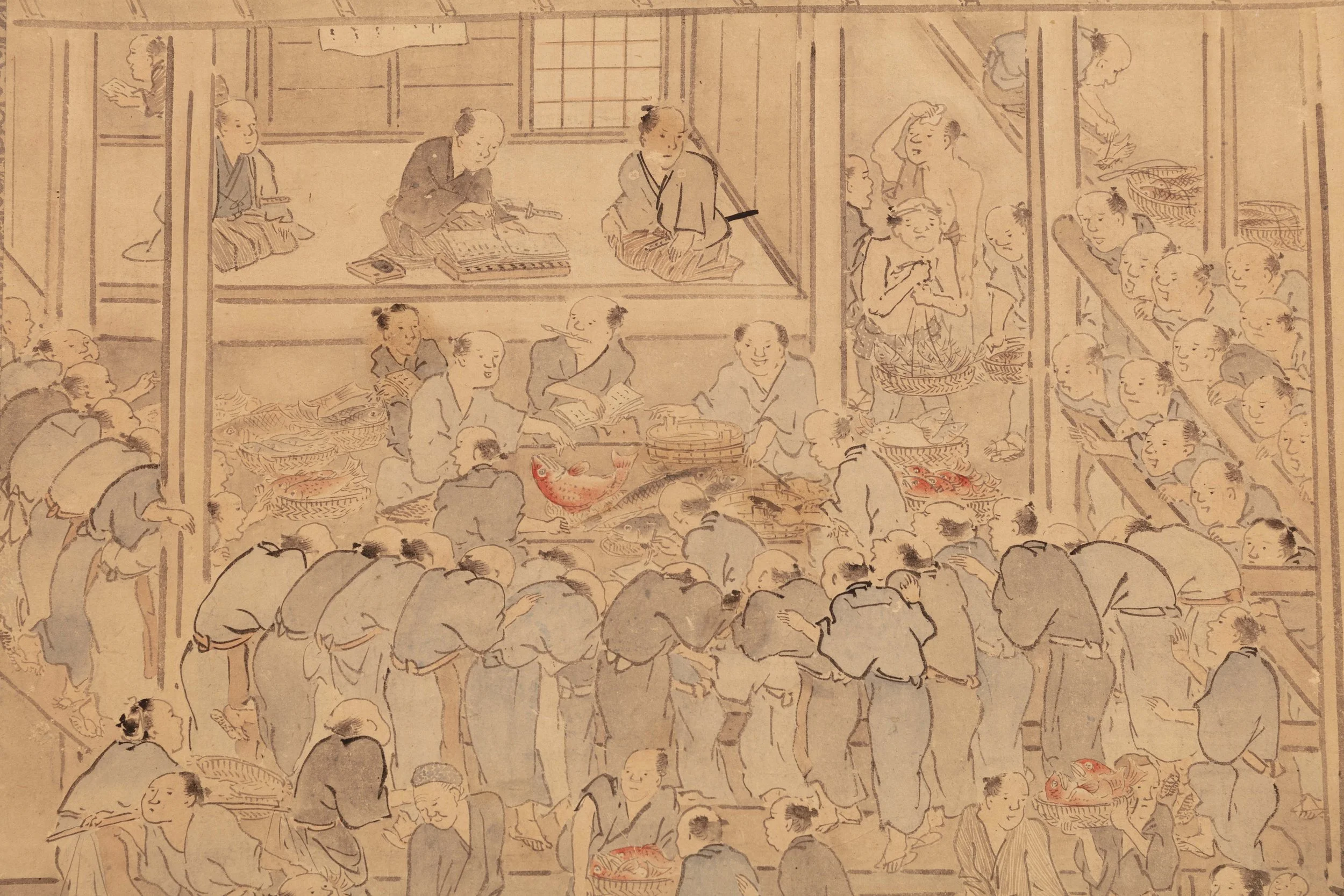
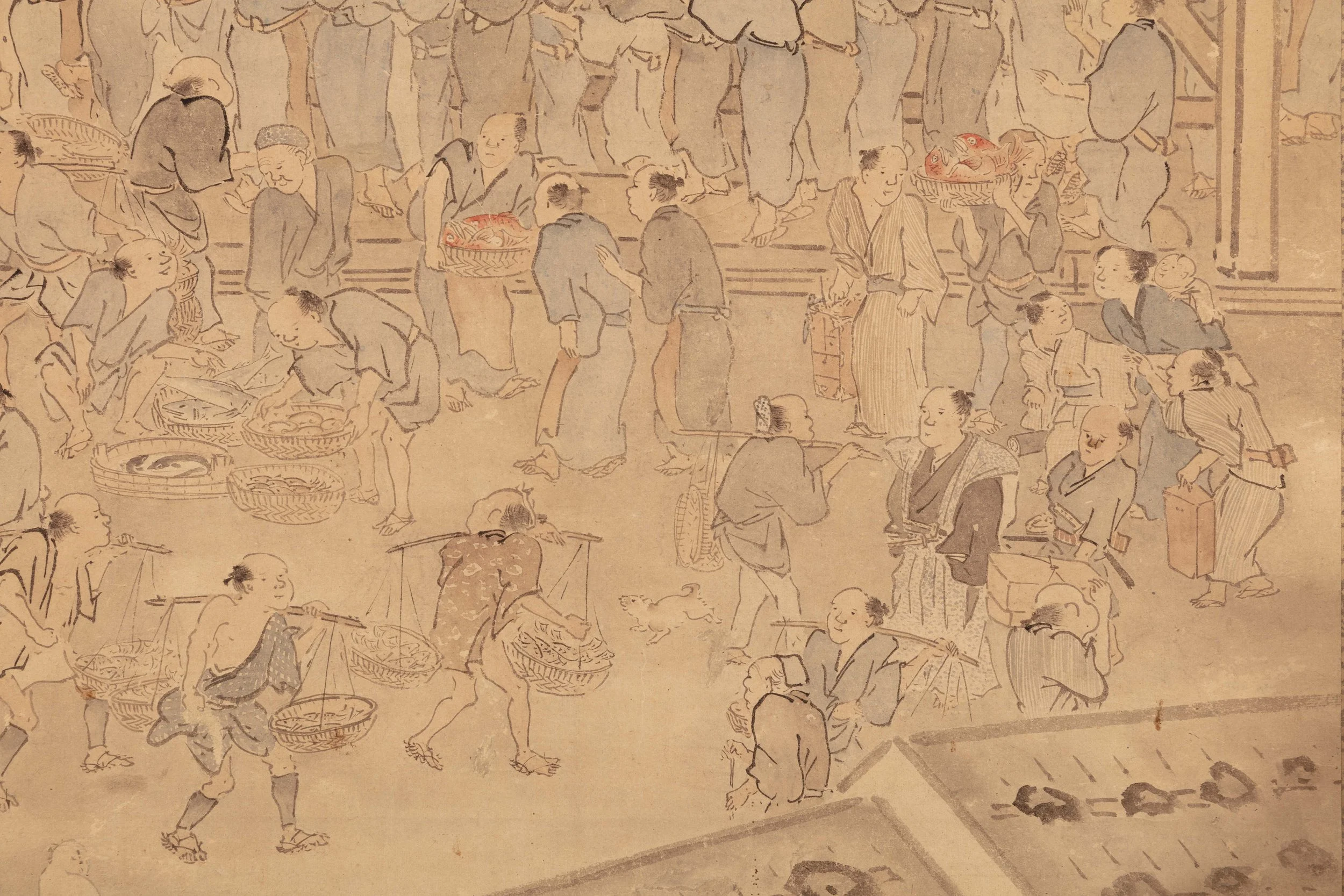
This duality — monumentality and intimacy — is central to their power.
It also reflects a broader cultural moment. The late Edo period saw the maturation of townspeople culture, in which merchants, artisans, and urban workers developed their own forms of taste, patronage, and visual expression. In this context, the fish market was not a marginal subject. It was emblematic of a world in which value was negotiated daily, in public, through skill, knowledge, and exchange.
Hokuba’s approach suggests a deep familiarity with this world.
There is little sense of idealization. The figures are not heroic; they are absorbed in their tasks. The architecture does not dominate; it frames. The emphasis falls instead on process — on the continual unfolding of activity. In this sense, his work aligns less with the theatricality often associated with ukiyo-e, and more with a kind of observational clarity. One might even say that he anticipates, in a distant way, the documentary impulse of much later visual traditions.
Looking again at the painting in my own collection, this quality becomes increasingly apparent.
The composition does not seek a single focal point. Instead, it invites the eye to move — to follow the flow of bodies, the repetition of gestures, the distribution of goods across the space. Baskets of fish punctuate the scene, small concentrations of colour and form that anchor the shifting crowd. There is humour here, certainly, and a lightness of touch, but beneath it lies a sustained attention to how things actually occur.
And this, perhaps, is where the connection to the present becomes most vivid.
When I visited Tsukiji in 2010, before its closure and relocation, I was struck by how accessible this world still was — how one could stand within it, rather than outside it. There was no barrier between observer and activity. I felt fortunate to witness, at close range, the whirl and rush of humanity, its life and death unfolding continuously within the same space.
The tools have changed, and the infrastructure has expanded, but the underlying choreography remains. The negotiation of space, the calibration of expertise, the physical handling of goods — these continue to define the experience. The market is still a place where knowledge is embodied, where value is determined through proximity and contact.
Fish markets endure because they resist abstraction.
Nothing is hidden. Nothing is deferred. Everything is present — immediate, tactile, and contingent. The world appears not as image, but as process.
It is not difficult to imagine why an artist like Hokuba would have been drawn to such a place.
Here, the city reveals itself most plainly: not in its monuments, but in its movements. Not in its ideals, but in its exchanges. A place where life gathers, disperses, and gathers again — endlessly, attentively, without pause.
In this sense, his paintings are not only records of Edo.
They are acts of attention — sustained, generous, and exact — directed toward the living fabric of the everyday.
4 April 2026
This week I have been reading a small mid-eighteenth-century printed volume from Edo containing the teachings of Hakuin Ekaku — the second volume of what was likely titled Instruction for Beginners. It is, in physical terms, a modest object: paper covers, worn edges, simple woodblock printing. But as an object, it is anything but modest. Over the course of its life, readers did not simply read this book — they wrote in it. A Tokugawa domain lord, a provincial village reader, and a modern owner all left their names and notes directly on its pages, as if each of them, in their own time, wanted to place themselves beside the words that had moved them. The book is therefore not only a printed text from the 1750s; it is also a record of readers across centuries, a small piece of paper history that people quite literally wrote themselves into.
The book itself begins with the enso, the Zen circle, and then turns immediately to the details of everyday life: honesty, greed, contentment, trust, and the quiet accumulation of good and bad actions. Again and again, the message is that heaven and hell are not distant places but conditions of the heart, formed moment by moment through ordinary behaviour. Gold and silver are described as small treasures, while virtue and trust are described as great ones. A person who knows contentment is rich even in poverty; a person who is greedy is poor even in wealth.
What becomes clear is that this little book functions in the same way as Hakuin’s paintings. It is a portable teaching — something to keep nearby, something to open at random, something that does not demand scholarship, only attention. The combination of image, calligraphy, and short moral reflection forms a kind of visual and textual practice — a way of returning, again and again, to the question of how to live. The more time one spends with these materials, the clearer it becomes that Hakuin was not only a painter or a Zen master in the formal sense, but a teacher of everyday conduct. His paintings, his calligraphy, and these printed booklets all seem to serve the same purpose: not to impress, but to guide; not to decorate a room, but to quietly correct the heart.
It is a very Edo-period idea, but also a very timeless one — that the smallest book, or the simplest painting, if it is returned to often enough, can slowly reshape a life.
Abridged Notes, Second Volume, Leaving Appearances
by Hakuin Oshō, 1750s, printed in Edo
This small, worn book is a mid-eighteenth-century printed volume from Edo containing the words of Hakuin Ekaku. Near the end of his life, Hakuin’s teachings circulated widely in printed form. Publishers produced small, affordable booklets containing his sermons, moral writings, and religious reflections so that ordinary people — townspeople, merchants, farmers, and samurai — could read and learn from them. This little book belongs to that world: not the world of temple treasures, but the world of printed teaching, where ideas travelled in paper covers and ink rather than in hanging scrolls.
The title on the outer cover is worn and difficult to read in full, but enough remains to suggest that the book was originally presented as a didactic text of the “instruction for beginners” type — a common category in Edo-period publishing. However, a printed title page at the end of the volume appears to read 離相下巻抄 — “Abridged Notes, Lower Volume: Leaving Appearances.” This internal title is more explicitly Buddhist in tone, and suggests that the work may be better understood not simply as elementary instruction, but as a distilled teaching concerned with non-attachment to forms — the letting go of appearances.
When one reads the book itself, this interpretation fits perfectly. Because this is not an abstract Zen treatise. It is a book about how to live.
One of the most striking things about the book is how it begins. It does not begin with a story, or a sermon, or a doctrinal argument. It begins with an explanation of the enso, the Zen circle. The circle is presented as something complete, something without beginning or end, something that contains everything. It is both empty and full. It is a visual teaching rather than a verbal one, and it is a very Hakuin way to begin: with a brushstroke rather than an argument.
But after beginning with the circle — with Zen in its most distilled and abstract form — the book turns immediately toward ordinary life. The pages that follow are filled not with koans or temple regulations, but with discussions of honesty, trust, greed, contentment, virtue, repentance, karma, Amida Buddha, heaven and hell, and the condition of one’s own heart. Again and again, the text returns to the same central idea: small actions accumulate, small thoughts grow, and the state of one’s heart determines the state of one’s life.
There are passages that explain that if you deceive people, you may profit briefly, but you will lose trust; and if you lose trust, you lose your place in the world. There are passages that say gold and silver are small treasures, but virtue is a great treasure. There are passages explaining that a greedy person is never at peace, but a person who knows contentment is always rich, even if they are poor. There are passages explaining that heaven and hell do not begin only after death, but begin in the mind itself. It is, in a sense, a kind of Edo-period moral psychology — a practical handbook for living among other people without destroying your own heart.
This is what makes the book so interesting. It shows Hakuin not only as the great Zen painter and calligrapher we know today, but as a public teacher whose writings were printed and distributed so that ordinary people could read them. It is Zen, Pure Land Buddhism, and Confucian ethics combined into something practical and direct. It is a book about how to live in society while keeping your mind in order.
What makes this particular volume even more fascinating are the handwritten notes that were added to it after it was printed. These notes connect the book to real people and real places, and they give the object a social history that extends far beyond the printing house in Edo.
On the very first page, written lightly in the margin, appears a short Zen phrase: 本来無生死 — “Originally there is no birth and death.” It is a concise and profound statement, expressing the idea that at the deepest level, the opposites of life and death do not truly exist as separate realities. It is not an ownership mark, but a reflection — the kind of phrase one writes down when something in a text has been deeply understood.
Further into the book, beside a passage on moral conduct — specifically the dangers of greed and the importance of honesty, humility, and right behaviour — appears a second, more formal annotation. The passage itself speaks about how people become trapped by desire for gold and silver, how winning and losing, profit and reputation, and the pursuit of wealth lead people into moral confusion, and how a person must instead learn to value virtue, honesty, and inner composure. Written beside this is the phrase 死活自在, meaning “freedom in life and death,” or composure and freedom regardless of circumstances. Beneath it appears the signature 紀州徳川家五代 源宗直, identifying the writer as Tokugawa Munenao (1682–1757) of the Kishū Tokugawa house.
The Kishū branch, based in Kii Province (modern Wakayama Prefecture), was one of the three great collateral Tokugawa houses. Munenao appears in Wakayama historical records not merely as a distant name but as an active domain lord: in 1722, the shogun Tokugawa Yoshimune ordered him to send the engineer Izawa Yasobei into shogunal service, reflecting the domain’s expertise in irrigation and civil engineering, and in 1727 he is recorded as dedicating imperial waka manuscripts at Tamatsushima Shrine, showing his participation in the cultural and ceremonial life of Kishū. If this little book was printed in the 1750s, as seems likely, then these notes may belong to the final years of his life.
Taken together, the two inscriptions — “Originally there is no birth and death” and “Free in life and death” — read almost like a paired reflection. They suggest not a casual owner, but a deeply engaged reader, responding to the text in the language of Zen itself. It is tempting to imagine the aging domain lord reading a small moral booklet by Hakuin — a text concerned not with power but with honesty, greed, contentment, and the condition of one’s heart — and responding in the margins not with political commentary, but with distilled expressions of spiritual insight. Whether or not we can know the exact circumstances, the notes read like moments of private reflection rather than official inscriptions.
Elsewhere in the book appears another short handwritten note, also associated with Kishū, which states that the text was “copied in full,” followed by the place name Kishū. This suggests something rather moving: that this was not merely a book that passed through his hands, but a book he valued enough to have copied. In the Edo period, copying a text was not a trivial act — it required time, paper, and skilled labour — and was usually done because a text was considered morally or educationally important. It is therefore possible that this little Hakuin booklet was copied for wider circulation within the Kishū domain, perhaps for retainers, students, or temple networks.
At the very end of the book, there are further handwritten pages that appear to be reflections by a later reader. Written in a flowing cursive hand, they form a continuous note across two pages. The text is difficult, but can be read broadly as follows:
The writer describes examining and reading through the book carefully, noting its content and preserving it with attention. There are references to gathering and recording the material, and to its value as something worth keeping. The text suggests that copies or versions of the work were sought out and brought together, and includes a line indicating movement “down to Edo,” implying either the transmission of the text or its circulation within a wider network. The tone is reflective and appreciative rather than formal — not a colophon, but a personal record of engagement with the book. It reads as the voice of someone who has taken the time to read, consider, and preserve the text, and who wishes to mark that encounter in writing.
Alongside these pages appears the clearer ownership inscription 平山蔵書 — “From the library of Hirayama” — and a place name identifying a village in Kai Province (modern Yamanashi Prefecture). This tells us that at some point the book belonged to a person or family named Hirayama living in a rural inland region west of Edo. The book thus moved from the world of a major Tokugawa domain to a provincial private library, continuing its life in quieter hands.
What is striking is that each of these readers chose not to keep their distance from the book, but to write directly into it. This is, in a way, quite an extreme act. They did not treat the book as a relic to be preserved untouched; they treated it as a living text. They wanted to place their names and their thoughts beside the words they had read. They wanted, in a sense, to be part of the book — to enter into it. Each reader, in a different century, added their presence beside the text that had moved them. In this way, the book becomes not just a printed object but a record of readers — a small thing that passed from hand to hand across time, carrying Hakuin’s teachings with it, and gathering the traces of those who responded to them.
What I find most beautiful about the book, however, is not only its history but its structure.
It begins with a circle. And then it spends the rest of the book explaining how to live inside that circle.
Not in a monastery, but in ordinary life. Do not lie. Do not cheat people. Do not be greedy. Be content. Value trust. Correct your heart while bad thoughts are still small. Do good quietly. Do not do evil even when no one is watching. Heaven and hell begin in your own mind.
It is a small book, but it contains a complete world. And perhaps that is why Hakuin began with the enso. Because the circle is not just a Zen symbol. It is the shape of a life, if one can learn how to live it properly.
And this little printed volume — Abridged Notes, Second Volume, Leaving Appearances — is, in its quiet way, a guide to how that might be done.
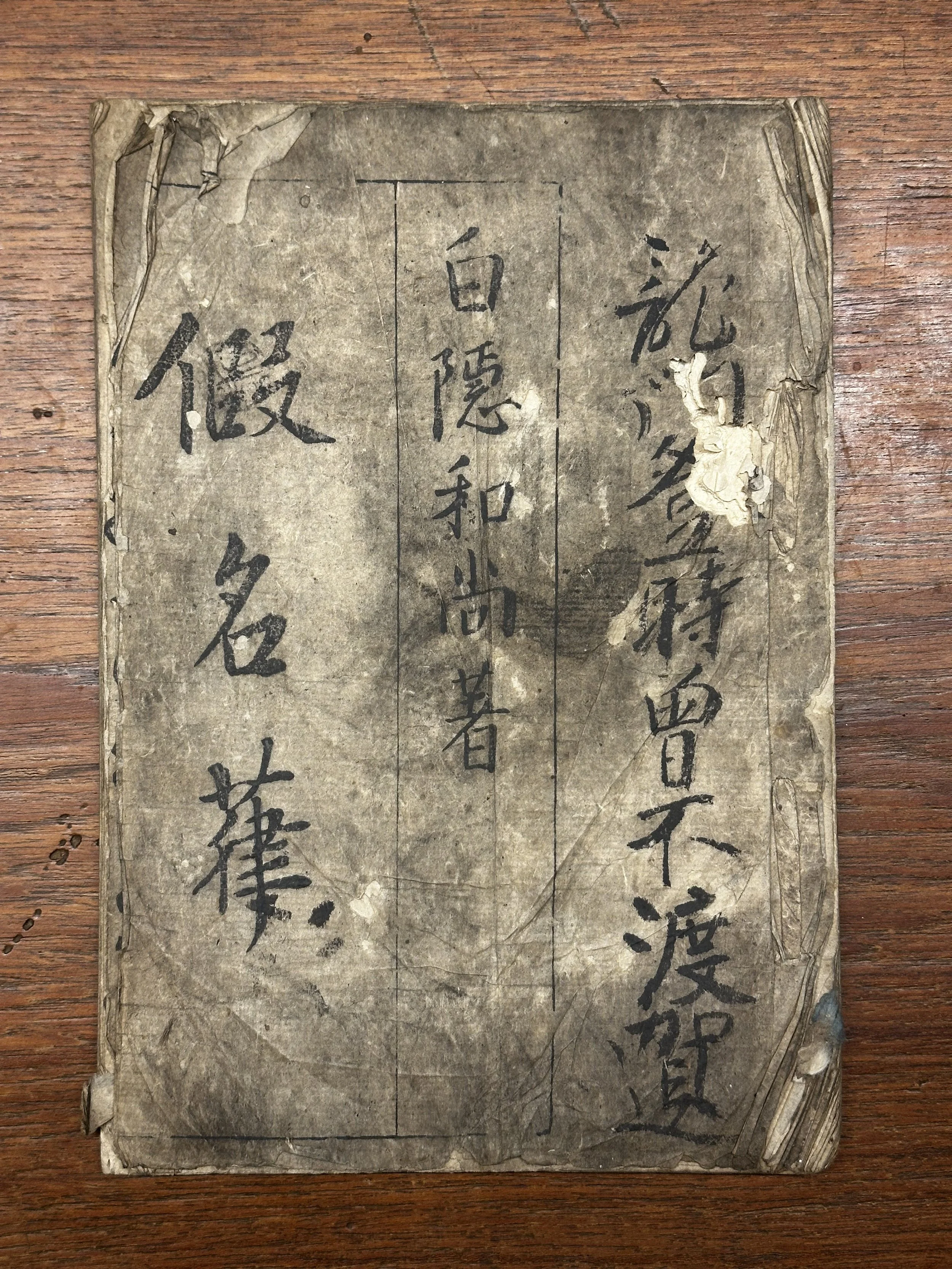
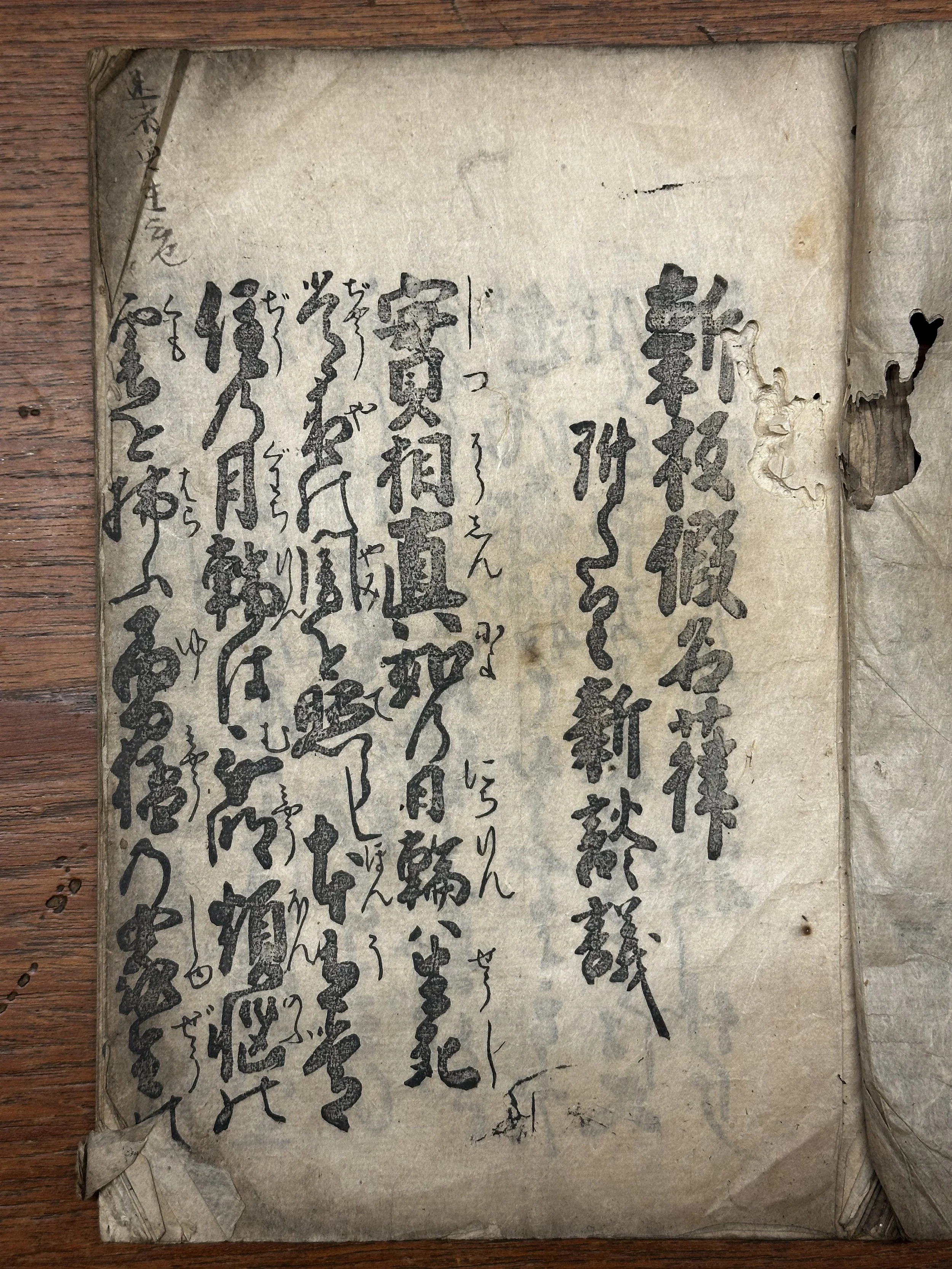
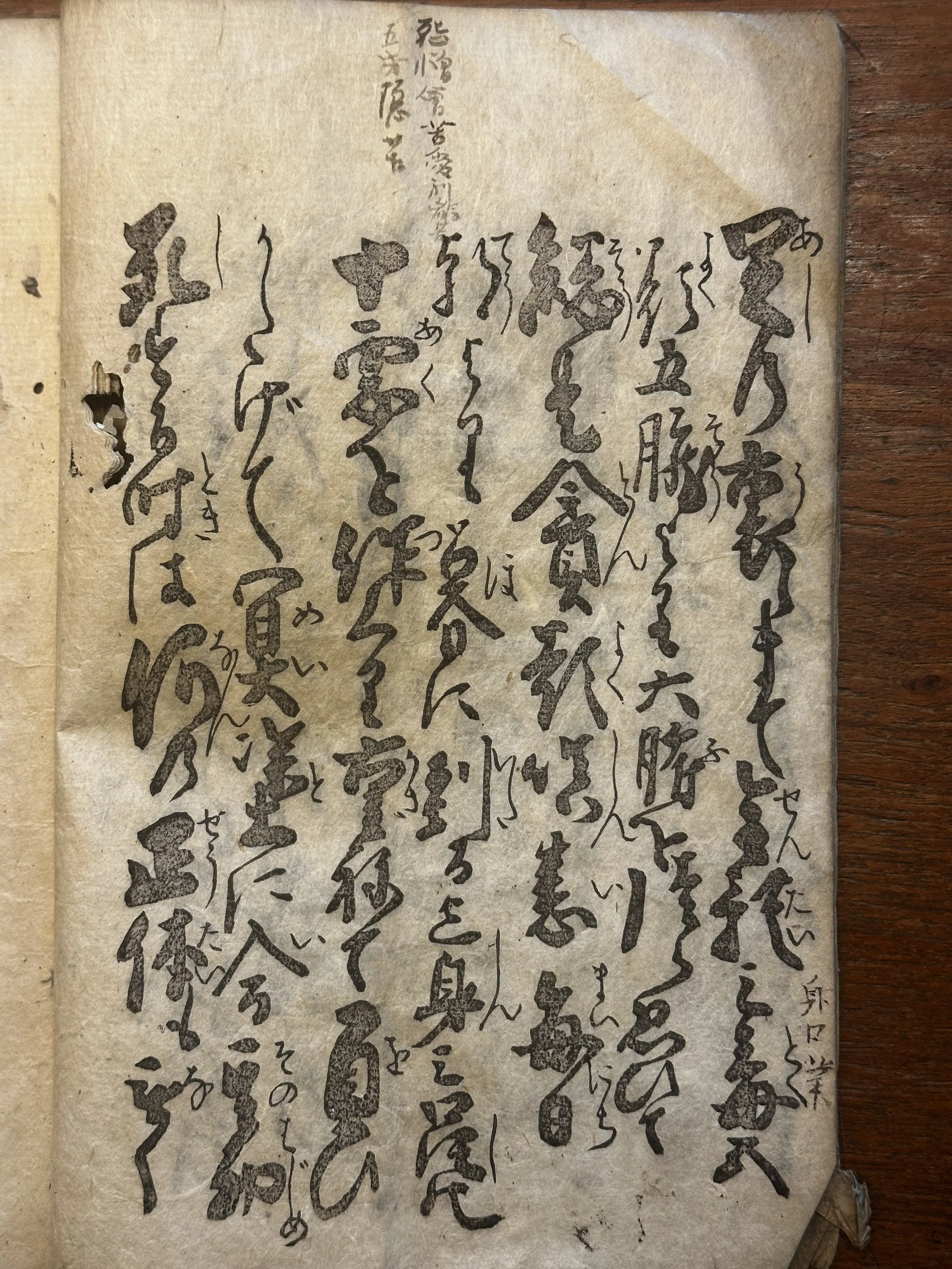
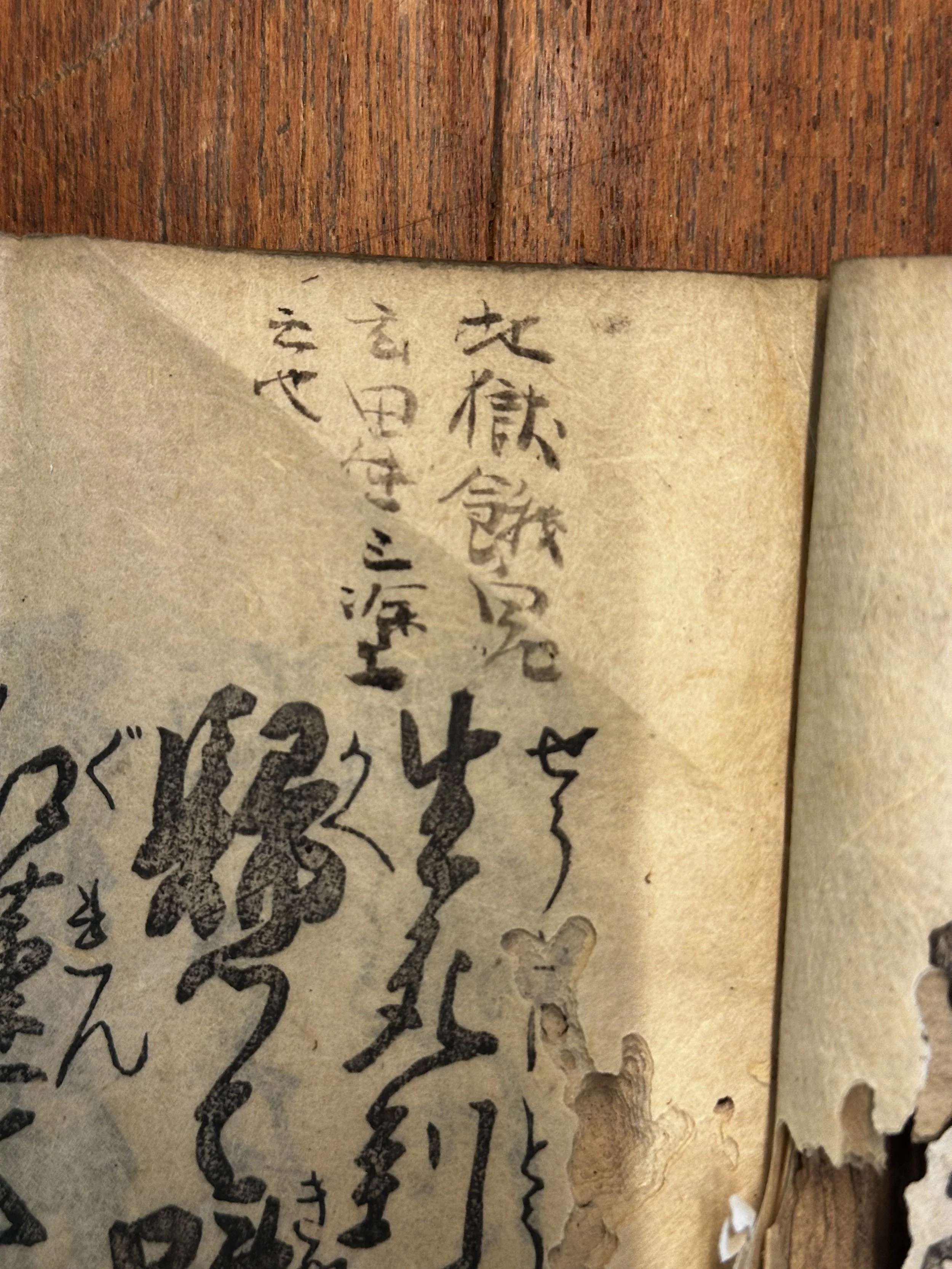
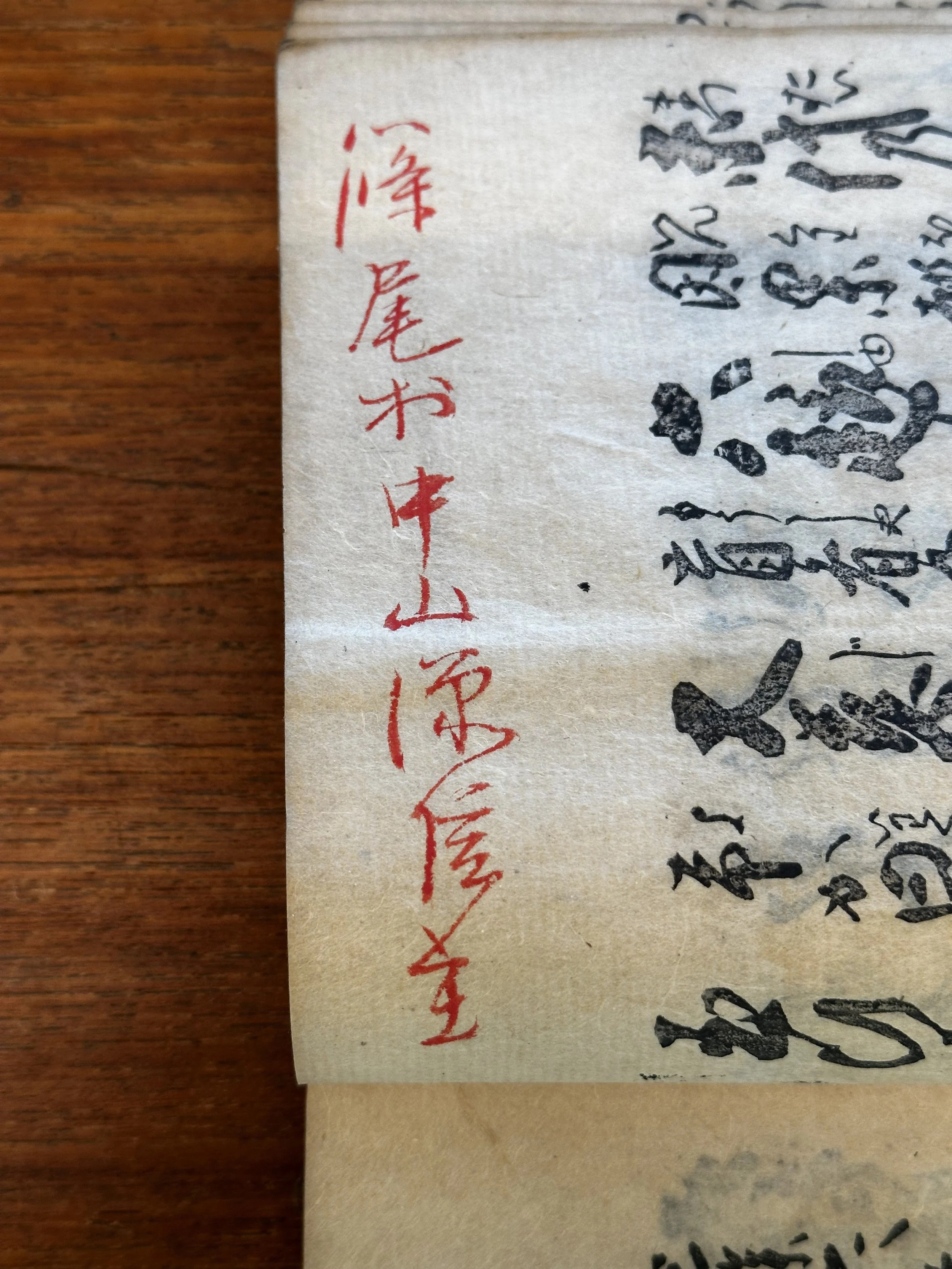
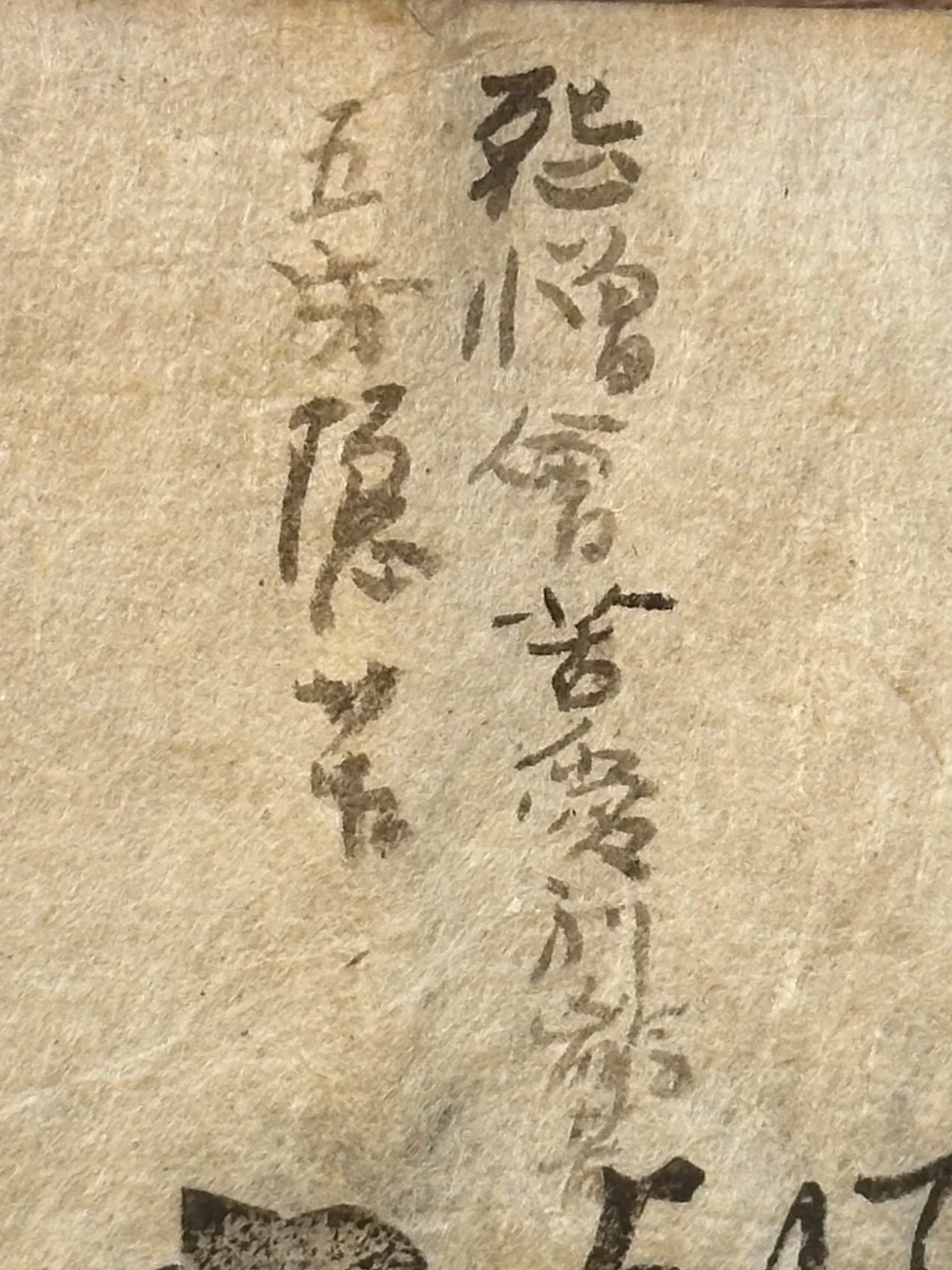
5 March 2026
This week’s reading has been the beginning of Hakuin no Zenga, Tanaka Akira’s thoughtful 1983 meditation on Hakuin’s paintings as things to be read, absorbed, and lived with. What emerges is a world of moral parable and visual brevity, where ordinary images — food, weather, errands, gestures — become vehicles for reflection, and where painting and text together form a kind of portable instruction for the heart.
What We Are Meant to Digest
Reading Hakuin no Zenga
After writing recently about authenticity — about proof, authorship, seals, and the uneasy theatre of attribution — I found myself turning, almost with relief, toward a very different kind of question.
Not: Is this genuine?
But: What is this trying to do to me?
This week I have been reading the opening pages of Hakuin no Zenga (Zen Paintings of Hakuin), a small volume by Tanaka Akira, published in 1983. It is beautifully written in a way that now feels increasingly rare: direct without being simplistic, moral without becoming heavy, and full of conviction about what painting can still do in the world.
Tanaka’s central claim is wonderfully unfashionable and therefore all the more refreshing. Hakuin’s paintings, he suggests, are not merely to be admired as cultural artefacts or appreciated as examples of Edo-period brushwork. They are to be read. More than that, they are to be absorbed, digested, and brought into life.
That struck me very strongly.
In my previous note, I was thinking about the fragility of proof — the way Zen painting unsettles the art world’s hunger for certainty. But this book opens another front entirely. It reminds one that Hakuin’s art is not primarily concerned with connoisseurship, however necessary that may be. Its real concern is the human heart: how easily it slips away, how stubbornly it clings, how often it confuses cleverness for understanding, and how patiently image and word might call it back.
What I have loved most in these opening chapters is the form that teaching takes. Hakuin does not retreat into abstraction. He teaches through dumplings roasting by the hearth, through a monkey and a turtle, through a tea ladle, through small domestic and folkloric scenes that seem almost playful at first glance. Yet each image carries an aphorism or parable that opens into something unexpectedly exact. The effect is not unlike a koan softened by humour, then sharpened again by recognition.
One of the most beautiful ideas in the book is Tanaka’s comparison of Hakuin’s paintings to food — specifically to dumplings prepared and offered, waiting to be eaten. A painting is not enough merely to look at. It must be chewed. Digested. Taken inward. Only then can it nourish. It is such a simple metaphor, but it illuminates everything. These works are not passive objects. They are offerings. Their real life begins only when the viewer participates.
That, perhaps, is why they feel so alive.
The combination of picture and phrase gives Hakuin a particular moral force. A line of ink can catch a posture, a weakness, a folly in an instant. A few words beside it can tilt the image from anecdote into instruction. Yet none of this feels sermonising. Hakuin is too earthy, too funny, too alert to the absurdity of human behaviour for that. He does not speak from above. He points. He teases. He exposes. He lets ordinary life become transparent to spiritual fact.
And so these small scenes begin to gather weight. One sees that they are not really about dumplings, or eels, or household errands, or village characters. They are about appetite, distraction, expectation, readiness, presence. They are about what happens when the mind is caught and what happens when it is free. They are about the extraordinary difficulty of being simple.
What moves me is that the book never treats painting and text as separate domains. The lesson does not sit behind the image like a caption, nor does the image merely illustrate a moral already complete in words. Each needs the other. The brush makes the teaching memorable; the phrase makes the image ring. Together they form something closer to a lived instrument of reflection.
It also feels, quietly, like a continuation of the authenticity question — but on another level. In the first piece I wrote that no seal can save a weak painting, and no paperwork can replace the authority of a living brush. Here the matter shifts inward. The question is no longer simply whether the work is authentic, but whether one’s own response is. Whether one is really seeing. Whether one is allowing the work to speak.
That may be the most unsettling demand Zen painting makes. It does not permit the viewer to remain comfortably external. It asks not only for judgment, but for self-implication.
And perhaps that is why this book has felt so companionable to me. Its tone is not institutional. It is not trying to secure Hakuin in a museum vitrine. It is trying to place him back into conversation — as a teacher who still has something exact and useful to say, through pictures that are agile enough to survive the centuries.
At the beginning of this reading, at least, that is what I am reminded of most clearly: that Hakuin’s paintings are not simply artworks that happen to contain teachings. They are acts of teaching in themselves. They use the force of image and the economy of phrase to make moral and spiritual insight briefly visible. They are small, portable awakenings — rustic, humorous, searching, and unexpectedly tender.
The more one reads, the more one suspects that Hakuin knew exactly what he was doing.
He did not paint to decorate Zen.
He painted to smuggle it into ordinary life.
A transcript and English translation of the opening section of Hakuin no Zenga is available in the Research section of this website.
15 February 2026
Authenticity is the art world’s most guarded currency — yet in Zen painting, the deepest proof often lies not in seals or paperwork, but in the unforced clarity of a single line. This essay explores how connoisseurship, cultural difference, and market psychology intersect, and why the strongest works of Hakuin and Jakuchū quietly unsettle the very obsession with certainty that surrounds them.
What Matters Is Authenticity?
Zen Painting and the Fragility of Proof
Authenticity is the great obsession of the art world. It sits at the centre of valuation, scholarship, insurance, inheritance, prestige and price. A work may be visually extraordinary, emotionally devastating, historically profound — and yet without authorship it becomes, in market terms, diminished.
But what if authenticity itself is more fragile than we imagine?
What if the very category wobbles under scrutiny?
Zen painting is uniquely positioned to expose this instability.
Because the greatest works of Zen art do not persuade through documentation. They strike through clarity.
⸻
The Samurai and the Gourd
Consider a small hanging scroll depicting a samurai straining upward to grasp a large gourd. His body is twisted, viewed from behind; his head is thrown violently backward at an almost impossible angle. The brow and nose are reduced to a few strokes, yet the psychological state is unmistakable. Effort. Strain. Futility.
Above him, the inscription declares in essence:
Whether one knows or does not know, even if one seeks, it cannot be obtained.
The pairing is devastating.
The warrior — symbol of status, control, and possession — attempts to seize emptiness itself. The gourd, traditionally associated with voidness and spiritual metaphor, becomes a literal object of grasping. The more intensely he clutches, the more absurd the effort appears.
The painting becomes a koan directed not only at aristocratic pride, but at the viewer. It indicts striving itself.
And here the question of authenticity becomes philosophical.
If the painting’s subject is the futility of grasping, then the collector’s anxious grasping for certainty becomes part of the work’s theatre.
⸻
Minor Work Intuition
When an unfamiliar design appears — one not widely published, not easily recognisable, not part of the standard repertoire — it often passes beneath the market’s radar. Recognisable subjects attract competition; obscure ones invite hesitation.
Rarity cuts both ways. It can indicate invention. It can indicate imitation. It proves nothing on its own.
What becomes more telling is micro-syntax:
How a head is constructed.
How the spine twists.
How the brow meets the nose in a single decisive motion.
Whether the line hesitates or lands once and moves on.
Subject matter can be copied.
Reflex cannot.
In Zen painting especially, authorship is often embedded in bodily grammar rather than iconography.
⸻
Seals: Evidence and Distraction
In Japanese painting, seals carry enormous weight. They function as signatures, markers of identity, chronology, studio practice. Their carving, wear, and pressure patterns can become forensic tools.
At their best, seal comparisons can be revelatory. Overlaying impressions from different works — matching voids, edges, micro-defects — can reveal continuity of carved block across decades. In cases such as the comparison between a rooster painting and a securely documented Metropolitan Museum work, cumulative correspondence can become highly persuasive.
And yet seals are not paintings.
As one catalogue entry wisely notes:
Seals can confirm identity, chronology, and habitual practice, but they do not in themselves establish authorship; the primary evidence remains the painting itself — its uncorrected line, economy, and the character of ink and paper.
When the debate collapses entirely into seals, something has shifted. The painting has been treated as silent, and the stamp as the speaker.
Zen painting resists that hierarchy.
If the brushwork lacks inevitability, no seal can redeem it.
If the brushwork possesses inevitability, the seal becomes confirmation rather than crutch.
⸻
Japan and the Obsession with Absolute Authentication
Within the Japanese domestic antique scene, authentication is approached with remarkable conservatism. In the absence of documentary proof — box inscriptions, temple provenance, scholarly publication — works are often heavily discounted. This does not imply dismissal; it implies caution.
A lack of evidence is not evidence of inauthenticity.
It is evidence of silence.
And silence is precisely where connoisseurship must step in.
Connoisseurship, however, is a dangerous instrument. It can be abused. It can become wishful thinking masquerading as insight. It demands discipline, comparative study, and humility. Without it, the category of authenticity becomes brittle — dependent solely on paperwork. Yet when it operates without restraint, it becomes equally fragile, vulnerable to projection.
Japanese dealers tend to privilege certainty over speculation. Western markets often do the opposite. At Sotheby’s, Bonhams, and Christie’s, narrative, exhibition history, and endorsement can elevate prices dramatically. Comparable works of good quality and condition can command sums vastly exceeding their domestic Japanese equivalents.
A particularly instructive case involves a Hotei in a Boat that appeared at a major Western auction house in 2001 catalogued as “Style of Hakuin Ekaku (19th century)”, where it realised USD 7,050. The designation was clear: the work was presented as in the manner of Hakuin, not by his hand. The same object later entered a prominent American university collection and was listed simply as a work by Hakuin Ekaku.
The movement from “Style of” to full attribution is not a minor editorial adjustment; it represents a significant shift in confidence. What this illustrates is not institutional inconsistency, but the interpretive elasticity embedded within attribution itself. Authentication is rarely a fixed verdict delivered once and for all; it is a negotiation shaped by documentation, connoisseurship, internal review, and evolving scholarly judgment.
This discrepancy reflects not ignorance, but difference in risk tolerance and cultural valuation.
In Japan, authenticity must often be proven beyond doubt.
In the West, authenticity is sometimes accepted within a margin of persuasive probability.
⸻
Scarcity and the Illusion of Rarity
There is also a historical misconception at play.
Nineteenth- and early twentieth-century Western collecting focused largely on durable objects — ceramics, bronzes, lacquer. Paper works, calligraphy, and ephemeral scrolls remained overwhelmingly in Japan. As a result, Western markets often perceive Japanese painting as rarer than it truly is.
Japan, uniquely, preserved paper culture at scale.
Temple storehouses, family kura, seasonal display traditions, and box systems allowed scrolls to “sleep” between appearances. The survival rate is internationally unprecedented.
Thus, Western pricing sometimes reflects a sense of rarity that is culturally rather than materially produced.
⸻
When the Painting Speaks First
Ultimately, Zen painting destabilises the entire authentication hierarchy because its primary authority is experiential.
A genuine Hakuin does not persuade through refinement; it persuades through clarity.
A genuine Jakuchū plum branch does not convince through decorative flourish; it convinces through structural inevitability.
In the Shakyamuni descending from the mountain, the ink lands once and does not search. In the Hotei moon-viewing, emptiness is inhabited without strain. These works do not require belief; they require looking.
The paradox is this:
The stronger the painting, the less desperately it needs authentication.
The weaker the painting, the more it clings to it.
This does not make authentication irrelevant. It makes it secondary.
⸻
The Gourd Revisited
The samurai clutches emptiness.
The collector clutches certainty.
Both are understandable gestures.
But Zen art quietly asks:
What is it you are trying to hold?
Authenticity matters. It structures scholarship. It protects history. It anchors value.
Yet in the end, authenticity is a means — not the end itself.
If the brush does not breathe, no seal will save it.
If the brush breathes, the seal becomes an annotation.
Zen painting leaves us in an uncomfortable but fertile position:
Proof is necessary.
Proof is insufficient.
Clarity must be seen.
And the act of seeing cannot be outsourced.
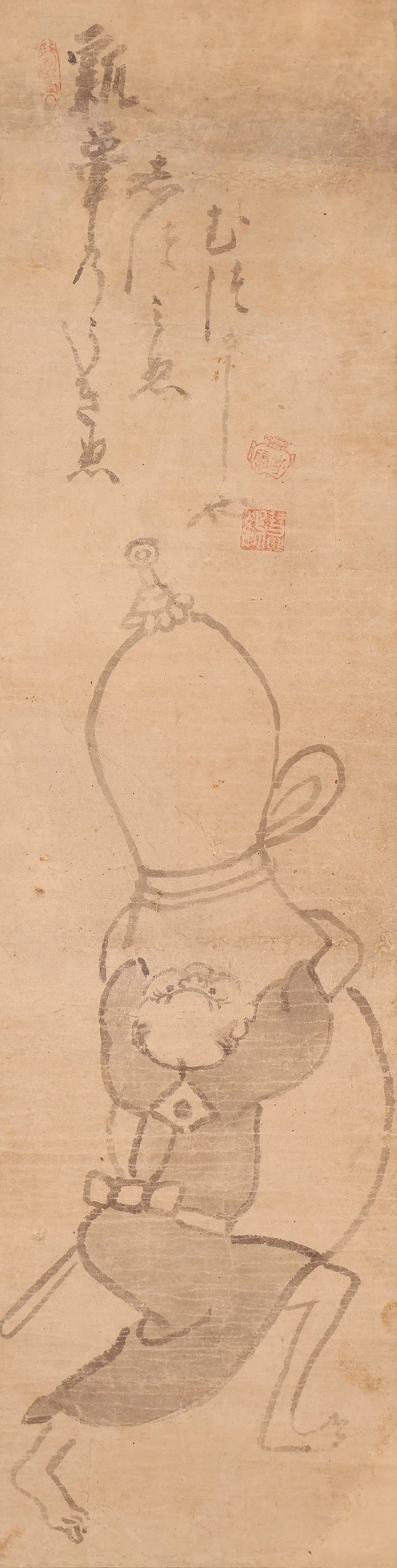
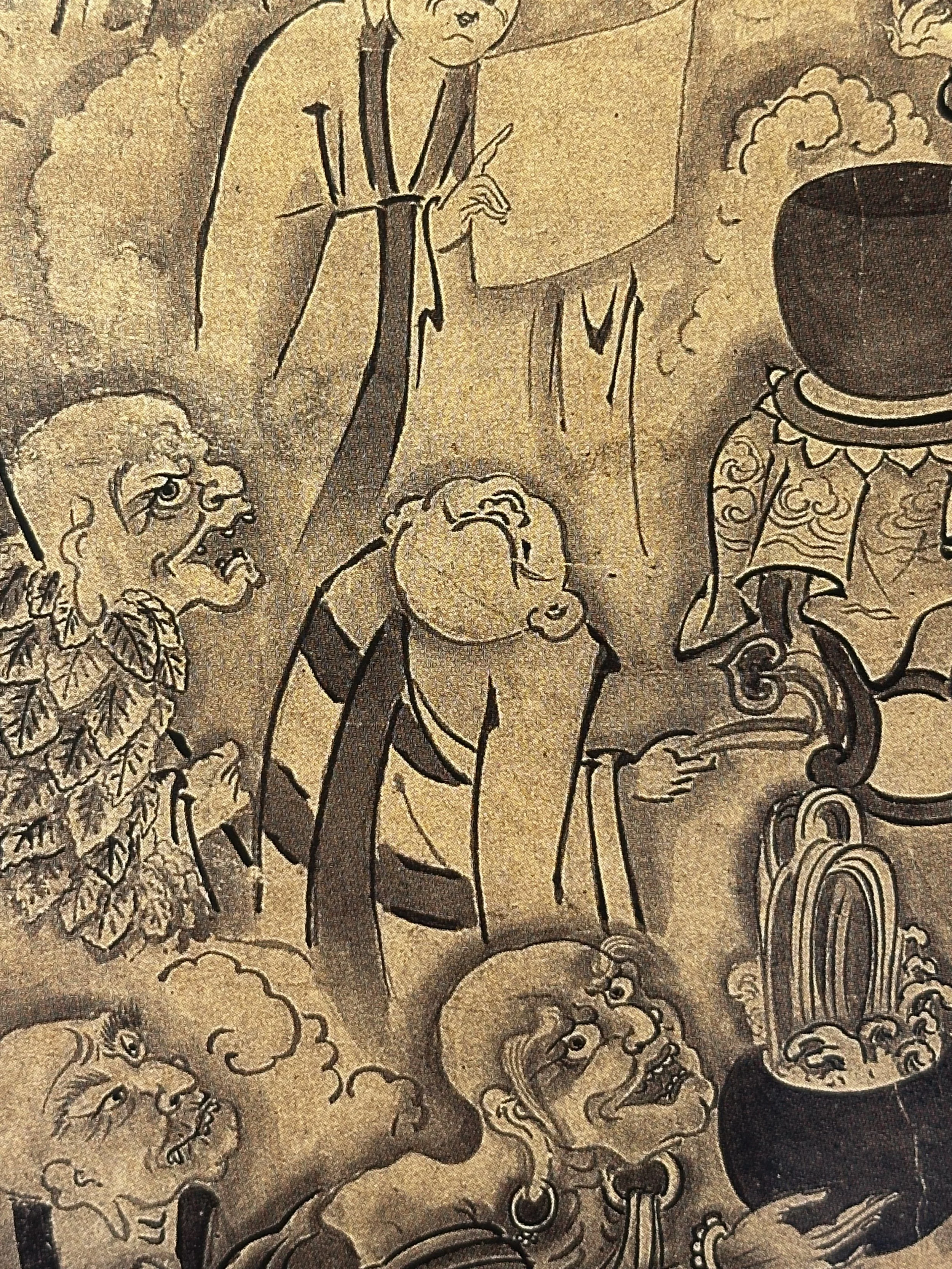
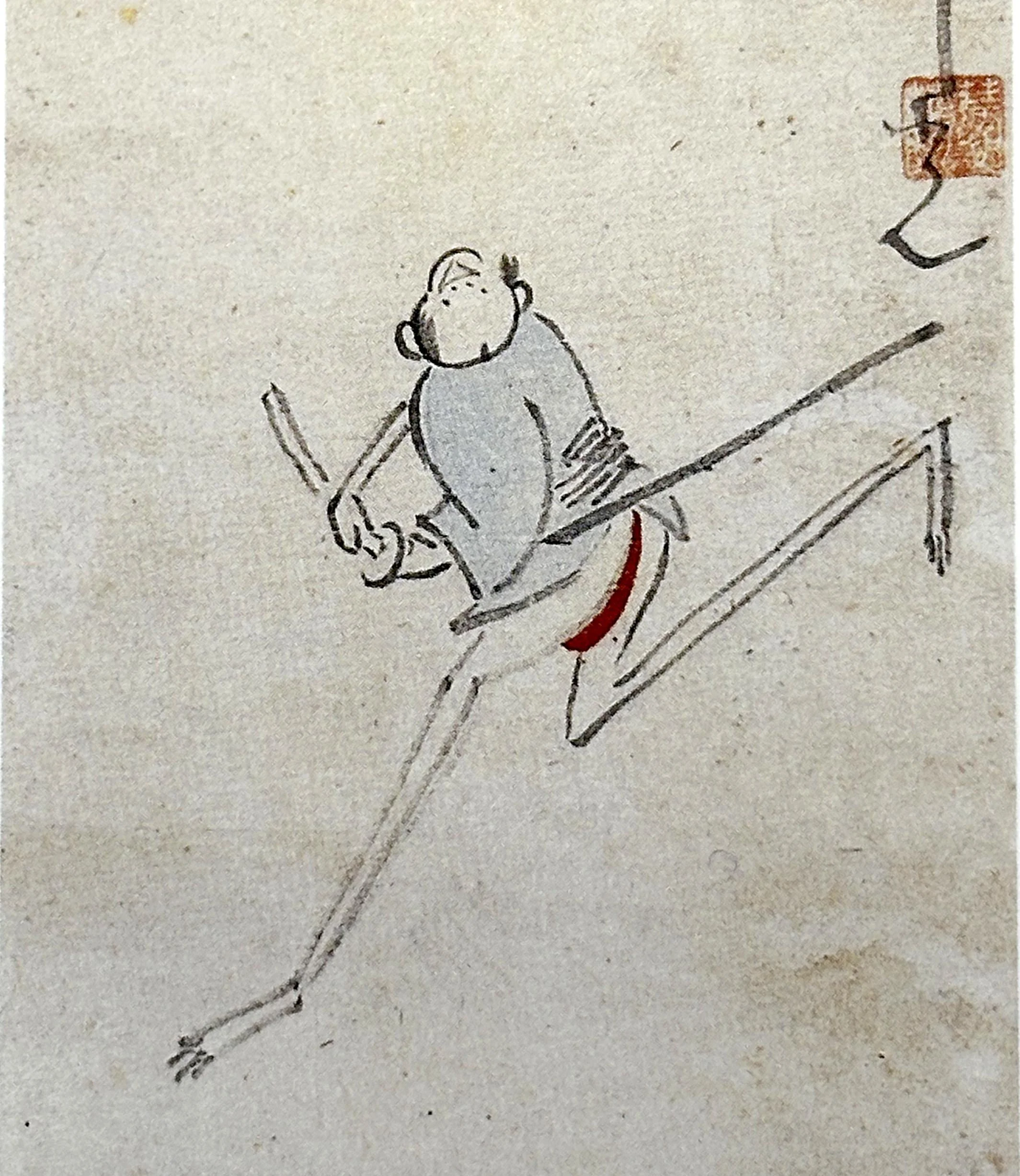
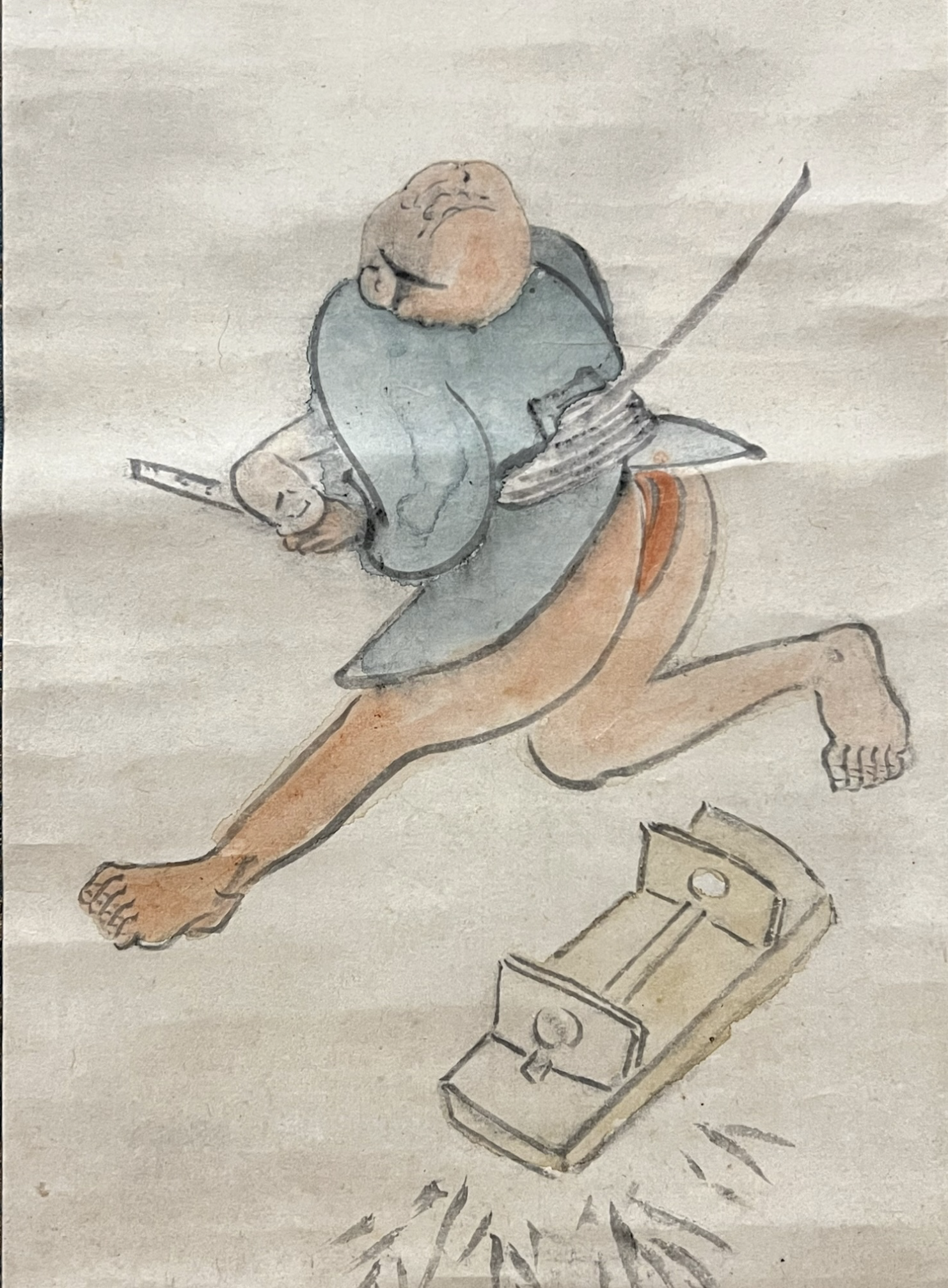
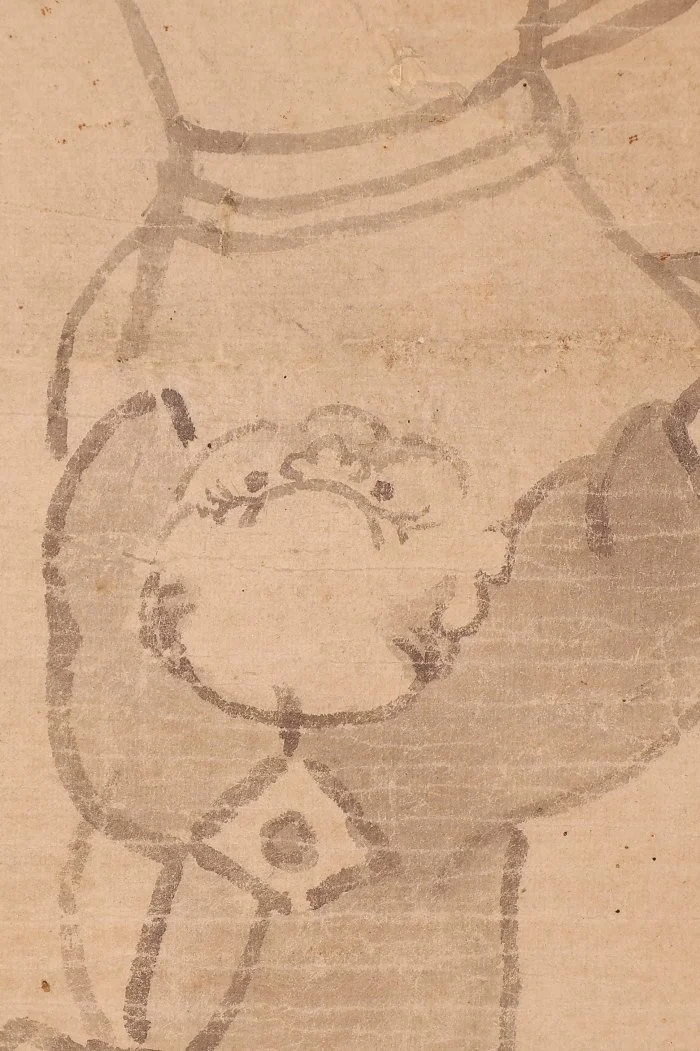
Hakuin Ekaku — Sixteen Arhats (detail), 122.0 × 48.8 cm
From Hakuin Zenga Bokuseki, ed. International Research Institute for Zen Buddhism, Hanazono University, vol. II, p. 219
In this detail from Sixteen Arhats, the shaved head is thrown sharply backward into an extreme upward tilt, the throat exposed, the skull rendered as a clean oval mass. The brow and nose are reduced to a few compressed, decisive strokes — the same economical profile logic seen in the Samurai and Gourd scroll. The structural tension lies almost entirely in that impossible rotation of the head, a reflexive anatomical exaggeration that recurs in Hakuin’s figure grammar.
Hakuin Ekaku — Spider and Carp (detail), 112.0 × 16.4 cm
From Hakuin Zenga Bokuseki, ed. International Research Institute for Zen Buddhism, Hanazono University, vol. III, p. 474
Here again the head is levered backward into an upward stare, constructed with the same minimal brow-and-nose articulation. The skull reads as a single oval unit, while the body twists beneath it in angular tension. The resemblance to the Samurai and Gourd figure extends beyond the head: the strained torso and sharply angled leg create a comparable sense that the entire body is being pulled by the head’s upward thrust.
Matsumoto Shōeidō Gallery
Hakuin Ekaku – Spider and Carp
Hanging scroll
Color on paper
124.6 × 17.5 cm
In this late work, inscribed “Hakuin, aged seventy-nine,” the figure’s head is again levered backward into an upward stare, formed with the same spare brow-and-nose articulation. The skull reads as a single compact oval, while the body twists beneath it in abrupt, almost comic tension. As in the Samurai and Gourd, the narrative undercuts martial seriousness: here the warrior lunges in exaggerated alarm at a descending spider, his posture heroic yet absurd. The strained torso and splayed limbs transform what might be a display of discipline into a quiet satire, suggesting that the true adversary is not external but the mind’s own reflexive fear.
Hakuin Ekaku —
Samurai Straining to Grasp a Gourd
(detail)
The head is forced backward into an extreme upward tilt, the throat exposed and the skull rendered as a single, sealed oval mass. The ear is reduced to a compact hooked form, while the brow and nose are articulated with a few compressed, decisive strokes — an economy identical in logic to the comparative examples above. As in those works, the psychological tension of the figure is concentrated almost entirely in this destabilising rotation of the head, suggesting a reflexive anatomical grammar rather than a copied pose.