Wheel of Life (Bhavacakra)
Sino-Tibetan Buddhist Painting, Qing dynasty, late 18th–mid-19th century
15 × 20 cm
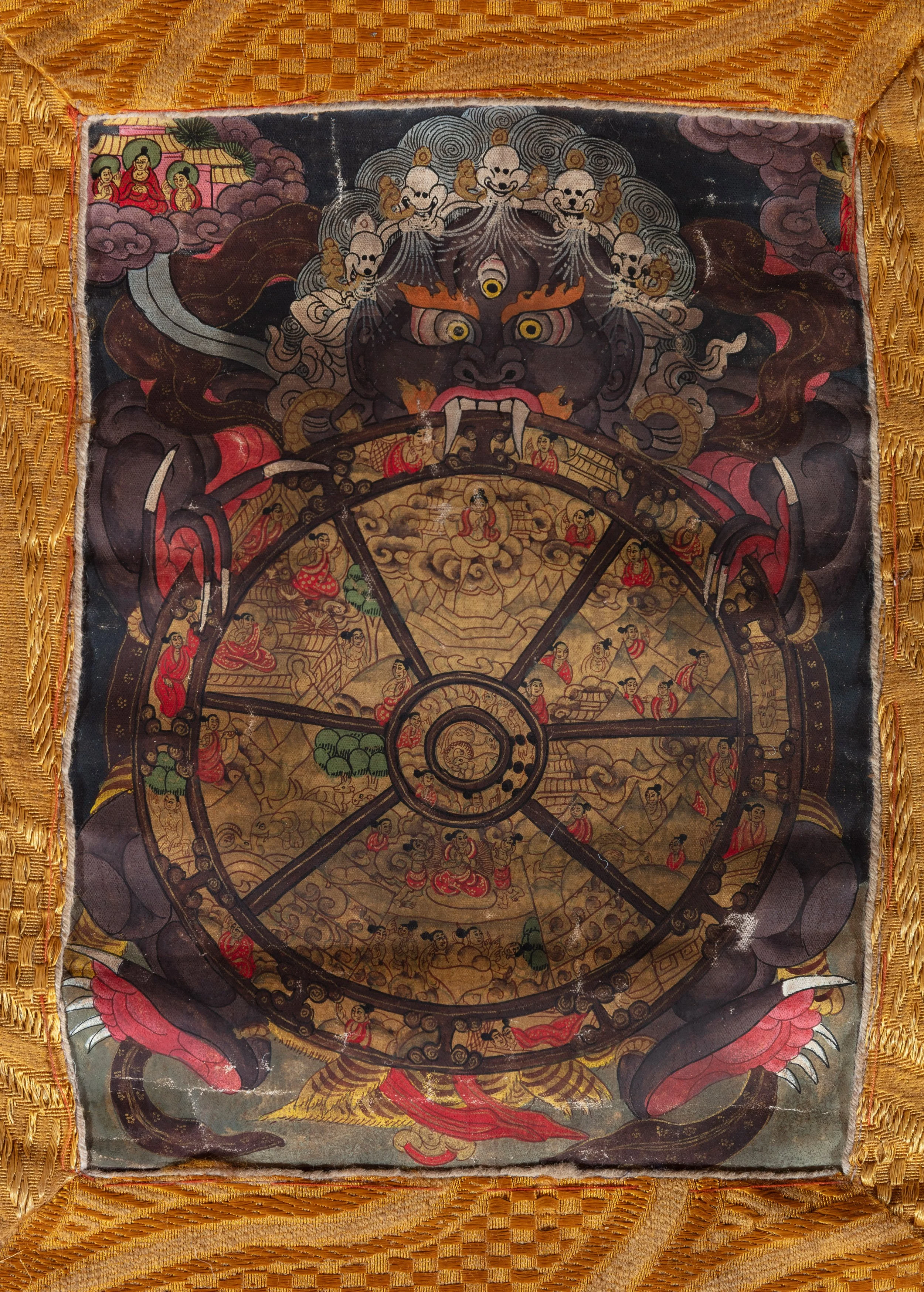
There is something quietly disarming about encountering a Bhavacakra at this scale. The subject itself is among the most expansive in Buddhist visual culture—a total map of conditioned existence—yet here it has been drawn inward, compressed into a format that sits almost within the span of the hand. Rather than confronting the viewer with spectacle, this painting invites a slower, more sustained engagement. It belongs not to the threshold of a monastery wall, where such images traditionally instruct the many, but to a more intimate sphere: the space of repeated looking, of gradual internalisation.
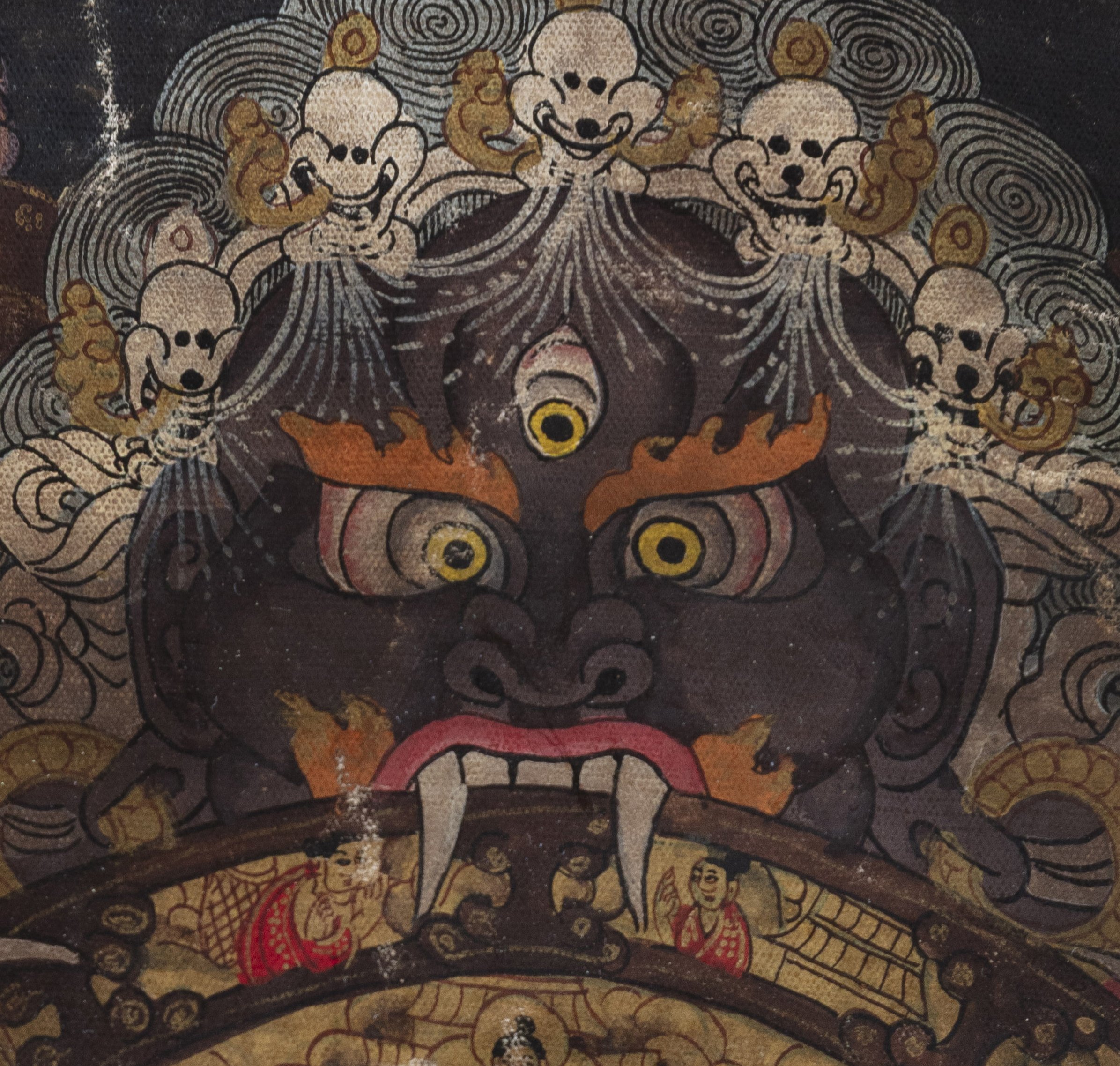
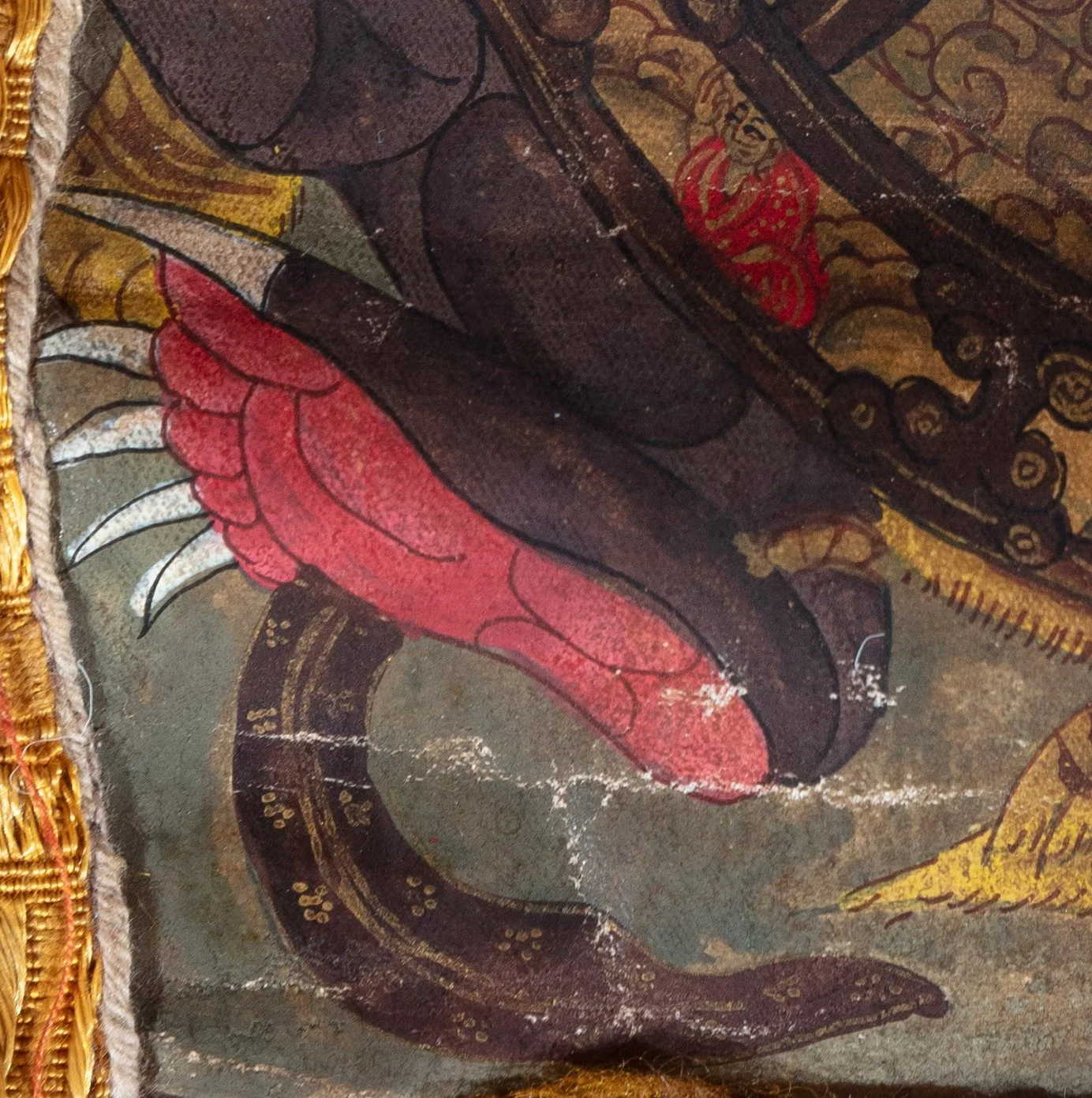
At first glance, the structure follows orthodox lines with notable fidelity. Yama, the Lord of Death, encloses the wheel with his body, his clawed hands gripping the rim while his jaws hover above it. Yet even here, there is a particular character to this rendering. His face is unusually broad and frontal, with an almost mask-like symmetry. The three eyes are sharply defined, but it is the directness of his gaze that holds attention—less ferocious than in some Himalayan examples, more fixed, almost watchful. The crown of skulls is handled with a curious liveliness: each skull slightly differentiated, almost animated, their small gestures echoing the multiplicity contained within the wheel below. The swirling hair and cloud forms around his head are rendered with a rhythmic, decorative repetition, suggesting a painter trained in controlled brush patterning rather than the heavier, more volumetric modelling seen in central Tibetan works.
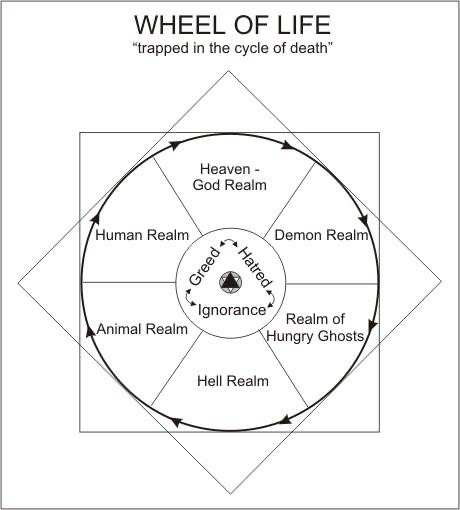
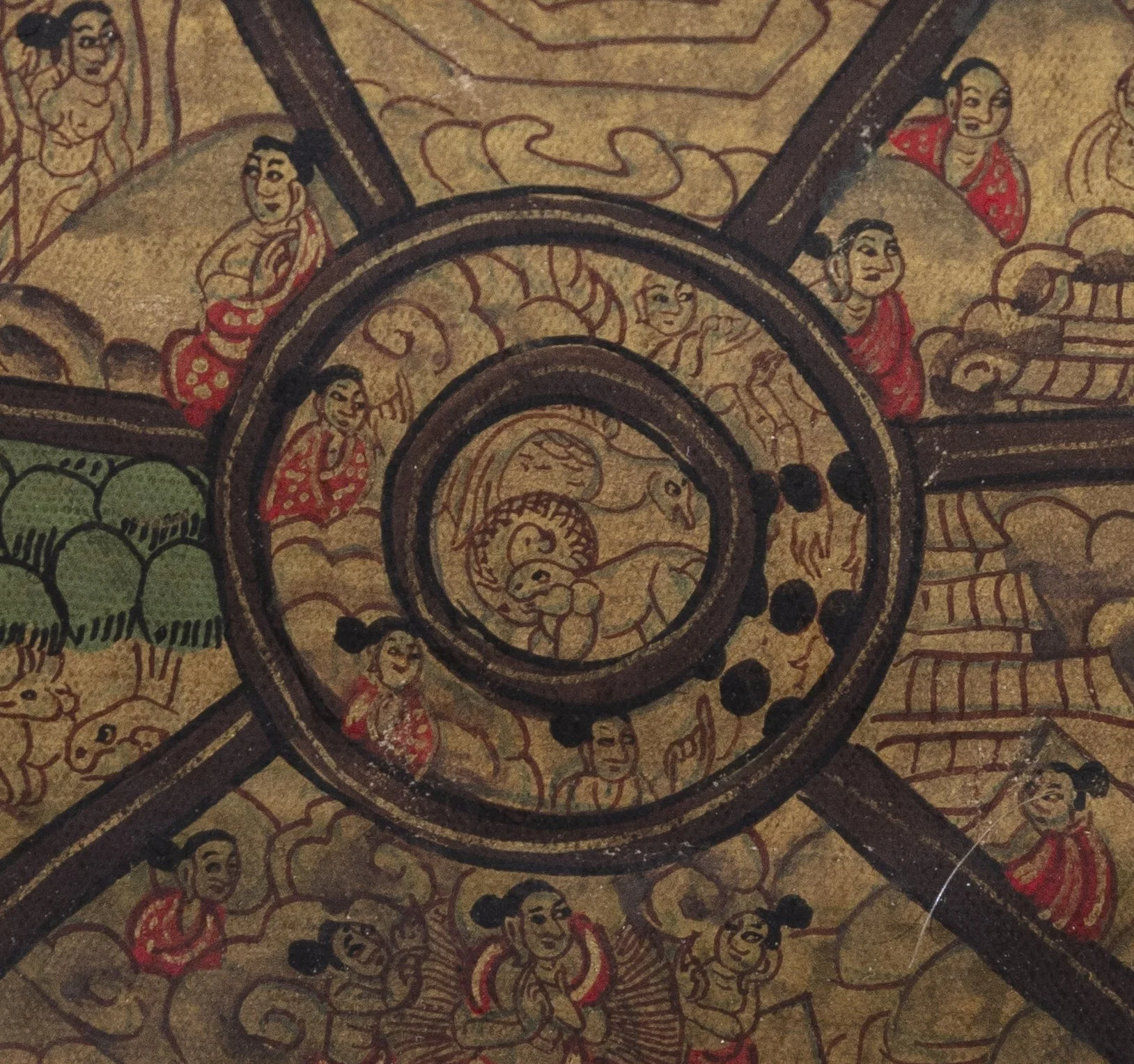
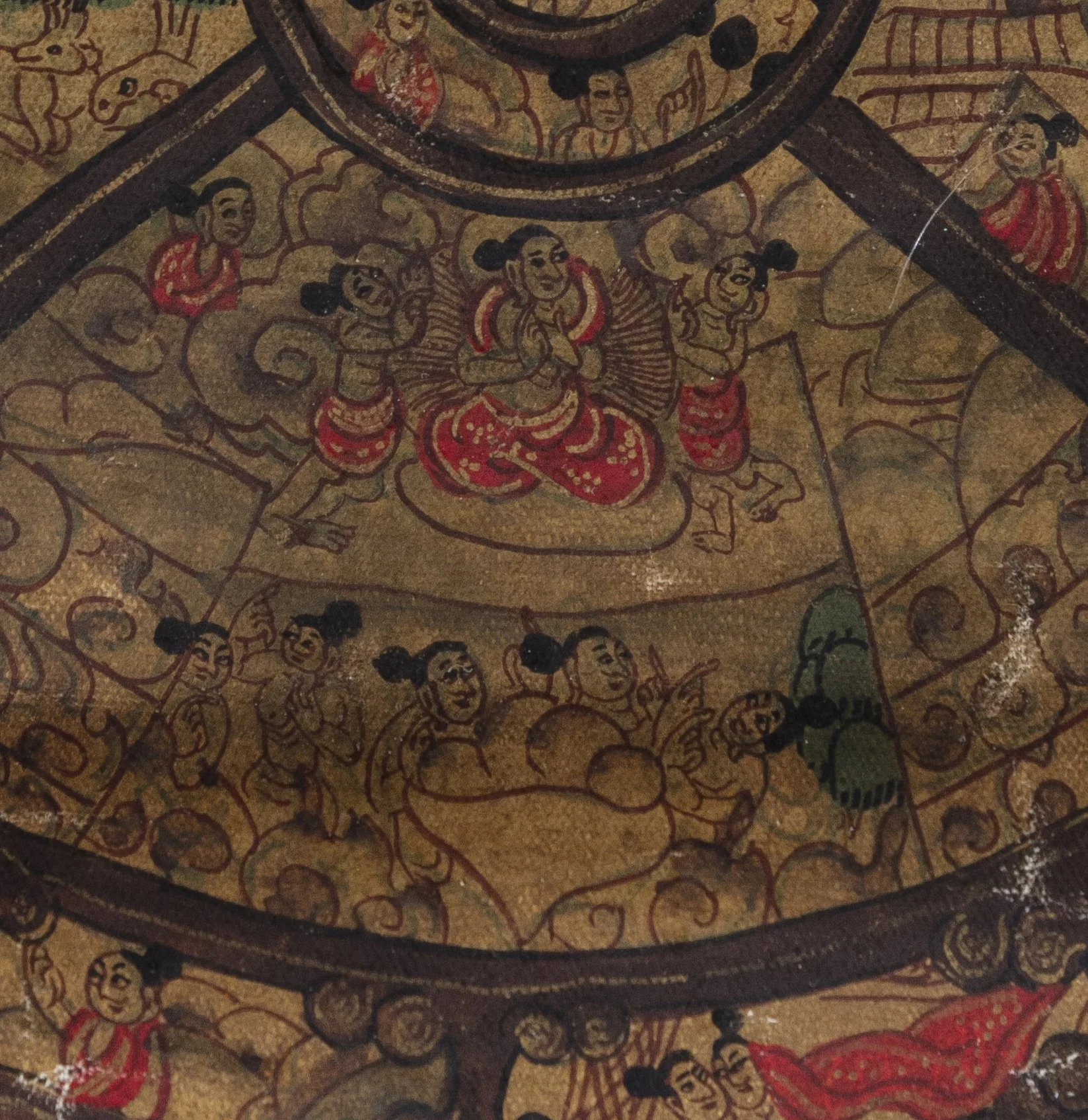
Within the wheel, the six realms unfold in carefully partitioned segments, but what distinguishes this painting is the density of narrative detail within each. The human realm, positioned prominently, is especially rich. One sees not only generic figures but scenes—gestures of offering, moments of rest, encounters that hint at the texture of lived experience. Even at this reduced scale, the painter has resisted simplification. Figures are not merely symbols; they are participants in small, unfolding dramas. In the hell realms, too, there is a restraint. The torments are present, but they do not overwhelm the composition. They are integrated into it, part of the same visual language that describes the calmer states above. This balance gives the work a certain composure. It does not dramatise suffering so much as situate it.
The outer ring of the Twelve Links of Dependent Origination is particularly impressive in this regard. These scenes, often the first to lose clarity in smaller examples, remain legible and deliberate. The metaphors—figures in action, processes unfolding—are articulated with a fine, almost calligraphic economy. There is no sense of hurried abbreviation. Instead, the painter seems to have approached each vignette as a complete unit, preserving the continuity of the doctrinal sequence without sacrificing visual coherence. It is here that one begins to feel the work less as an image to be decoded and more as a structure to be entered, the eye moving from one link to the next in a quiet, circular rhythm.
Stylistically, the painting sits at a subtle but telling intersection. The line is controlled and even, with a clarity that recalls Chinese ink discipline. Pigments are applied in thin, translucent layers, allowing the drawing beneath to remain active. The reds retain a quiet luminosity, while the gold is used sparingly, not as a field but as an accent. This restraint, combined with the compositional balance, suggests a Sino-Tibetan workshop context, likely within the Qing period when such hybrid forms were actively produced. There is a sense here of translation—not only of iconography across cultures, but of technique. The Tibetan cosmological structure is preserved, but it is articulated through a hand that has been trained to value precision, rhythm, and control.
The mounting adds another layer to this history. The brocade, with its patterned silk and narrow gold borders, speaks of a later life, most likely within Japan. Such remountings were common as Buddhist paintings circulated beyond their original contexts. The object, in other words, has already travelled—geographically and culturally—before arriving here. Its current form is not a fixed origin but an accumulation of care, adaptation, and continued use.
There are, of course, signs of age. Areas of abrasion, small losses of pigment, a general softening of the surface. Yet these do not disrupt the image so much as temper it. The painting has not become fragmentary; it has simply settled. The colours have quietened, the contrasts eased. What remains is a coherent, balanced whole, still entirely capable of sustaining attention.
And perhaps this is where the work reveals its deeper character. Despite its subject—the endless cycle of birth, death, and rebirth—it does not press itself upon the viewer. It does not insist. Instead, it holds its structure with a kind of calm certainty. The entire cosmos is present, fully articulated, yet contained within a modest frame. One can return to it repeatedly, tracing the same paths, noticing different things, allowing its logic to unfold over time.
In that sense, it fulfils its purpose not through impact, but through duration. It is an image that becomes clearer not in a single viewing, but in many.