Kano Eisen Hisanobu (1696–1731)
Tiger and Dragon (Ryūkō-zu)
Ink on paper, mounted as a pair of hanging scrolls, each 213 × 66 cm
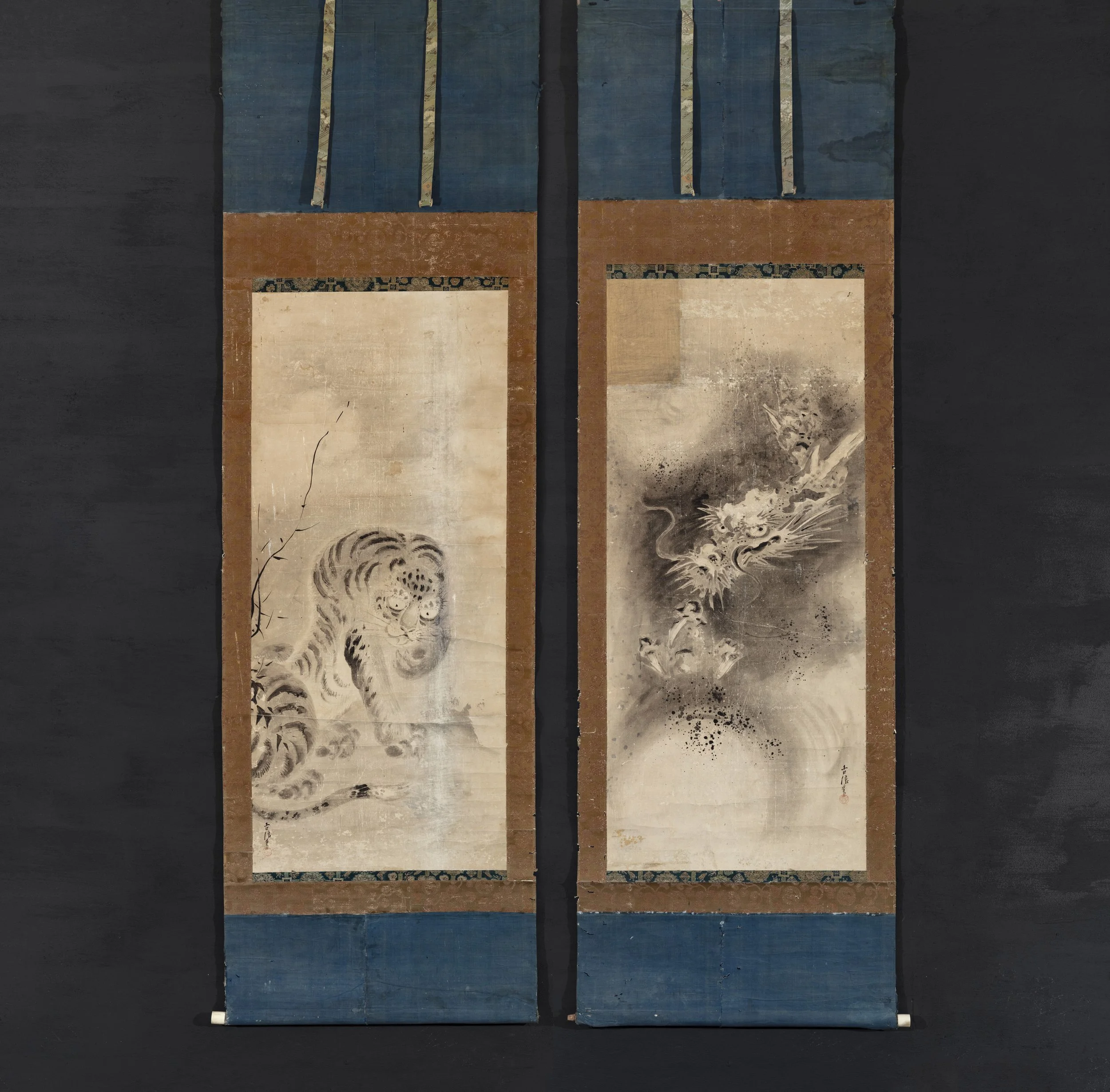
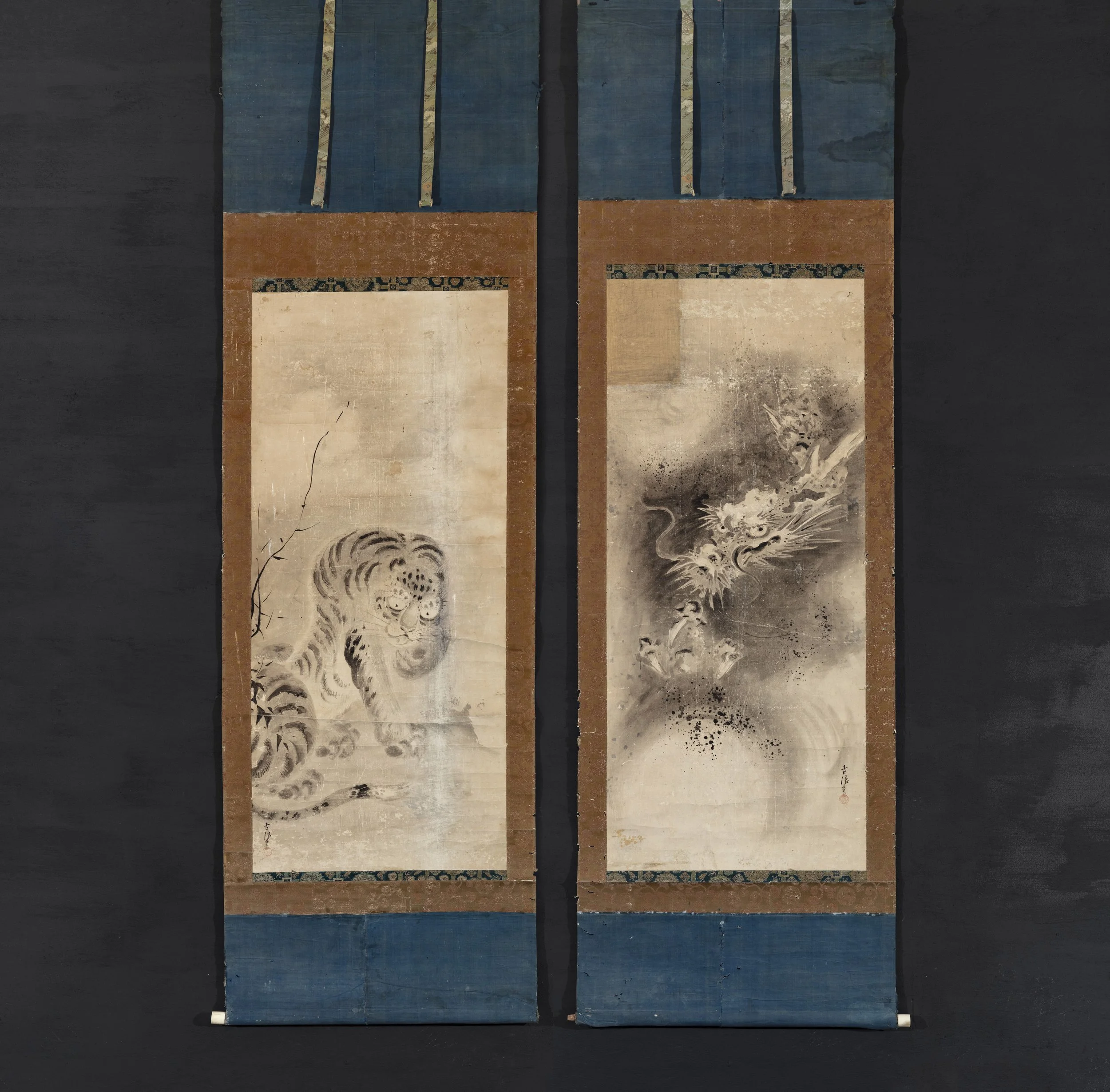
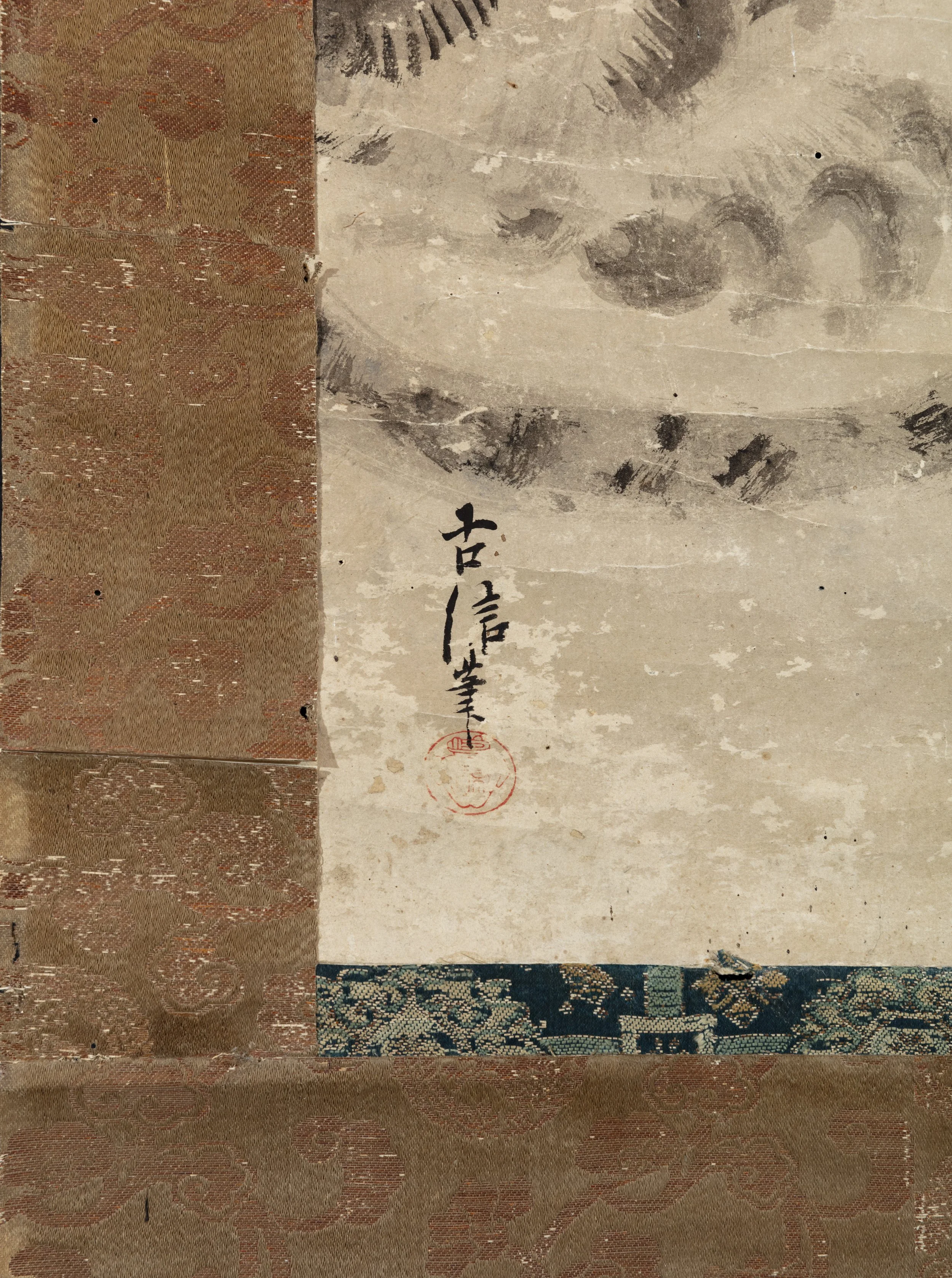
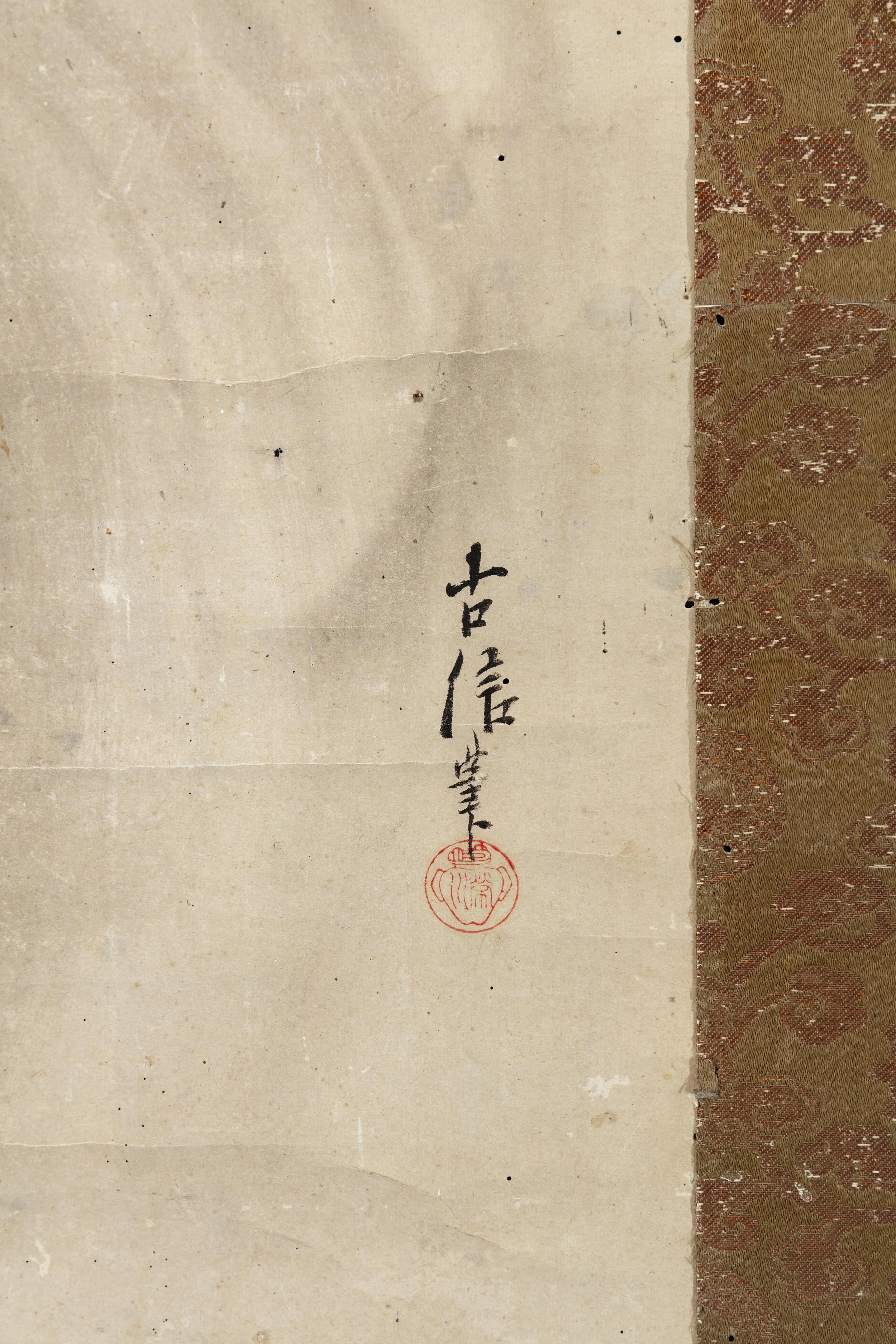
Signed Koshin hitsu and bearing Hisanobu’s round Hōgen seal, this rare dragon-and-tiger diptych belongs to the world of the Kanō school at a moment when its authority still shaped elite painting across Japan. The Kanō school had dominated Japanese painting from the late Muromachi period into the Edo era, sustaining both monumental decorative production and the monochrome brush traditions derived from Chinese models. By the seventeenth century, it had divided into several branches, but the Kyoto and Edo lineages remained the principal bearers of a highly disciplined studio language built on transmission, copying, and refinement across generations.
If the seal does indeed point to Eisen Hisanobu (英川古信, 1698–1731), the pair sits close to a very specific historical juncture within that lineage. Hisanobu succeeded Kanō Tsunenobu as head of the school in 1728, only a few years before his early death in 1731. His son Michinobu, later one of the most important eighteenth-century Kanō painters, inherited that position as an infant. That chronology gives works associated with Hisanobu a particular interest: they belong to a brief, transitional moment between the mature seventeenth-century Kanō inheritance of Tsunenobu and the ambitious eighteenth-century revival carried forward by Michinobu.
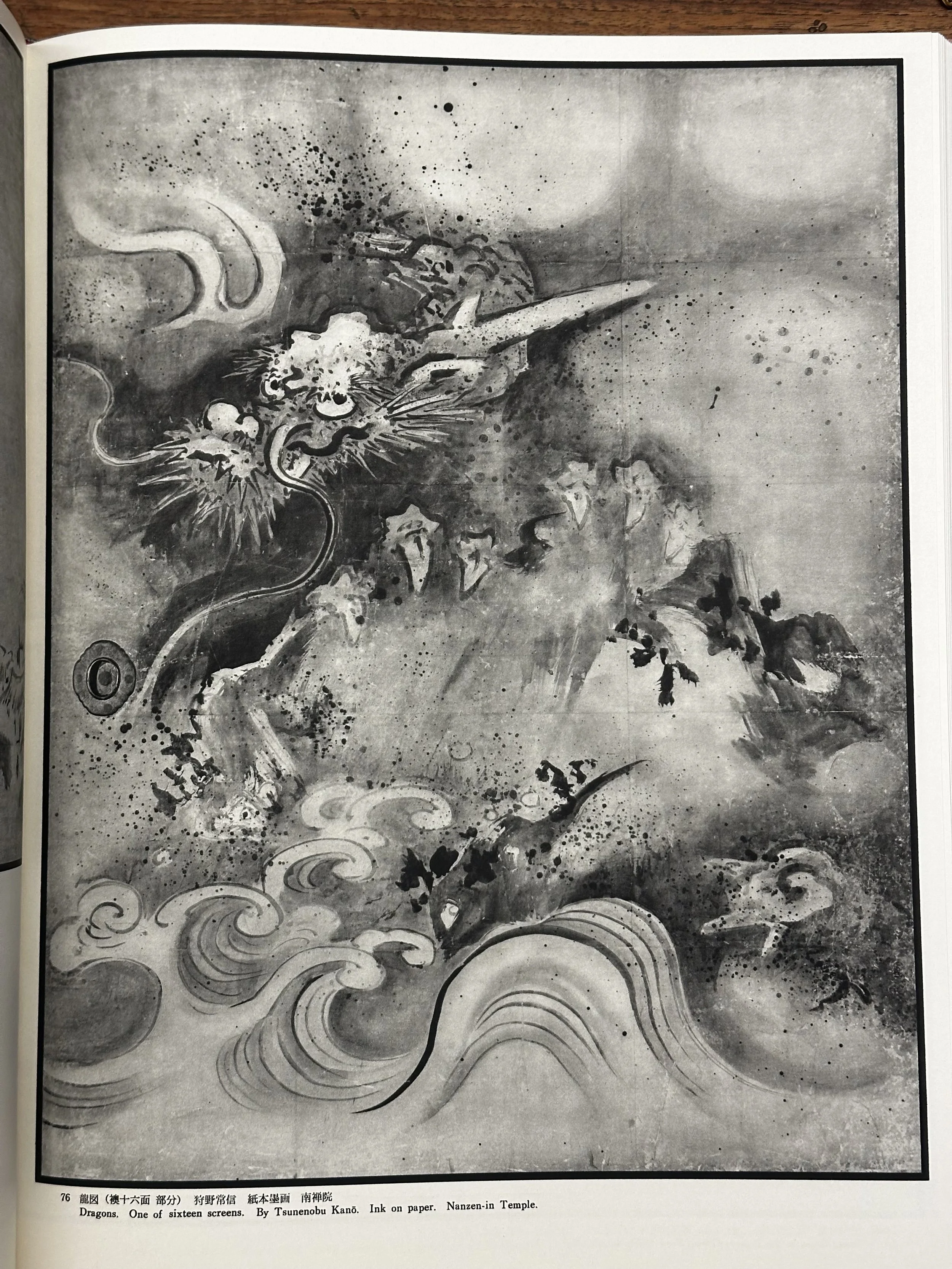
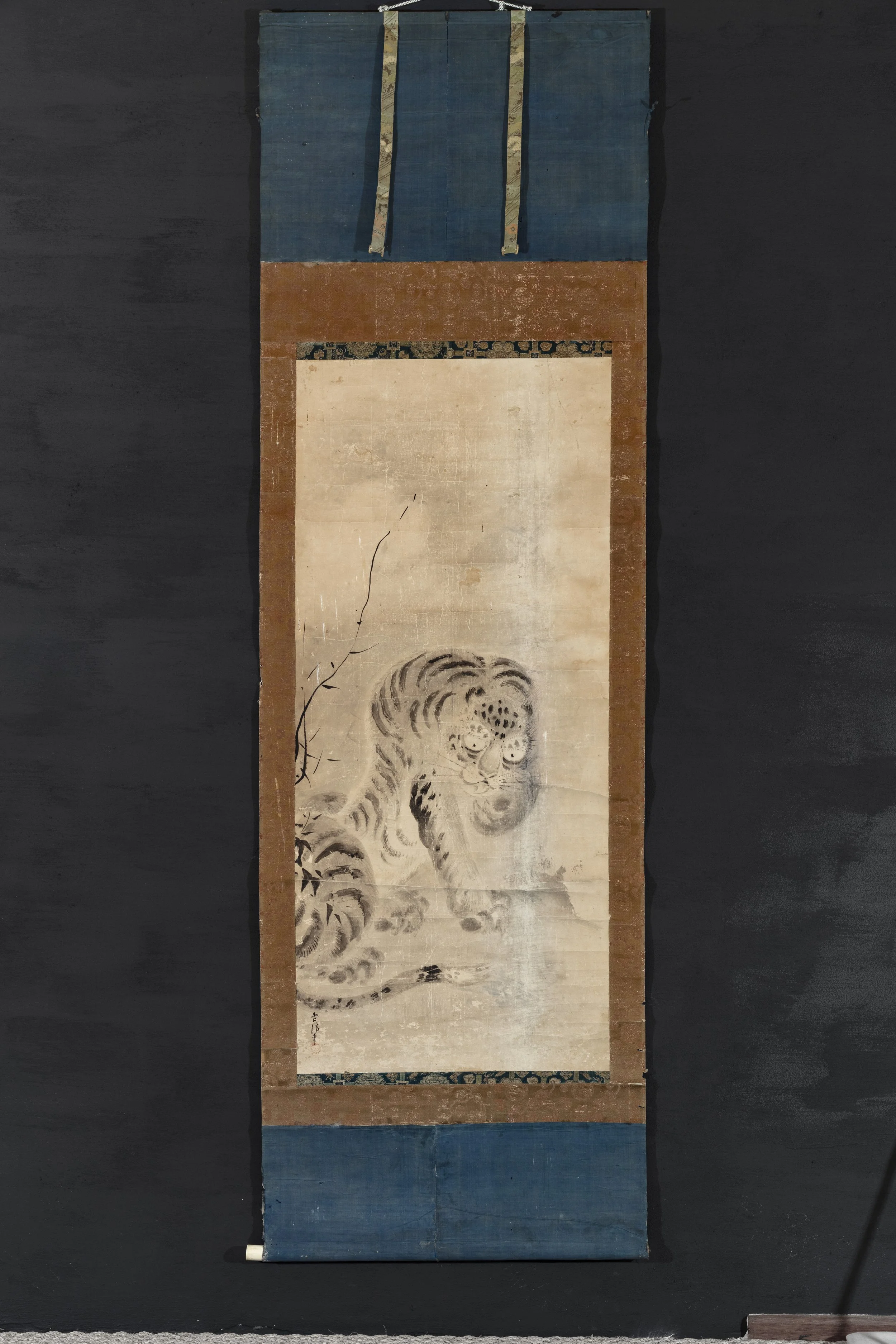
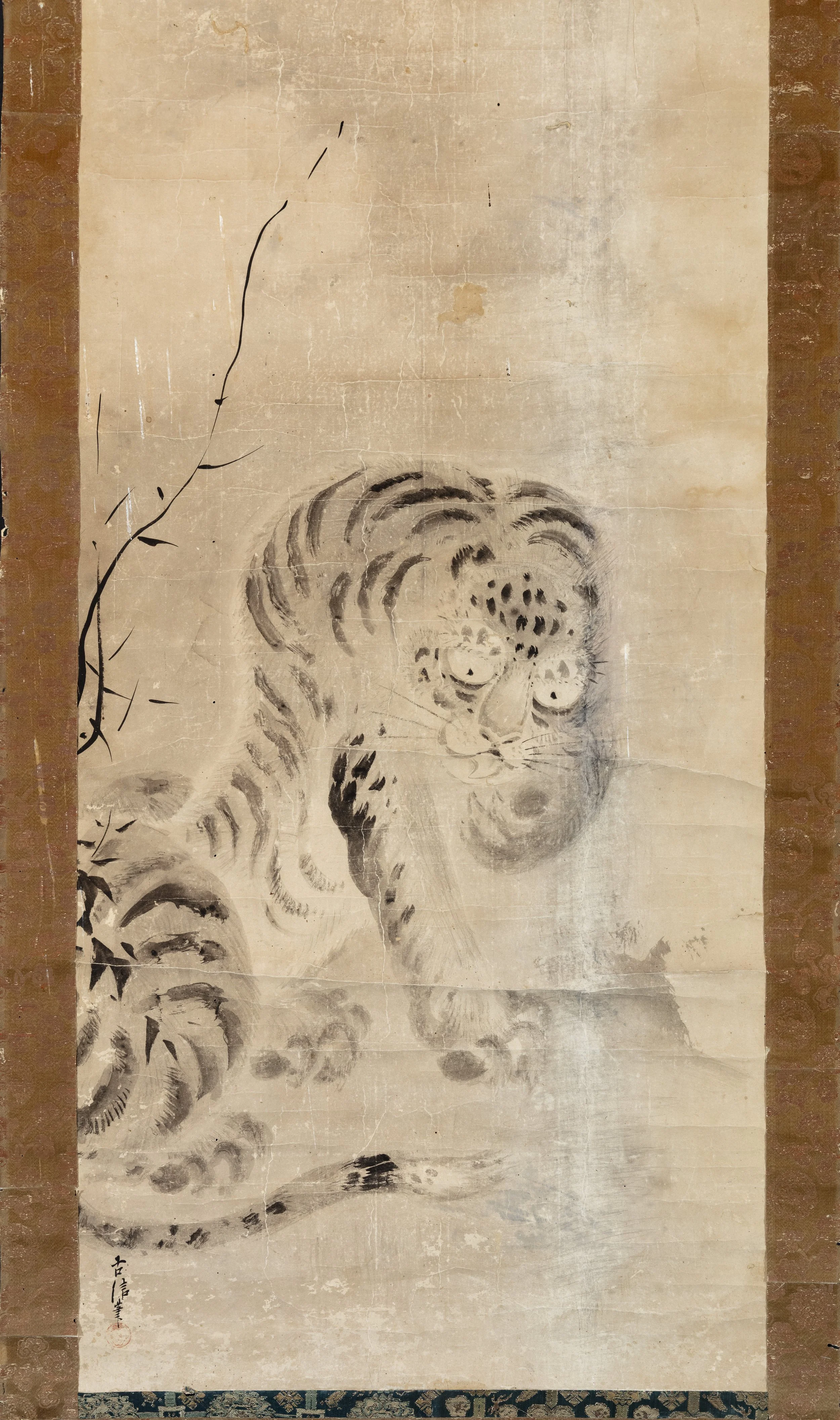
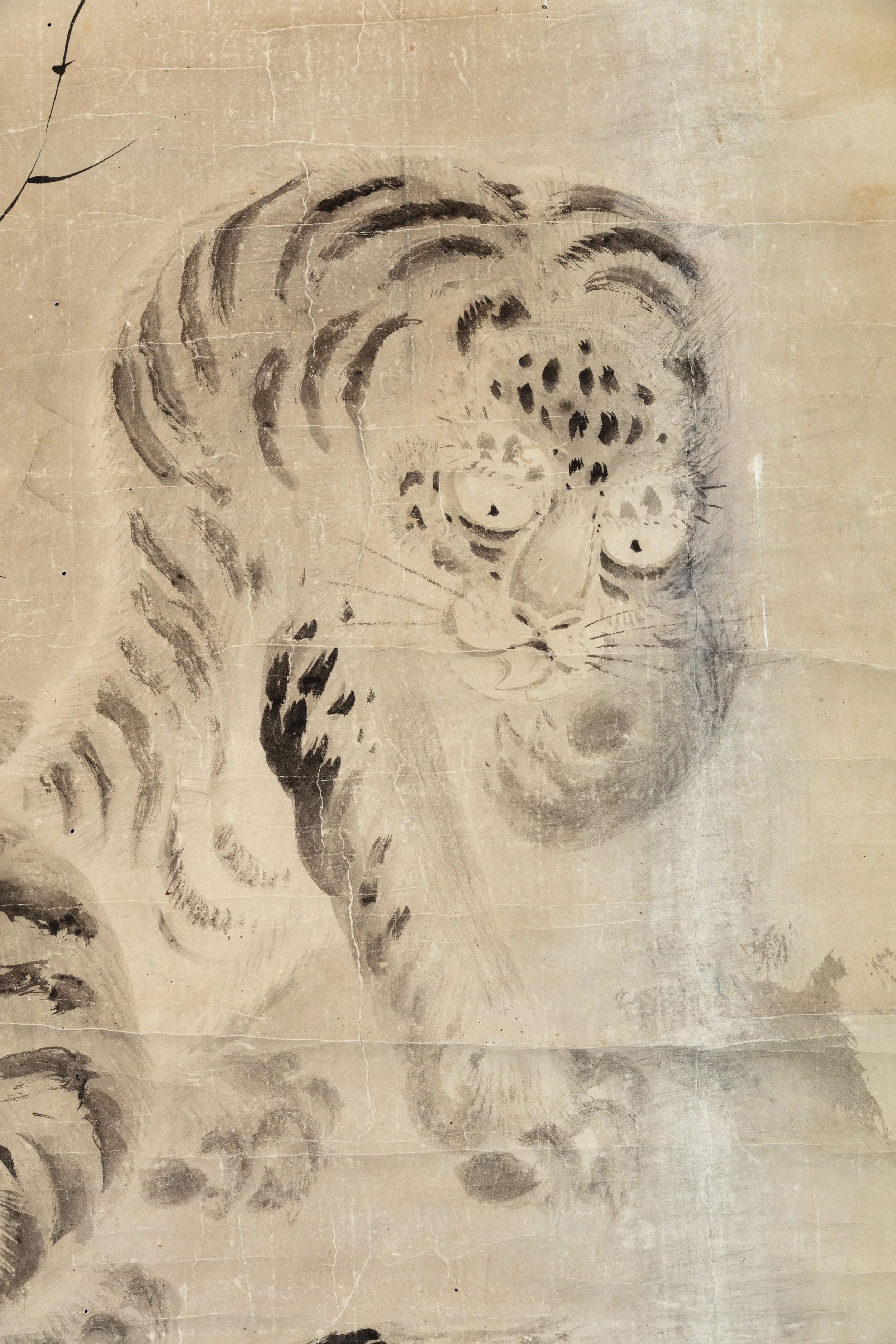
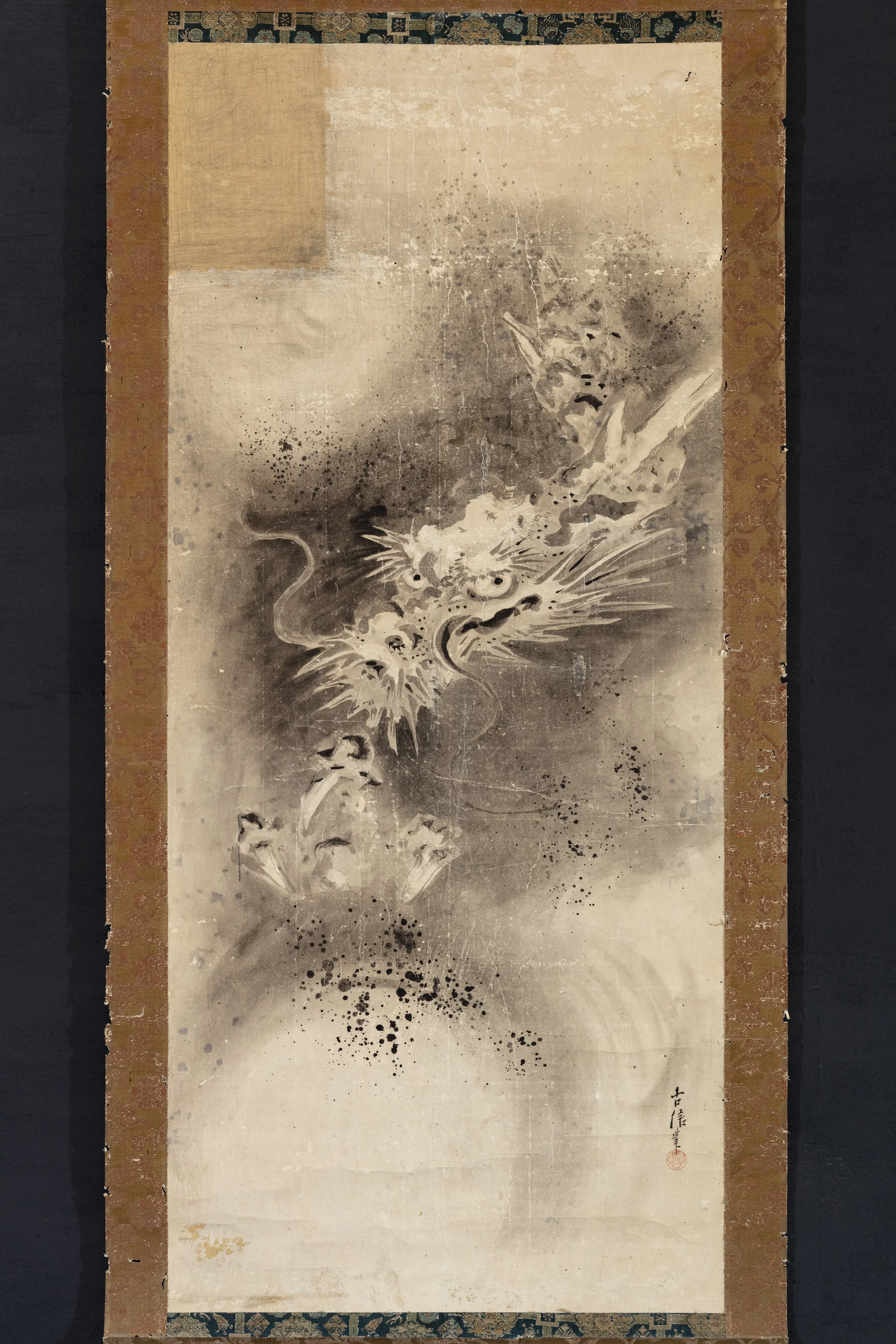
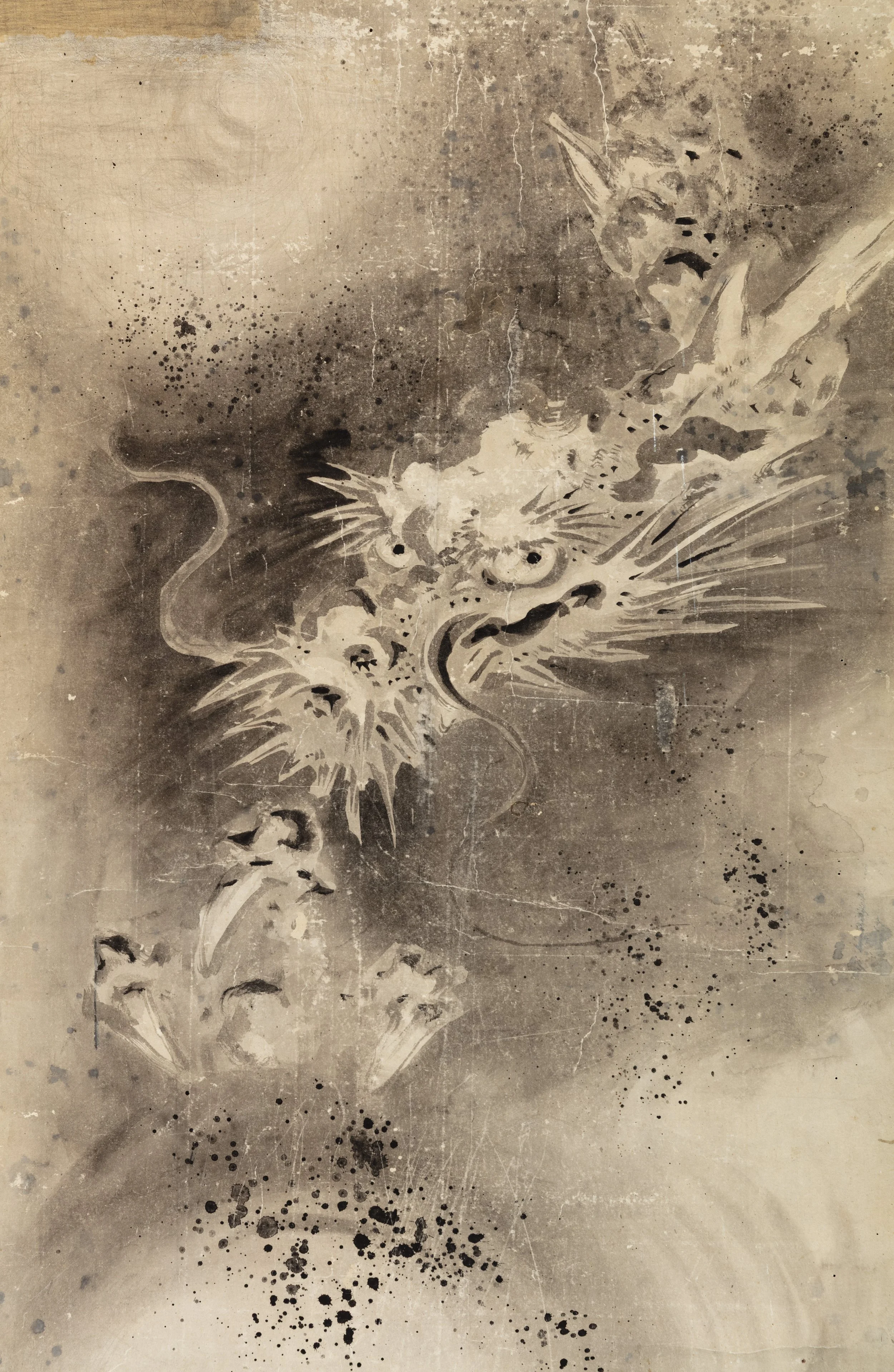
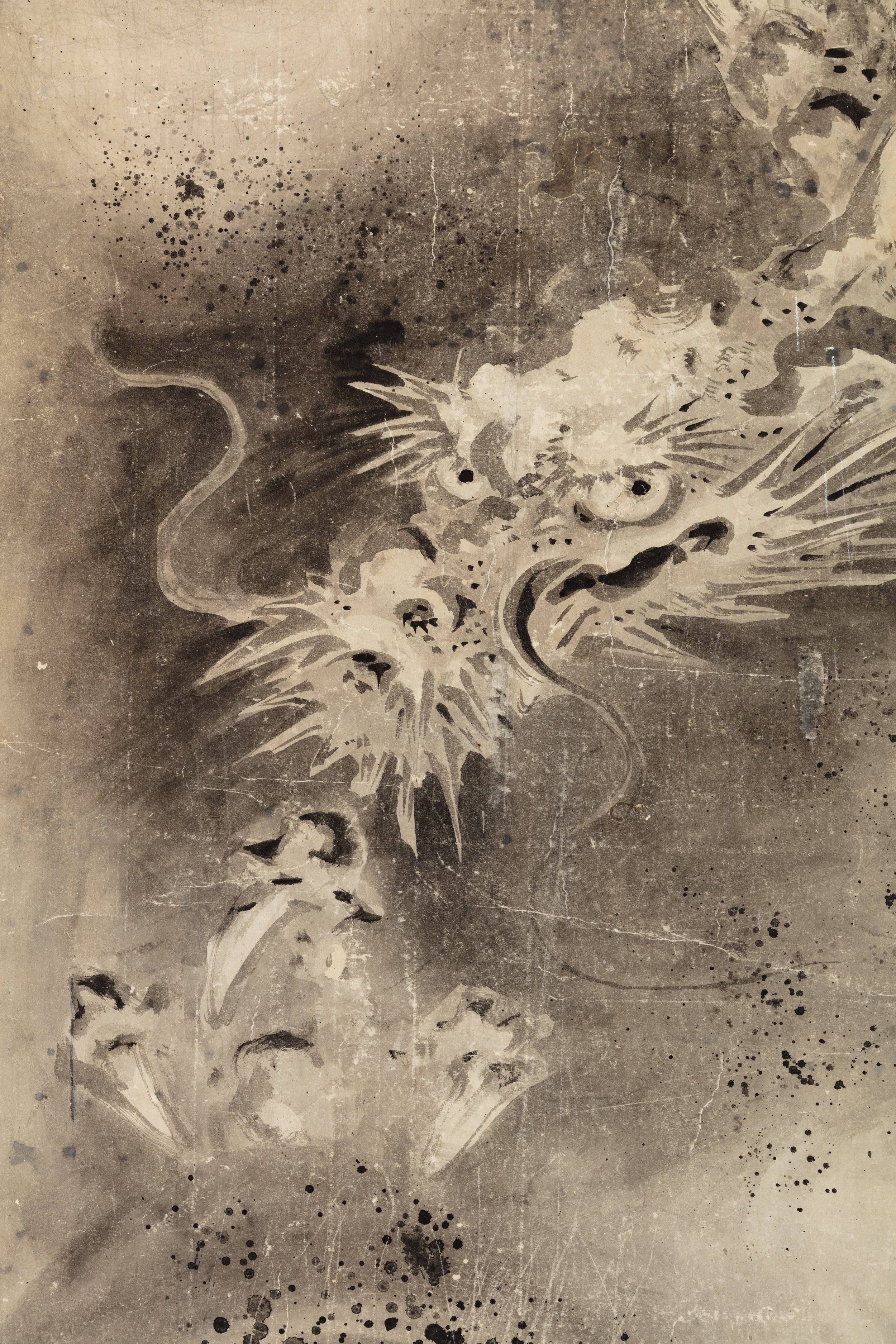
The subject itself is canonical. Dragon and tiger pairings had long served as one of the great testing grounds of East Asian brush painting, and in Japan the Kanō school made the theme central to its own identity. The contrast is both pictorial and cosmological: dragon and tiger, heaven and earth, vapor and muscle, volatile ascent set against grounded force. In the best Kanō treatments, the pair is not merely emblematic but structural, allowing one image to answer the other through temperament, stroke, and spatial logic. Here that dialogue is exceptionally clear. The tiger is weighty, frontal, and watchful, its mass built from broken stripes and softened washes. The dragon is all disturbance—thrusting diagonally through cloud and spray, its head emerging from atomised ink and reserve brushwork with startling force.
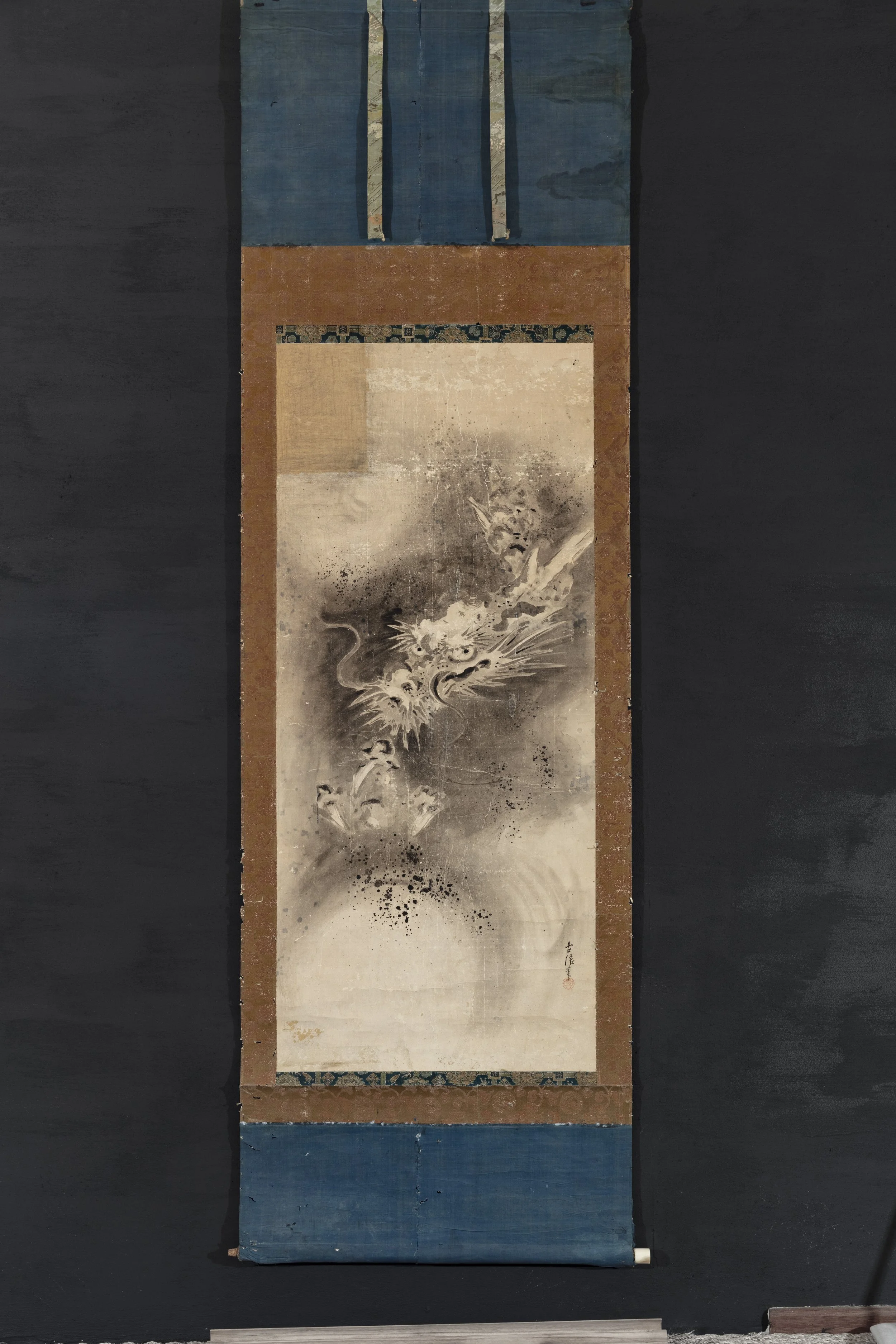
The dragon scroll is, to my eye, the stronger of the two and one of the more compelling ink paintings in the collection. Its power lies not in finish but in conviction. The head is constructed through abrupt contrasts of soaked wash, dry cutting line, and unpainted reserve, while scattered ink droplets and pooled tonal passages create an atmosphere of electrical instability around the form. The handling recalls the Kanō ability to let accident and control meet productively: splashed ink is never merely decorative, but becomes weather, pressure, and spatial vibration. In this respect the painting stands close in spirit to the great Kanō dragon tradition associated with artists such as Tsunenobu, whose work often occupies the difficult ground between inherited formula and genuine painterly urgency. Tsunenobu himself succeeded Tan’yū as head of the school in 1674 and is now understood to have been one of the most important transmitters of the mature Kanō idiom into the late seventeenth century.
The tiger scroll is quieter but no less necessary to the pair. Its role is not to rival the dragon’s volatility but to stabilize the diptych. The animal emerges through softer contour, rubbed wash, and broken stripes that seem to breathe rather than proclaim themselves. The face, with its rounded eyes and slightly dazed, inwardly focused expression, avoids theatrical ferocity. Instead, it offers density, gravity, and a kind of earthly alertness. This asymmetry is one of the pair’s strengths. The two images are not equivalents; they are complements. The tiger grounds the ensemble and makes the dragon’s violence legible.
What is especially remarkable is their survival in what appears to be an early Edo-period mounting, complete with the deep indigo upper and lower sections and the old brocade borders. Mountings of this age were inherently vulnerable, and many paintings of comparable date were remounted, cropped, or visually altered over the centuries. Here, despite pronounced wear, abrasion, creasing, and losses, the original format still communicates with unusual clarity. The indigo silk gives the pair a formal dignity that is completely in keeping with Kanō taste, while the weathering itself has become part of the object’s historical truth. These are not pristine survivals; they are aged working paintings that have carried their own time visibly. That matters.
Indeed, part of the force of the pair lies in this very conjunction of condition and authority. The surfaces are heavily worn, and yet the images still project with extraordinary directness. The dragon has lost none of its charge. The tiger, for all its faded softness, retains its composure. One is reminded that Kanō painting was never only about polished finish. At its best, it rests on a command of structure so secure that even damaged works can continue to hold the eye through rhythm, balance, and the internal logic of brushwork.
Seen together, these two scrolls provide a valuable witness to the persistence of the Kanō mainline aesthetic after the high age of Tan’yū and Tsunenobu. They show how deeply the school’s central themes—paired forces, disciplined monochrome, tension between formula and improvisation—remained alive in the early eighteenth century.If the Hisanobu association is correct, they also preserve something rarer: an unusually intact glimpse of a brief and historically compressed generation within the school’s transmission. For that reason, and for the sheer authority of the dragon in particular, the pair deserves to be taken very seriously. What distinguishes the dragon is not simply competence within a known formula, but a kind of concentrated clarity—an immediacy of execution in which each stroke appears both inevitable and fully resolved. This quality, which might be described as a sudden coherence or “thunderclap” of understanding within the brush, is exceedingly difficult to imitate convincingly. Later or derivative works often reproduce the outward vocabulary of the Kanō school, but rarely sustain this level of internal energy and engagement across the image. In this case, the combination of structural confidence, tonal control, and expressive force strongly suggests a hand working from within the tradition rather than at a remove from it, making it more plausible that the work belongs close to the period and artist to whom it is attributed.