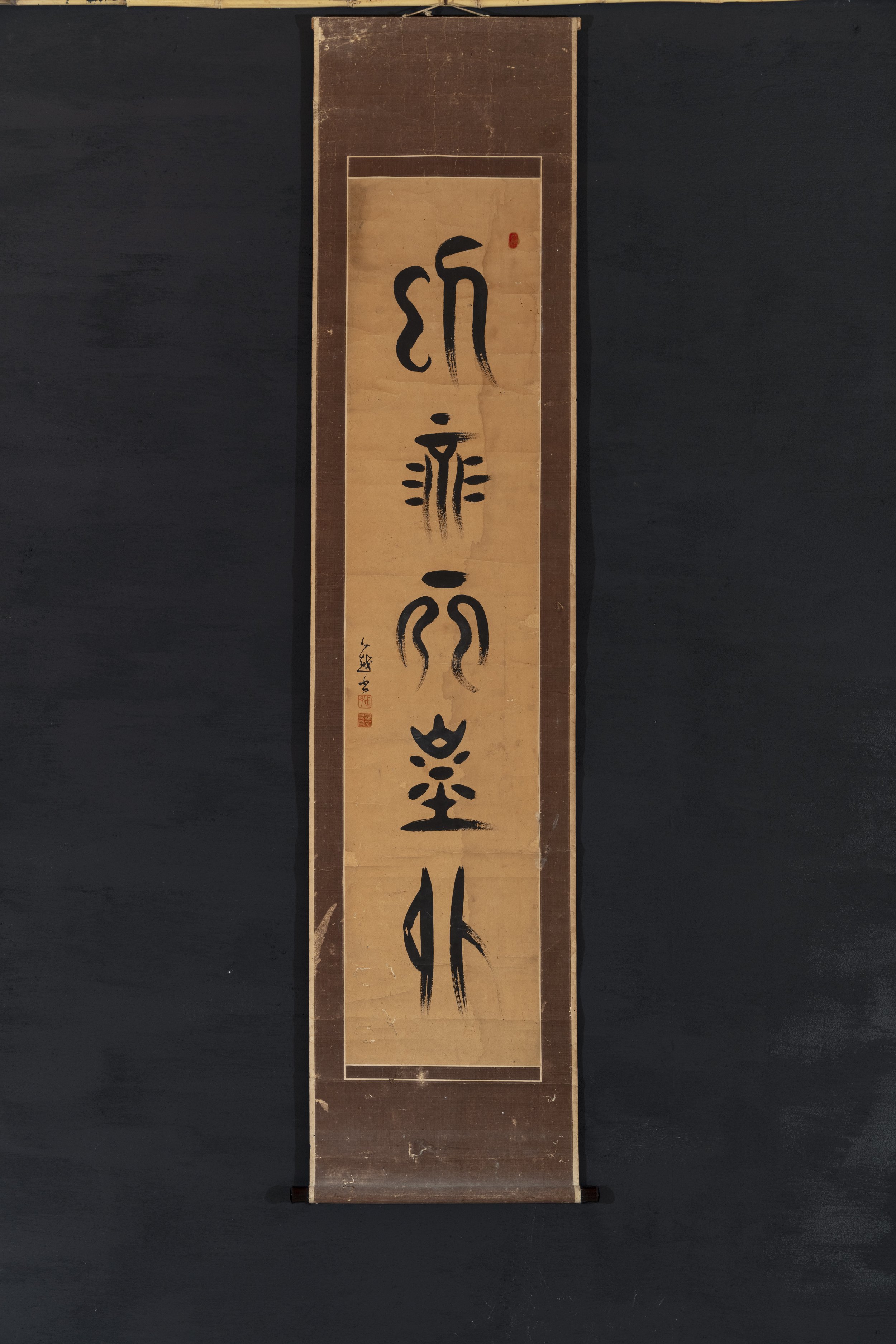
Water Flows to the Boundless Sea
Tōgō Shin’etsu (Donggao Xinyue, 1639–1696), late 17th century
Ink on paper, mounted as a hanging scroll
180 × 40.5 cm (overall); 135 × 29.5 cm (image)
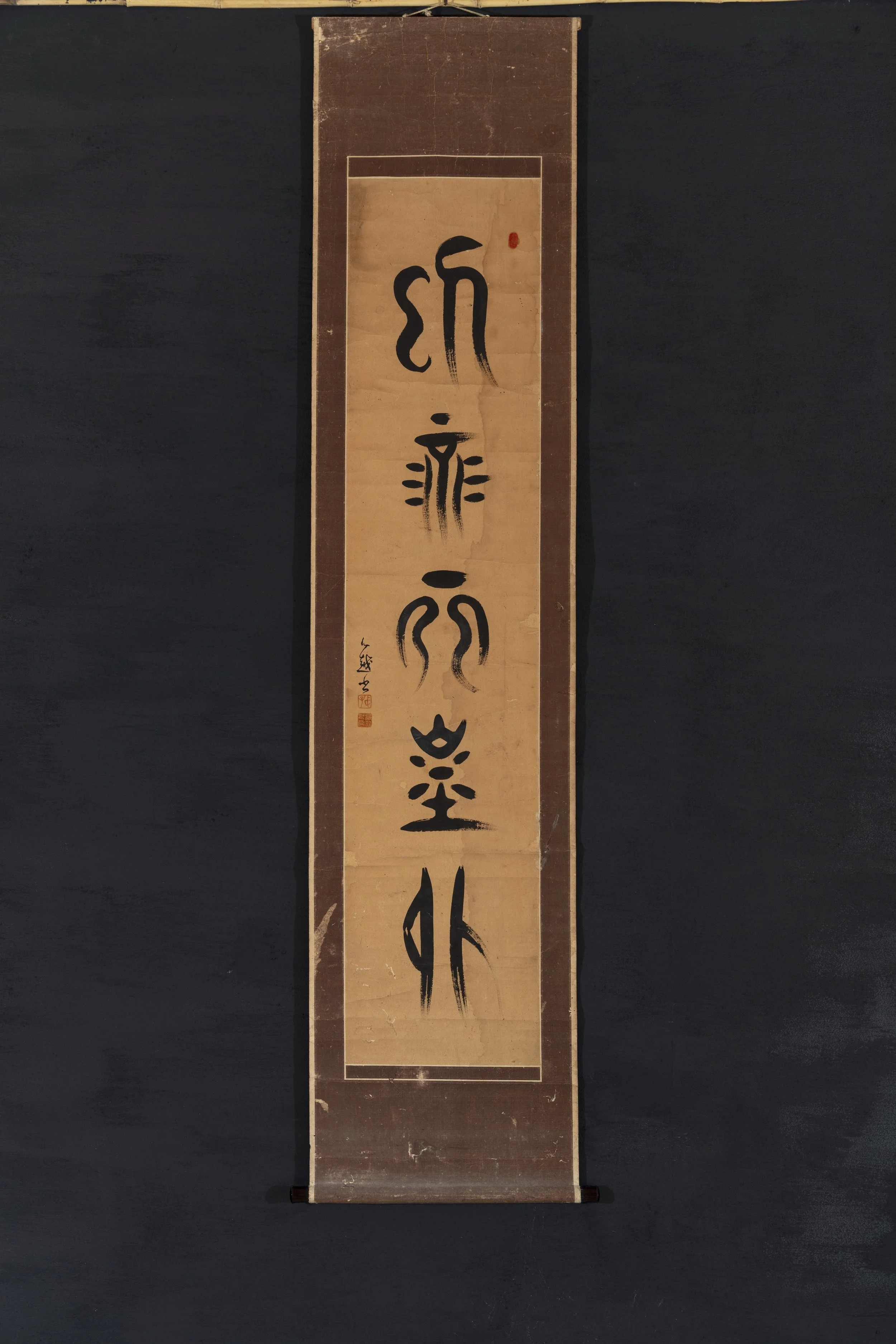
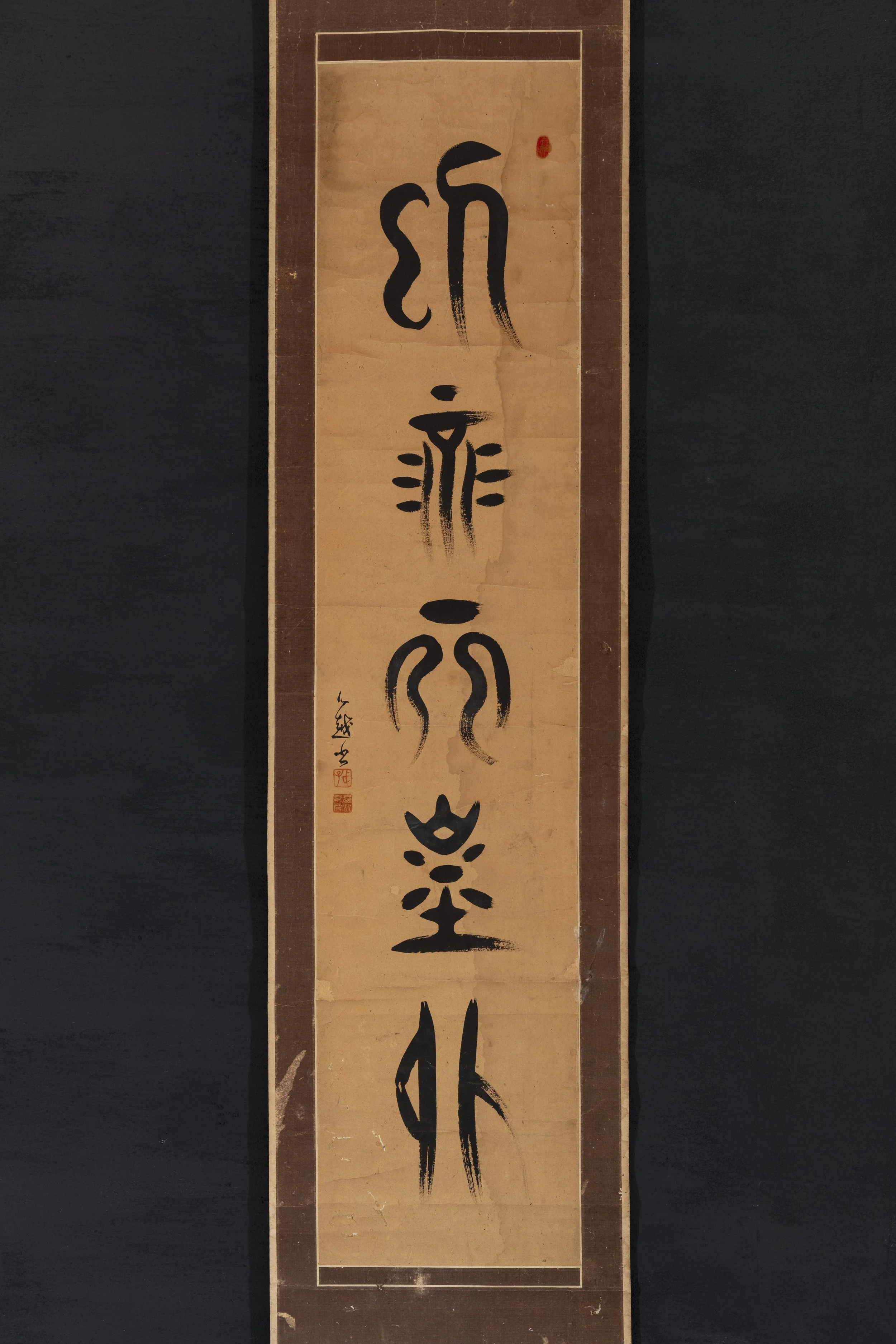
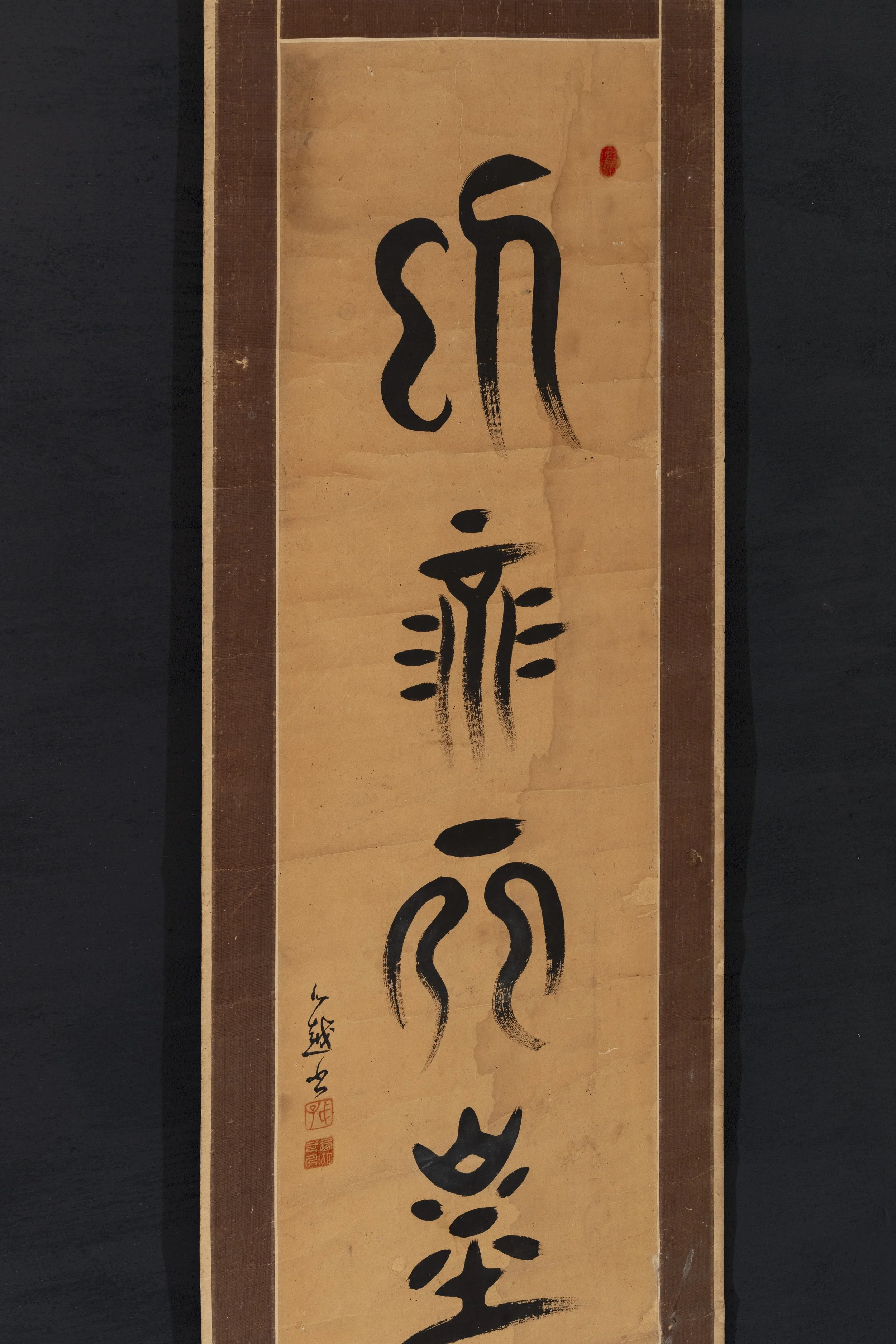
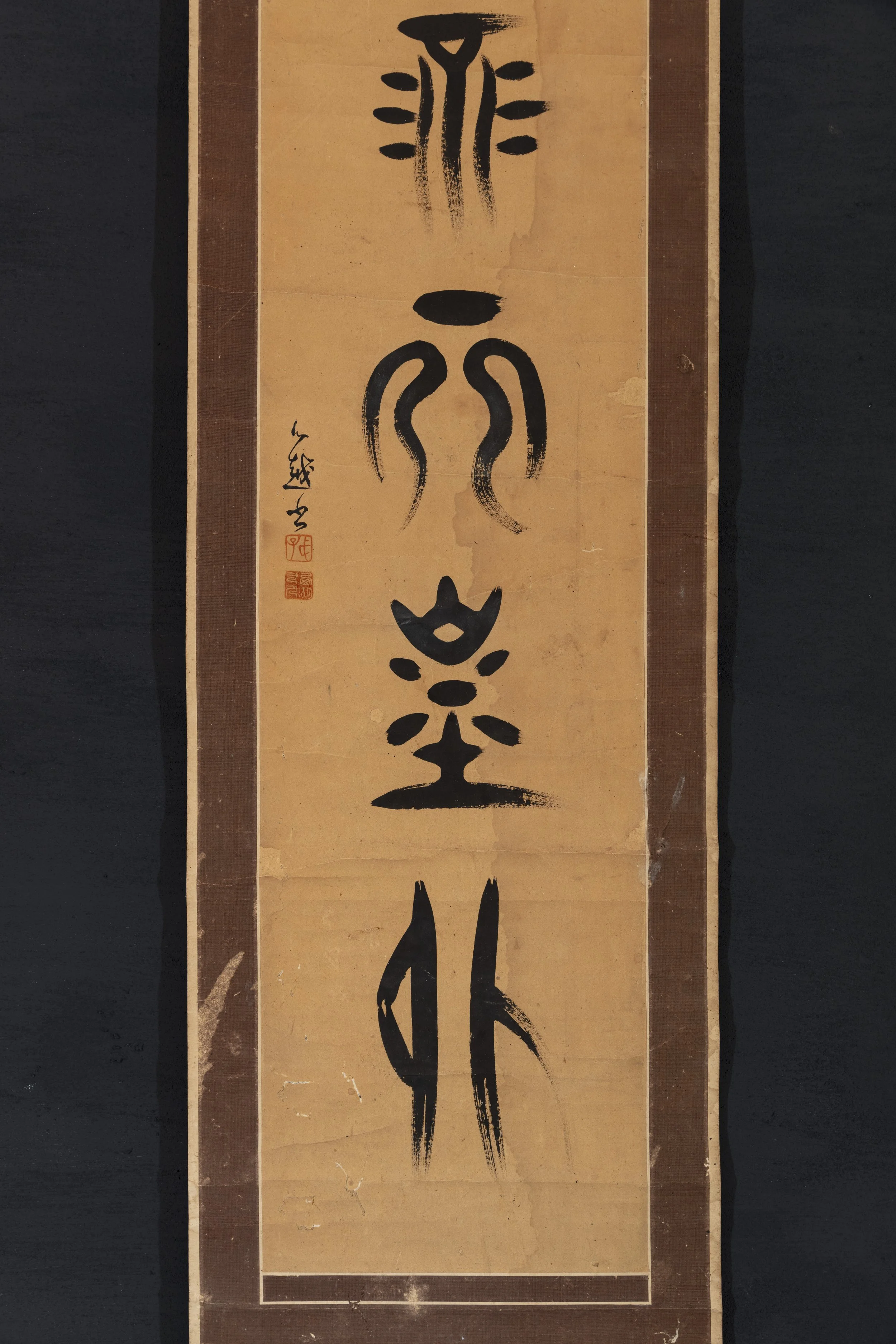
Brushed with commanding energy in six sweeping characters, this calligraphy presents the phrase Water flows to the sea, which has no edge — a succinct meditation on continuity, dissolution, and boundlessness deeply resonant within late Ming and early Edo Zen culture. The inscription is rendered in an archaising seal-script mode drawing upon ancient tensho forms, yet handled with notable freedom and elasticity. The characters are not merely constructed but released into movement: strokes widen, contract, hesitate slightly, and accelerate again, giving the writing a physical sense of current and flow. The composition unfolds vertically like water itself — gathering force, opening briefly around the central character for sea, and finally narrowing into the dense gravity of the concluding forms.
Tōgō Shin’etsu, born Jiang Xingchou near Hangzhou, emerged from a literati and monastic environment in which calligraphy, music, poetry, and Chan practice were inseparable disciplines. Trained in qin culture alongside Buddhist study, he travelled to Japan during the late seventeenth century as part of the broader movement of Chinese Ōbaku monks whose influence reshaped aspects of early Edo intellectual and religious life. Settling eventually in Mito under the patronage of Tokugawa Mitsukuni, he became associated not only with Zen teaching but with the transmission of a highly cultivated Chinese literati sensibility grounded in textual culture and disciplined artistic practice.
Within that milieu, calligraphy functioned simultaneously as spiritual enactment, cultural transmission, and personal expression. Works of this type circulated among monks, patrons, and disciples less as isolated art objects than as traces of cultivated presence and relationship. The emphasis placed within Ōbaku circles on lineage, authenticity, and continuity gives such works a particularly layered historical position today. Questions of attribution and transmission remain inseparable from the works themselves, especially in a field where later homage, reinterpretation, and devotional copying formed an enduring part of artistic culture.
The present scroll sits meaningfully within that complexity. The brushwork possesses considerable vitality and internal coherence, particularly in the modulation between compressed seal forms and more fluid cursive inflections. Especially striking is the treatment of the central character for sea, which opens outward in petal-like expansions that briefly release the dense vertical rhythm before the composition contracts once more into the final descending forms. The writing demonstrates a sophisticated awareness of spacing, pressure, and breath, whether understood as the work of Shin’etsu himself or of a highly accomplished follower working closely within the same calligraphic and spiritual tradition.
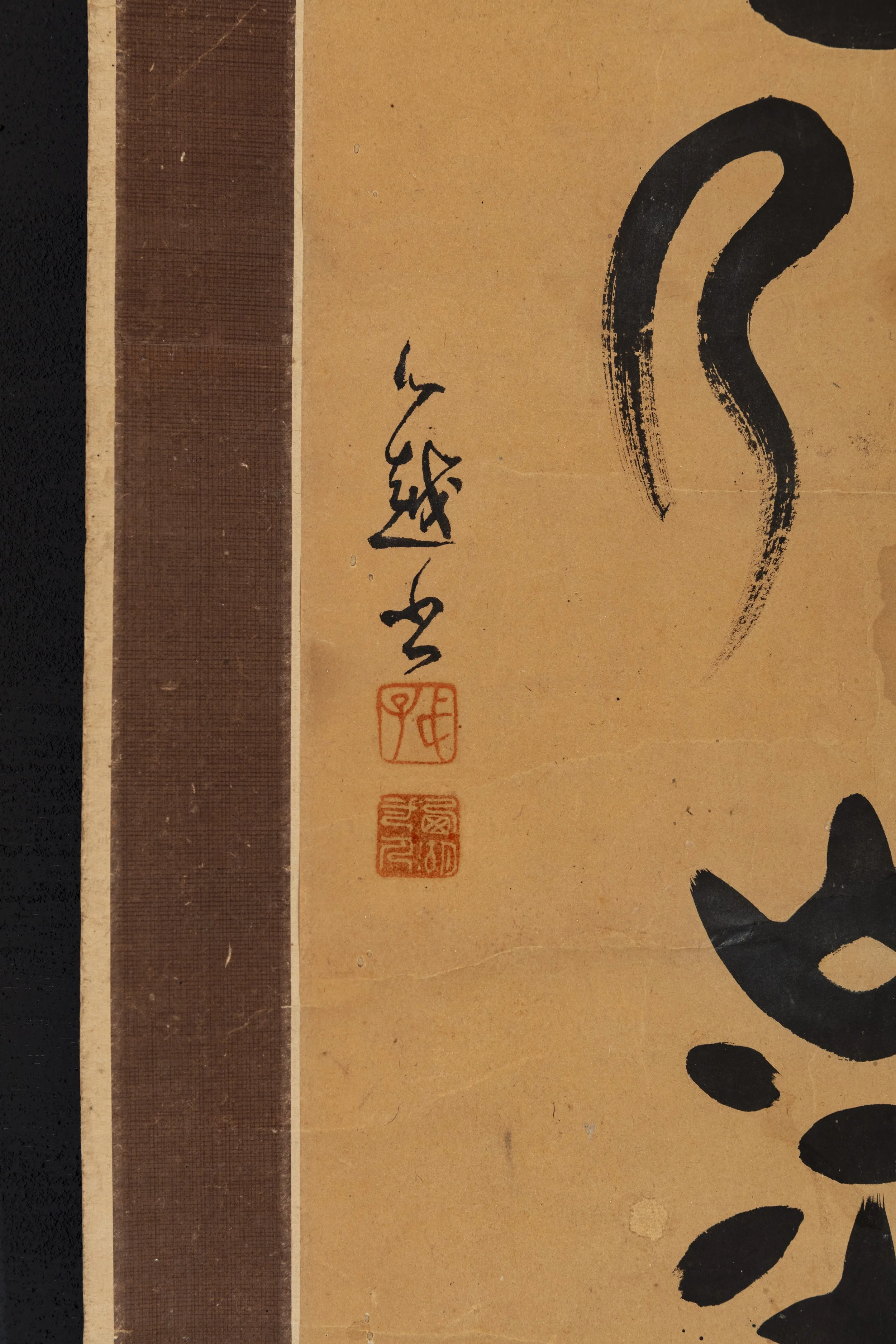
Materially, the scroll appears consistent with an Edo-period origin. The warm tonality of the paper, the character of the ink surface, and the mounting structure all suggest considerable age, with later conservation and remounting likely undertaken in keeping with normal Japanese preservation practices. The signature and seals correspond closely with recorded examples associated with Shin’etsu, though, as with many works circulating outside firmly documented temple or institutional provenance, questions of authorship remain open to continued study and comparison.
What remains most compelling, however, is not certainty alone but the unusual clarity of the work’s internal rhythm. The phrase itself speaks of movement toward boundlessness, and the calligraphy seems structured around precisely that idea: pressure releasing into openness, form dissolving into flow, individuality entering something larger and less fixed. Whether approached as an authenticated work, a close-period transmission, or a later homage executed within an inherited lineage, the scroll retains a genuine contemplative force. It does not merely describe flow and dissolution; it enacts them through the movement of ink across paper.