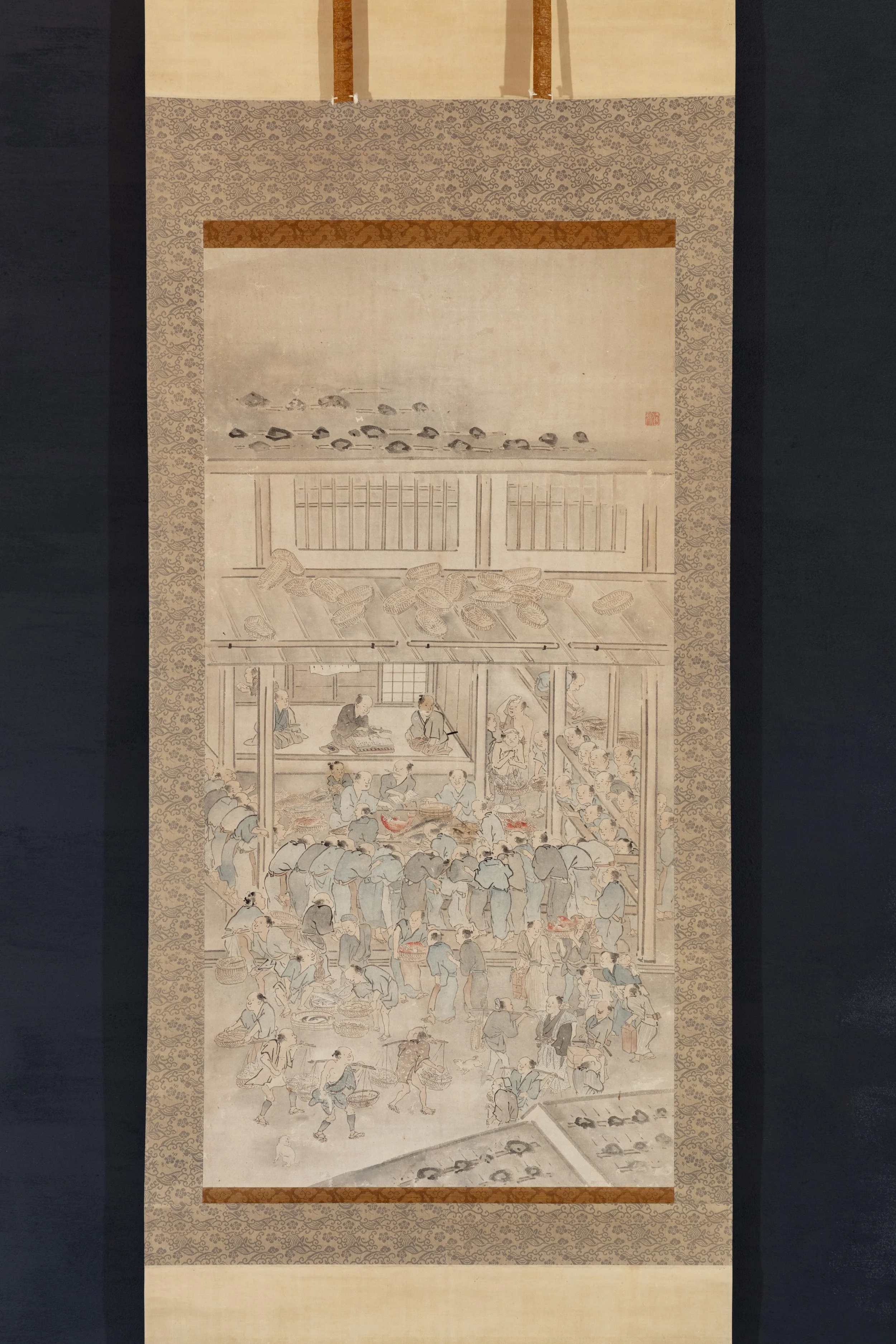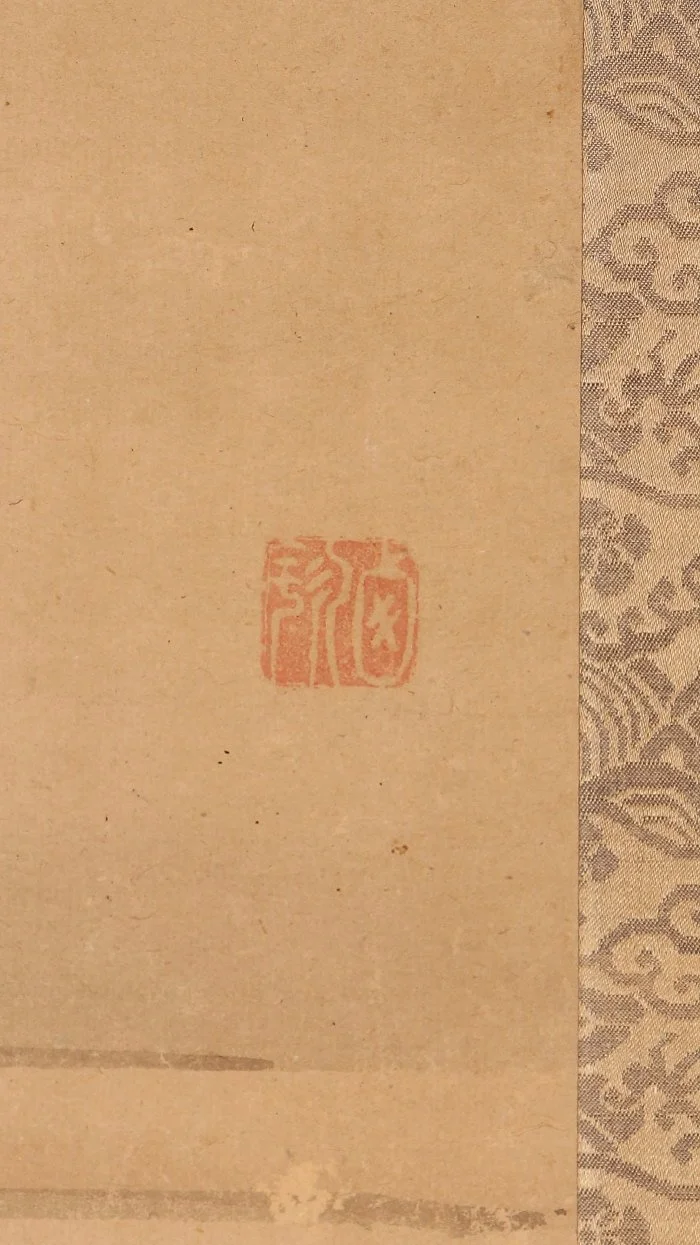
Fish Auction at Uogashi, attributed to Teisai Hokuba (魚屋北馬, c. 1771–1844)
206 x 72 cm (total)
114 x 57 cm (main work)
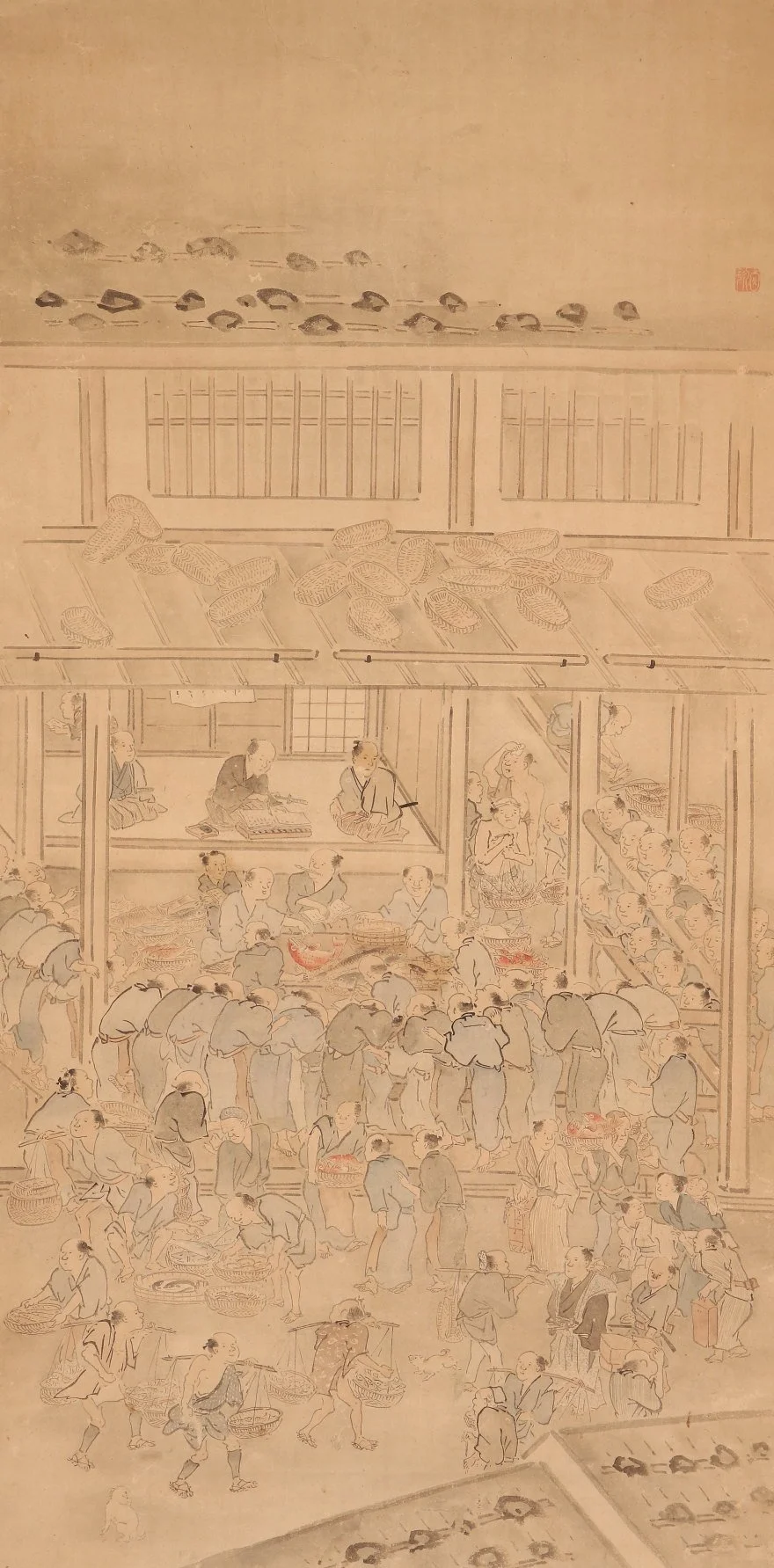
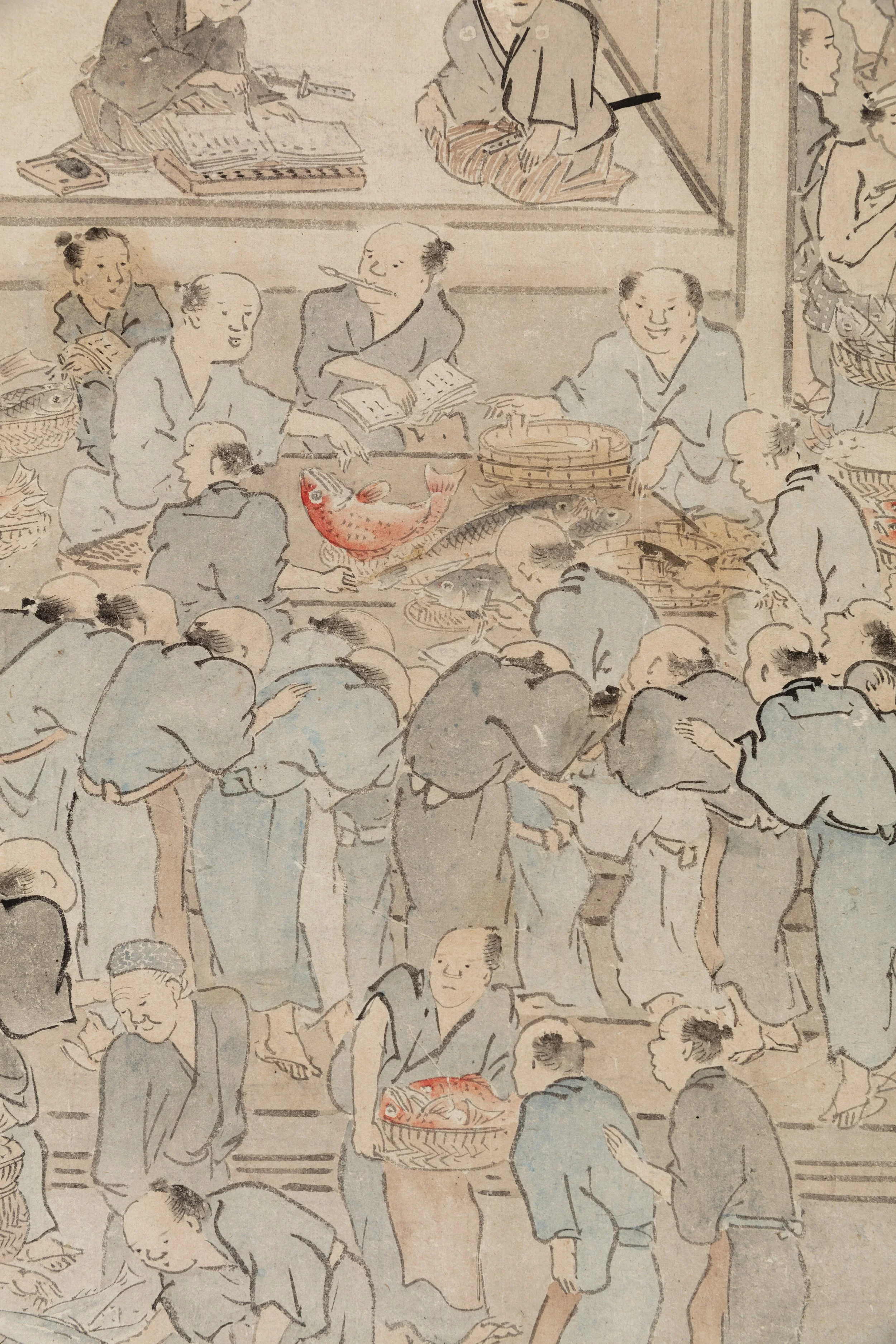
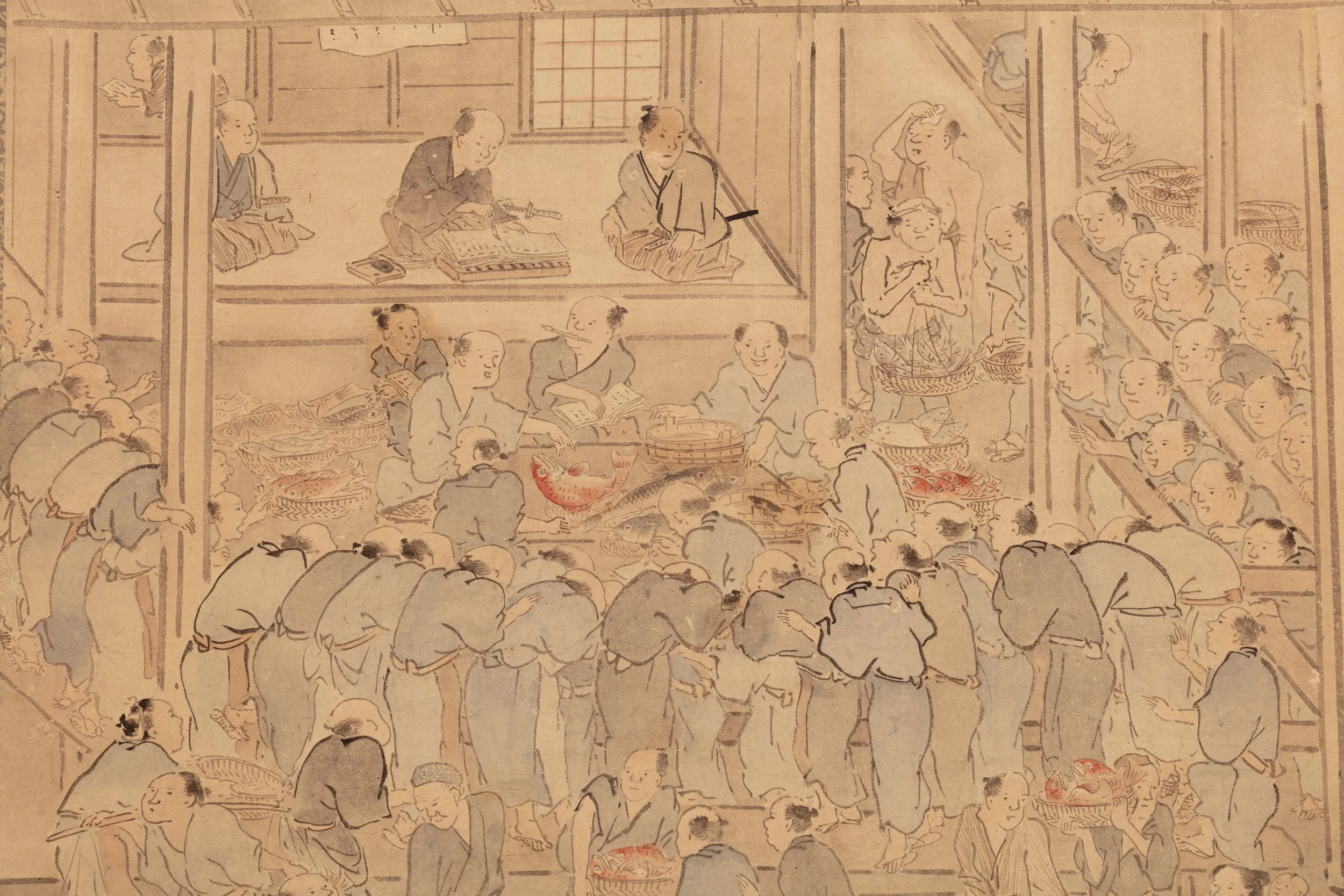
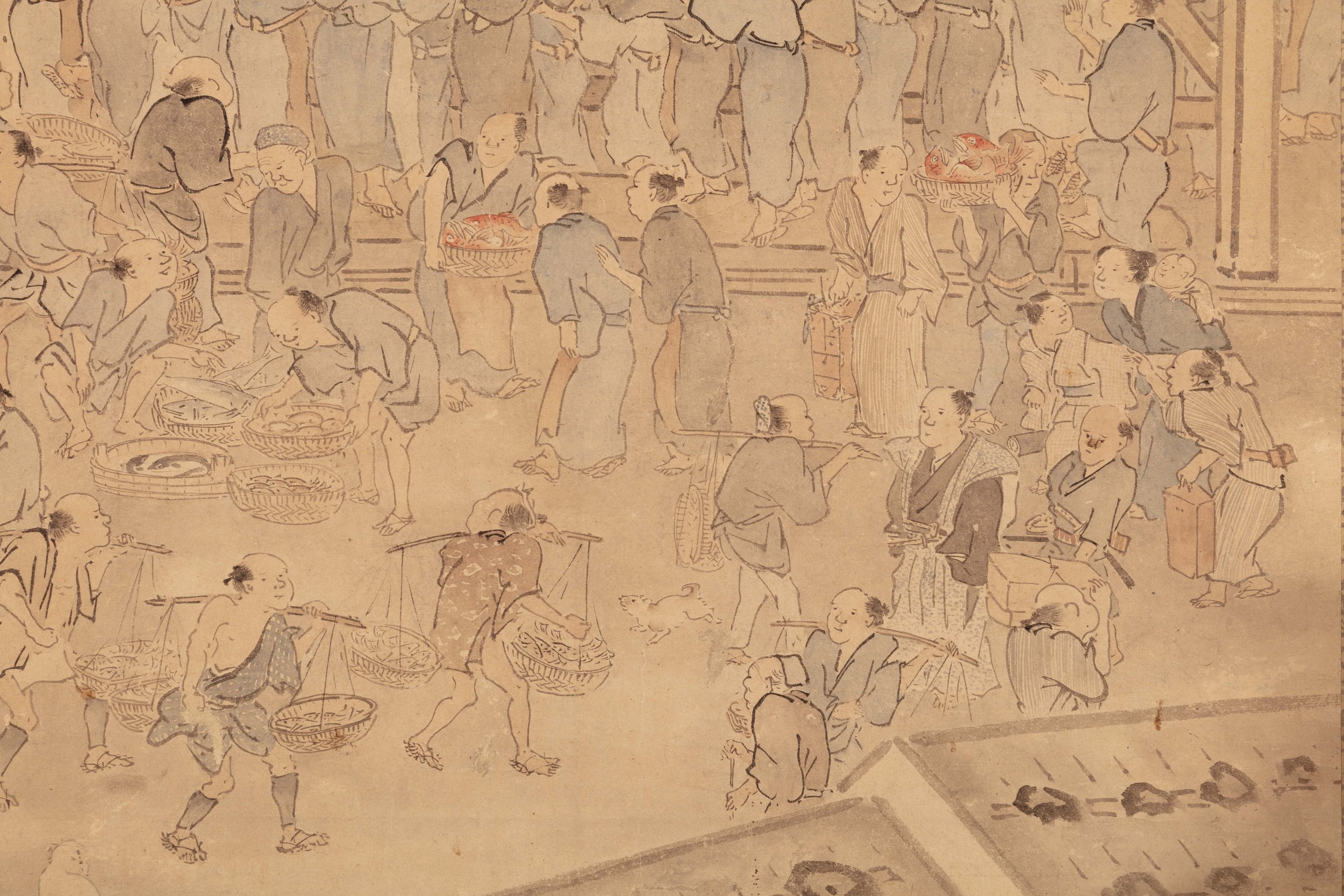
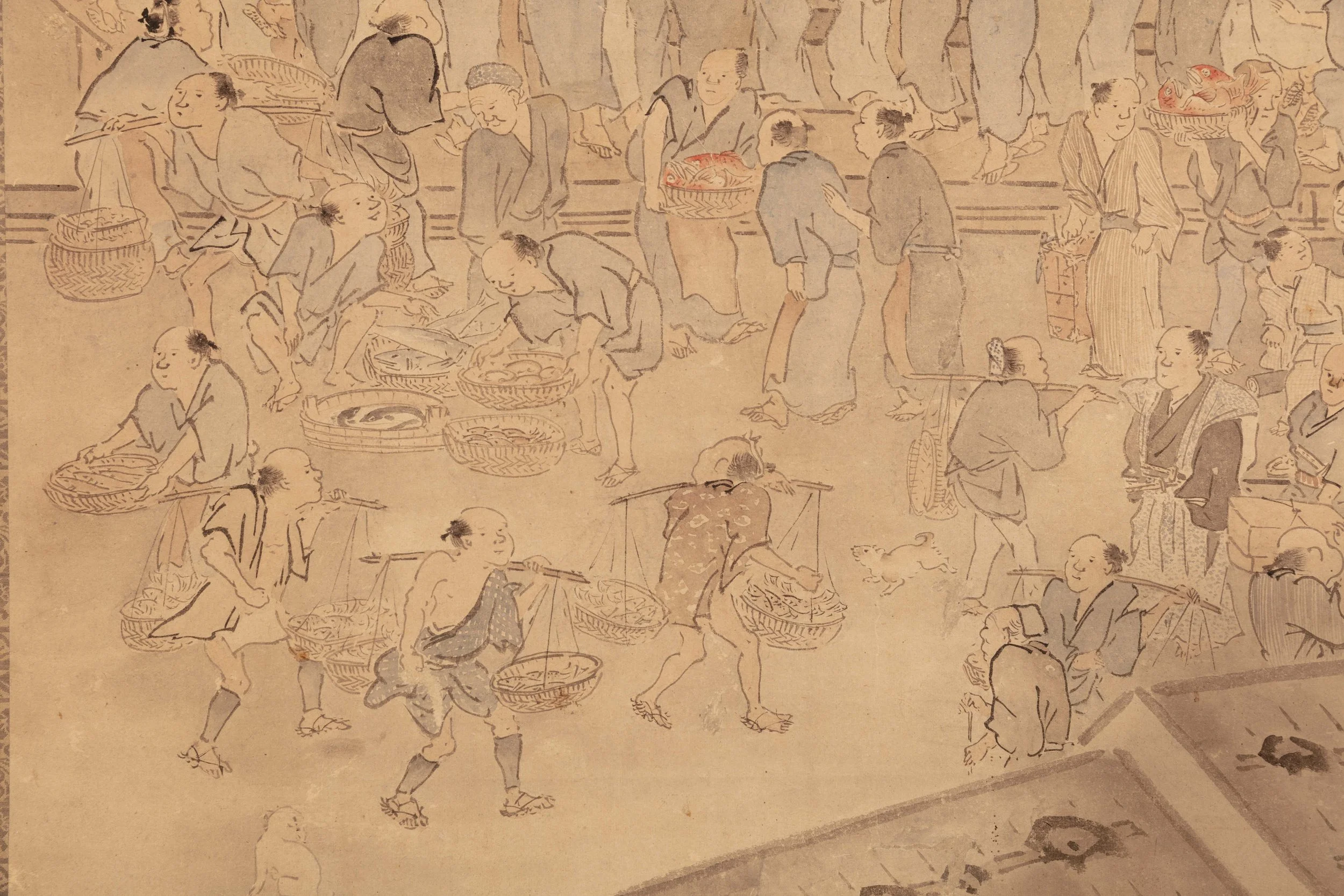
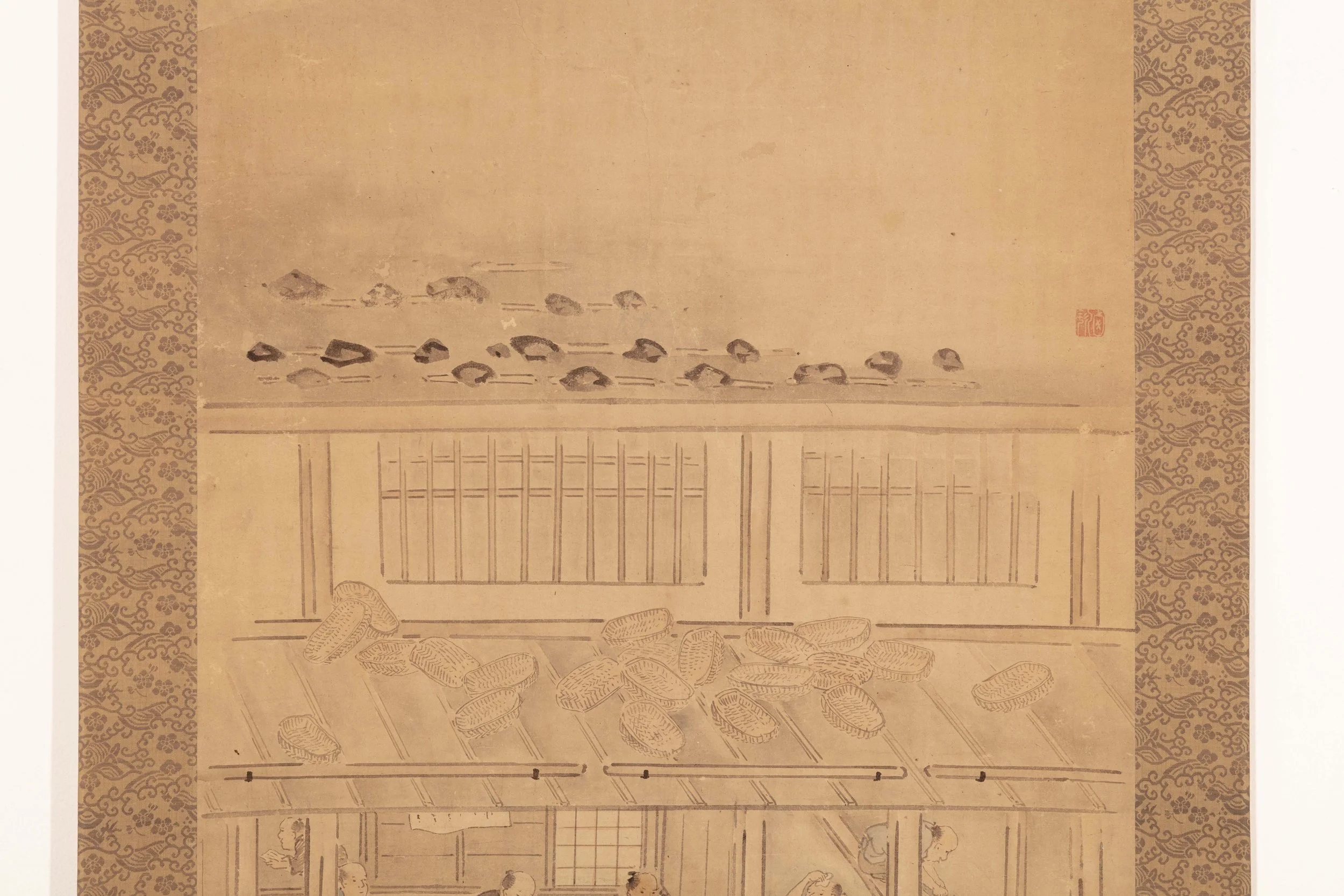
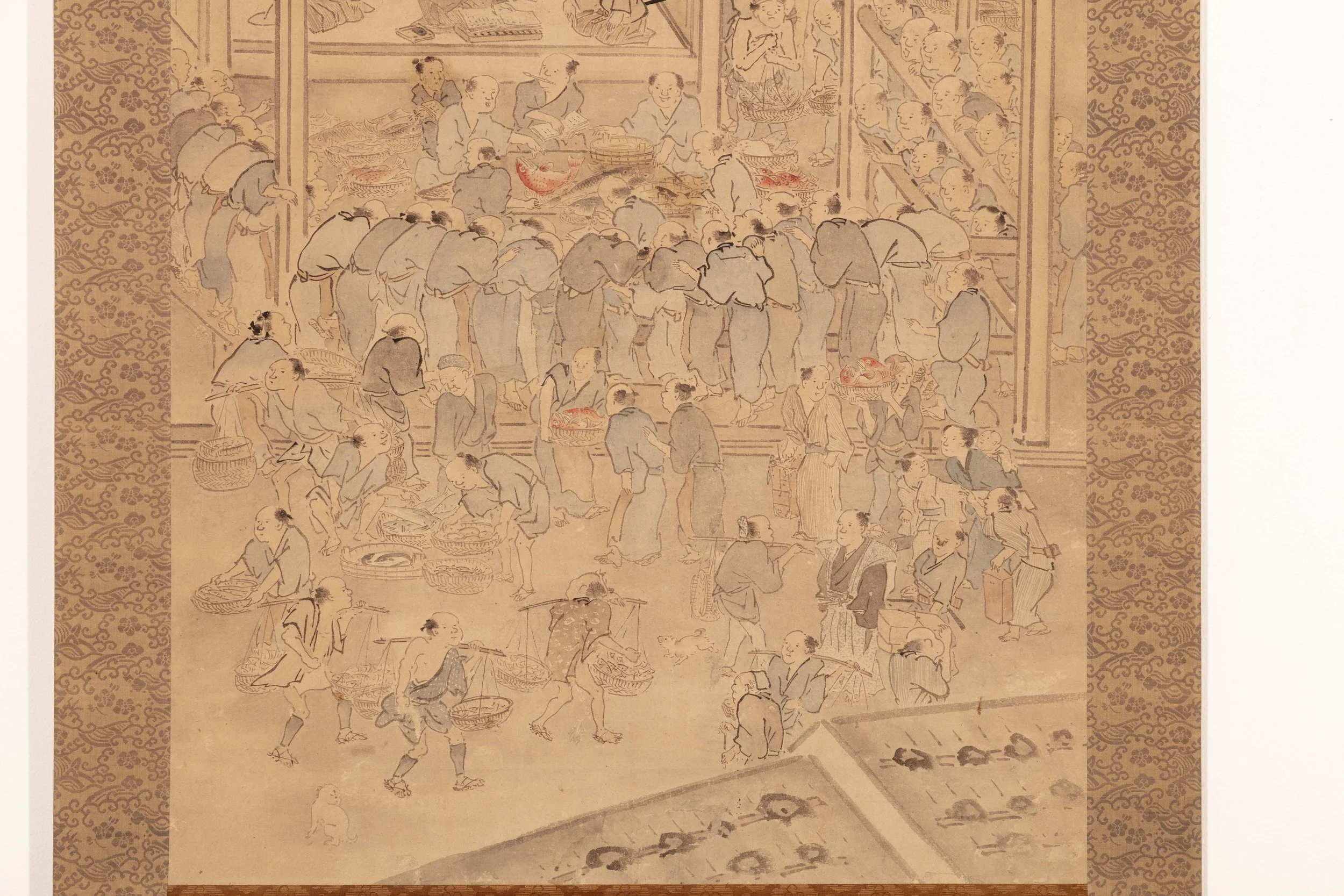
An animated panorama of Edo’s Uogashi fish market, drawn with the supple, calligraphic line and pale washes characteristic of the Hokusai school. Porters, merchants, and clerks move in tightly interwoven rhythms through the open market hall, their bodies bending, turning, and compressing as they negotiate space. Baskets are piled high with glistening catch — tuna, eel, and sea bream — the latter picked out in flashes of vermilion that punctuate the otherwise restrained palette. The scene unfolds not as a staged composition, but as a continuous field of activity, observed with immediacy and precision.
The work aligns closely with the tradition of late Edo fūzokuga — genre painting concerned with the depiction of everyday urban life — in which the great commercial districts of Edo became subjects of sustained visual attention. In this context, the fish market at Uogashi was not incidental, but central: a site where labour, exchange, and the circulation of goods formed the visible structure of the city’s economy. While comparable folding screen views of Edo often extend horizontally across a panoramic field, the present composition unfolds vertically, with space compressed into layered zones of activity that guide the eye upward through the scene. At the same time, it operates through an accumulation of small, observed acts, combining a strong sense of structure with a dense, attentive description of lived experience.
Recent comparison with a published Edo city-view screen attributed to Teisai Hokuba strengthens the association. In both works, figures are rendered with a distinctive economy: clipped male profiles, wiry, protruding ears, sparse tufts of hair, and lightly articulated features that suggest character without caricature. Limbs are drawn with a quick, confident line, and bodies are slightly abbreviated, lending the crowd a sense of compression and forward movement. The handling of space is similarly fluid, with overlapping figures forming a continuous, shifting structure rather than a hierarchically organised scene.
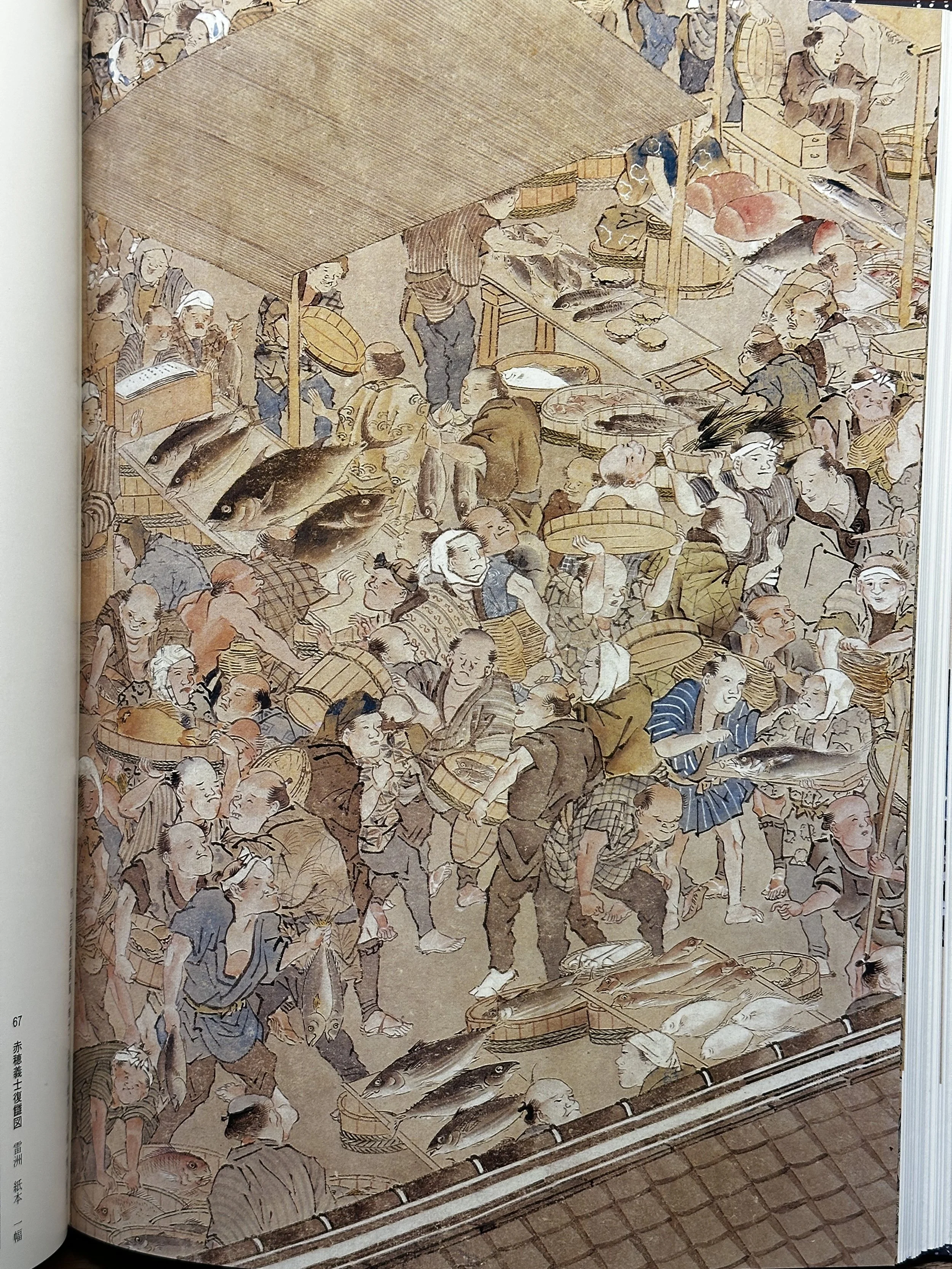
Hokuba, a direct pupil of Hokusai, appears to have absorbed the master’s linear vitality while directing it toward a more observational, descriptive mode. Where Hokusai often pushes toward invention and dramatic compression, Hokuba’s work tends toward accumulation — a careful registering of activity as it unfolds. This lends the present painting a distinctly documentary quality. The figures are not idealised or theatrical; they are engaged in the practicalities of trade — weighing, carrying, inspecting — their gestures economical and unselfconscious.
The architecture serves to frame rather than dominate the scene, opening onto a space in which movement and exchange take precedence. The eye is invited to move across the surface, following the flow of bodies and goods, rather than settling on a single focal point. In this way, the painting captures not only the appearance of the market, but its underlying rhythm — a continuous negotiation of space, labour, and value.
A spirited and humane vision of the marketplace, the work offers a vivid account of Edo’s daily commerce. At the same time, it stands as a sustained act of attention — one that records, with clarity and restraint, the lived fabric of urban life in the late Edo period.
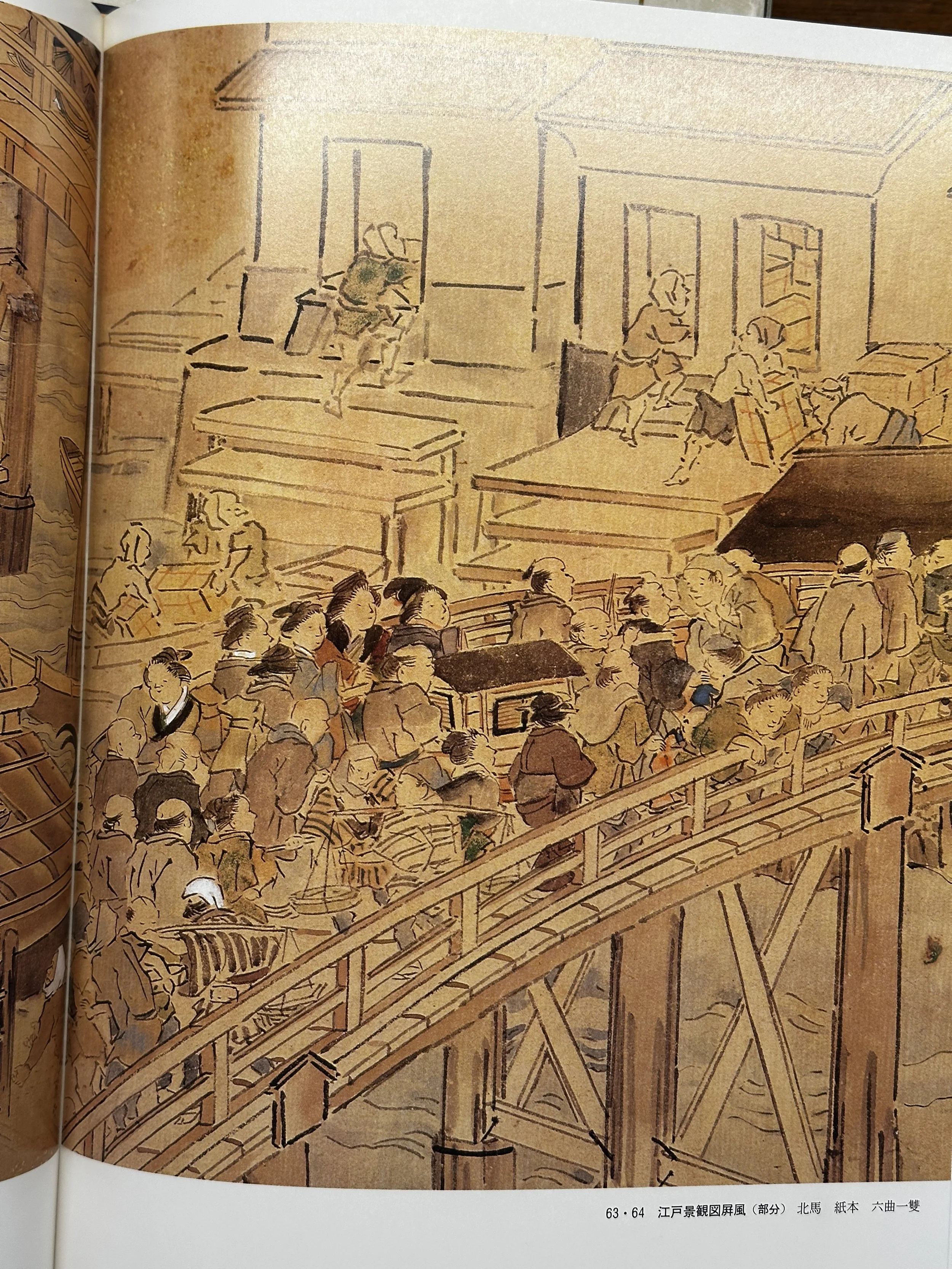
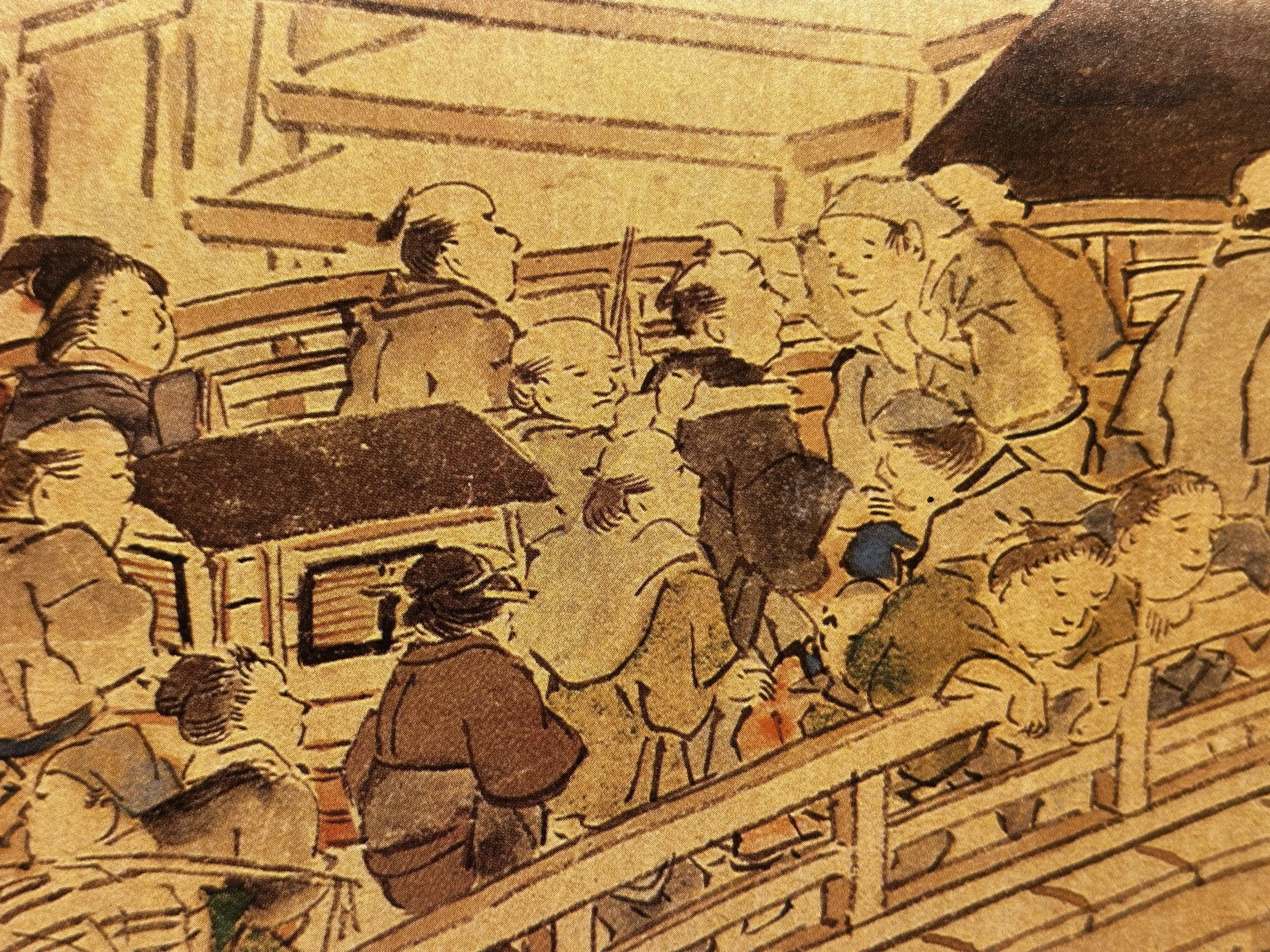
Fish Market Scene (detail), from From Nikuhitsu Ukiyo-e (Hand-Painted Ukiyo-e), Vol. 7: Hokusai, Shueisha, Tokyo, 1982.
Comparable Edo-period market composition, attributed to Teisai Hokuba (d. c. 1844), from a published folding screen.The animated clustering of figures, brisk brushwork, and flashes of vermilion catch closely parallel the pictorial language seen in Fish Auction at Dawn, reinforcing its placement within the Hokusai school.
Bridge and Crowd Scene (detail)
Detail from an Edo Views folding screen by Teisai Hokuba (d. c. 1844).The compressed procession of figures, distinctive male profiles, and economical linework echo the same lively figure-type and rhythmic movement observed in the Myōan Collection scroll.