Nirvana of Shakyamuni
Anonymous Kyoto School, mid-Edo period, ca. 1740–1770
Ink, mineral pigment, gold and silver on paper, mounted as a hanging scroll
157 × 55.5 cm
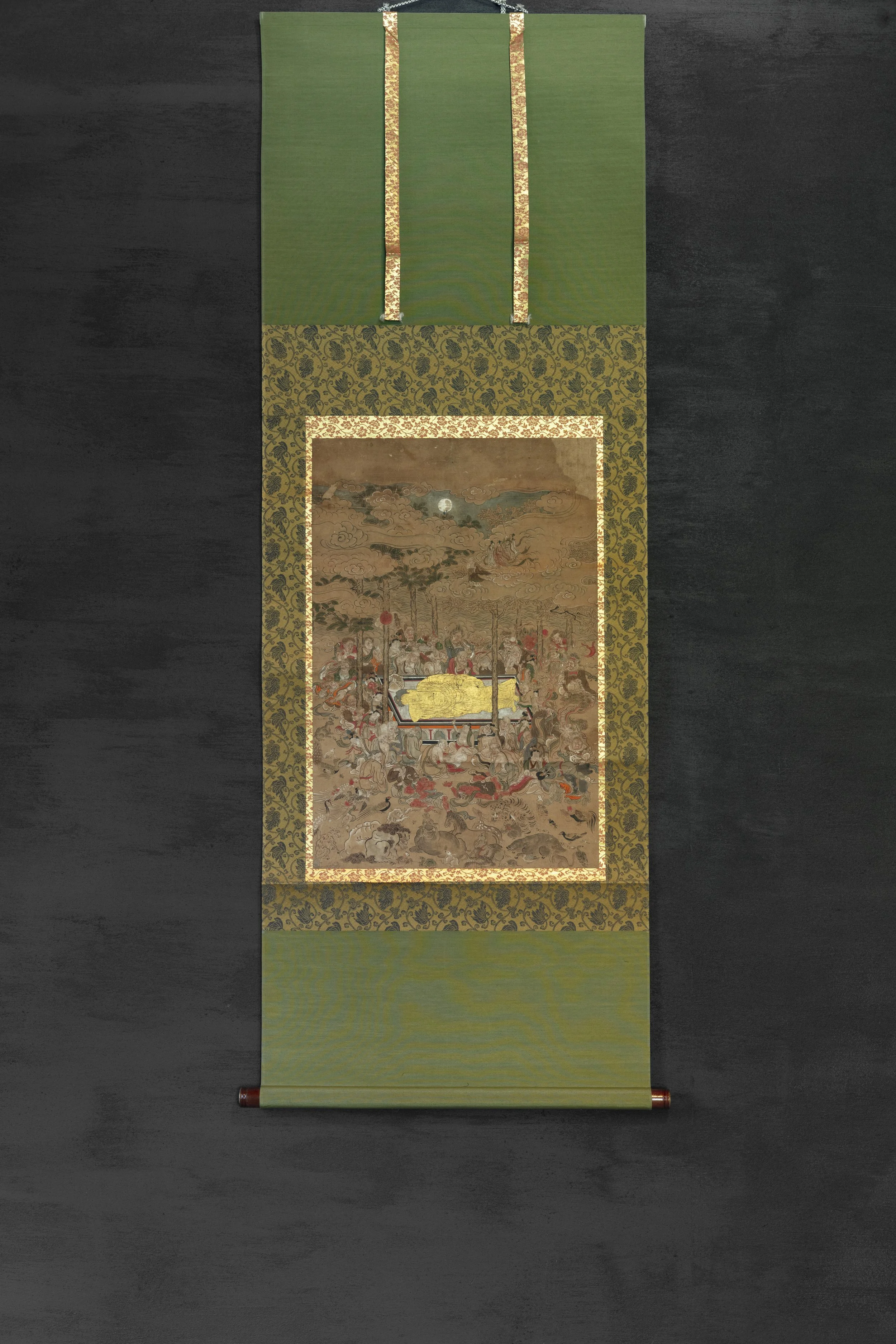
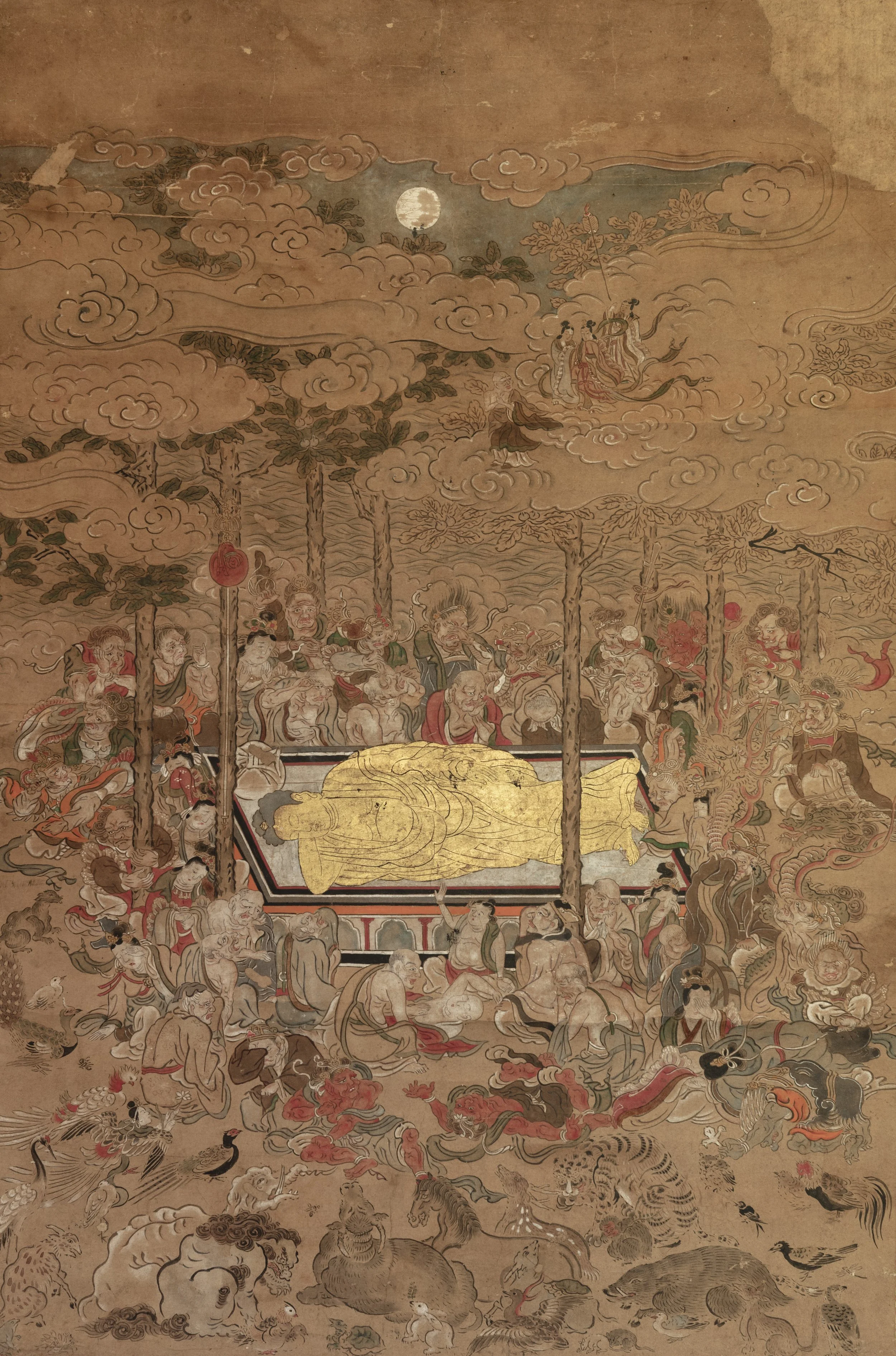
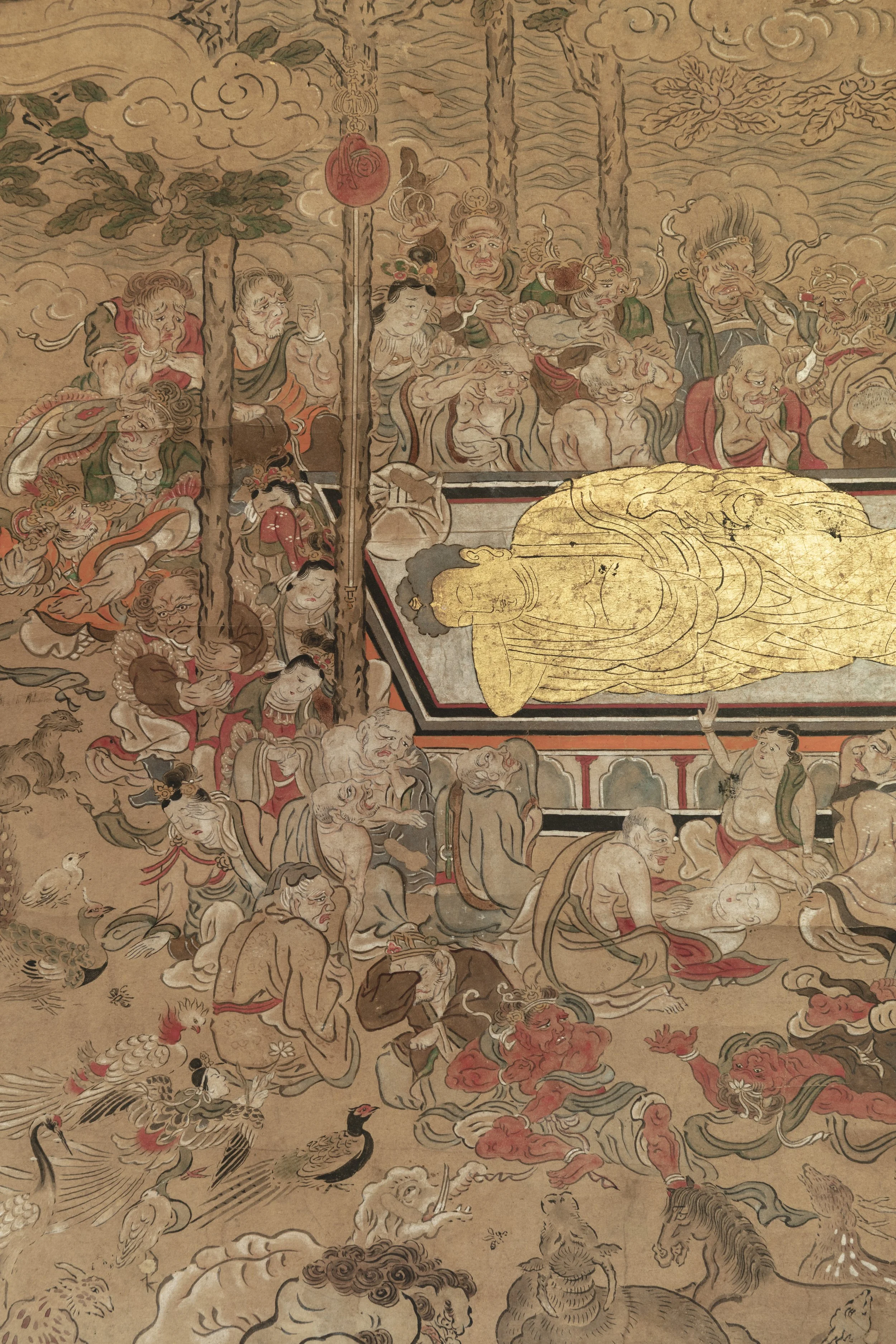
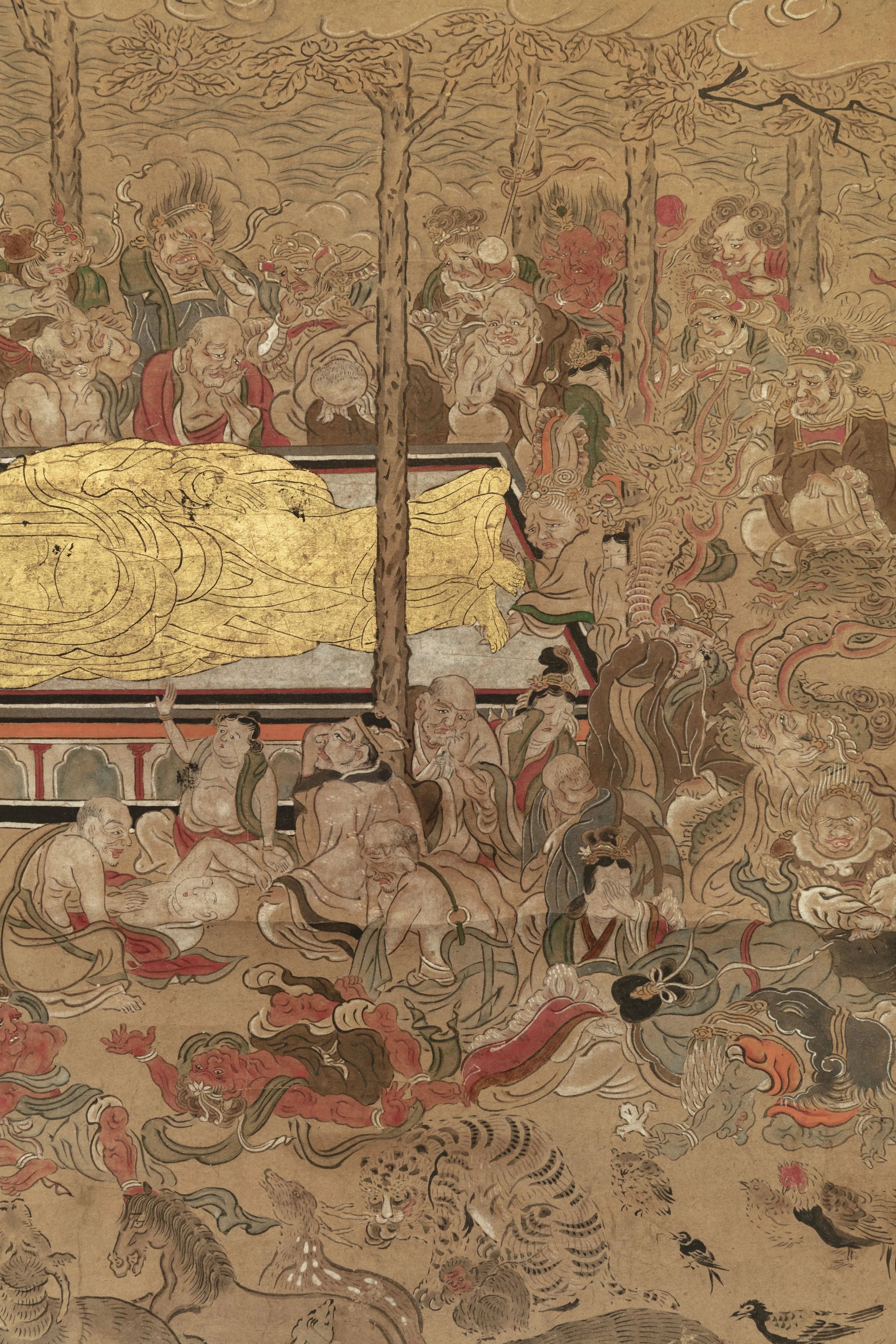
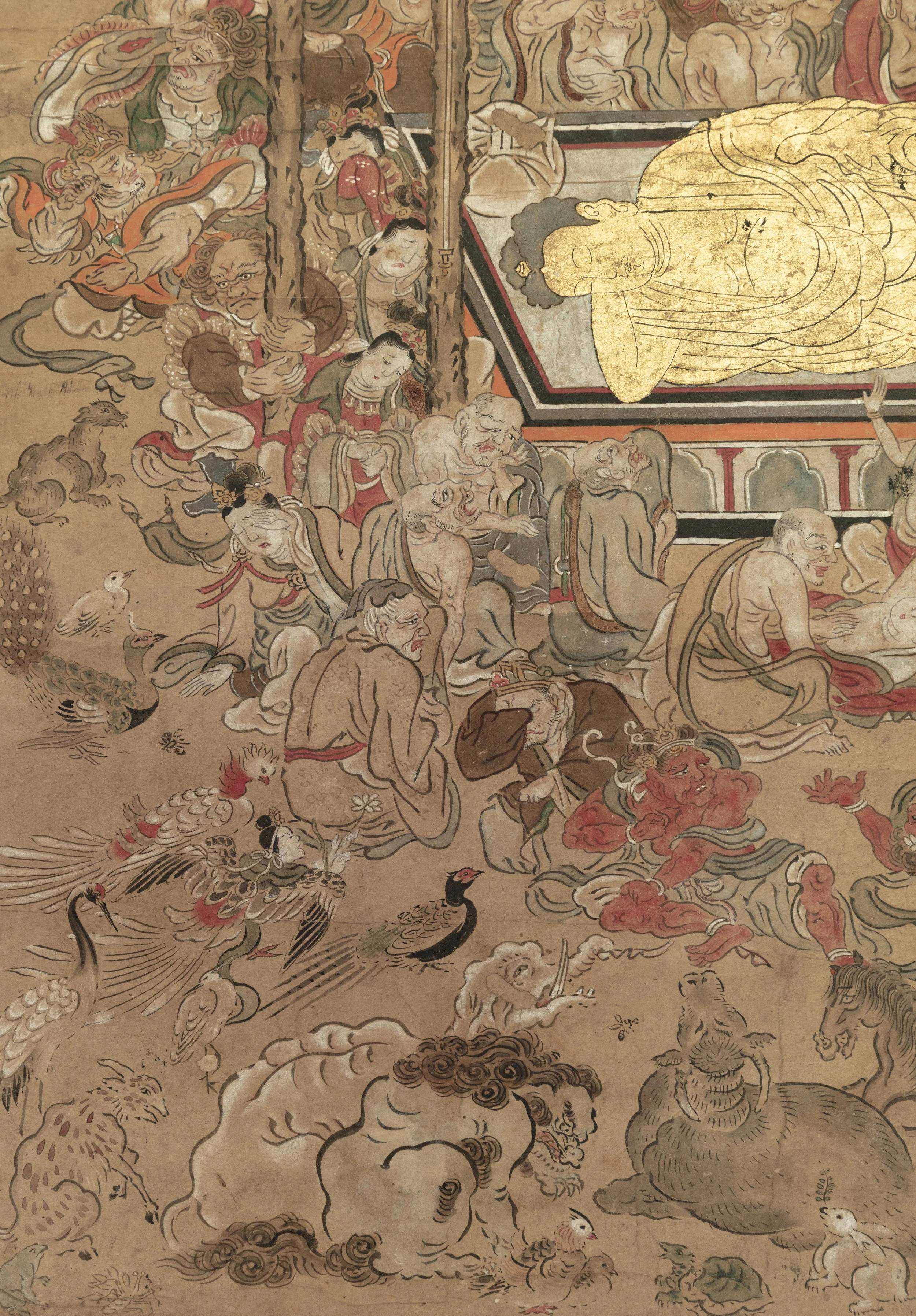
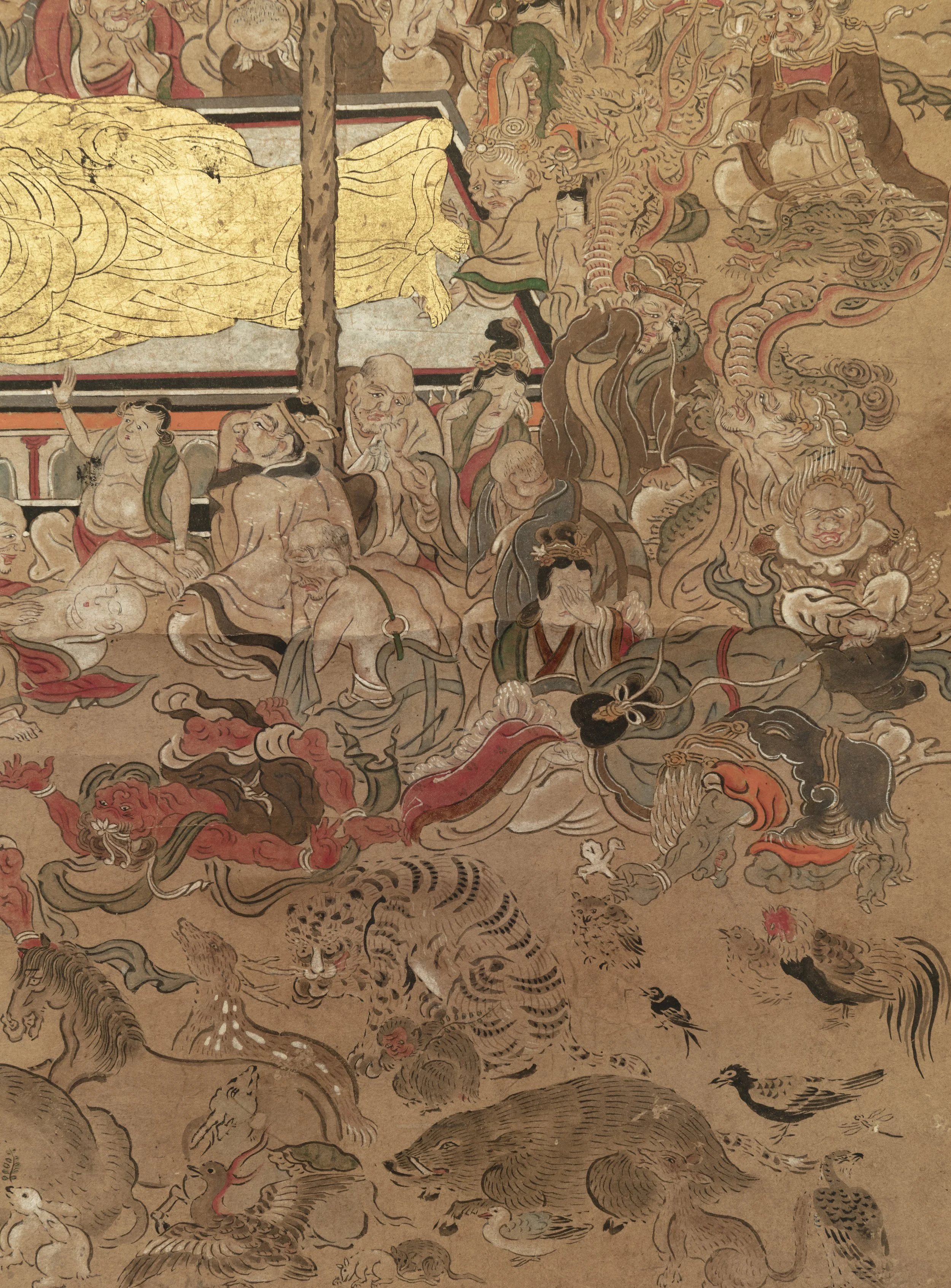
A finely structured Nehan-zu depicting the passing of Shakyamuni beneath the twin sala trees, attended by arhats, bodhisattvas, guardian figures, celestial beings, and mourning animals. The Buddha reclines on a jewelled dais at the centre of the composition, his body rendered in gold against a subdued field of earth colours, greys, and soft mineral reds. Above him, drifting cloud forms open briefly to reveal the moon and the descending figures associated in Japanese Nirvana imagery with the final cosmic gathering at the Buddha’s death. Around him, the assembled beings do not dissolve into confusion, but are organised with quiet intelligence into a series of compressed zones of lamentation, contemplation, and witness.
The painting belongs to the long Japanese tradition of Nehan-e or Nehan-zu, images displayed in temple contexts for the annual memorial observance of the Buddha’s passing, traditionally held on the fifteenth day of the second month. Paintings of this subject survive in Japan in considerable numbers from the late Heian period onward, and by the medieval period two broad compositional types had become established. One is more horizontal and architectonic; the other, more influential for later Japanese hanging scrolls, is vertical, centred near the Buddha’s head, and populated by a large gathering of mourners, animals, and supernatural beings. The present work clearly belongs to this second lineage, with its vertically compressed field, moonlit upper register, descending cloud-borne figures, and richly peopled terrestrial zone below.
What distinguishes the present scroll is the balance it achieves between density and legibility. The subject is inherently crowded, but the painting never loses formal clarity. Trees rise in measured intervals through the middle zone, creating a kind of visual armature that steadies the crowding of the figures and gives the composition its internal rhythm. The clouds, drawn in curling pale bands, soften the transitions between the earthly and celestial realms while also helping to distribute the eye across the surface. Silvered and grey cloud passages, even in worn condition, still contribute to the cool, veiled atmosphere of the scene. The palette is restrained rather than sumptuous, but it is precisely this restraint that gives the work its depth. Reds are used strategically, not diffusely; gold is concentrated in the Buddha’s body; the broader field remains deliberately subdued.
The iconography is handled with notable confidence. In Japanese Nirvana paintings, the inclusion of mourning animals is one of the most moving and characteristic features, and here they gather densely at the lower edge: birds, deer, feline creatures, hoofed animals, and smaller beasts all drawn into the same field of grief. Japanese treatments of the subject were especially attentive to the Nirvana Sutra’s emphasis on universal participation in the event of the Buddha’s passing, and the lower register often becomes a profound image of shared sentience across realms of existence. The present work takes that aspect seriously. The animals are not decorative fillers. They are integral to the theological and emotional logic of the composition.
Stylistically, the painting sits well within a Kyoto workshop context of the mid-Edo period. It does not have the hard linear polish of a formal Tosa revival piece, nor the radically abbreviated energy of Zen monochrome painting. Instead, it inhabits the middle ground one often finds in temple ateliers and devotional workshop production: careful drawing, stable iconographic transmission, moderate but sensitive colour, and an evident dependence on older compositional models. That dependence should not be misunderstood as weakness. In Buddhist painting, repetition through pattern books, inherited cartoons, and workshop transmission was not only normal but essential. The goal was not invention for its own sake, but the continued re-articulation of an authoritative image.
That point becomes especially interesting in light of a near-identical related painting presented here for comparison. The comparison is extremely revealing. The second work follows the same basic compositional architecture almost point for point, but differs in key details, most notably in the treatment of the Buddha’s robe, which appears darker and more fully clothed. This strongly suggests that both works descend from a shared workshop cartoon or established studio model, adjusted in execution by different hands or at different moments within the same atelier tradition. Rather than diminishing the present scroll, that comparison helps locate it more precisely: not as an isolated invention, but as part of a living Kyoto pictorial practice in which successful devotional images were replicated, refined, and varied across time.
Within that framework, the present example can be understood as one expression within this broader pictorial lineage. Its tonal relations are quiet and integrated; its figures sit naturally within the surface; and the handling of the cloud bands, tree trunks, and surrounding mourners feels composed and assured. The result is a painting with real internal poise. Even in worn condition, it retains a persuasive moonlit stillness and a sense of doctrinal completeness. The mood is mournful, certainly, but not agitated. What emerges instead is an image of cosmic calm at the threshold of extinction and release.
The condition is honest and fully legible. There is surface wear, rubbing, and loss, particularly in the upper passages and in areas of delicate pigment, but the composition remains coherent and the iconographic programme intact. Indeed, some of the abrasion has the paradoxical effect of increasing the work’s atmospheric softness, especially in the clouds and sky. The mounting is sympathetic and stable, framing the image without competing with it.
As a Kyoto Buddhist painting of the mid-Edo period, the scroll is valuable not because it claims singular invention, but because it preserves a highly successful and moving devotional image at a mature stage of workshop transmission. It stands at the intersection of doctrine, ritual use, and studio practice: an object made to be seen, contemplated, and understood within the recurring liturgical life of a temple. Its strength lies in that combination of formal steadiness and emotional intelligence. Even now, it continues to do exactly what such paintings were made to do: gather the worlds of gods, monks, beasts, and ordinary beings into a single field of witness before the mystery of passing away.
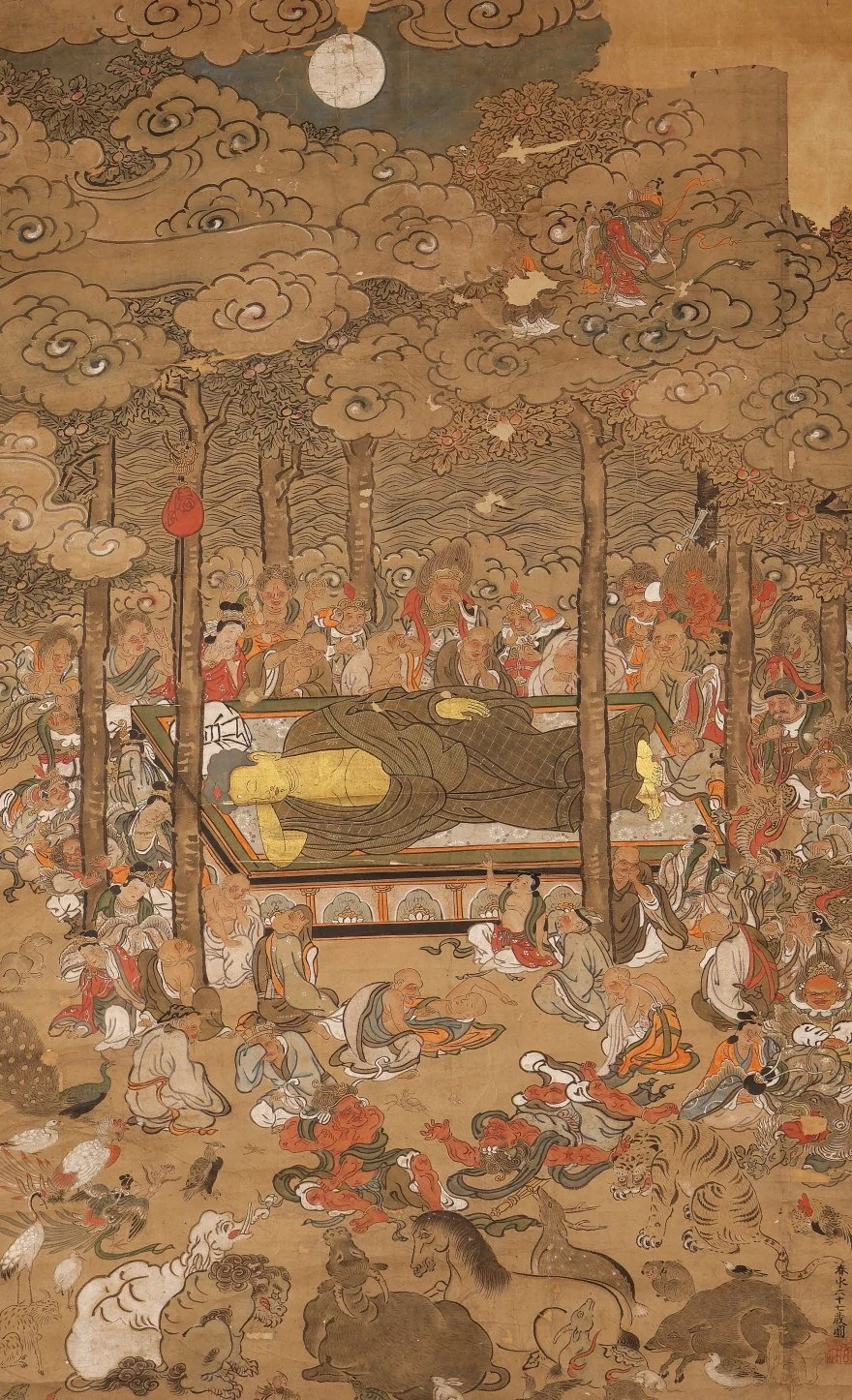
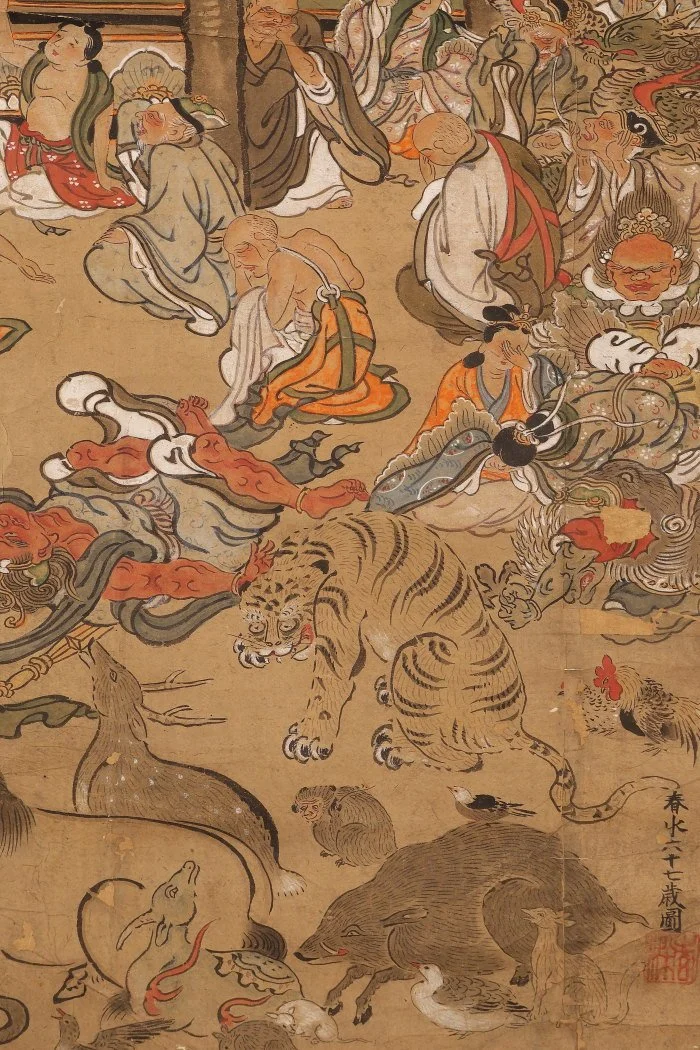
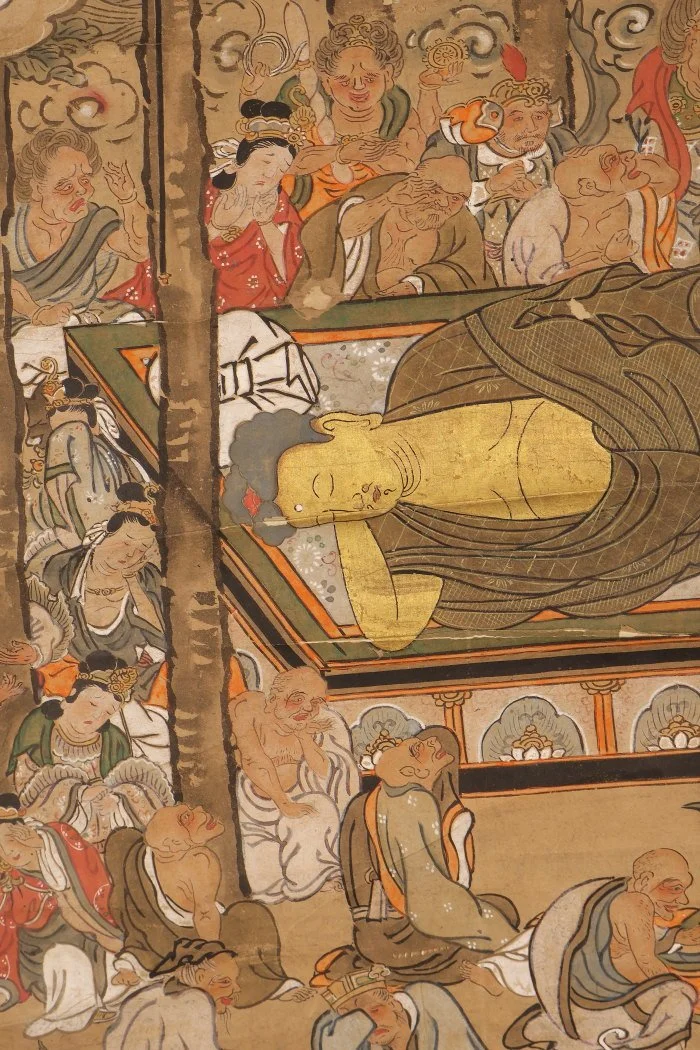
Comparative example of a closely related Nehan-zu from the same Kyoto workshop tradition, showing a near-identical composition with variations in the Buddha’s robe and tonal handling—likely derived from a shared studio cartoon.