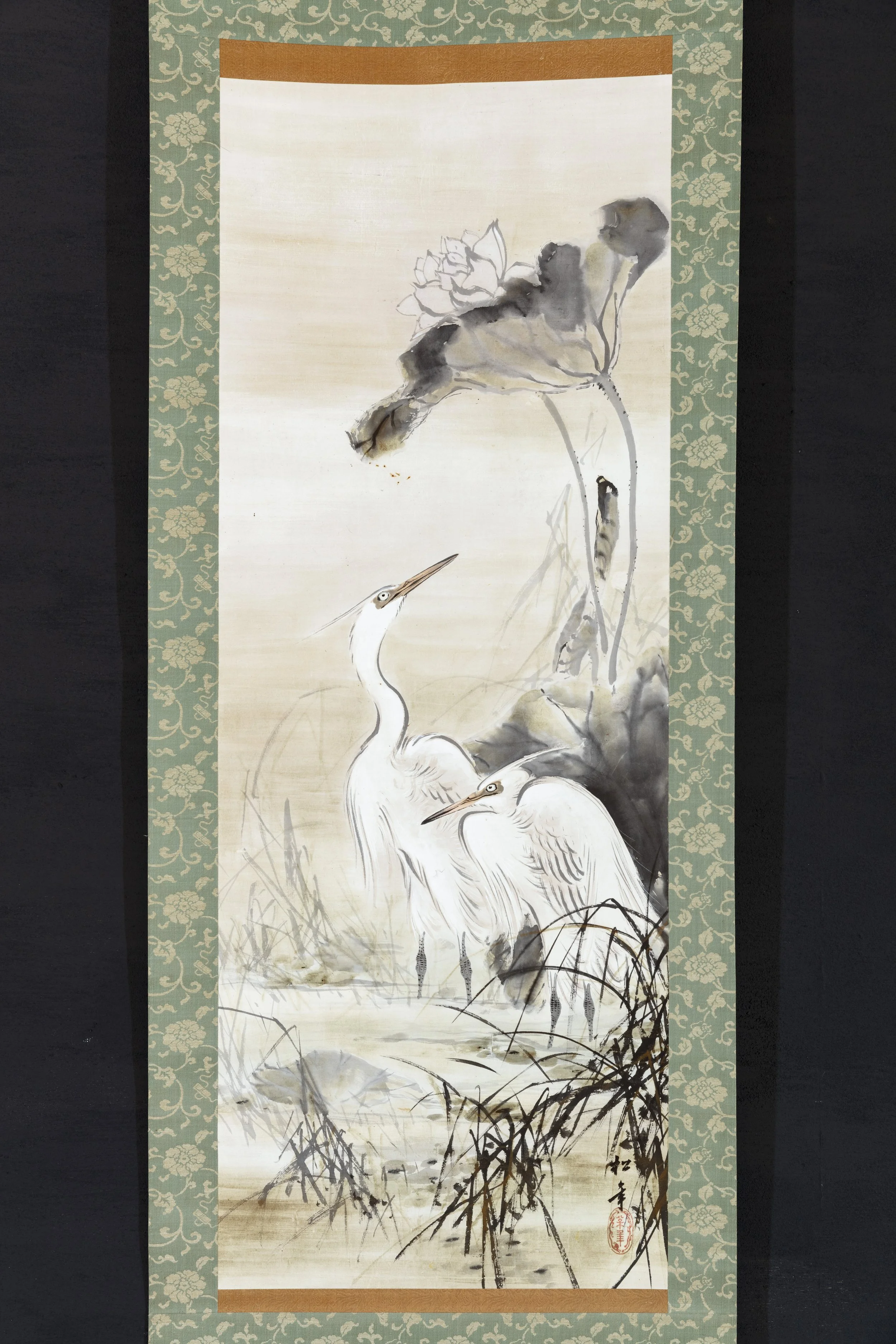
Herons and Lotus
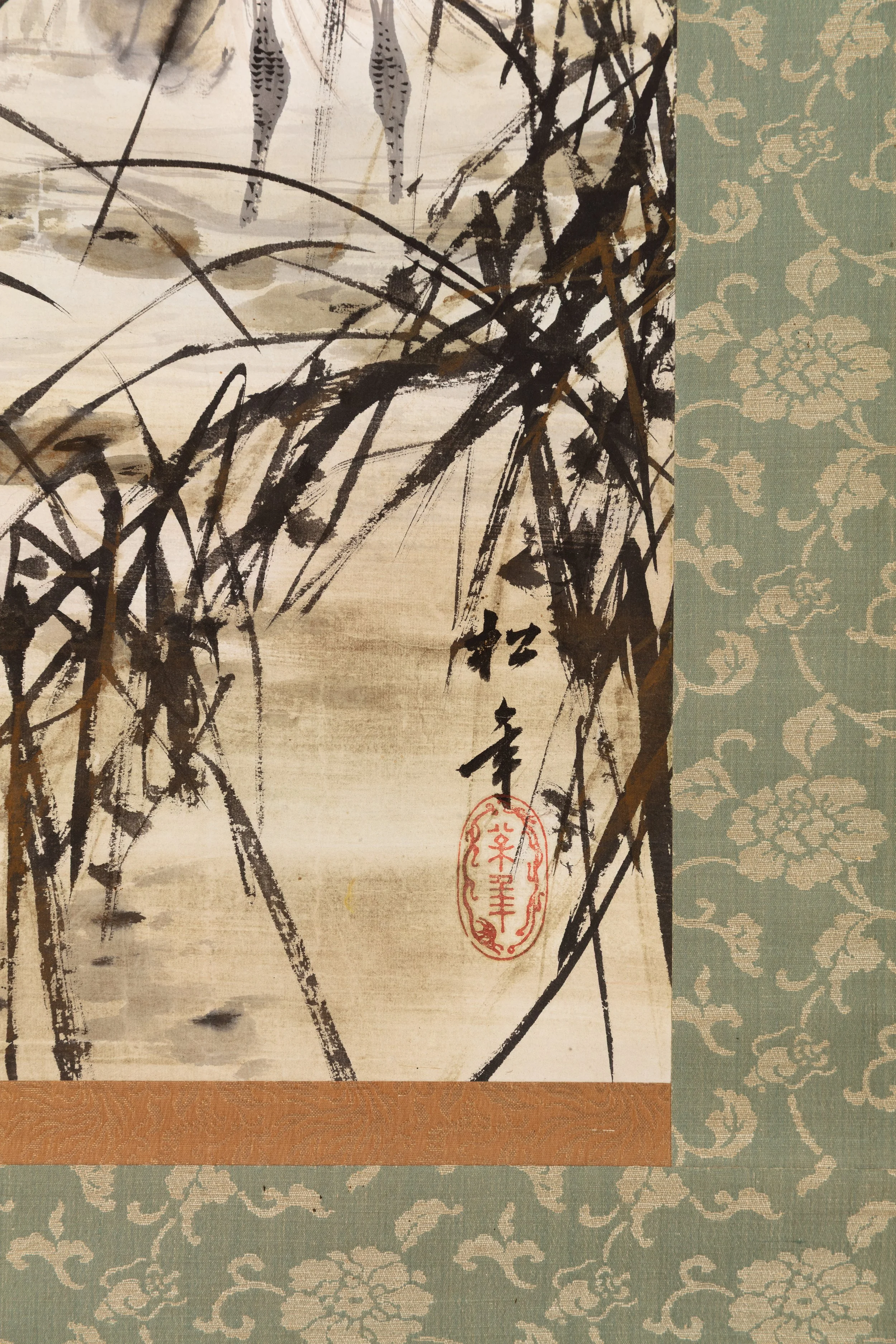
Suzuki Shōnen (1849–1918)
Meiji period, ca. 1890–1915
Ink and light colour on silk, 199 × 59 cm
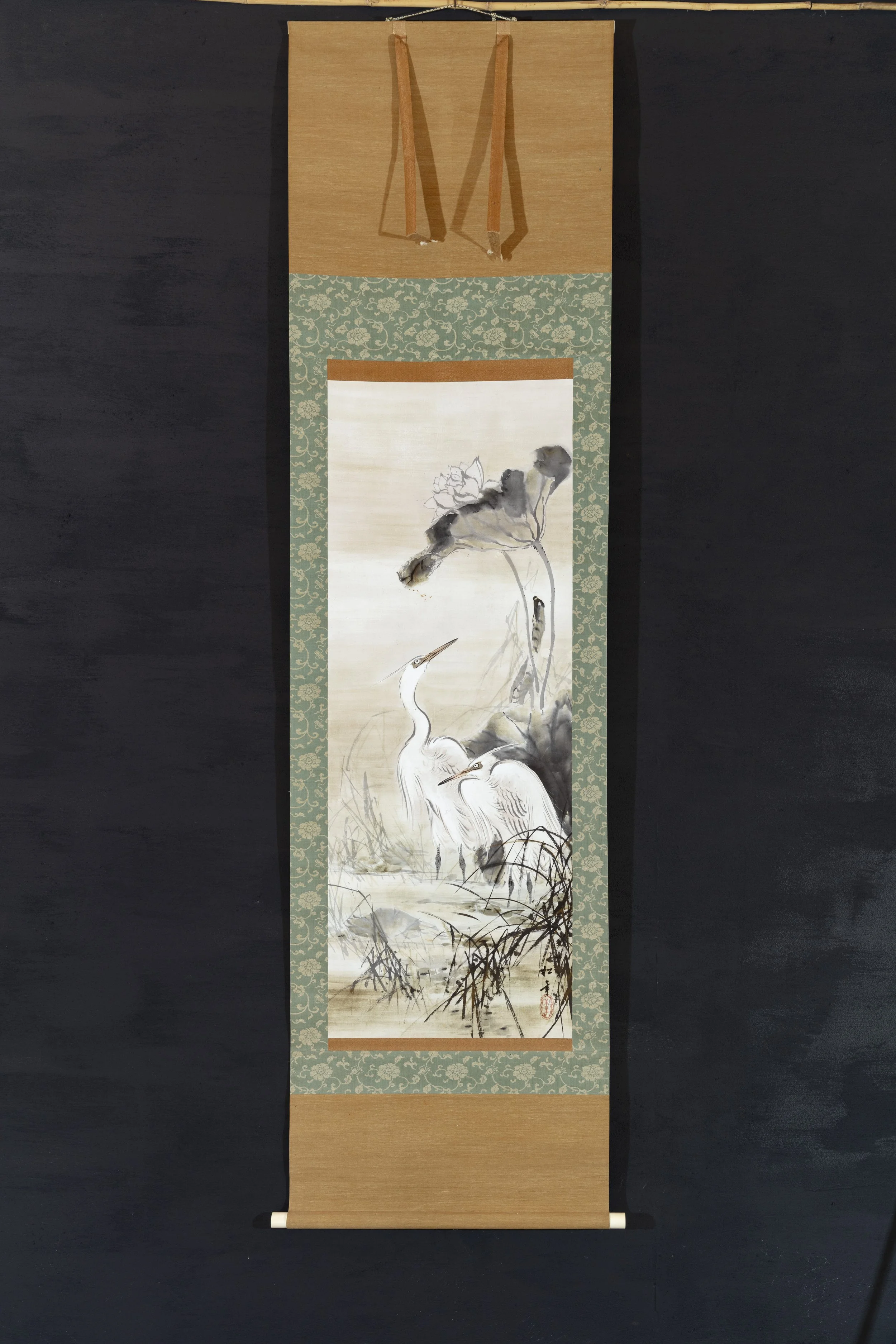
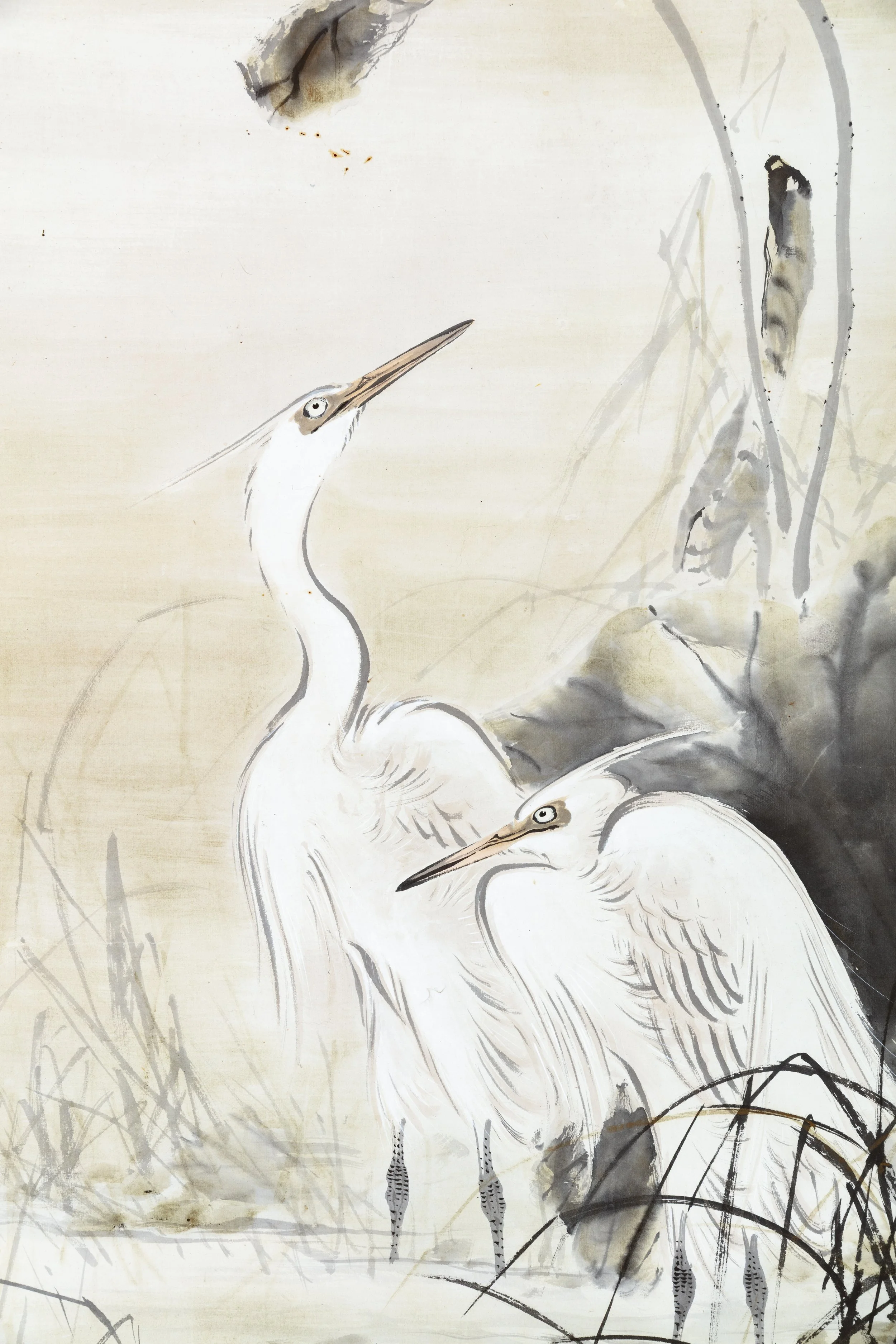
This elegant hanging scroll presents a pair of white herons standing among reeds beneath a flowering lotus, a subject deeply rooted in East Asian pictorial tradition yet here interpreted with the refined sensibility of the Meiji period. The composition is asymmetrical but carefully balanced: the upward reach of the lotus stem and bloom draws the eye vertically, while the two birds anchor the lower register, their bodies rendered with quiet authority and restraint.
Suzuki Shōnen, the son of the Kyoto painter Suzuki Hyakunen, emerged within a lineage that bridged late Edo literati painting and the shifting artistic climate of the Meiji era. Trained initially within the Shijō tradition—known for its naturalism, softness of line, and close observation of the living world—Shōnen developed a style that combined this attentiveness to nature with elements of literati expressiveness. His work often moves between descriptive clarity and suggestive economy, allowing forms to appear fully realised without excessive detail.
In this work, that balance is especially evident. The herons are defined through controlled ink outlines and delicate tonal washes, their plumage suggested rather than exhaustively described. Subtle modulation within the white bodies—achieved through faint greys and warm undertones of the silk—prevents them from appearing flat, while the sharpness of the beaks and the alert, slightly widened eyes lend a quiet intensity to their presence. They are not merely decorative forms, but attentive, living beings within a specific moment.
The surrounding environment is treated with greater looseness. Reeds and grasses are rendered in abbreviated, calligraphic strokes, some dissolving into the ground, others cutting sharply across the foreground. The lotus plant, with its broad leaves and emerging bloom, is handled in a more fluid wash, allowing areas of ink to bleed and pool. This contrast between the controlled articulation of the birds and the freer handling of the vegetation creates a subtle tension within the painting, animating the otherwise still scene.
The subject itself carries longstanding associations. Herons, often depicted in pairs, are linked to themes of vigilance, longevity, and seasonal transition, while the lotus—rooted in mud yet rising cleanly above the water—serves as a central Buddhist symbol of purity and awakening. By the Meiji period, such motifs had become part of a shared visual vocabulary, but artists like Shōnen continued to reinvigorate them through close observation and sensitive execution rather than mere repetition.
Within the broader context of Meiji painting, works of this kind occupy an important transitional position. While Japan was rapidly modernising and engaging with Western artistic models, many Kyoto-based painters maintained and refined established modes of ink and colour painting. Shōnen’s work reflects this continuity: it neither rejects tradition nor simply preserves it, but quietly adapts it to a changing cultural environment.
The scroll’s mounting, with its soft green brocade and warm silk borders, complements the painting without overwhelming it, reinforcing the vertical flow of the composition and the subdued tonal harmony of the image. The overall effect is one of calm attentiveness. Rather than presenting a dramatic or symbolic narrative, the work sustains interest through observation—through the posture of the birds, the spacing of forms, and the interplay between line, wash, and ground.
Taken as a whole, the painting exemplifies a mode of seeing that values clarity, restraint, and continuity. It does not seek to astonish, but to hold attention steadily over time, revealing its qualities through repeated viewing. In this respect, it stands as a compelling example of late nineteenth-century Kyoto painting, grounded in tradition yet responsive to the present.