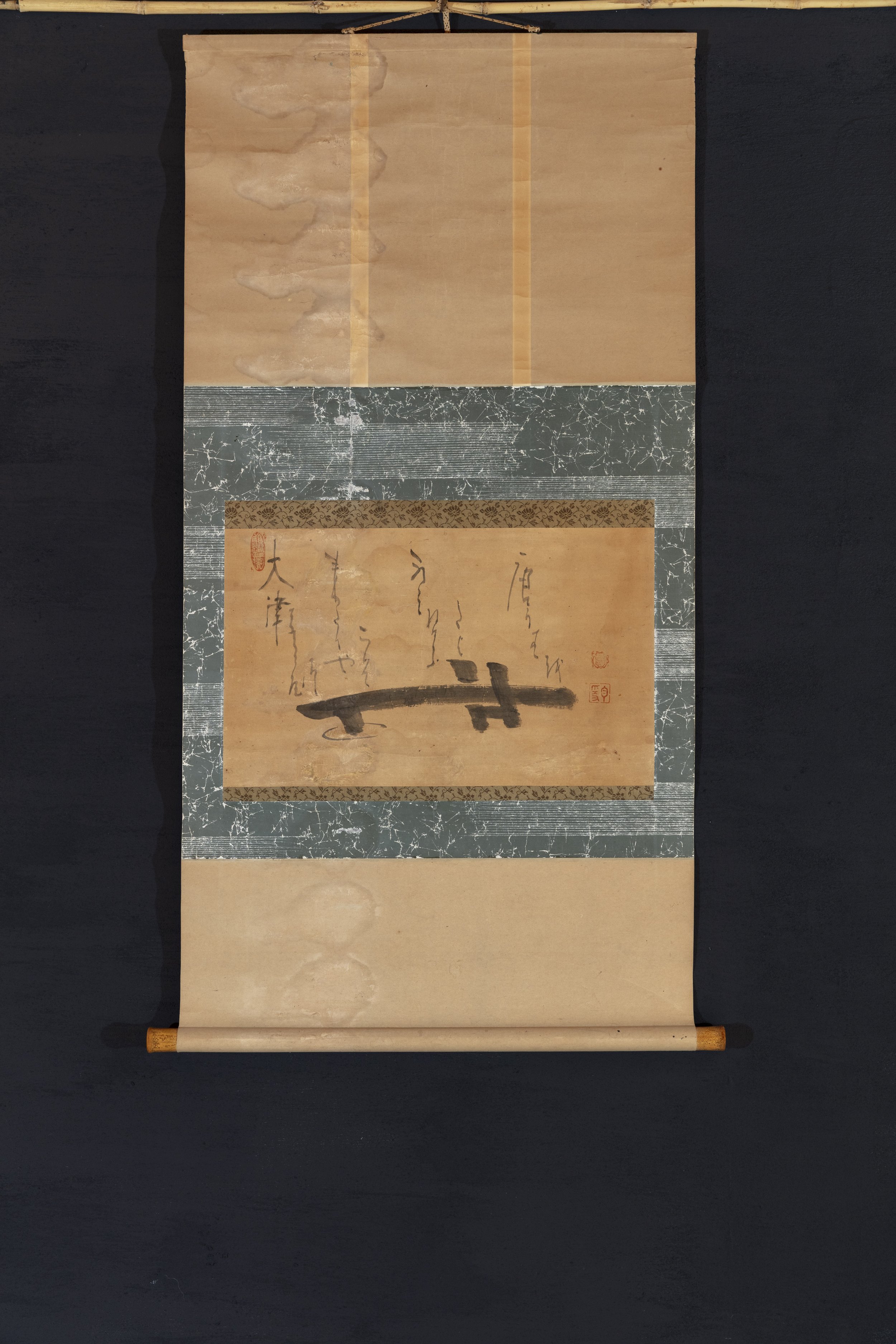
Hakuin Ekaku (1686–1769) ●
The Sixth Patriarch’s Rice Mill
Ink on paper, mounted as a hanging scroll, mid–Edo period, c.1740s–1760s
118 × 59.5 cm (overall); 30 × 50 cm (image)
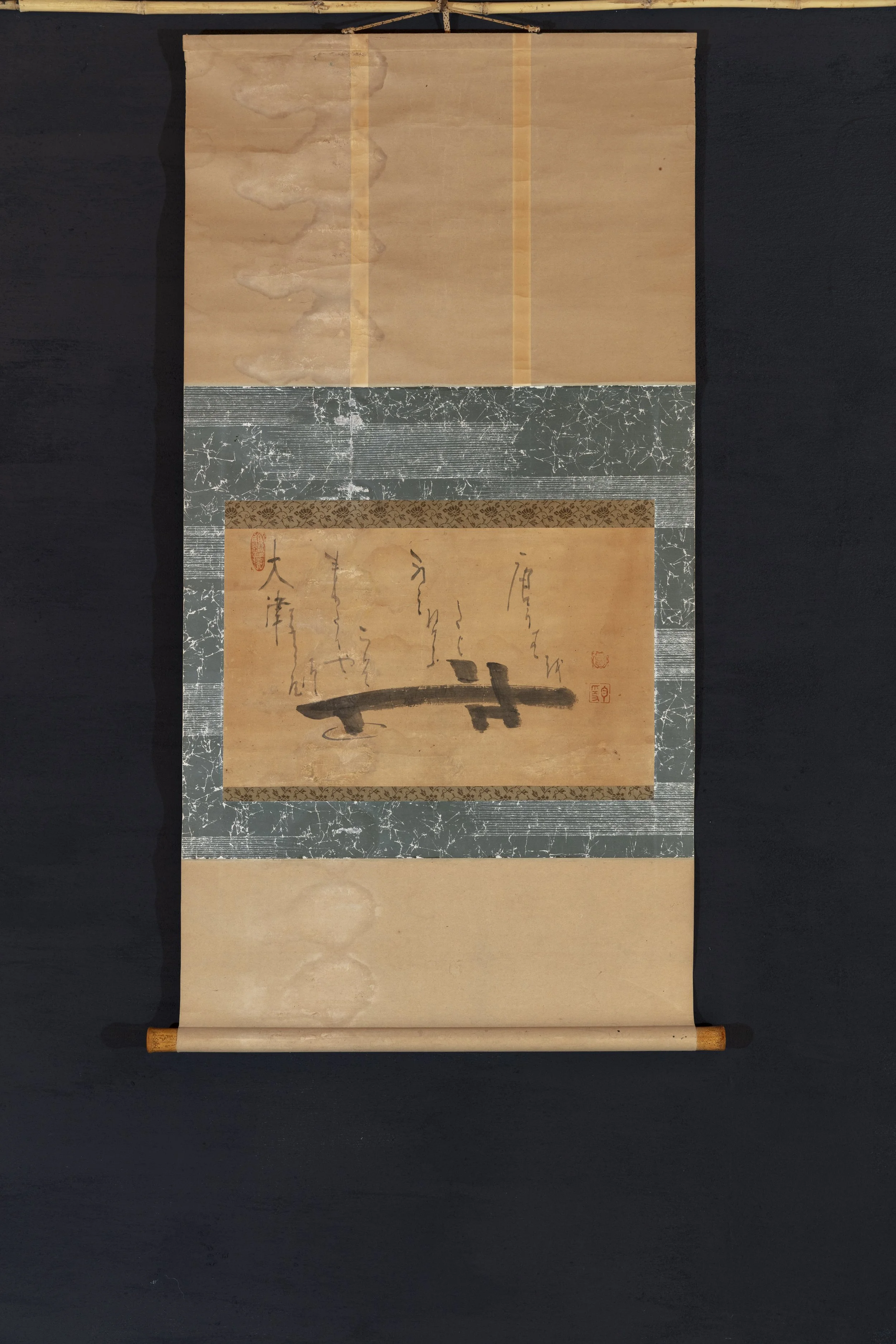
Among the most enduring visual teachings in Hakuin Ekaku’s Zen oeuvre is the image of the rice-pounding mill associated with the Sixth Patriarch, Huineng. According to Zen tradition, Huineng laboured anonymously in the monastery kitchen, pounding rice long before his awakening was publicly recognised. Though illiterate and socially marginal, he demonstrated a profound intuitive grasp of Zen insight, culminating in his spontaneous understanding of the verse contest at Huangmei.
Recognising this, the Fifth Patriarch, Hongren, secretly transmitted the robe and bowl of succession to Huineng under cover of night, instructing him to depart quietly. Huineng’s recognition as patriarch was thus concealed for years, his authority affirmed not through institutional position or public teaching, but through realization alone. For Hakuin, this episode became a concise emblem of Zen practice itself: realization concealed within ordinary work, insight ripening in obscurity, and awakening emerging through sustained effort rather than formal instruction.
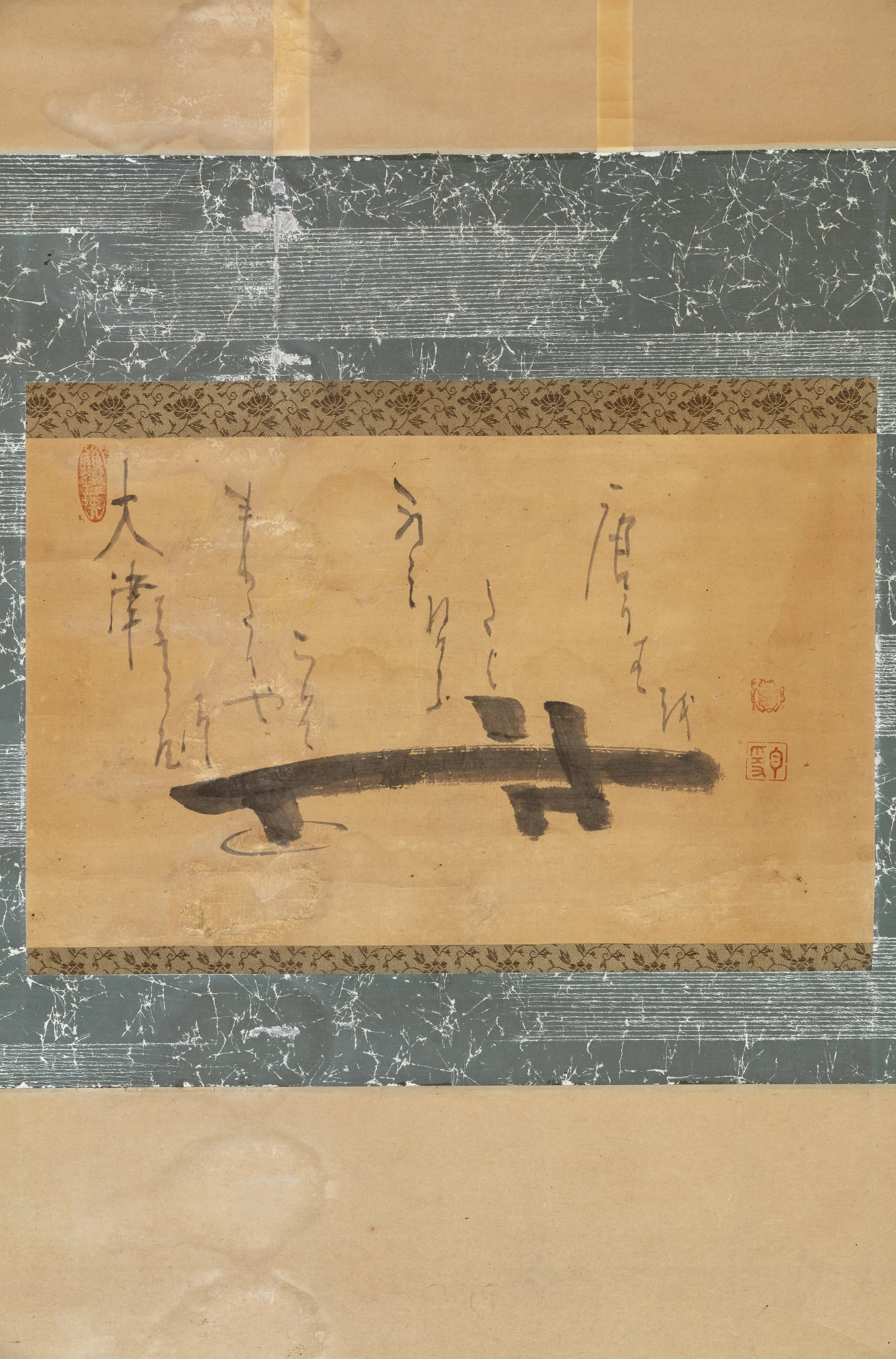
This painting belongs to a group of closely related rice-mill images produced by Hakuin across several decades of his teaching career. Rendered with extreme economy, the mill is reduced to a small number of assertive strokes—broad, weighted, and deliberately uneven. The brushwork avoids descriptive refinement, instead favouring immediacy and force. The object remains unmistakable, yet hovers between representation and sign, a characteristic feature of Hakuin’s Zen painting practice.
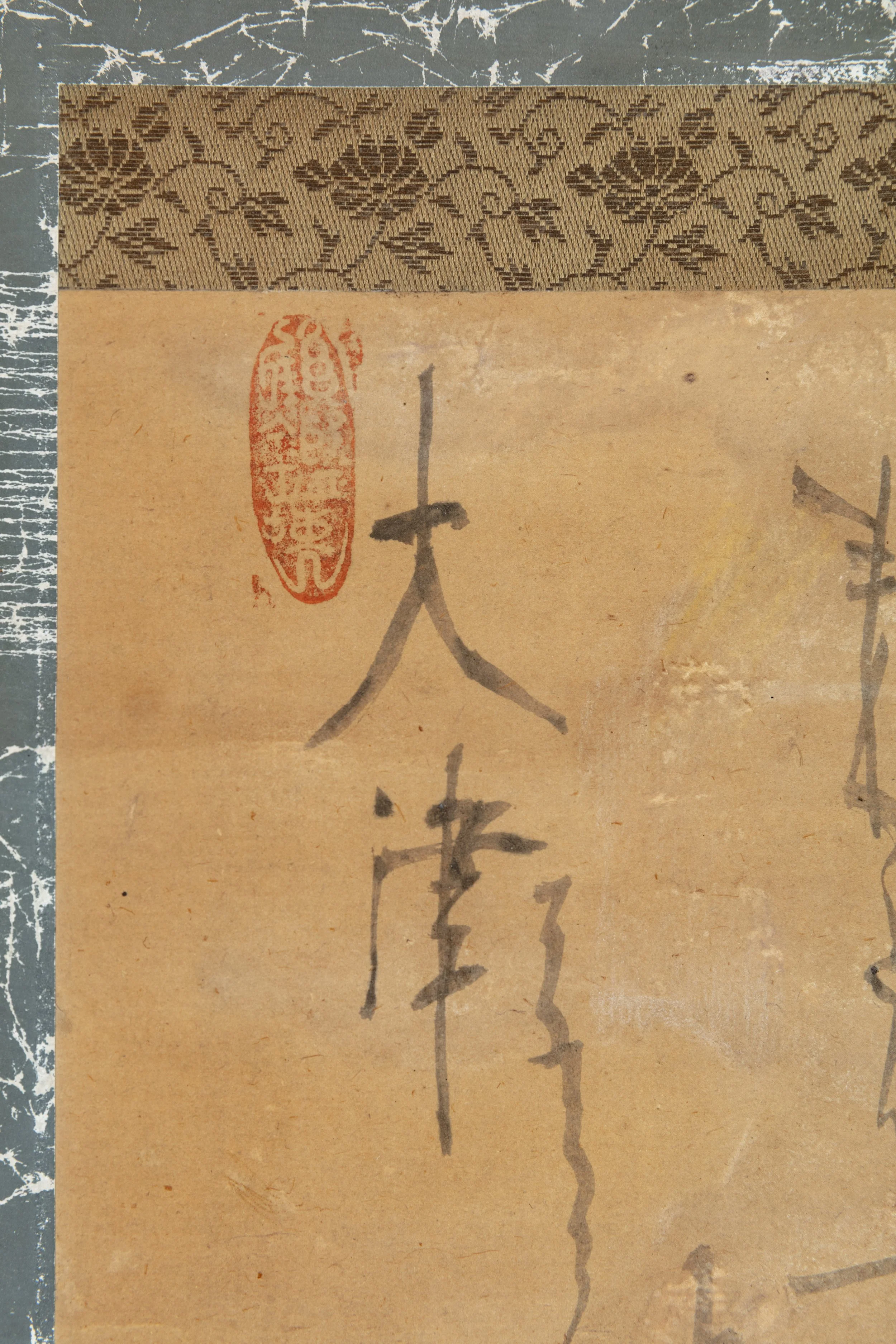
Above the image, Hakuin has brushed a short inscription in highly cursive script. As with other examples of this subject, the wording is not fixed but varies slightly between works, consistently invoking the Sixth Patriarch and his concealed labour. The calligraphy is abbreviated to the edge of legibility, prioritising movement and rhythm over textual clarity. Meaning is carried through repetition, context, and brush energy rather than through a formally resolved poem. In this instance, the inscription may be read in essence as:
The Sixth Patriarch, before awakening was known, quietly pounded rice.
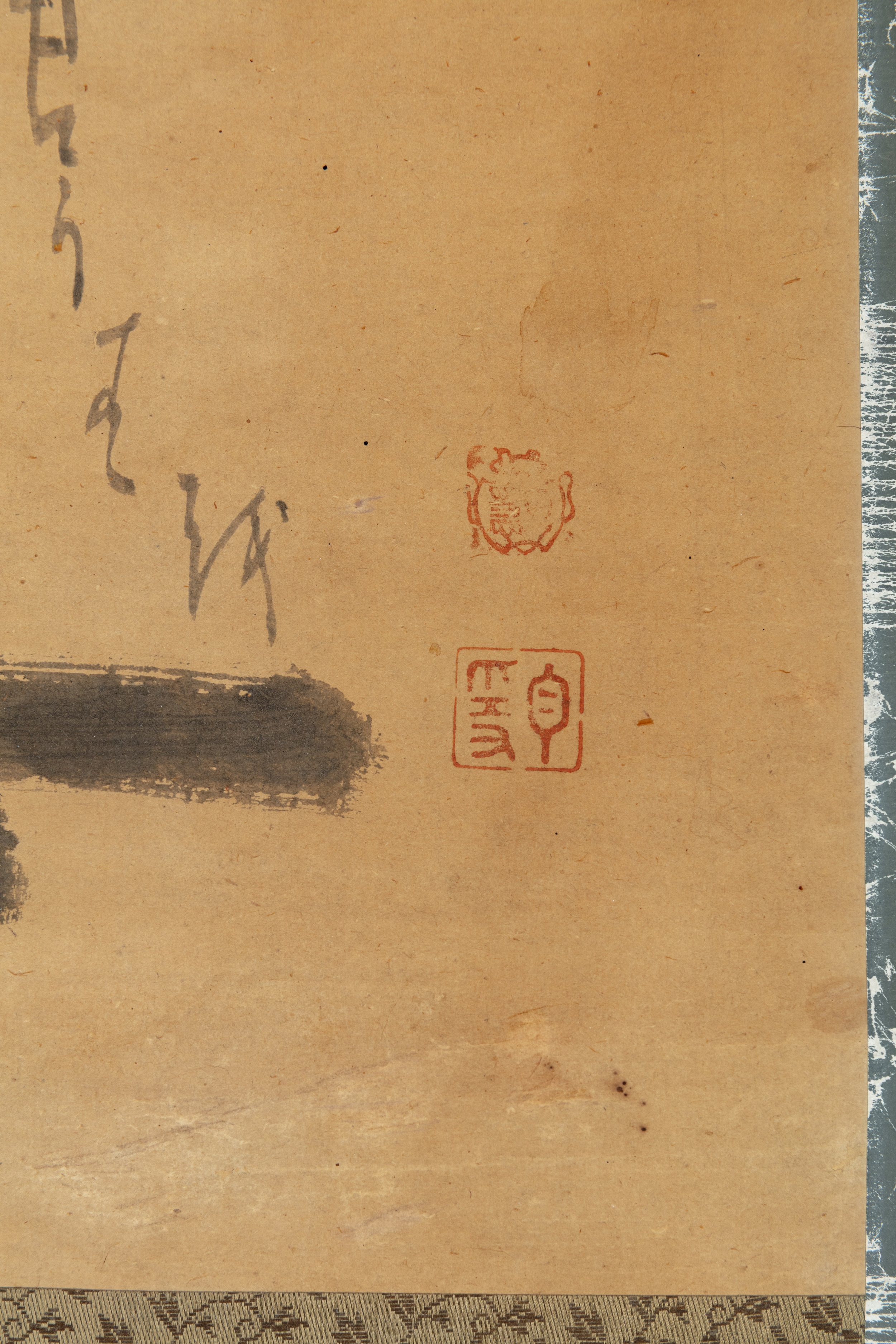
The seals are of particular importance. The Kōkan’i seal and the square “Hakuin” seal present here correspond exactly to those found on the Shakyamuni Descending the Mountain painting in this collection. At scale and in microscopic detail, the impressions align precisely, including line structure, internal wear, and minor idiosyncrasies of carving. This correspondence situates the present work securely within Hakuin’s authenticated seal corpus and provides important confirmation for a subject whose extreme economy offers few stylistic anchors.
Philosophically, the image expresses one of Hakuin’s central teachings: that awakening does not stand apart from labour, but arises within it. The rice mill functions neither as narrative illustration nor as metaphor to be decoded. It is presented as practice itself—plain, repetitive, and complete. In this reduction, Hakuin collapses the distance between work and realization, allowing the image to operate as a direct visual teaching rather than a symbolic representation.