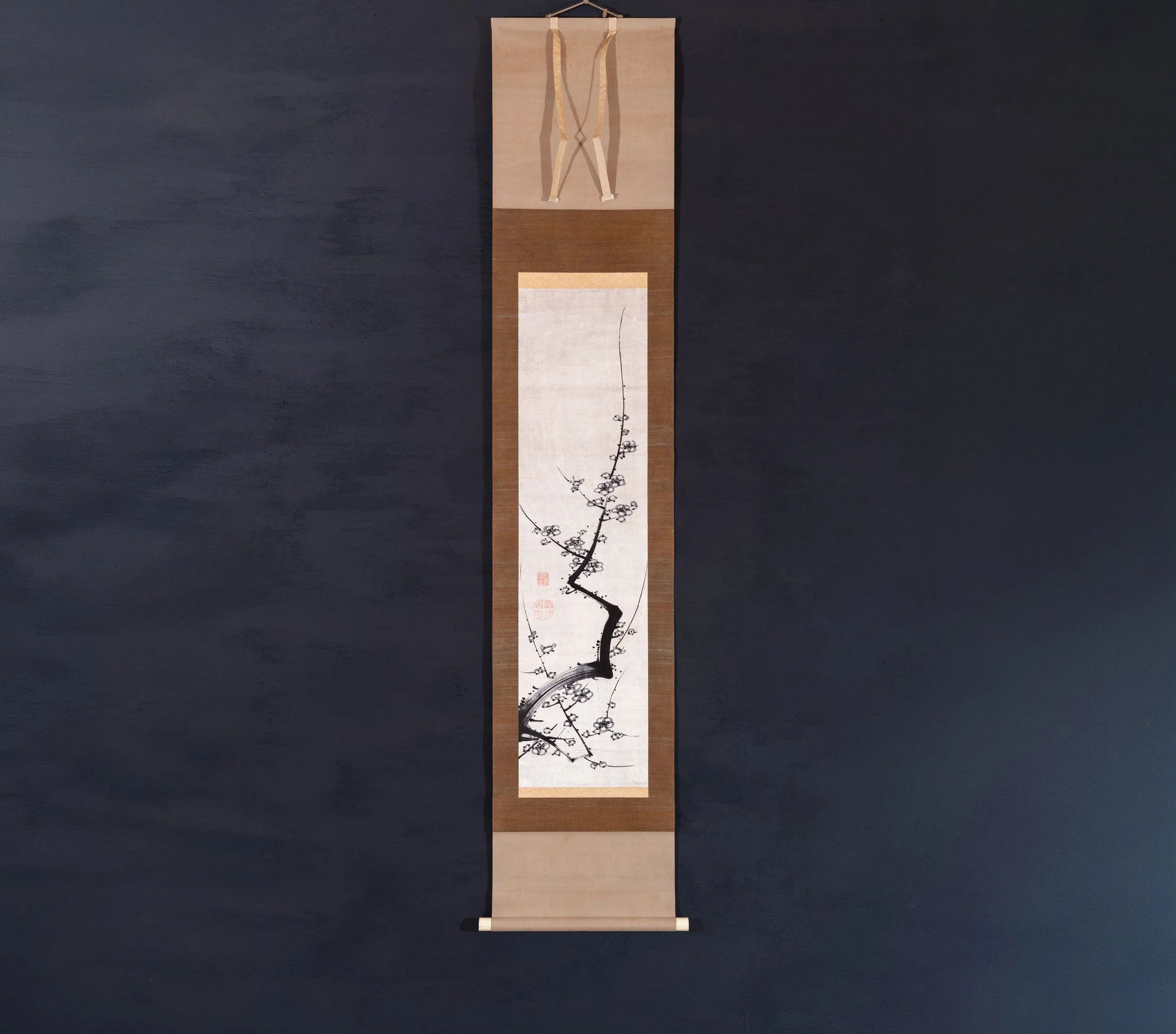
After Itō Jakuchū (1716–1800)
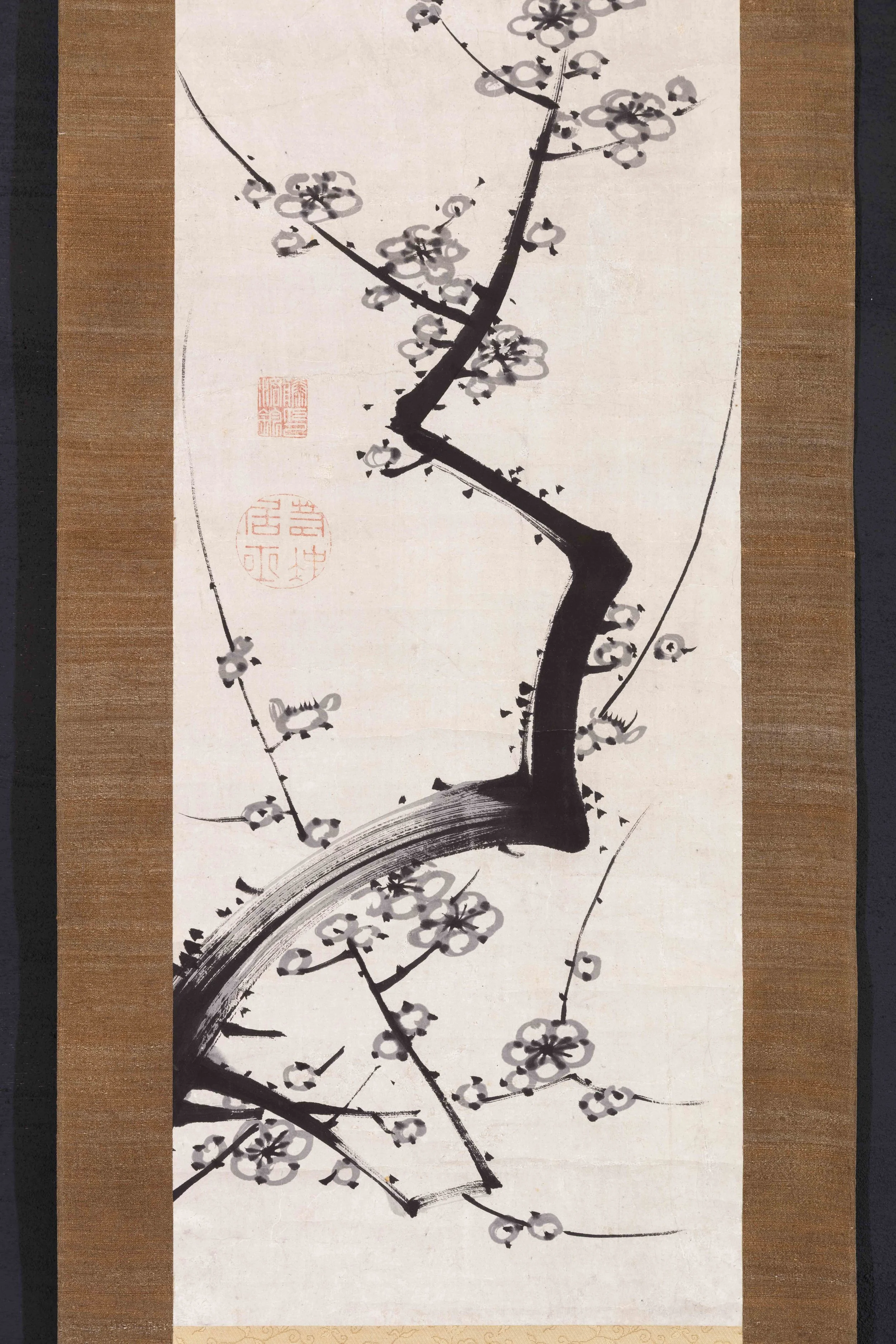
Plum Blossom Branch (Baika-zu)
Japan, mid–Edo period, late 18th century
Ink on paper, mounted as a hanging scroll
192 × 38 cm (overall); 105.5 × 27 cm (image)
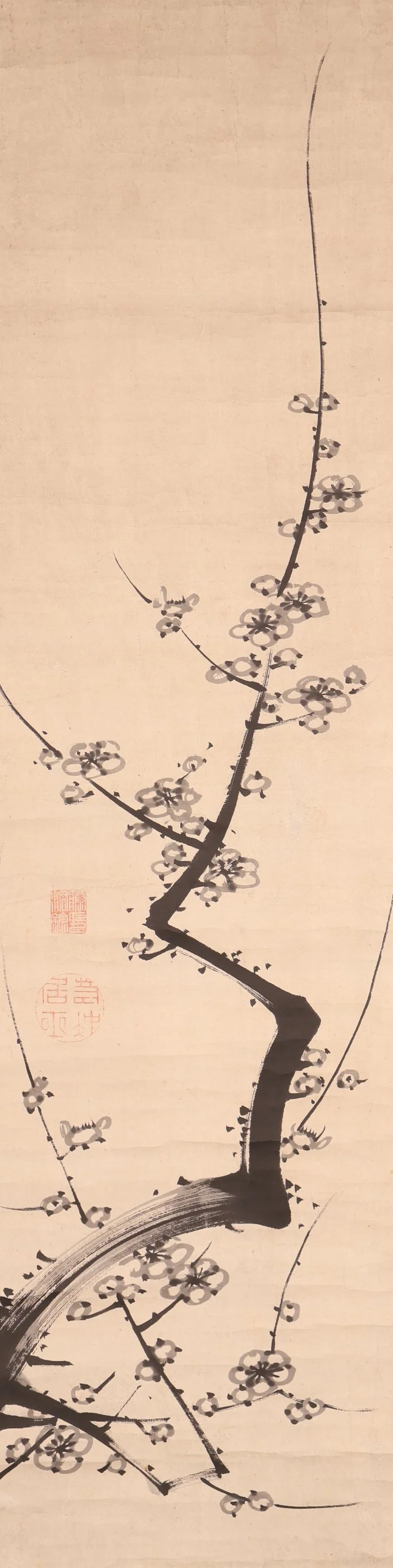
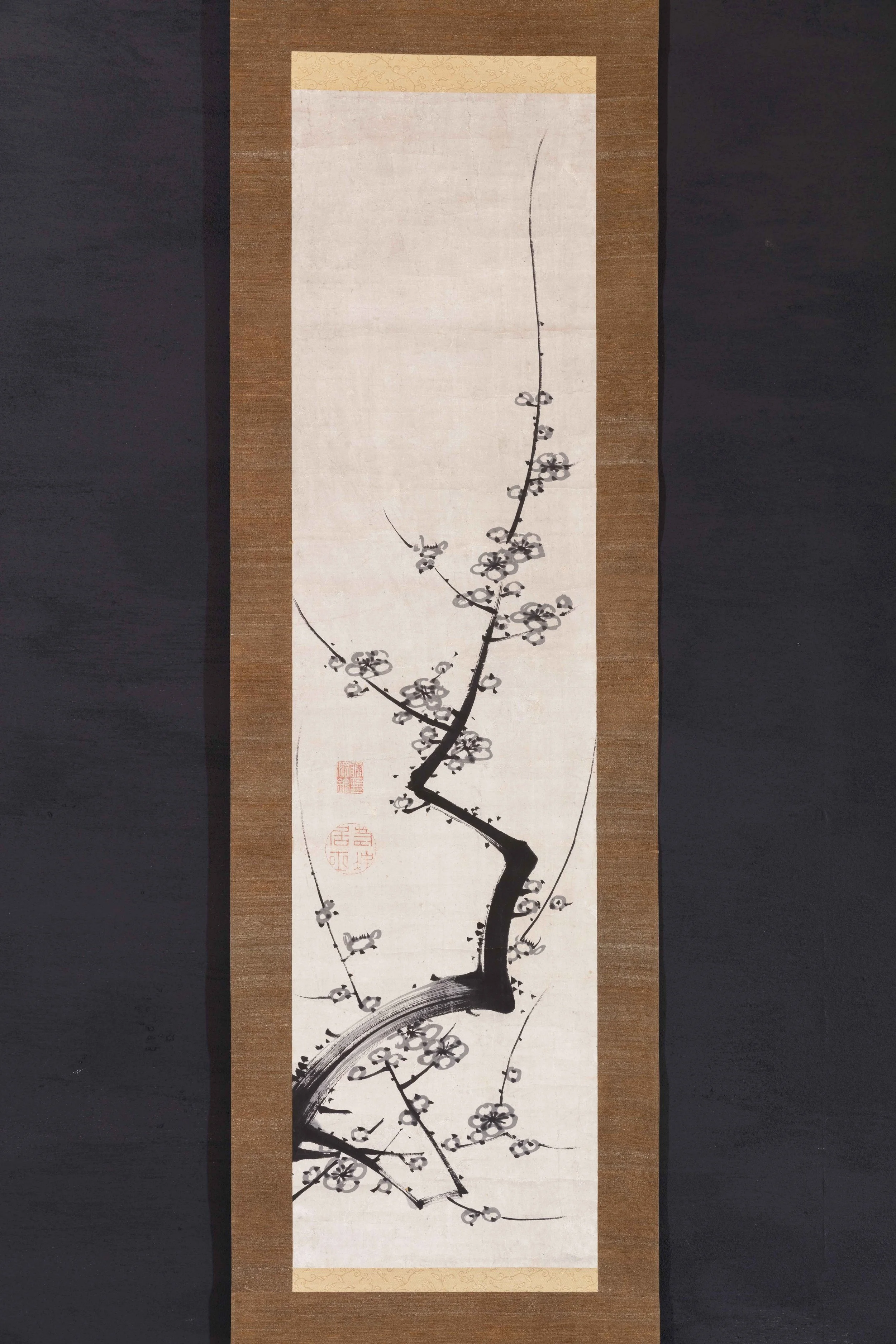
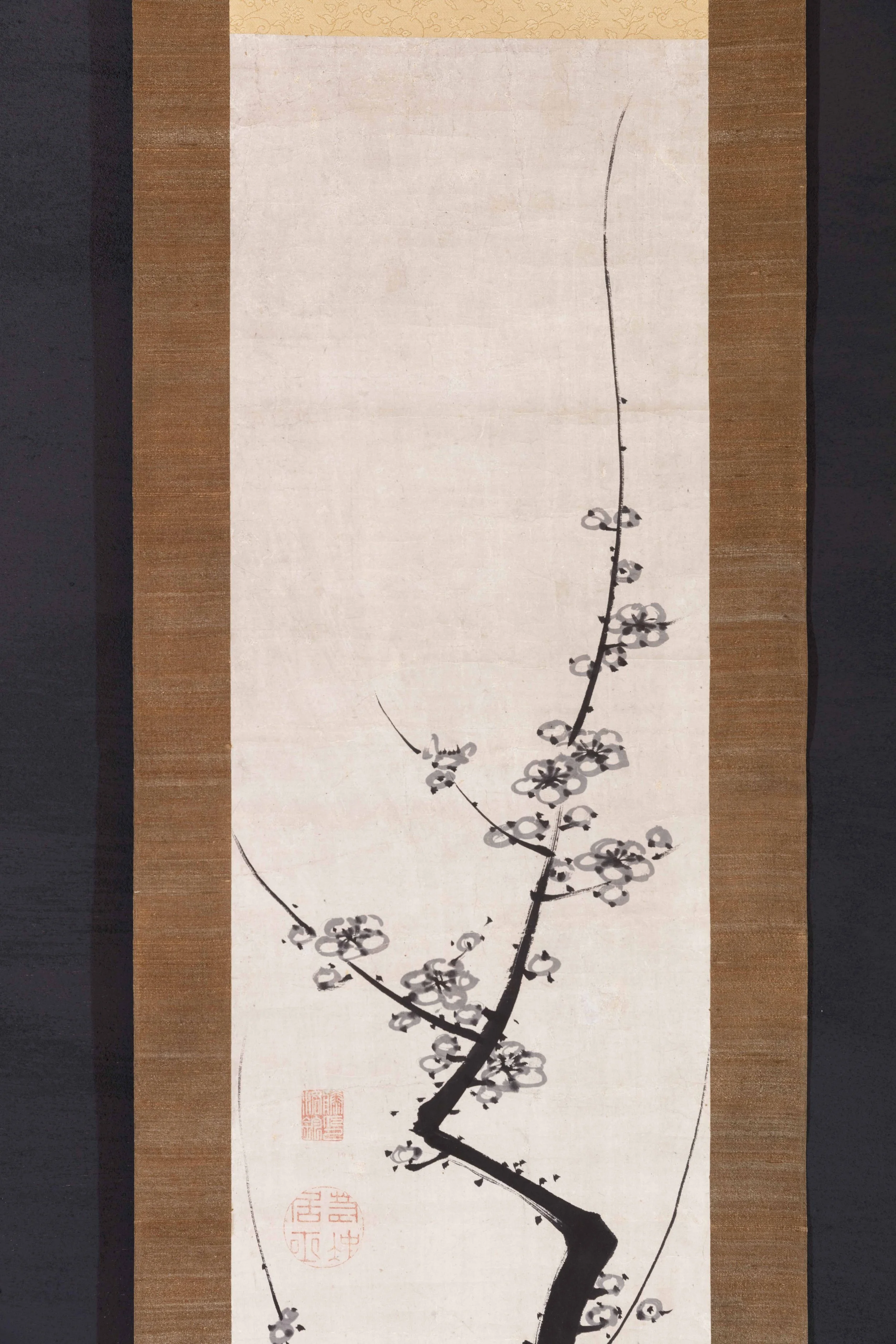
Following Itō Jakuchū’s brush, this monochrome plum branch painting distills the subject into an economy of highly controlled calligraphic movement. A single rising trunk structure carries the composition upward through sharply angled turns and abbreviated lateral shoots, while clusters of blossoms emerge through rapid, reduced notations of remarkable fluency and consistency. Rather than describing a branch in naturalistic space, the painting constructs form through movement itself, unfolding as a continuous calligraphic event.
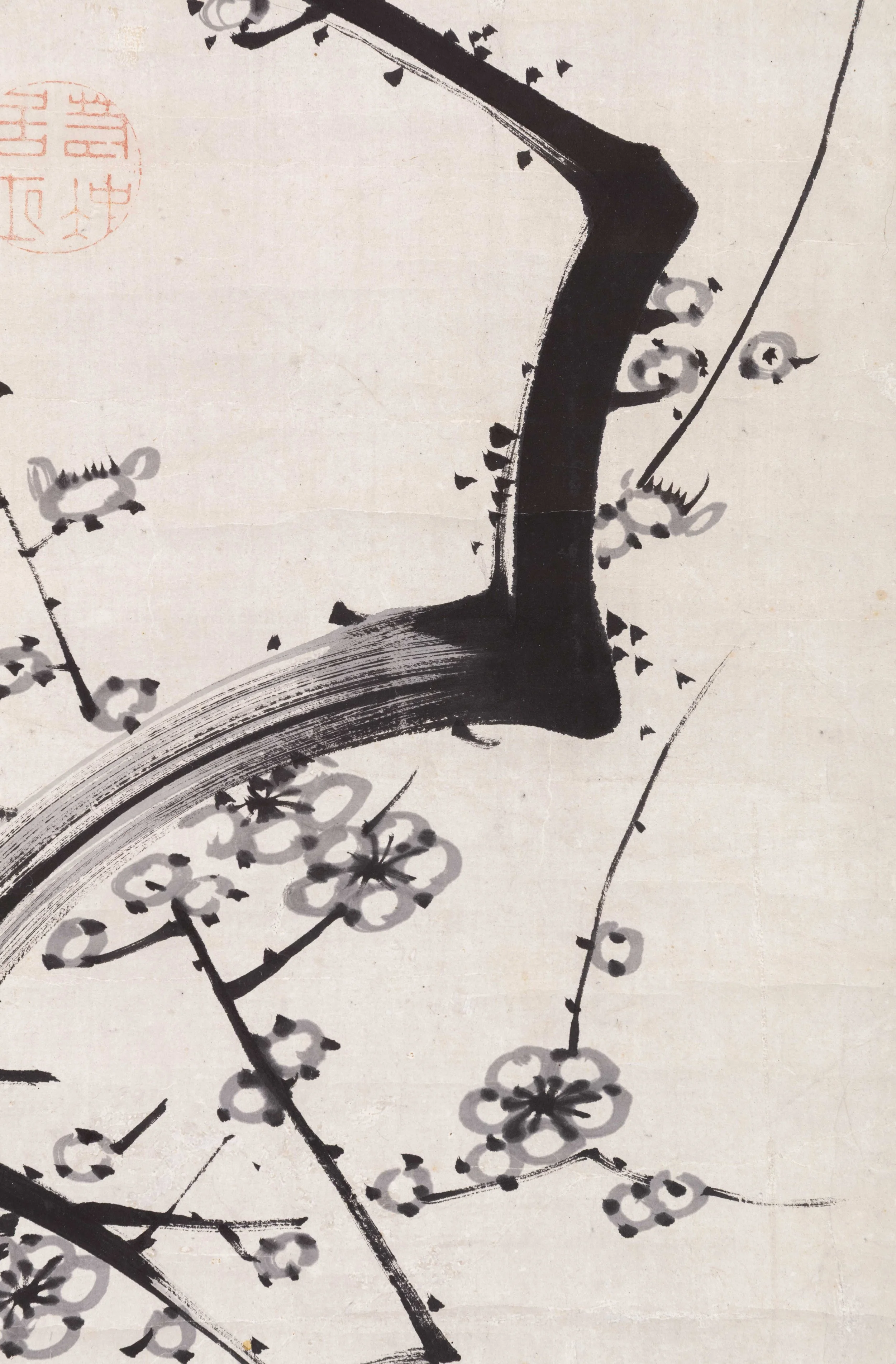
The handling of ink is central to the work’s effect. Along the lower branch, a pale streaked underlayer is laid down rapidly beneath darker linear reinforcement, producing dry filamented passages where the brush hairs separate visibly under pressure and directional change. These moments preserve the speed and physicality of execution directly on the paper surface. Throughout the work, the handling of ink demonstrates a sophisticated understanding of dilution, absorbency, timing, and directional movement. The image records decision-making in real time, preserving both confidence and risk within the brushwork itself.
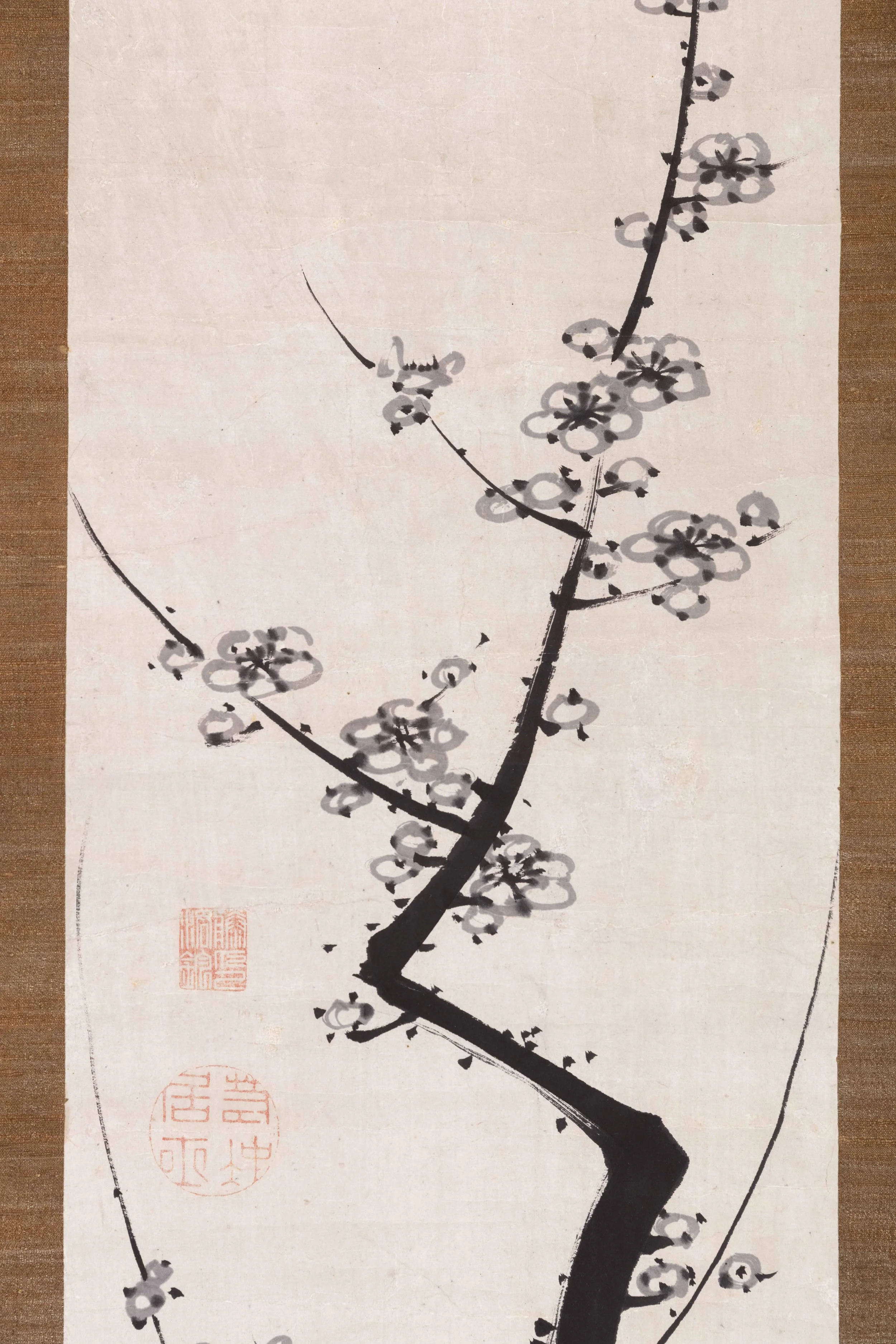
Particularly notable is the treatment of the blossoms. Several are constructed through an extremely economical sequence of gestures: a faint circular wash establishing volume, small anchoring dots at the base, paired lateral loops suggesting unfolding petals, and rapid dark flicks indicating stamens. Repeated across the composition with only slight variation, these abbreviated forms create a convincing sense of organic rhythm without descriptive excess. The blossoms resolve consistently into related graphic structures, suggesting deeply internalized habit and fluency rather than hesitant imitation.
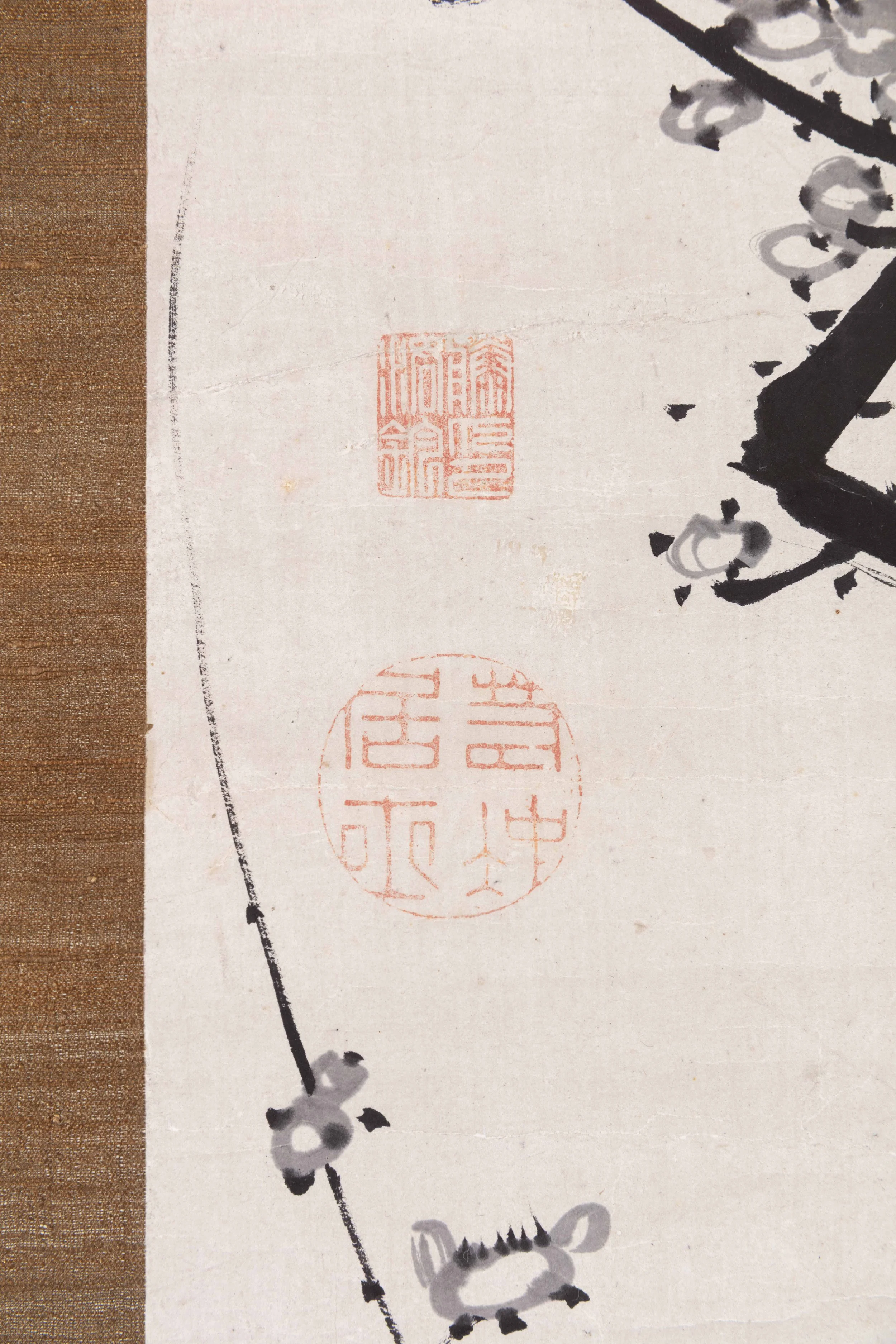
Two seals appear at the lower left: a square relief seal reading Tō Jokin no in and a round relief seal reading Jakuchū koji. The round Jakuchū koji seal corresponds with extraordinary precision to impressions found on the rooster painting in this collection and on Hanshan and Shide in the collection of the Metropolitan Museum of Art, New York, from the Mary Griggs Burke Collection. When the impressions from all three works are compared, they align not only in overall form but also in minute irregularities and progressive wear, suggesting either direct use of the same seal stones or access to impressions derived from closely related exemplars circulating within Jakuchū’s extended sphere of influence.
The square seal provides a complementary and equally compelling line of comparison. The Tō Jokin no in seal appearing on Hanshan and Shide represents a well-documented merchant-name seal associated with Jakuchū’s studio practice. The corresponding seal on the rooster painting aligns closely with authenticated examples, including Goose and Reeds, circa 1770, sold at Bonhams, London, in The Ethereal Brush: Important Japanese Paintings from a London Collection, 10 November 2016. That work bears the same combination of seals — Senga zeppitsu at the upper right and, at the lower left, Tō Jokin no in together with Jakuchū koji — and demonstrates how consistent seal usage could persist across works now occupying very different positions within modern scholarly opinion.
The plum painting, while bearing a different square seal, gains significance precisely through this configuration. Its round Jakuchū koji seal aligns remarkably closely with those on the rooster painting and the Metropolitan Museum example, while the differing square seal reflects the fluid and varied seal practices associated with Jakuchū and works produced within his wider orbit. Rather than resolving authorship conclusively, these convergences reveal the extraordinary complexity of Edo-period workshop culture and the transmission of admired visual languages through repetition, study, and reinterpretation.
Recent scholarship and connoisseurial reassessment have increasingly emphasized the presence of highly sophisticated copies, later studio works, and historically proximate reinterpretations within the corpus traditionally associated with Jakuchū. In some cases, paintings long accepted as autograph works have later been reconsidered, while certain copies demonstrate such fluency, vitality, and technical intelligence that they preserve aspects of the master’s visual thinking with astonishing immediacy.
Although now best understood as a highly accomplished work produced after Jakuchū rather than securely autograph, the painting nevertheless preserves many characteristics associated with the broader Jakuchū tradition: disciplined reduction, structural clarity, and an insistence on vitality achieved through brush movement rather than elaborate finish. Viewed alongside authenticated works associated with Jakuchū and his circle, the present painting reveals a shared underlying logic — an insistence on exactitude under speed, a refusal of decorative smoothing, and a reliance on deeply internalized procedures. Its vitality lies not in documentary certainty alone, but in the remarkable persistence of a visual language transmitted across generations of admiration, study, and practice.