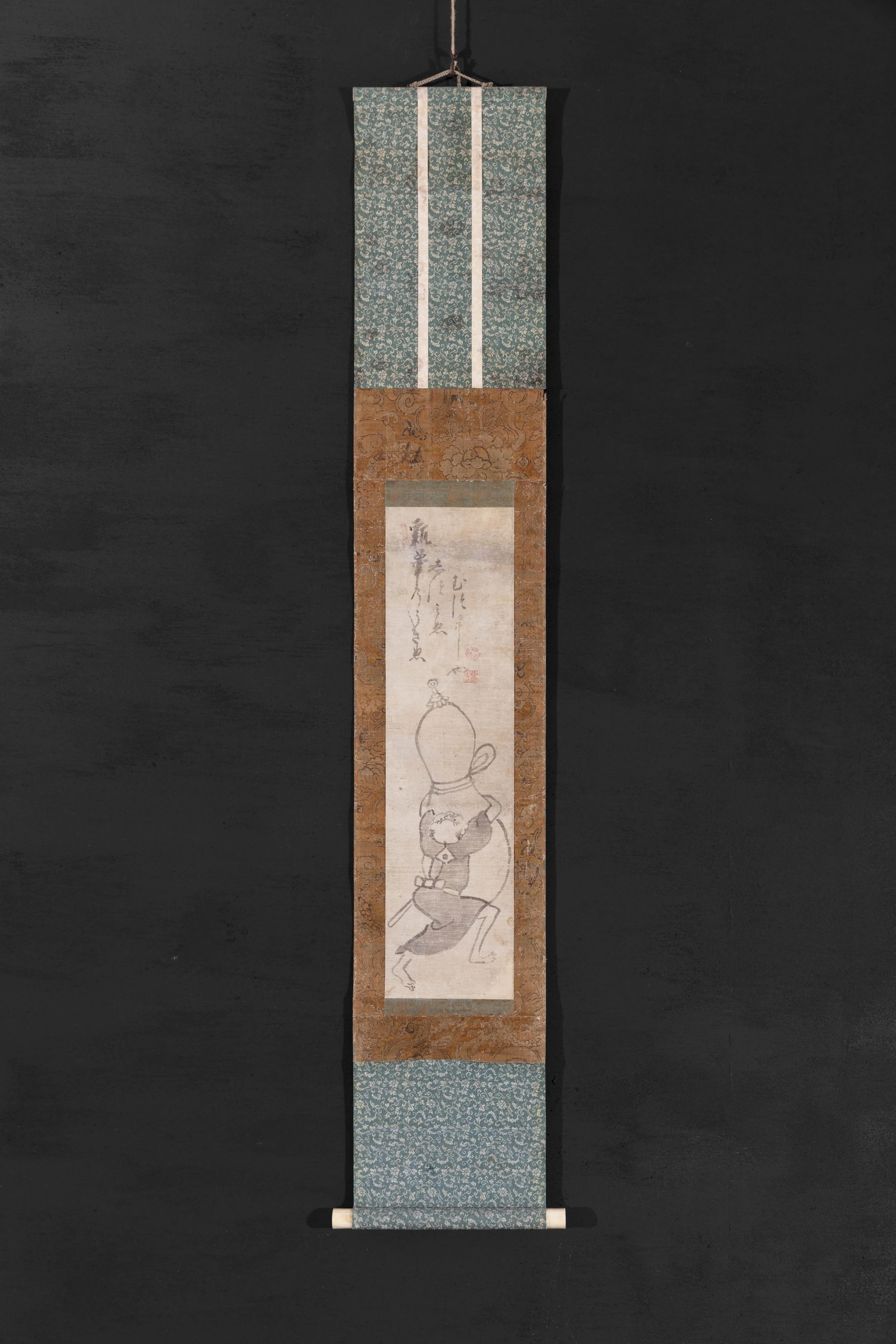
After Hakuin Ekaku (1686–1769)
Samurai Straining to Grasp a Gourd
Japan, mid–Edo period.
Ink on paper, mounted as a hanging scroll 137 x 23 cm (total) 59 x 15.5 cm (image)
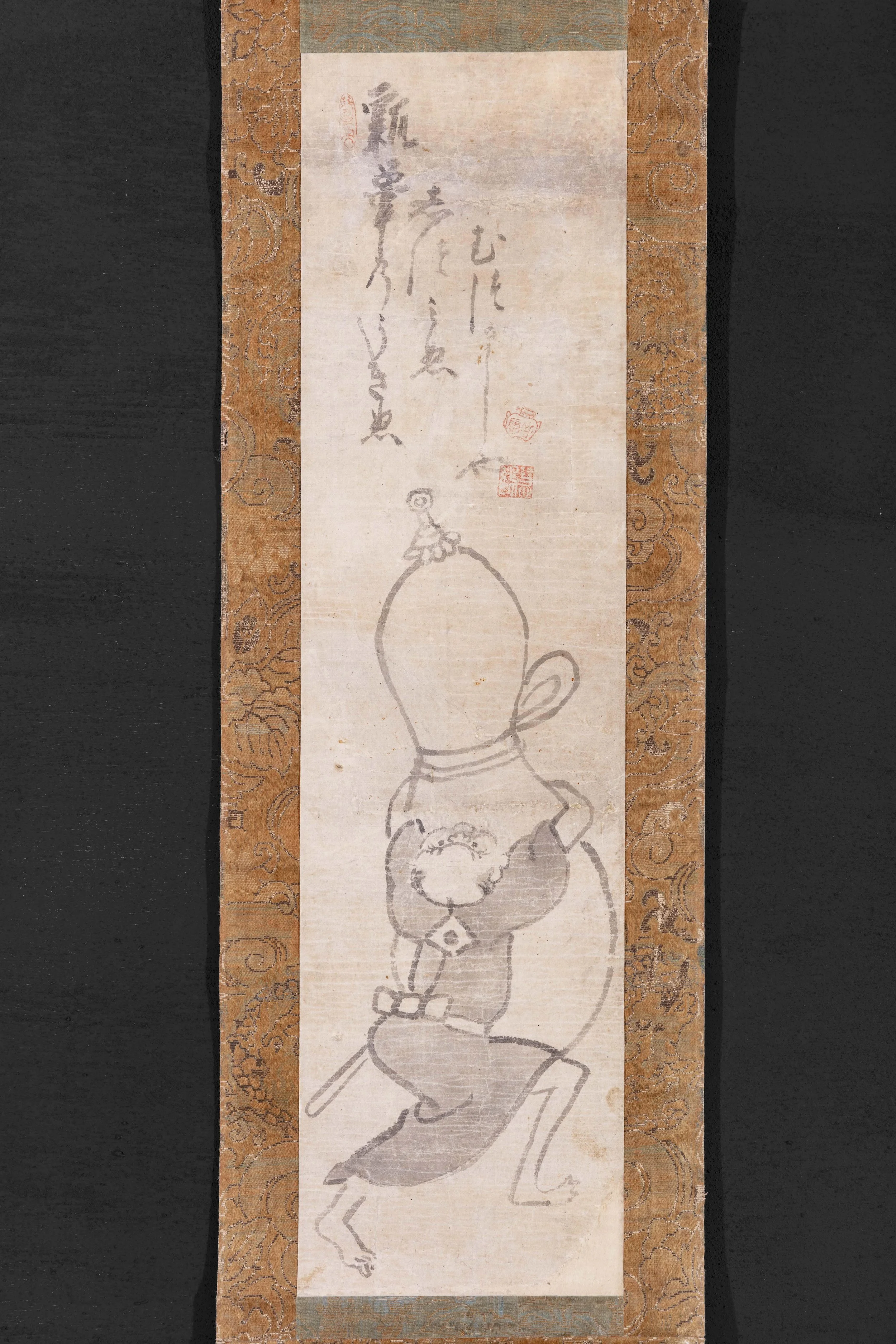
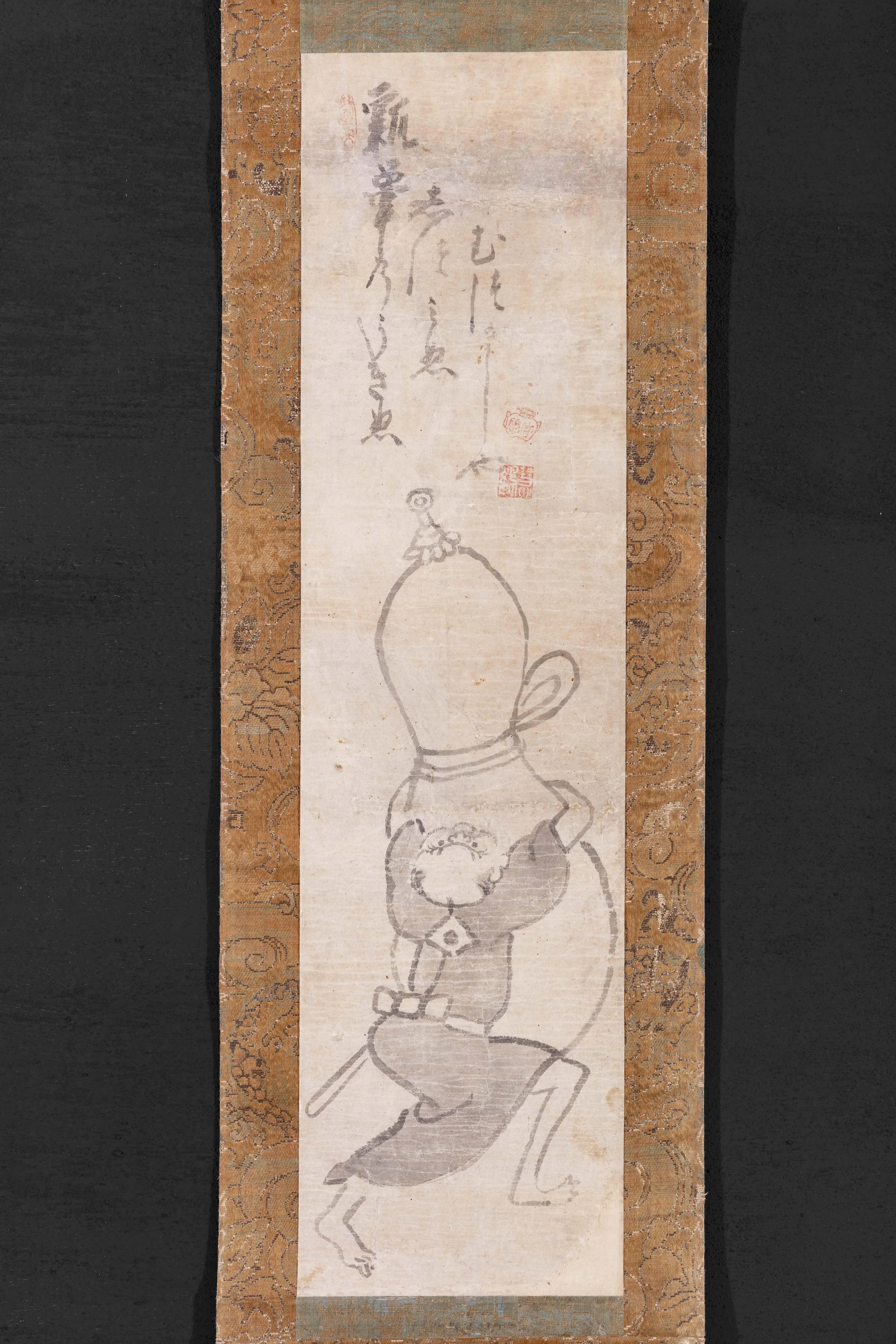
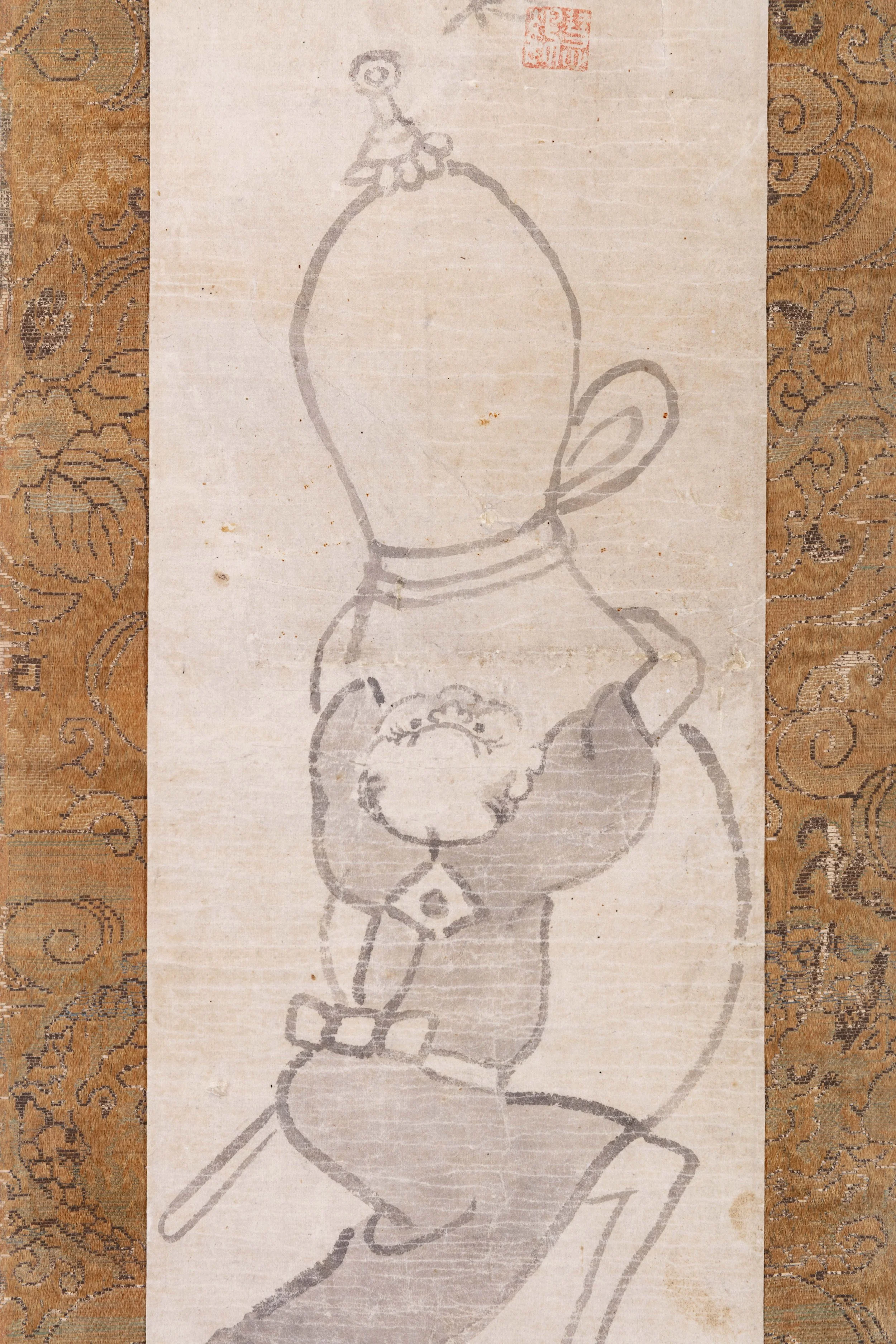
This striking and deliberately unstable composition depicts a noble figure locked in an impossible act of exertion, straining upward toward an oversized gourd suspended above his head. The posture is intentionally precarious: knees bent, torso twisted, arms extended rigidly upward in visible effort. The figure appears almost off balance, as though the very act of reaching has destabilized the body itself. Rendered with remarkable economy, the image depends less upon descriptive detail than upon the expressive tension generated through posture, imbalance, and directional movement.
The gourd carries long-standing associations within Zen and Daoist visual traditions, where it frequently functions as a symbol of emptiness, impermanence, wandering, or unattainable understanding. The composition also recalls earlier Zen pictorial paradoxes descending from Muromachi-period ink painting, most famously the tradition surrounding Josetsu’s Catching a Catfish with a Gourd. In such images, the object pursued remains structurally inaccessible because the means of grasping it are themselves inadequate. Here the paradox is sharpened through exaggeration and theatricality. The gourd looms impossibly overhead while the figure commits himself ever more completely to the futile mechanics of reaching.
Particularly notable is Hakuin’s apparent decision to cast the protagonist not as a monk or anonymous seeker, but as a figure of rank or martial authority. The distinction may not be incidental. The image carries a subtle but perceptible satirical edge, transforming the act of grasping into a reflection on ambition, fixation, or the instability of worldly striving itself. The samurai’s rigid exertion becomes faintly comic without ever losing psychological conviction.
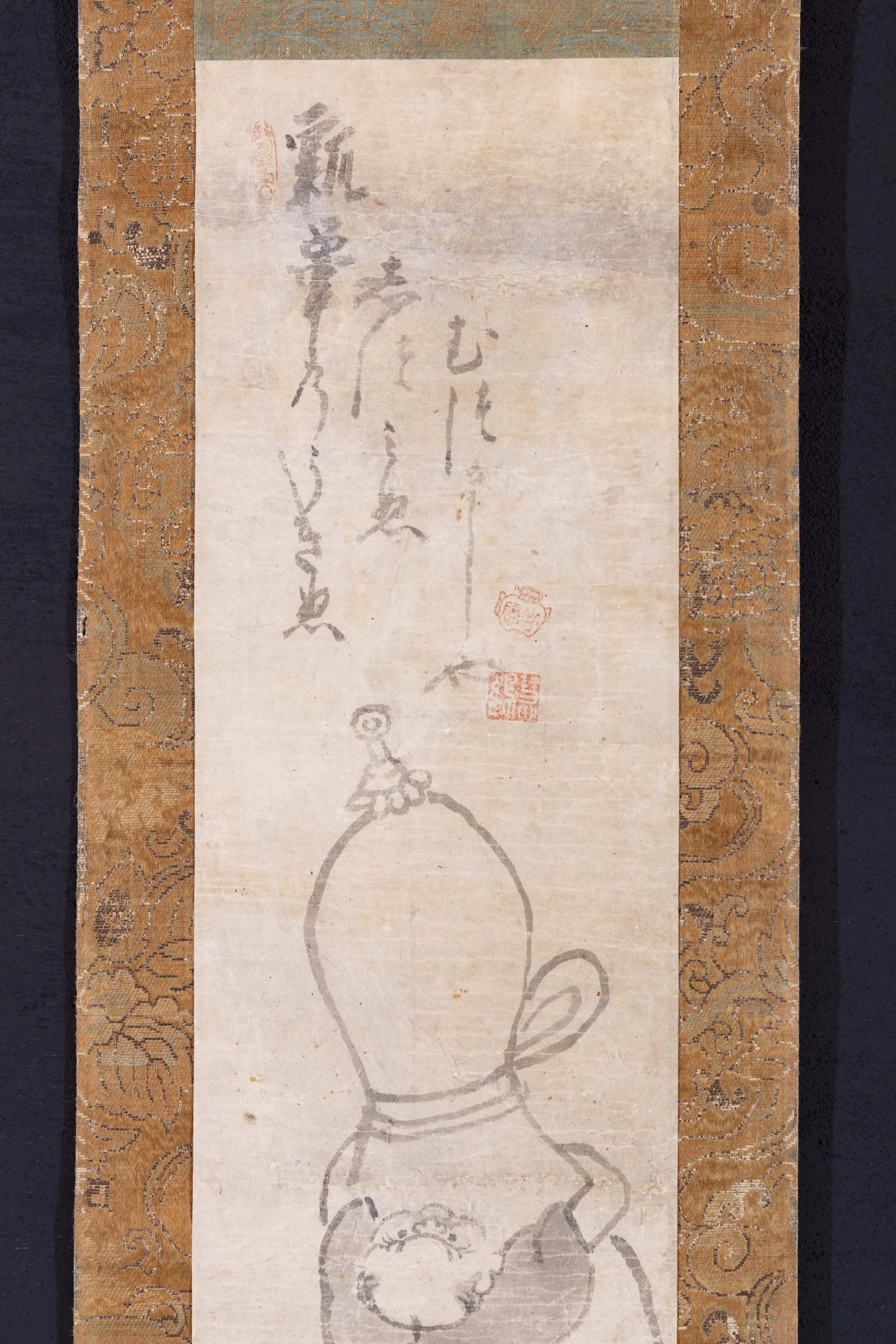
The inscription above the figure corresponds closely with formulations found elsewhere in paintings associated with Hakuin and his circle. In reconstructed form, the text conveys a severe and compact reflection on seeking and non-attainment: whether knowing or unknowing, even if one seeks, it cannot be grasped. The phrase does not merely caption the image but structurally reinforces it. The physical strain enacted below becomes the visible analogue of the mental fixation described above.
Shireba / shirazuba
motomete mo
ezu
Whether one knows or does not know,
even if one seeks,
it cannot be obtained.
The brushwork throughout remains highly economical. The figure is constructed through rapid but controlled linear movements alternating between dry abrasion and fuller passages of ink. The robe contours preserve visible shifts in pressure and speed, while the sparse colouring heightens the sense of theatrical concentration without overwhelming the monochrome structure beneath. The composition achieves much of its force through emptiness itself: the open paper surrounding the figure intensifies both the absurdity and isolation of the gesture.
Three red seals appear below, including an oval Kokan’i seal rendered in a rare reverse-intaglio format in which the design appears as red linear reserve against a pale ground. Comparable examples of this particular seal treatment appear only infrequently among works associated with Hakuin and related traditions. While such correspondences offer useful points of orientation, seal evidence alone remains insufficient for resolving questions of authorship with certainty.
At the same time, close comparison with other paintings associated with Hakuin reveals recurring compositional habits and inherited line structures that complicate straightforward attribution. Certain facial solutions, robe articulations, and calligraphic rhythms appear repeatedly across works of varying quality and degree of spontaneity, suggesting the persistence of transmitted models and repeated reinterpretation within broader Hakuin painting lineages. The present work is therefore best approached not as a definitively autograph painting, but as part of a wider visual tradition shaped through admiration, disciplined emulation, and the circulation of established motifs.
Nevertheless, the painting remains unusually compelling as an image. Unlike many repeatedly transmitted Zen themes, this specific formulation appears comparatively uncommon. No exact parallel combining this particular figure type, inscriptional structure, and compositional arrangement has yet been identified among published examples. Whether understood as autograph, closely associated, or later interpretive work, the painting sustains a remarkable degree of graphic clarity and psychological immediacy.
What ultimately gives the image its force is the precision with which visual instability and philosophical meaning converge. The figure reaches upward with total commitment, yet the very structure of the composition denies resolution from the outset. The resulting tension — comic, severe, and strangely humane — allows the painting to operate simultaneously as satire, Zen paradox, and study in human striving. Its power lies less in final certainty of attribution than in the enduring vitality of the visual language through which that insight is conveyed.