Sengai Gibon (1750–1837)
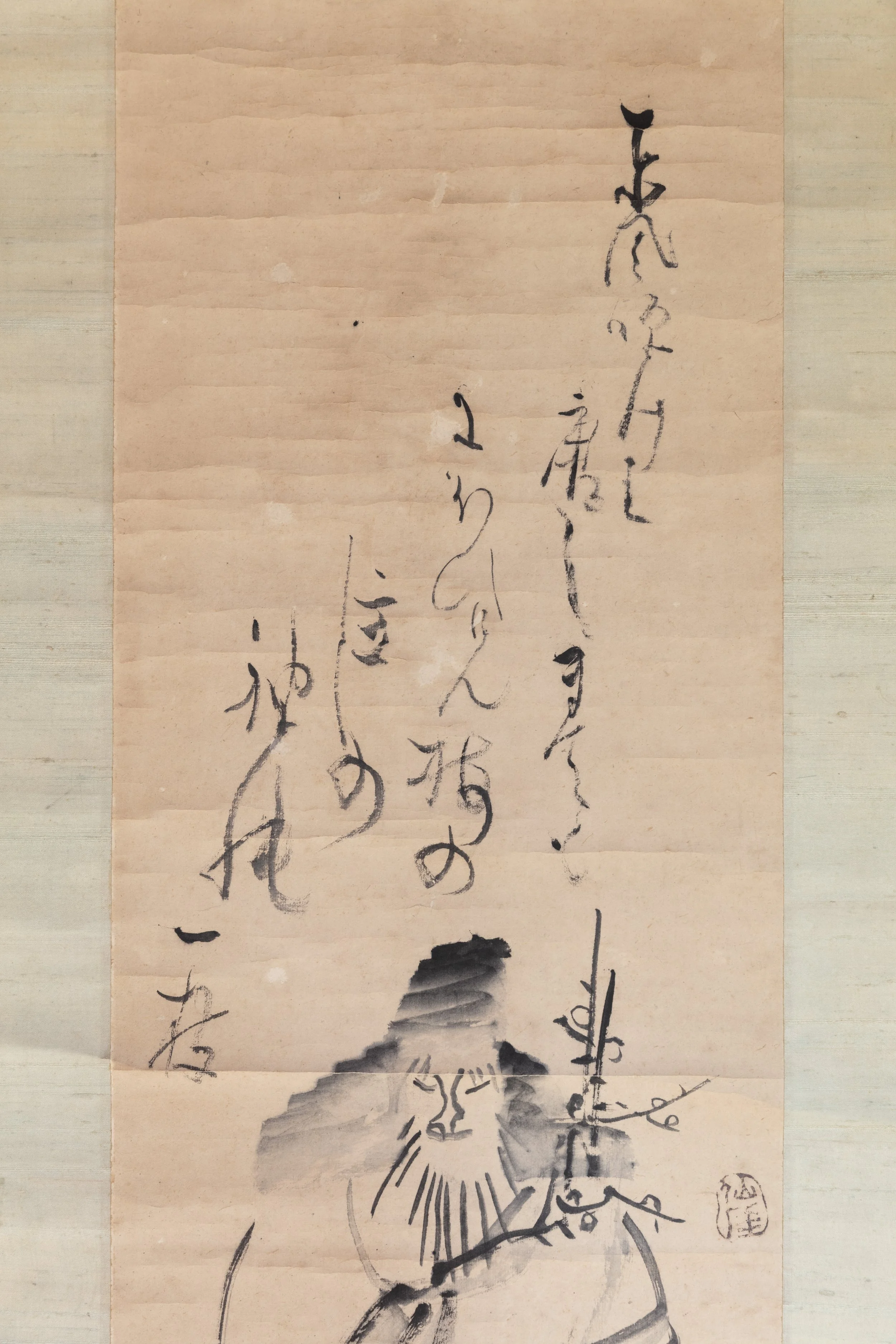
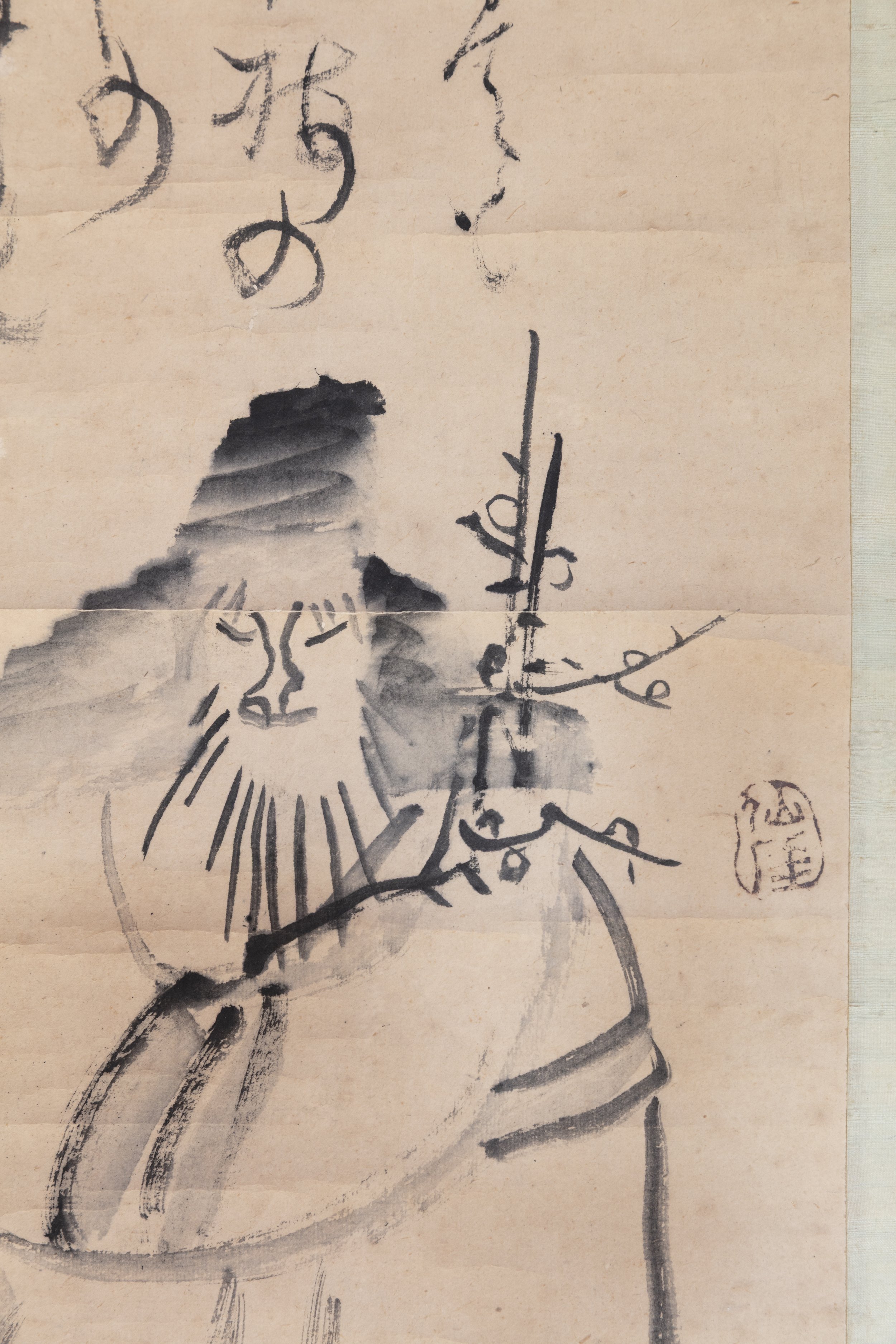
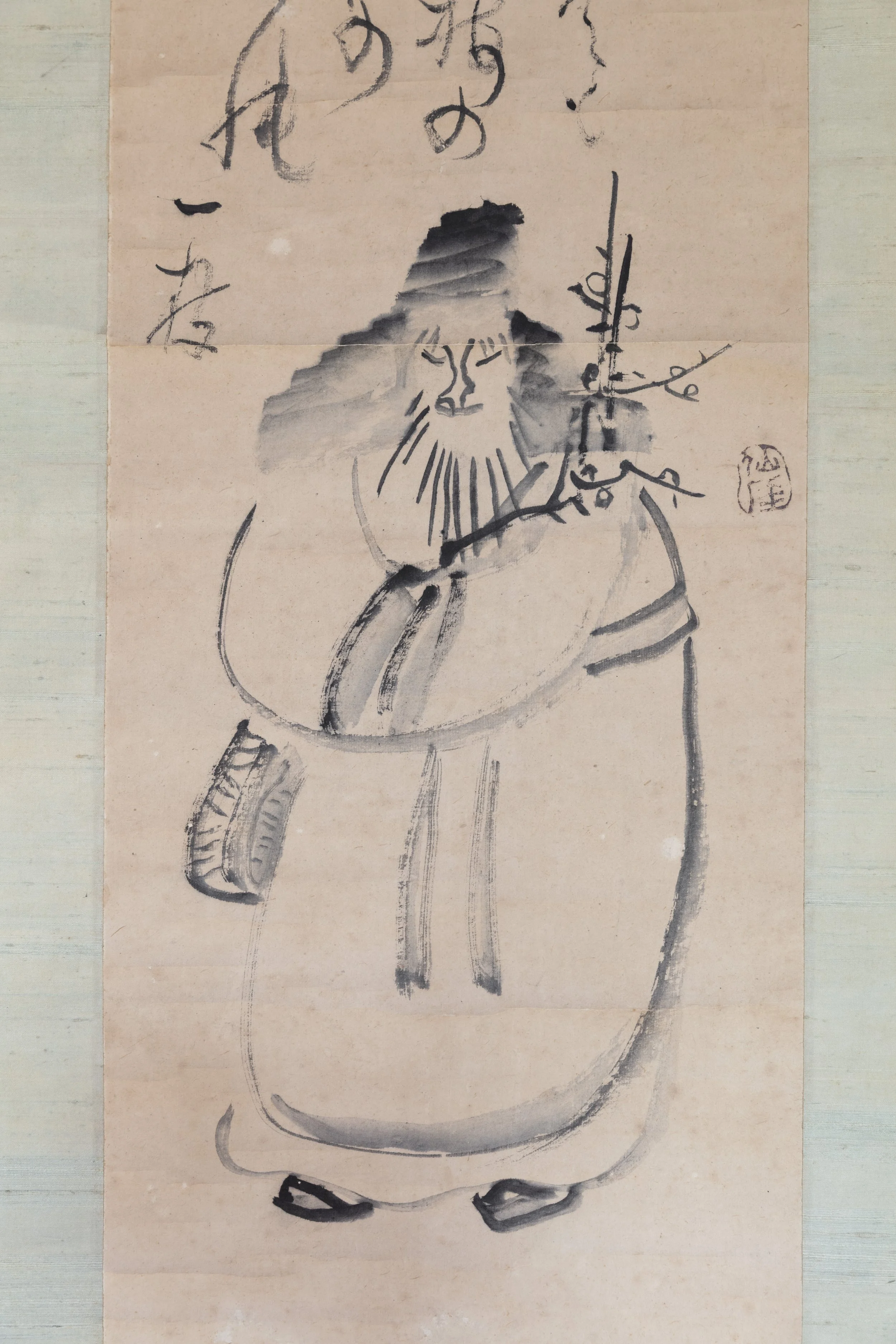
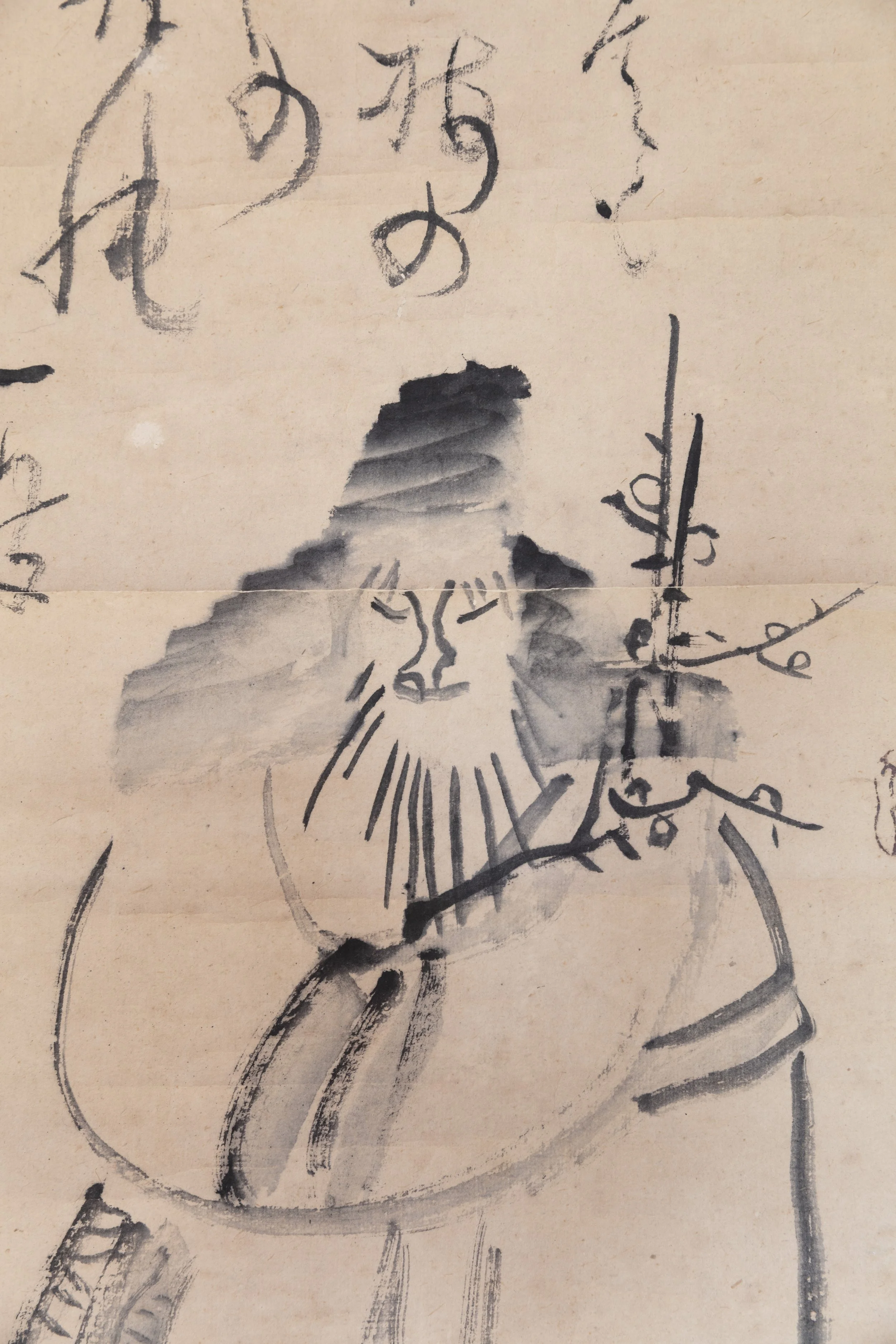
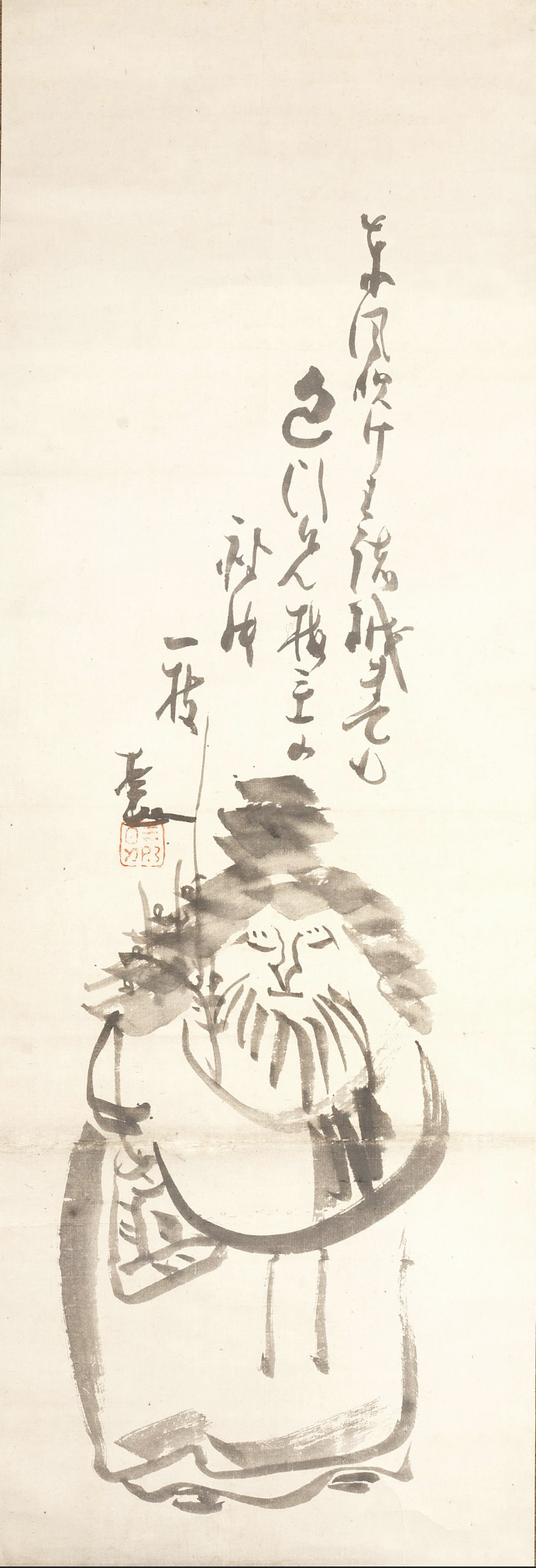
Watō Tenjin (Tenjin Travelling to Tang China)
Ink on paper; Edo period, late 18th to early 19th century
86 × 27 cm (image)
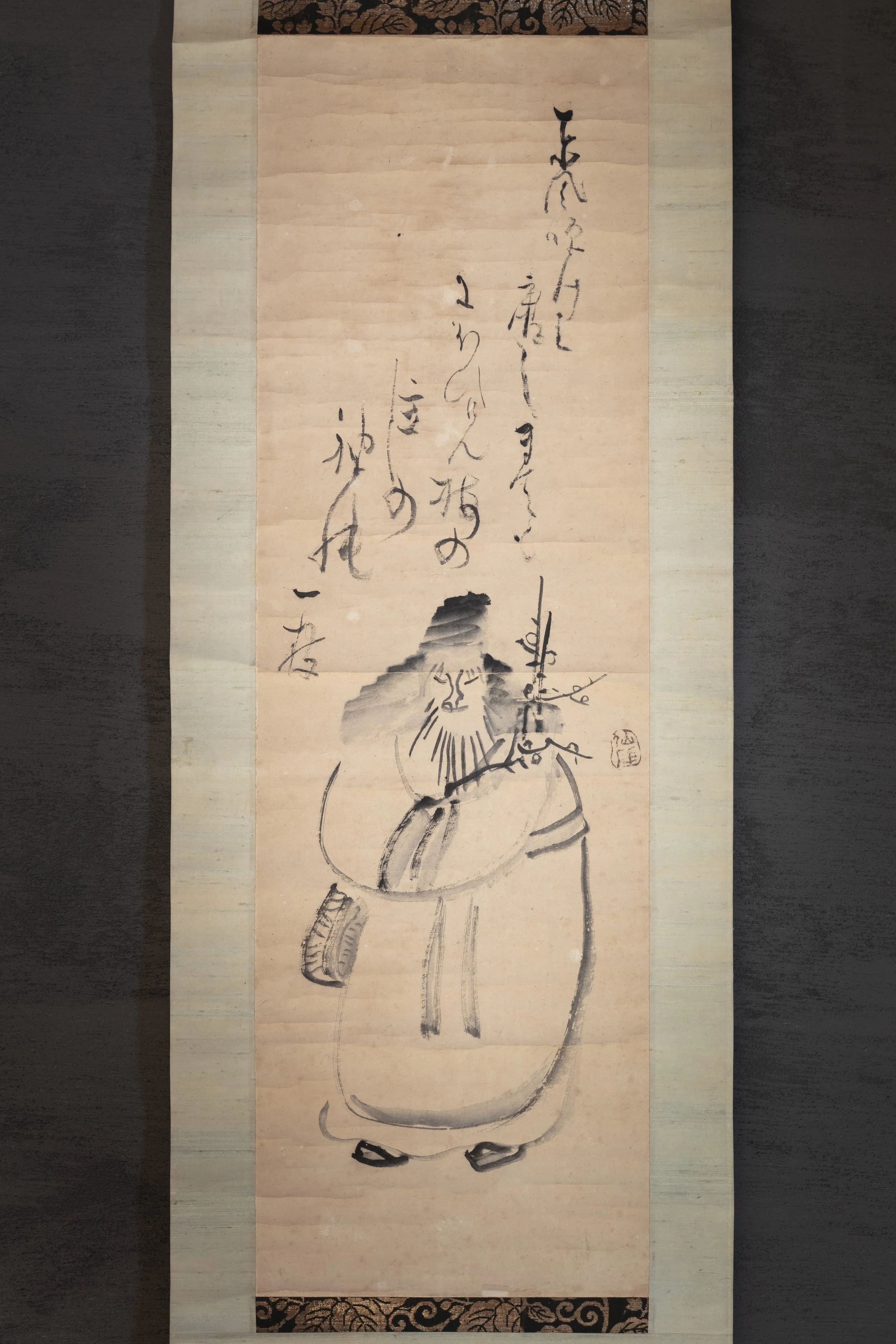
This painting depicts Tenjin, the deified form of the historical scholar Sugawara no Michizane (845–903), one of the most important cultural figures in classical Japan. Michizane was a great scholar of Chinese literature and culture who served at the imperial court in Kyoto, but after falling victim to political intrigue he was exiled to Dazaifu in Kyushu, far from the capital. In exile he longed for Kyoto and for his beloved plum trees, and according to legend one of the trees flew across Japan to be with him. After his death, Michizane was deified as Tenjin, the kami (deity) of scholarship, poetry, and calligraphy. Fro m Fromthat time onward, the plum blossom became his symbol—representing learning, perseverance, memory, and renewal in adversity.
In later legend and art, Michizane was sometimes imagined as travelling to China, the great center of learning and culture, even though he never actually made such a journey. This theme was not intended as literal history but as a poetic idea: that scholarship, culture, and wisdom travel across the sea just as the fragrance of plum blossoms travels on the wind. The inscription on this painting refers to a well-known poem which may be summarised as: when the east wind blows, the fragrance of plum blossoms reaches even to China; the master too carries a branch of plum in his sleeve. The image therefore shows Tenjin as a travelling scholar, carrying culture and memory with him across distance.
This subject held particular meaning for Sengai Gibon (1750–1837). Sengai spent much of his life in Kyushu and his later years in Dazaifu, the very place of Michizane’s exile and the center of Tenjin worship. For Sengai, Tenjin was not only a historical or religious figure but a local and personal presence — a scholar in exile, a poet, and a cultural figure associated with perseverance and learning. Sengai, himself a Zen monk, calligrapher, and teacher who often lived outside the main centers of power, seems to have felt a deep affinity with this figure. In Sengai’s hands, Tenjin is not portrayed as a distant deity but as a gentle, human presence: a travelling scholar wrapped in robes, holding a simple branch of plum blossom. The painting thus combines humour, humility, and scholarship — qualities that define Sengai’s Zen painting as a whole.
Several closely related paintings of this subject by Sengai are known. Comparable examples include a painting of Tenjin Travelling to China sold in New York, Bonhams, 14 September 2016, Lot 65; another sold in London, Bonhams, 6 November 2012, Lot 429; and a related example illustrated in Sengai, moine zen 1750–1837: Traces d’encre (Paris Musées, 1994). These works form a small but recognisable group within Sengai’s oeuvre, all depicting Tenjin in Chinese robes holding a plum branch and accompanied by a poetic inscription referring to the drifting fragrance of plum blossoms. The present painting belongs to this group and reflects Sengai’s mature style, in which the figure is reduced to a few essential brush lines, combining simplicity of form with expressive calligraphy.
Within Sengai’s work, this theme is unusually literary and historical compared to the more purely Zen subjects associated with painters such as Hakuin. The subject of Tenjin allowed Sengai to unite several themes that were central to his life and art: scholarship, exile, poetry, travel, and the transmission of culture across distance. The plum blossom, blooming in the cold of late winter, serves as a symbol of endurance and renewal, and in this image the travelling Tenjin carrying a plum branch becomes a quiet image of learning and memory carried across the world.
Bibliography (selected):
– Sengai: Traces d’encre, Paris Musées, 1994.
– Sengai: Masterpieces of Zen Painting from the Idemitsu Collection, Idemitsu Museum of Arts, Tokyo, 2007, p. 70, pl. 45.
– Terabres, biographical essay on Sengai (as previously referenced).
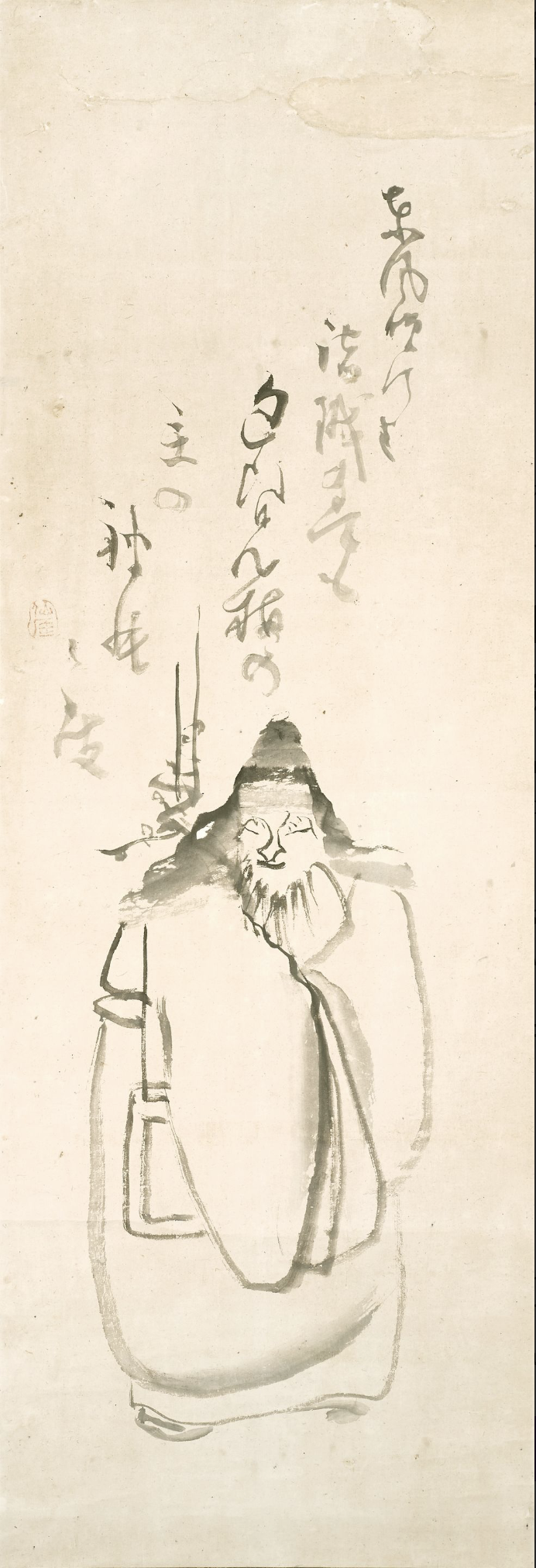
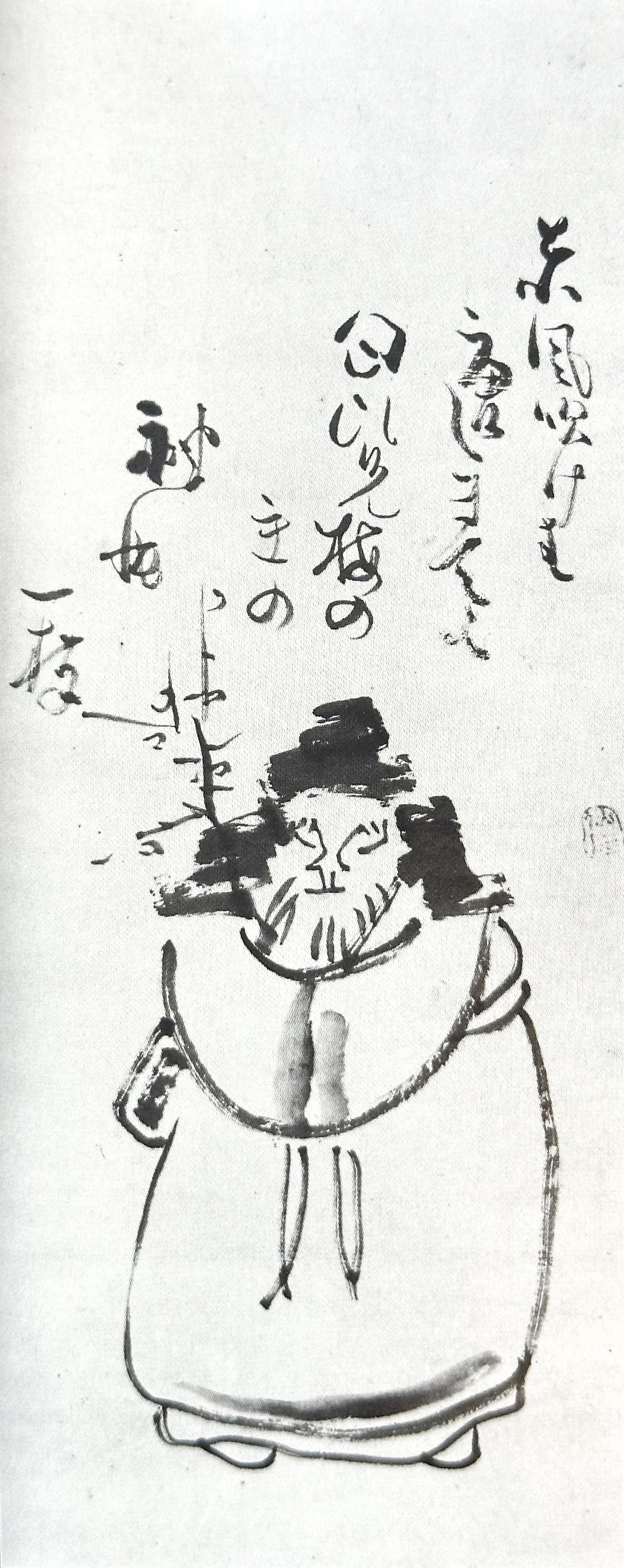
Comparata, presented left to right
Sengai Gibon — Tenjin Travelling to China
Bonhams, New York, 14 September 2016, Lot 65.
Ink on paper hanging scroll depicting Tenjin with plum branch and inscription on the drifting fragrance of blossoms.
Comparator 2
Sengai — Watō Tenjin (Tenjin Travelling to China)
Illustrated in Sengai, moine zen 1750–1837: Traces d’encre, Paris Musées, 1994.
Museum-published example of Sengai’s Tenjin theme.
Comparator 3
Sengai Gibon — Tenjin Travelling to China
Bonhams, London, 6 November 2012, Lot 429.
Related composition showing Tenjin in Chinese robes holding a plum branch, from the same thematic group.