How a collection comes into being
On the Person Behind the Collection
This collection is shaped by a photographer and researcher based in Cape Town. Photography formed the discipline of looking, but the identity here is not primarily professional. It is grounded in attention, curiosity, and sustained study.
An early influence came from a father who was both an academic and an antique collector. As head of the School of Architecture at the University of Cape Town, he lived among books, objects, and ideas. Classic art and material history were part of the domestic atmosphere. Collecting was understood not as acquisition, but as engagement.
For more than two decades, the collector has also worked within the contemporary art world, in close partnership with a practising gallerist. Daily proximity to living artists, exhibitions, and critical discourse has shaped a sensitivity to authorship, material decision, and intention. The turn toward Japanese painting did not arise from nostalgia, but from a search for structural clarity and philosophical depth beyond the cycles of contemporary production.
Japanese art offered something distinct: restraint, grounding, and a refusal of spectacle. In contrast to more declarative traditions, Japanese scroll painting often operates through compression—image, inscription, and gesture held in tension. That orientation proved decisive.
Building a collection of Japanese paintings in Cape Town may seem unlikely. Yet distance from major art centres has advantages. Removed from the pressures of large markets and institutional validation, it becomes possible to look slowly. Many works emerging from Japan are slightly damaged or incomplete in documentation. Most are not singular masterpieces, but serious examples within established traditions. This situates the act of collecting within study rather than acquisition.
Cape Town’s dry climate supports conservation. Works are stored in darkness and displayed in rotation—sometimes briefly, sometimes for longer periods. Duration is determined by the work itself.
Acquisition is deliberate. A painting may be examined for many hours before purchase, though recognition of its significance is often immediate. Brushwork and internal coherence are primary. Seal impressions and provenance follow. Condition is considered, but not always decisive.
Mistakes have been instructive. Early attention to copies and derivative works gave way to a clearer focus on artists of structural force, including Hakuin and Jakuchū. Over time, decorative appeal has become less persuasive than formal compression and intellectual integrity.
Zen painting, particularly as articulated by Hakuin, provides a framework that is direct and disciplined. It privileges clarity over belief, practice over mythology. That orientation informs both collecting and daily life.
The role assumed here is custodial rather than possessive. These works are temporary responsibilities—studied, conserved, and eventually to be released.
Research and acquisition are continuous. Study precedes purchase and continues long after it. Publishing that research openly is an attempt to test ideas publicly and to discover whether sustained looking can generate quiet forms of connection across distance.
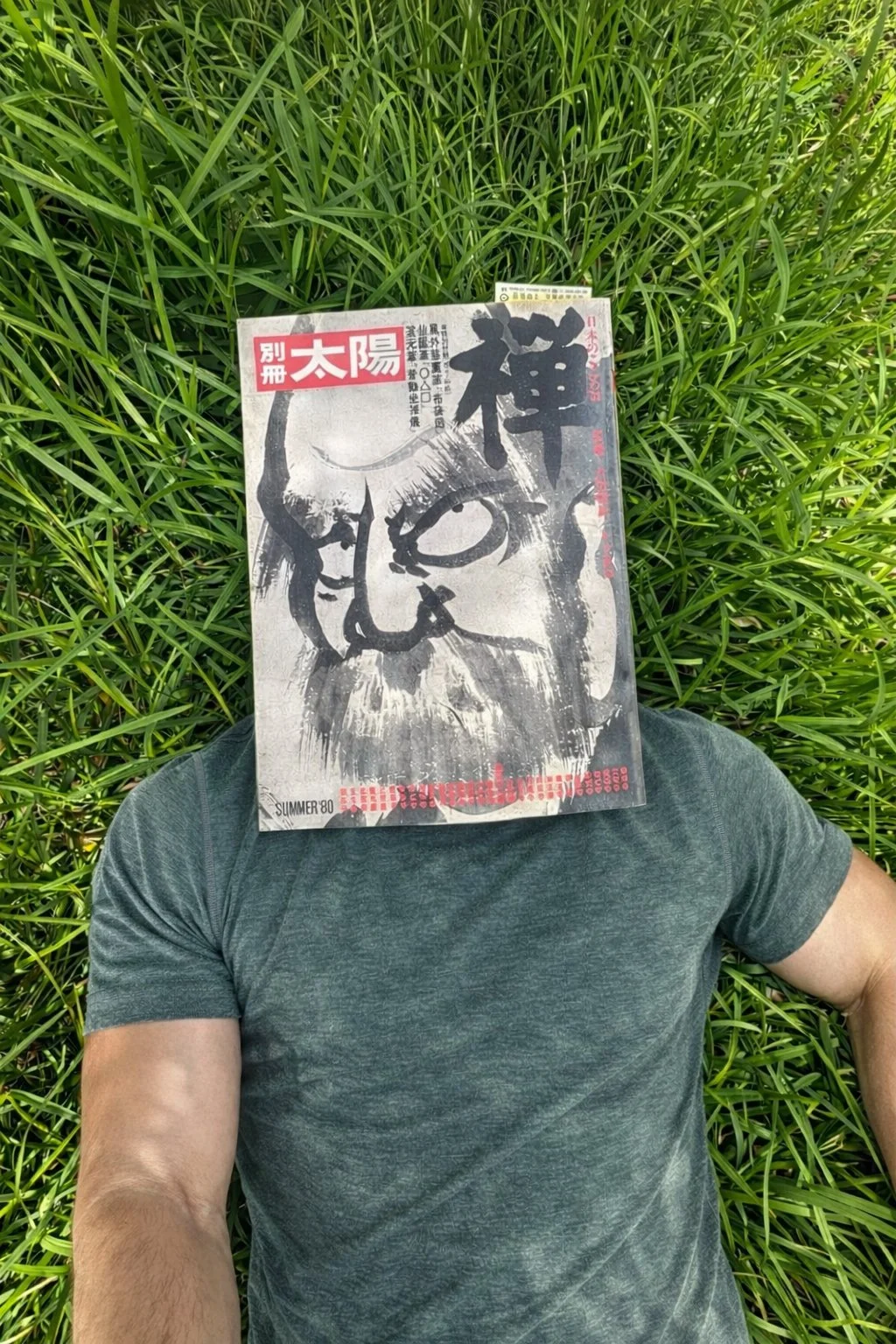
How a collection comes into being is rarely linear. It is shaped by chance, patience, loss, and the discipline of sustained looking.
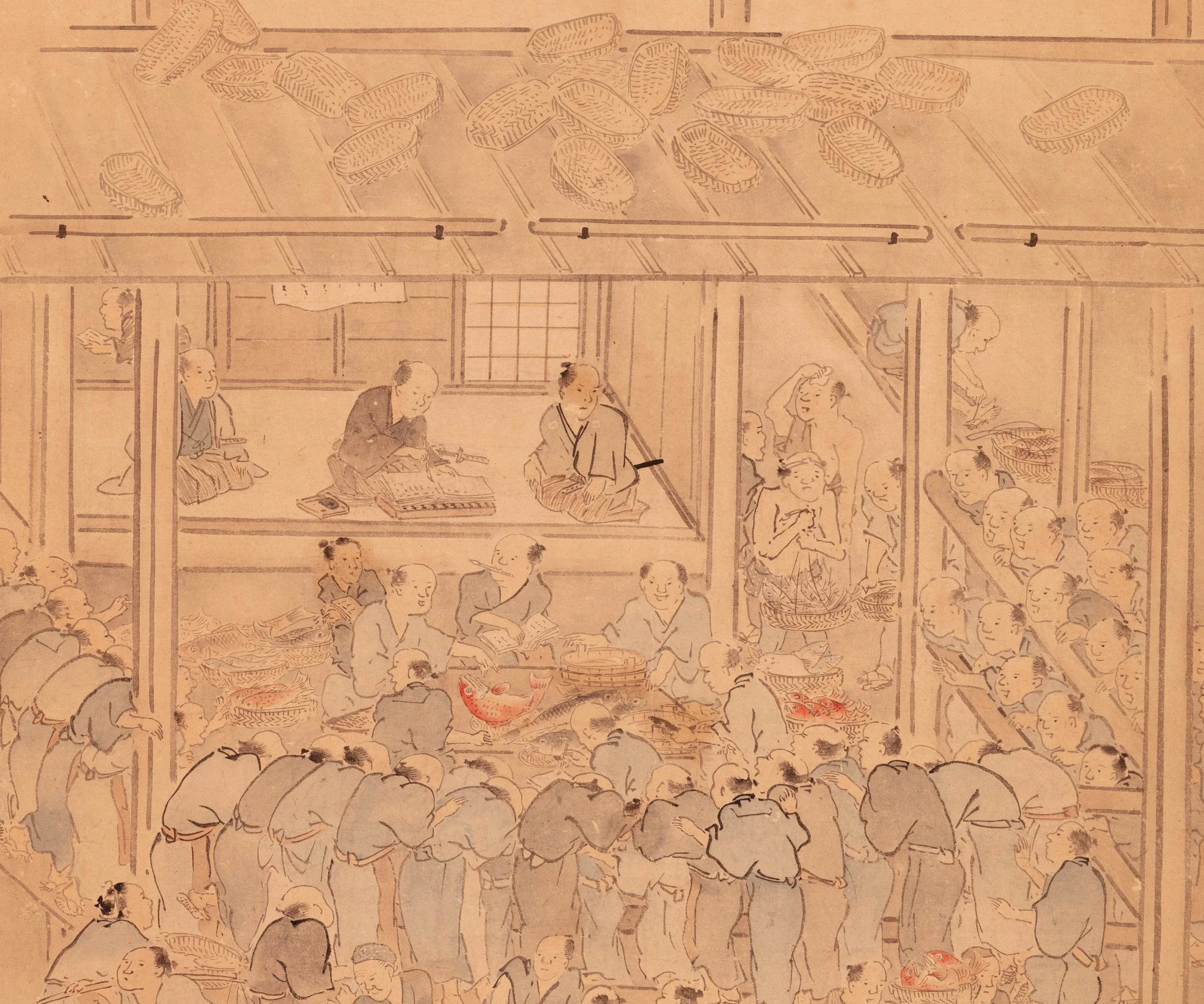
As Japan emerged from the upheavals of the Meiji Restoration and, later, the aftermath of the Second World War, most works of acknowledged importance had already been secured within state institutions, temples, and long-established private or family collections. What remained outside these frameworks was a more marginal body of material—often originating from regional temples, private homes, and rural or suburban contexts—that had never been formally catalogued, studied, or absorbed into recognised lineages. Catalogued works came to define the visible canon of Japanese painting, while alongside it persisted a quieter body of material whose histories had thinned, fragmented, or disappeared altogether.
By the mid-twentieth century, Japanese life was changing at an unprecedented pace. Rapid urbanisation, postwar reconstruction, and the rapid shift toward urban life altered patterns of living, space, and cultural use. During this period, kura—traditional storehouses attached to temples and private residences—were opened after having remained closed for generations. Their opening released a substantial number of objects that had long remained unseen, often untouched, and largely undocumented. Paintings that had lain dormant for centuries entered the market for the first time, frequently without clear attribution, provenance, or written record. Detached from their original contexts, such works came to be described as mu-en—無縁, “without ties,” or orphaned: objects whose social and historical connections had been lost, leaving only the material work itself.
Many of these mu-en works were quietly absorbed into private collections during the postwar decades, where they remained largely out of public view. As we slowly approach the midpoint of another century, a similar process appears to be unfolding again. Collections formed during that earlier period now begin to disperse as estates are settled, family structures change, and traditional modes of storage give way to contemporary realities. Paintings re-enter circulation briefly, often without explanation, before passing onward or returning once more to obscurity. Access to this largely domestic and regional circulation remains indirect and incomplete, yet its existence allows for sustained looking across a field that was previously difficult to approach.
Within this flow, one encounters a wide range of material: numerous copies of uneven quality; competent and occasionally compelling reworkings of classical subjects and themes; overlooked works of genuine depth; and, in rare instances, paintings whose significance has passes almost completely unnoticed due to the sheer volume of circulating material. Navigating this density becomes a form of study in itself. The discipline lies less in acquisition than in learning to recognise presence—and in knowing when to leave most things behind.
Over time, this sustained attention alters perception. Decorative appeal gives way to structure; narrative yields to restraint; technical display recedes in favour of clarity. The works that remain tend toward compression, reduction, and quiet intensity, particularly within Zen painting, where image, practice, and thought are closely aligned. Such works speak less through explanation than through form and economy. The Ki-no-an Collection has taken shape within this gradual movement inward, guided by paintings that suggest not only a lineage of making, but a way of living attentive to simplicity, measure, and calm.
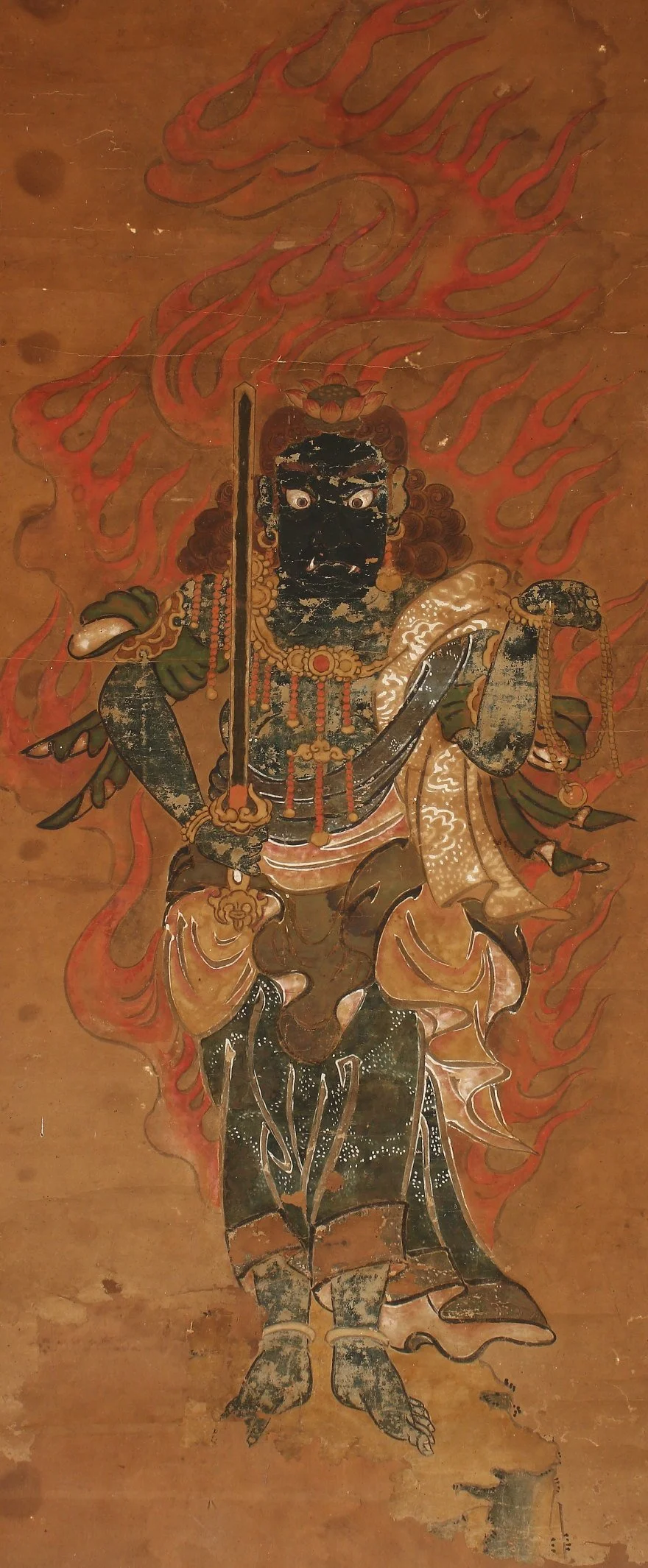
About the Collection
This site documents a private collection of Japanese painting formed through long attention, daily proximity, and sustained study. Although serious acquisition began around 2018, the interest that led to this collection reaches back much further, to an early and persistent fascination with Japanese visual culture that preceded any formal collecting practice.
The collection did not begin as a programmatic project, but as a way of living with objects made for quiet spaces—works intended to be encountered slowly, repeatedly, and without spectacle. Over time, looking gave way to research, and research to writing. What began with fragments—partial attributions, uncertain histories, or works without provenance—gradually unfolded into deeper historical, aesthetic, and philosophical engagements. The collection continues to evolve through this process of looking first, understanding later, and choosing carefully.
Works are typically encountered through a small number of trusted dealers, and selection is slow and deliberate. Large volumes of material are reviewed, but very little is acquired. Both successful acquisitions and mistaken ones have played an equal role in shaping judgment. Over time, the collection has moved away from decorative or showy works toward paintings of greater inward force, particularly Zen paintings, where urgency, discipline, and moral clarity are held within the economy of brush and ink.
Condition has never been the primary measure of value here. Many works are old, worn, or damaged, and it is often precisely this fragility that makes them compelling. The idea of historical rescue—of temporarily sheltering objects that have lost their original contexts—remains an important undercurrent. These paintings are understood as finite things: to be cared for attentively, but also to be held lightly, with an acceptance that they will not last forever, even if they may outlast their present guardian.
The works live within a domestic rhythm. Only one or two paintings are displayed at a time, rotated weekly or seasonally, in keeping with traditional Japanese hanging practices. Light exposure is strictly controlled; storage is dark and stable. Daily proximity matters more than accumulation. A few minutes spent each day with a single work—attending to a gaze, a brushstroke, a compositional decision—has proven far more formative than constant visual abundance.
Research plays a central role. It is often possible to begin with little more than a subject description or tentative attribution and, through sustained inquiry, to build meaningful connections to related works in museum collections, archives, and scholarly literature. This process—patient, uncertain, occasionally corrective—has become one of the most significant rewards of collecting.
The collection is guided by a sense of responsibility rather than ownership. These works are understood as temporary companions, to be cared for with seriousness and eventually passed on—whether through sale, collaboration, or placement with others who will continue their study. Market-driven trophies and spectacle-oriented works hold little interest here.
Ultimately, this collection is less about possession than about orientation: surrounding oneself with objects that act as reminders, correctives, and quiet guides. The website exists to document this process, to share research as it unfolds, and to allow the works to be encountered by others who may approach them with similar patience and care.
Conservation and Care
Japanese paintings were not originally conceived as permanent objects. Scroll paintings in particular were designed to exist within cycles of use, rest, and renewal. They were meant to be unrolled briefly, contemplated, then returned to darkness. Their materials—paper, silk, ink, and mineral pigment—are responsive, vulnerable, and inherently impermanent. Preservation therefore depends less on heroic restoration than on attentiveness to rhythm: knowing when to display a work, when to rest it, and when to leave it untouched.
Within the Ki-no-an Collection, conservation begins with restraint. Paintings are stored in darkness and brought out only in rotation, usually one or two at a time. Exposure to light is kept deliberately short. Even modest illumination, sustained over years, slowly weakens paper fibres and fades pigments. Japanese mounting traditions long recognised this fact, which is why scrolls historically appeared only seasonally or during particular gatherings before being carefully rolled again.
Cape Town’s naturally dry climate offers certain advantages for the long-term preservation of works on paper and silk. Relative humidity remains comparatively stable, reducing the expansion and contraction that can cause mounting fabrics to warp or adhesives to fatigue. Nevertheless, stability rather than dryness alone is the goal. Sudden changes in humidity or temperature can stress delicate fibres, so storage environments are kept calm and consistent.
Handling follows similar principles of minimal intervention. Scrolls are opened slowly and supported evenly across their width so that the mounting and paper do not bear unnecessary strain. Rolling and unrolling is done deliberately, allowing the material to move at its own pace. The mechanics of the scroll—its wooden rollers, silk borders, backing papers, and layered adhesives—form an integrated structure that must remain balanced if the painting itself is to survive.
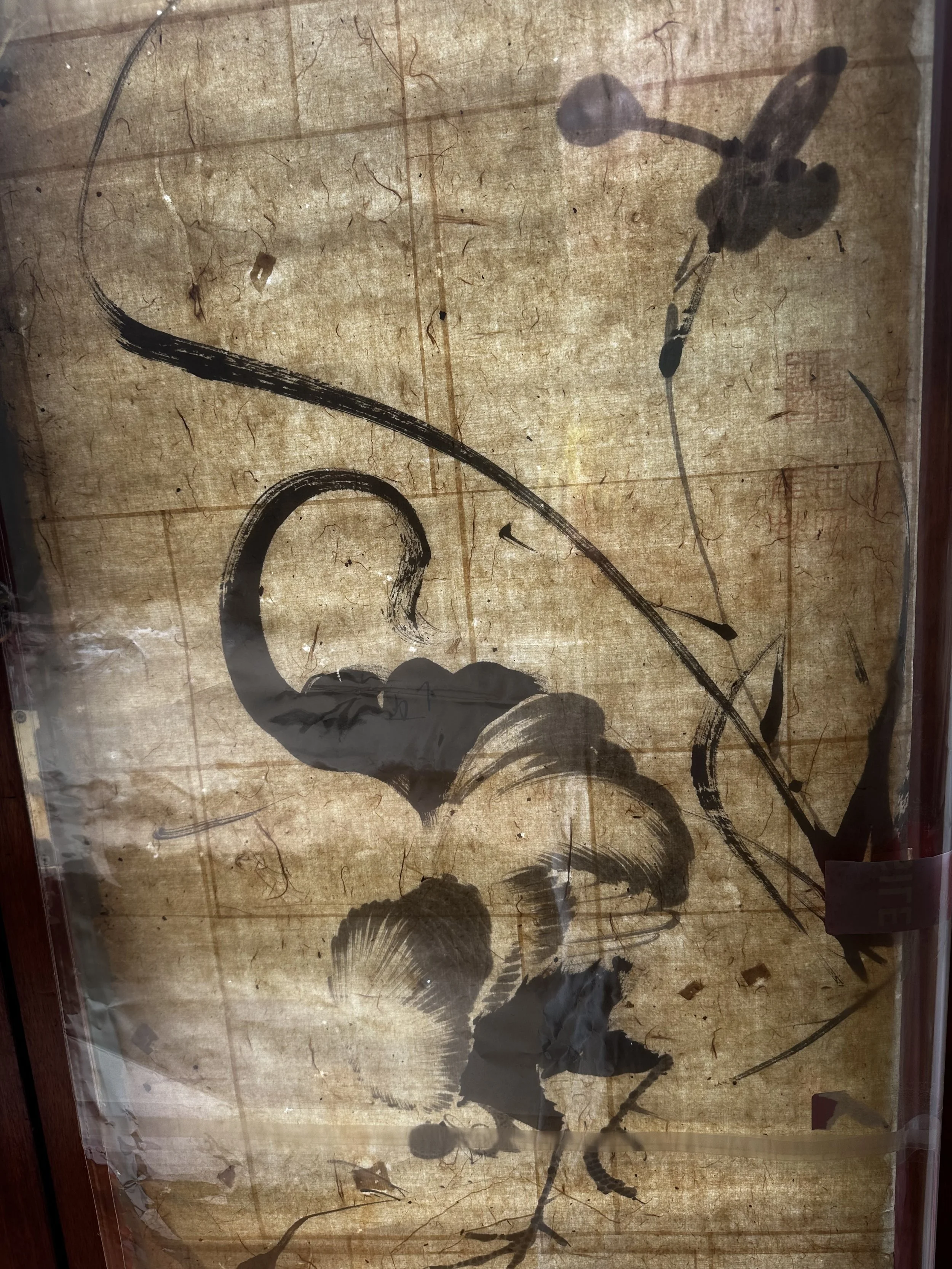
Most works encountered today already bear the marks of time. Creases, wormholes, pigment loss, oxidised silk, and earlier repairs are common. These traces are not always signs of neglect; they are often simply the evidence of long life. In many cases the responsible decision is not restoration but patience. Conservation in Japanese tradition has historically been cyclical rather than corrective. Mountings are occasionally renewed through hyōgu—the remounting process carried out by specialist artisans—but only when the structural integrity of the work demands it. Until such intervention becomes necessary, the painting is allowed to remain as it is.
This approach differs from the instinct, common in some collecting cultures, to pursue visual perfection. Repair always alters an object. Even the most skilled conservation introduces new materials into an old structure. For that reason, unnecessary intervention is avoided. The guiding question is not whether a work can be made to look newer, but whether its present condition still allows it to exist safely.
Daily proximity also forms part of conservation. Living with a small number of paintings makes it easier to notice subtle changes—slight shifts in tension, new creases, pigment movement, or mounting fatigue. Such awareness often proves more protective than remote storage. Quiet observation allows problems to be recognised early, before intervention becomes urgent.
At the same time, fragility is accepted as part of the nature of these works. Ink sinks slowly into fibres. Paper softens with centuries of handling. Silk loses its elasticity. Even under ideal conditions, scroll paintings remain finite objects. Conservation therefore involves a certain humility: the recognition that preservation can only extend, not suspend, the life of materials.
The custodial role assumed here is therefore modest but deliberate. These paintings are sheltered, studied, and cared for with the understanding that they belong to longer histories. Some will eventually require professional conservation in Japan. Others will pass onward before such intervention becomes necessary. In every case, the aim is the same: to ensure that each work leaves this collection in at least the same condition in which it arrived, and ideally with a clearer understanding of its history and meaning.
Within that framework, conservation becomes less a technical activity than a form of attentiveness. The discipline lies not in controlling objects, but in creating the conditions in which they can continue to exist quietly and without strain.