
Observations from the ongoing study of Japanese painting — where brushwork, seals, history, and intuition meet, and where authenticity is tested against the act of seeing.
Journal
10 April 2026
The Weight of Things: Hokuba’s Documentary Vision of the Floating World
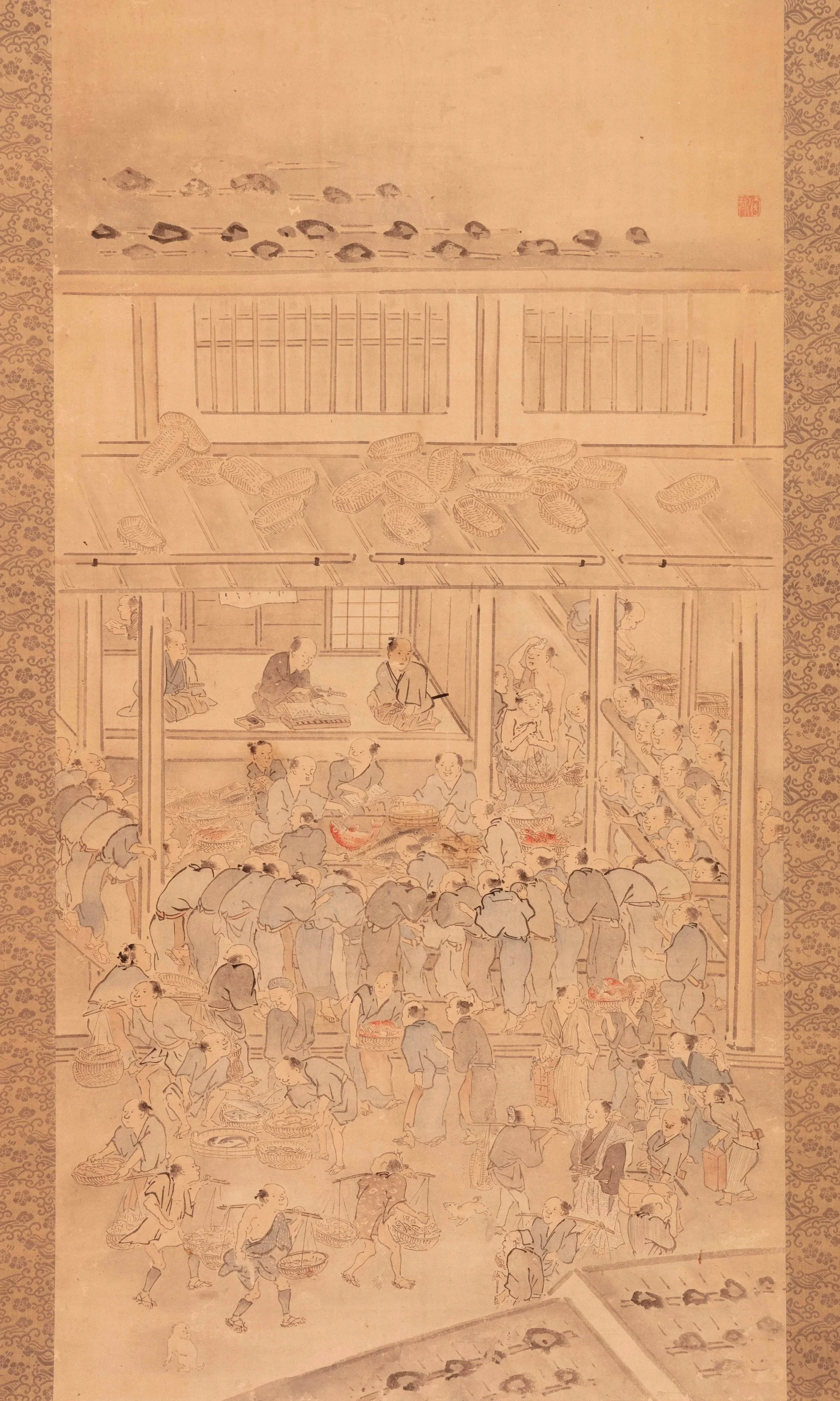
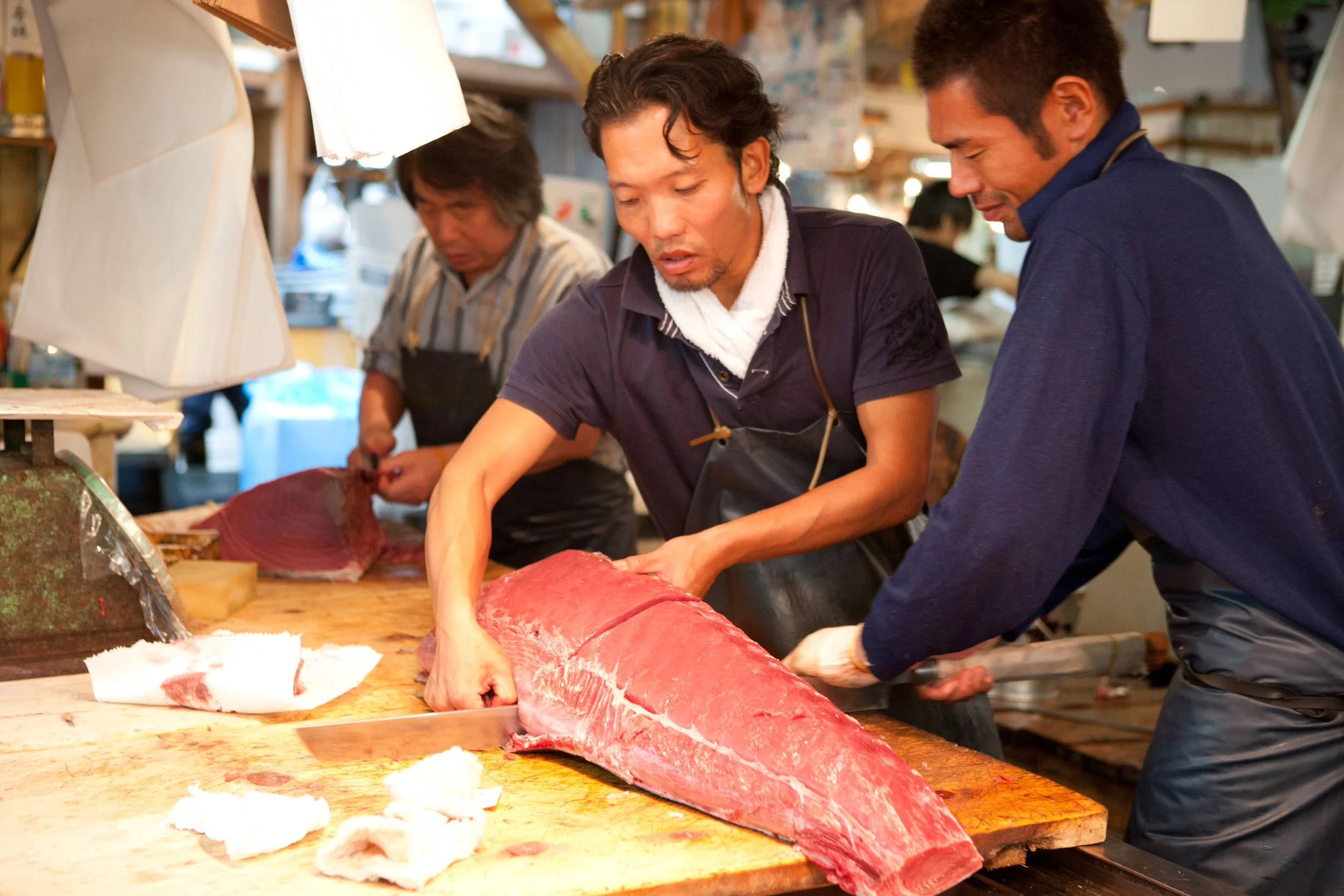
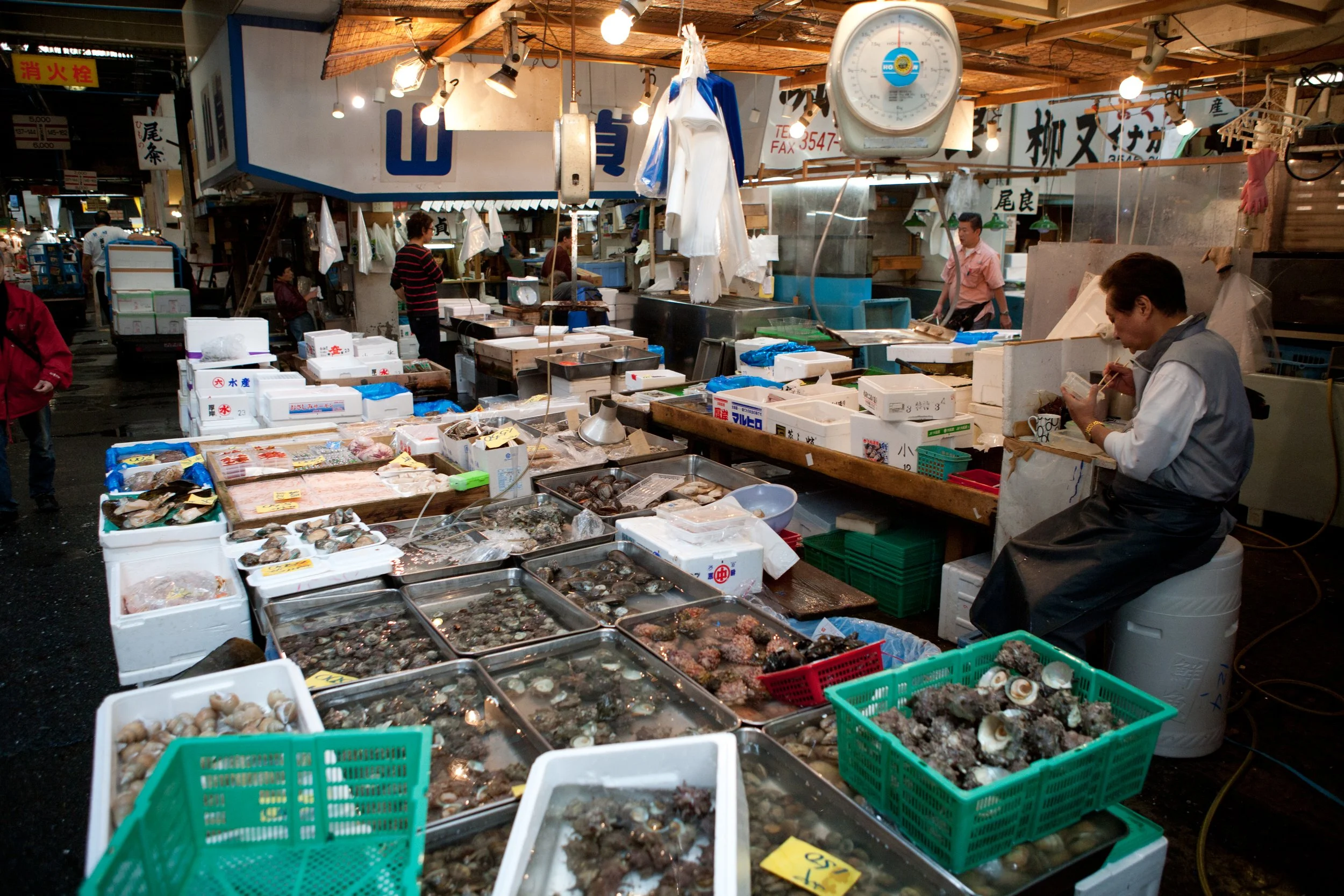
Fish markets are among the few places where life and death are held openly in view. The fish and shellfish laid out on ice or carried through the crowd are unmistakably recent presences — their forms intact, their surfaces still luminous. But this immediacy extends beyond the catch itself. The people who move through the space — buyers, sellers, porters — are equally bound into this cycle of exchange, labour, and time. One becomes quietly aware that the same forces of arrival, duration, and departure apply to all.
Fish markets are places where nothing is concealed. In contrast to the abstracted systems of modern commerce — where goods arrive cleaned, packaged, and detached from their origins — the entire process is visible. One sees the labour, the handling, the negotiation, and the product in its raw state.
It is not simply noise, though the air is full of it. Nor is it only movement, though everything seems to shift and flow. Rather, it is a density of lived experience — a place where abstraction falls away, and the world presents itself as weight, body and time.
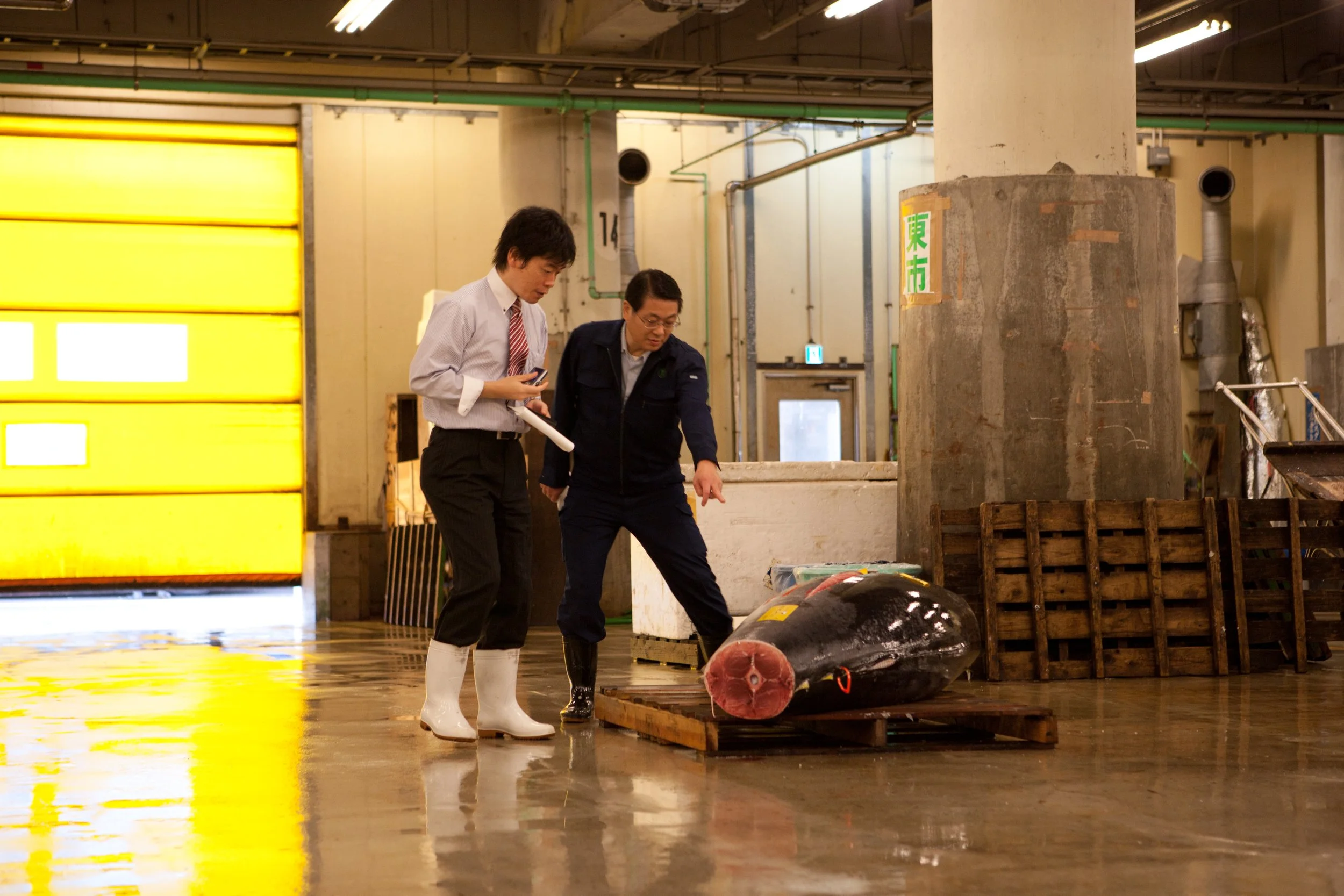
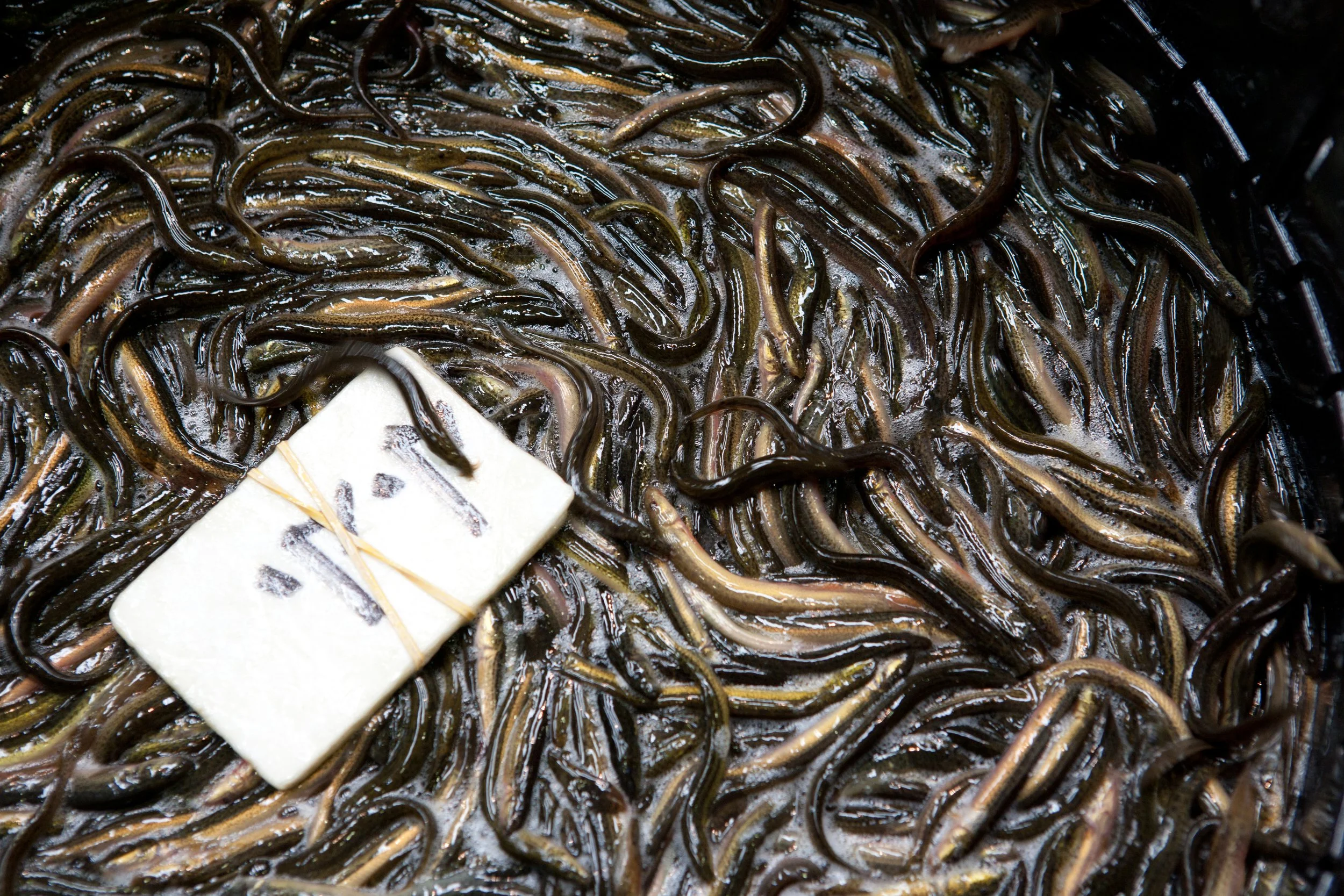
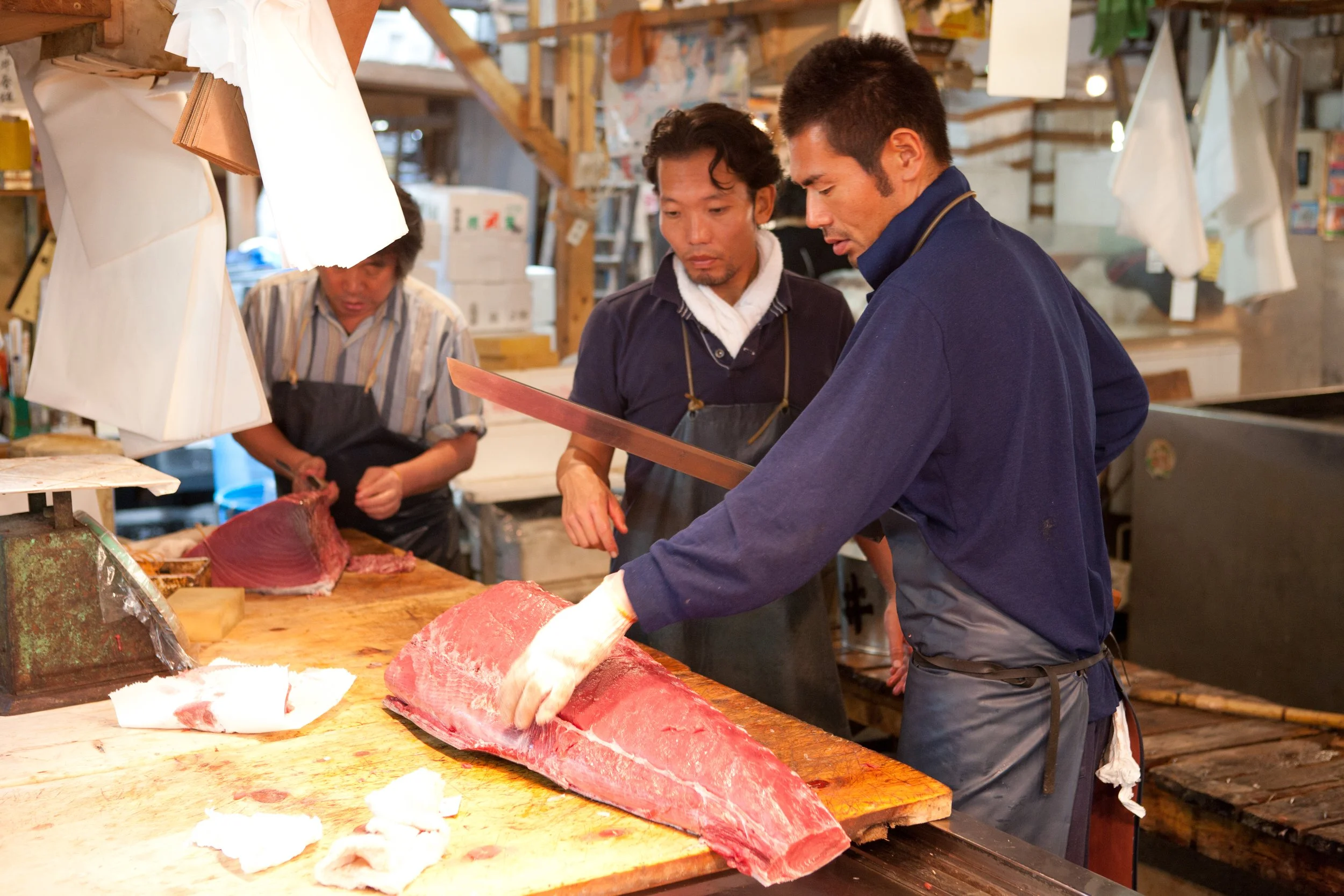
Standing in the early morning at Tsukiji, one becomes aware of a choreography that feels both improvised and ancient. Tuna lie like dark, glistening forms against the wet floor, their interiors revealed in sudden fields of red. Eels gather in restless, calligraphic knots. Knives move with an economy that borders on ritual. Everywhere there is water — held, spilled, evaporating — catching the light in brief, shifting flashes.
What is most striking is the absence of separation.
One does not observe the market; one is absorbed into it. Buyers lean in, bodies compressed forward. Porters pass through narrow openings with practised ease. Transactions occur in gestures as much as in words. The senses are not detached — they are implicated.
It is here that the world of Edo begins to emerge with unusual clarity.
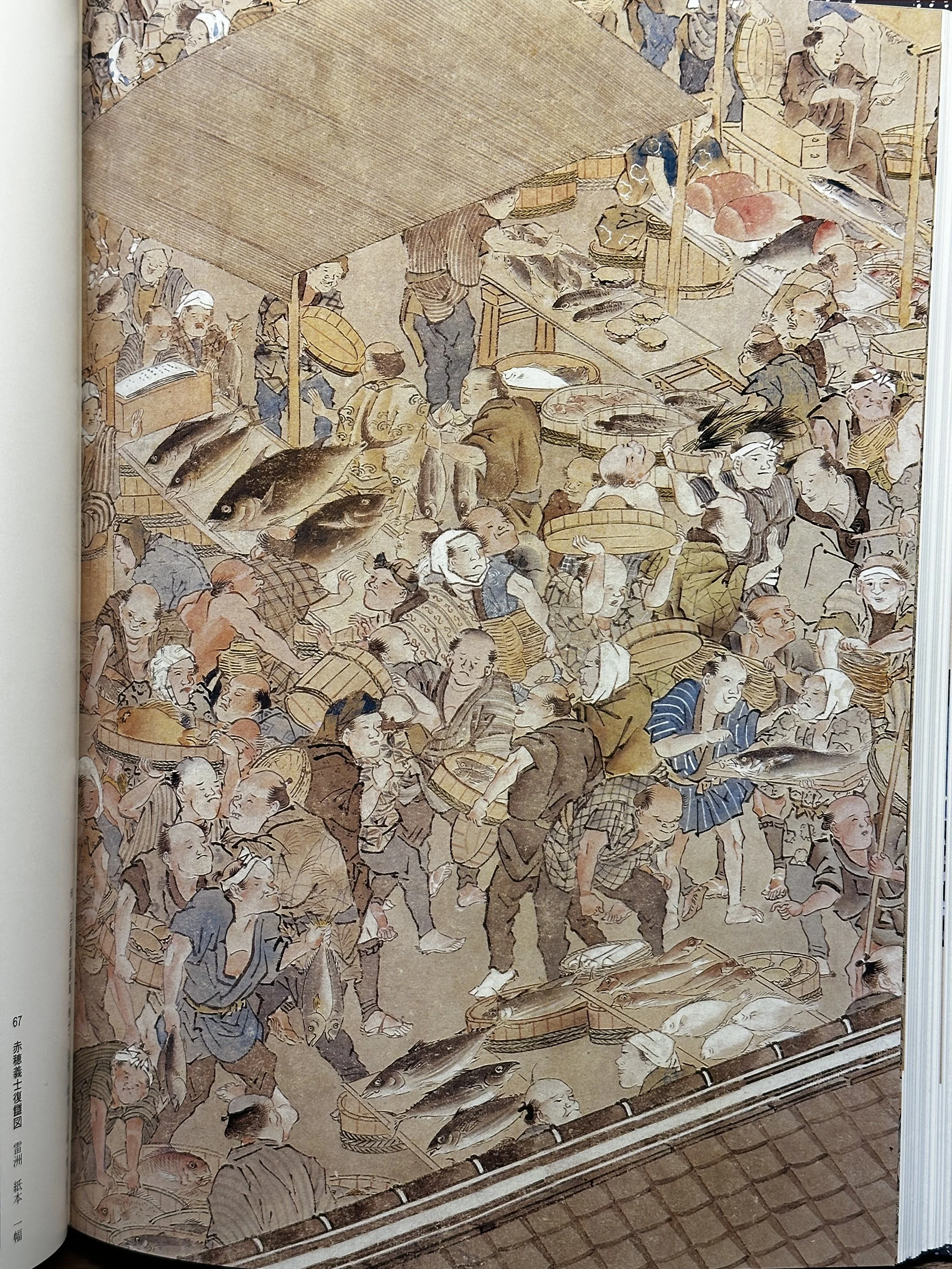
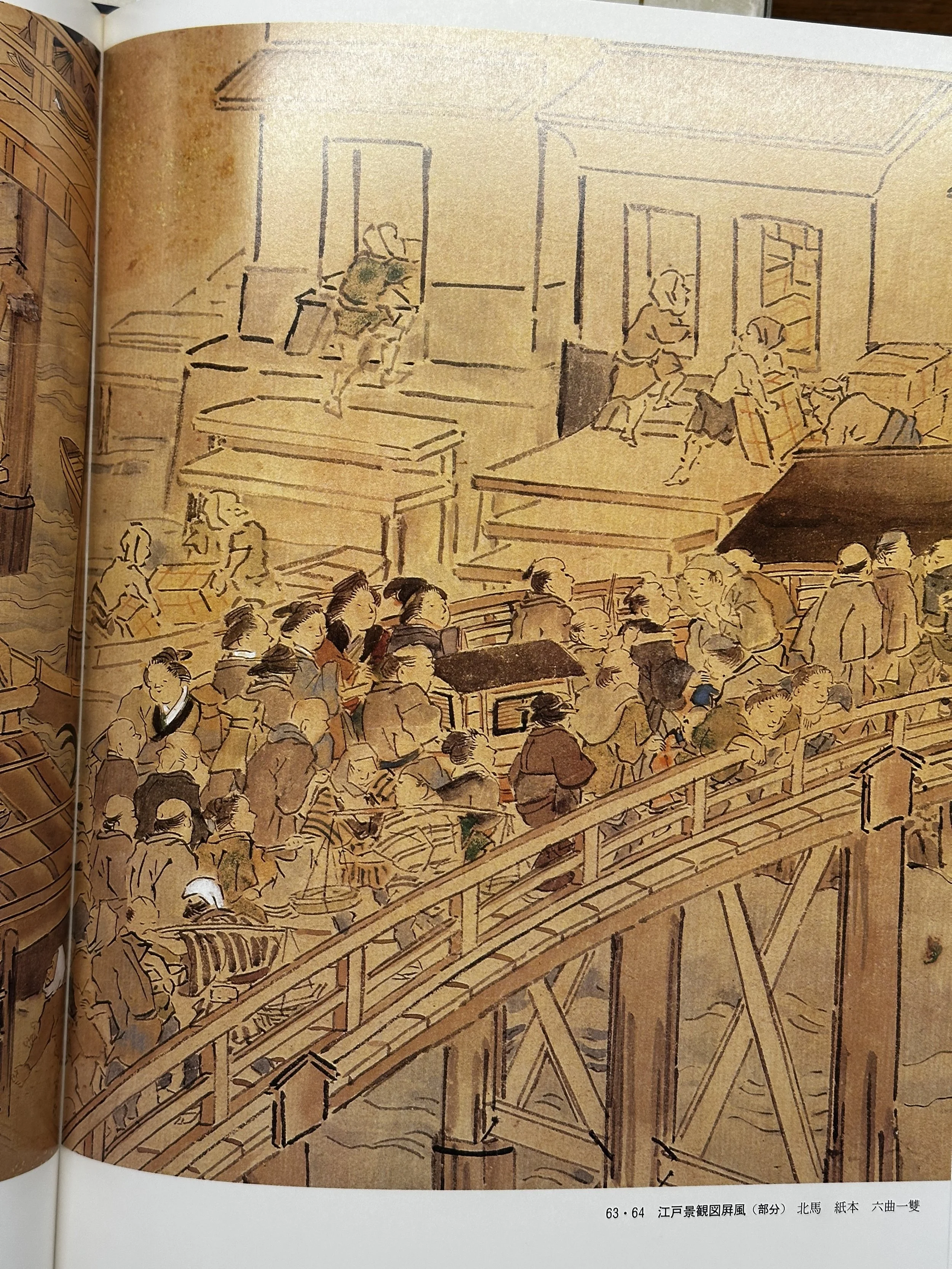
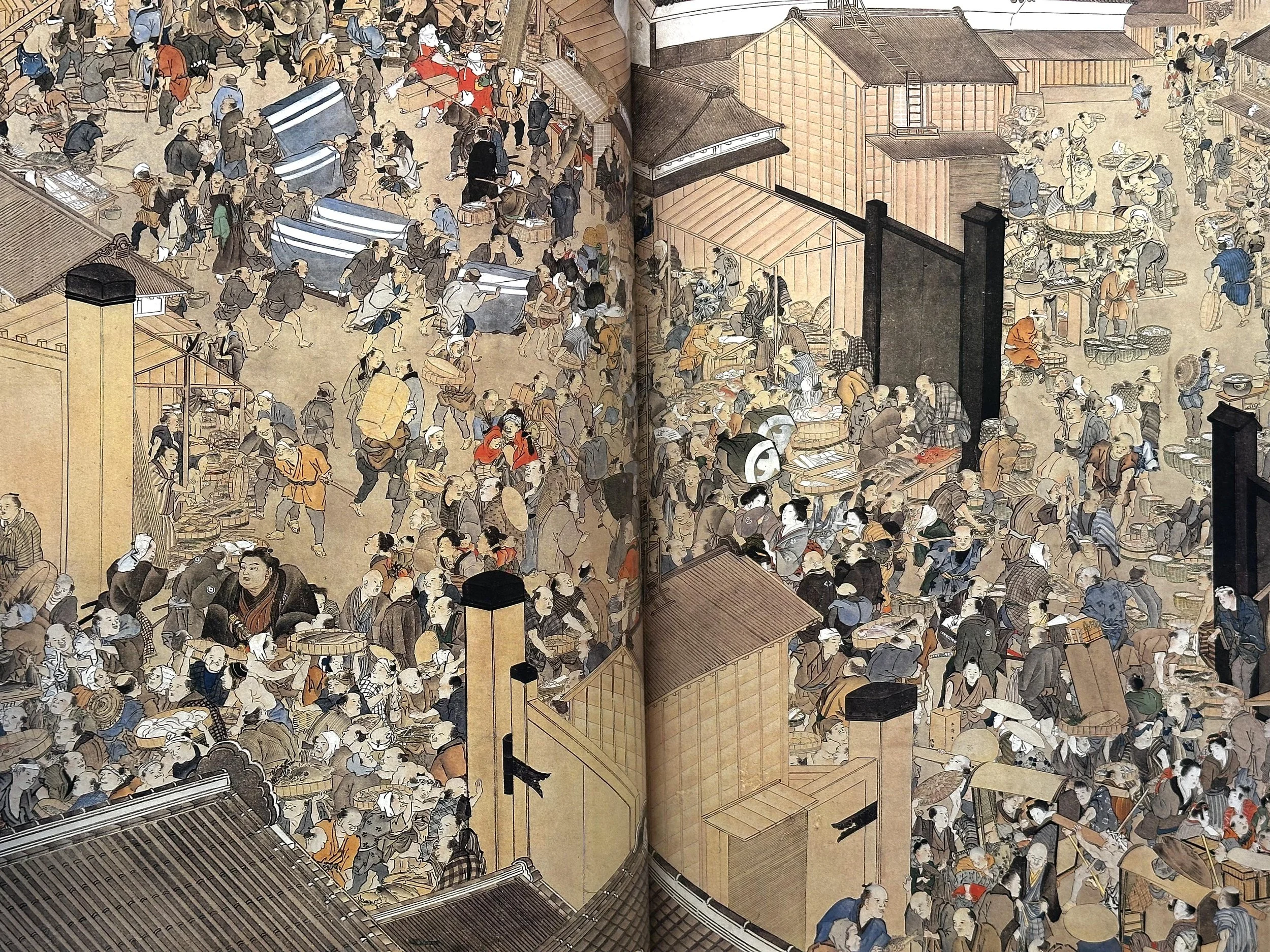
In the great folding screen views of Edo painted by Teisai Hokuba, the same compression of life unfolds. These works belong to a broader tradition of urban panorama painting — large-scale images that attempt to grasp the city as a total environment. Yet unlike earlier, more formalized screen traditions, these are not distant or ceremonial views. They are inhabited. The city is not arranged; it is in motion.
The texts in Nikuhitsu Ukiyo-e, Vol. 7: Hokusai (Shueisha, 1982) describe these works as part of the flourishing culture of genre painting — fūzokuga — in the late Edo period, when the daily life of townspeople became a subject of sustained artistic attention. This was not incidental. By the late eighteenth and early nineteenth century, Edo had become one of the largest cities in the world, and its commercial districts — including the great fish market at Uogashi — formed the beating heart of its economy. What we see in these paintings is not anecdote, but structure: the circulation of goods, labour, and attention within an increasingly complex urban system.
Within this context, Hokuba’s position is particularly compelling.
A direct pupil of Hokusai, he inherits the master’s fluid line and compositional energy. Yet his sensibility is notably different. Where Hokusai often pushes toward invention, compression, and imaginative force, Hokuba tends toward observation. His work carries a distinctly documentary impulse — a desire not simply to transform the world, but to record it with fidelity and breadth.
This quality is especially evident in the treatment of the fish market.
The scenes do not isolate dramatic moments. Instead, they accumulate detail. Figures press inward, overlapping, bending, negotiating space. Porters carry loads suspended from shoulder poles; clerks lean over ledgers; buyers crouch to inspect the catch. Fish appear not as symbols, but as objects of weight and exchange — laid out, handled, assessed. The crowd itself becomes a kind of organism, structured yet fluid, dense yet legible.
The texts note a key characteristic of these screens: their ability to combine scale with precision. From a distance, the composition resolves into a vast panoramic field — a sweeping vision of Edo’s built environment, with bridges, riverbanks, and market halls arranged across the surface. But as one moves closer, that field dissolves into innumerable small acts, each rendered with quiet attentiveness. The grandeur of the whole is sustained by the exactness of the parts.
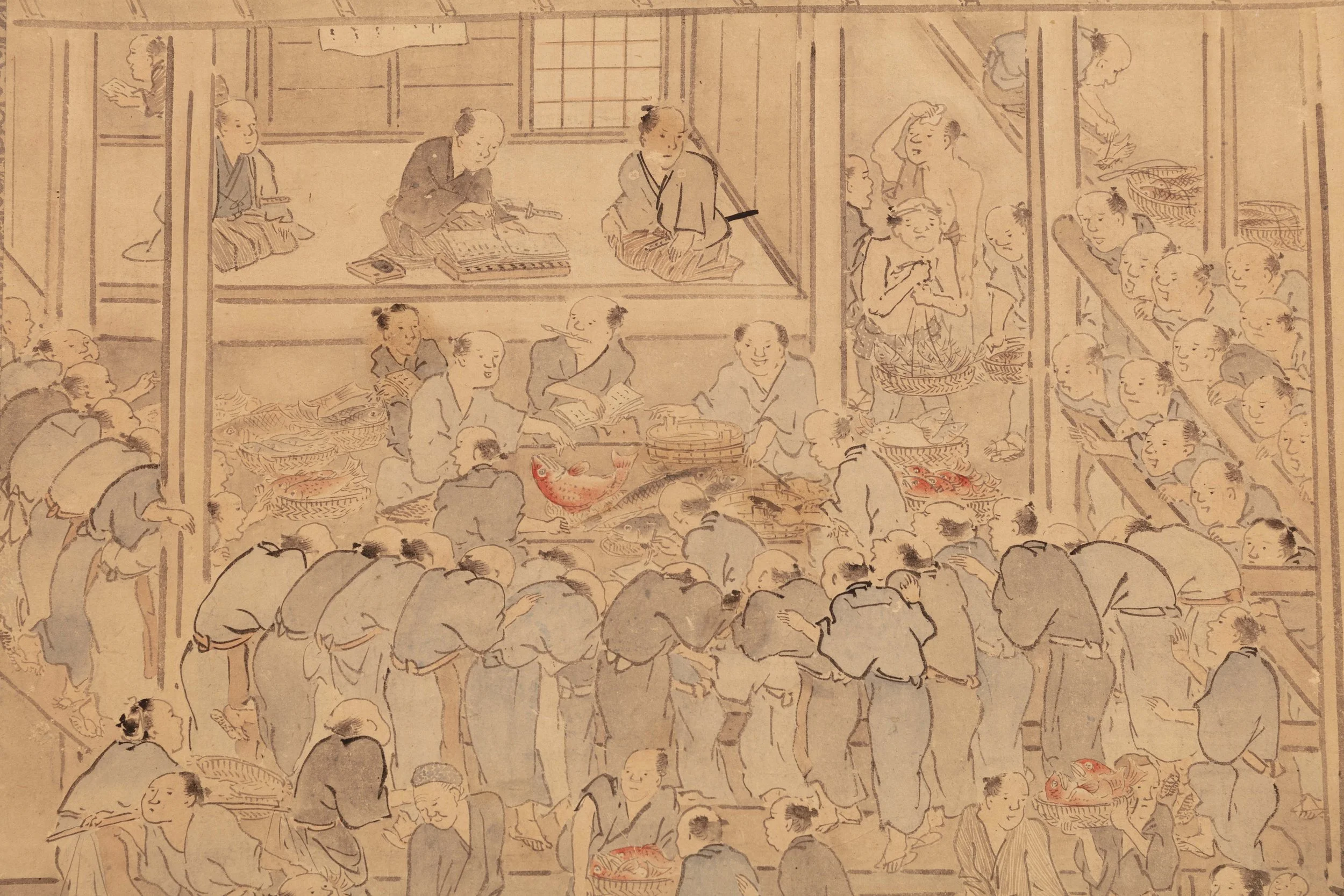
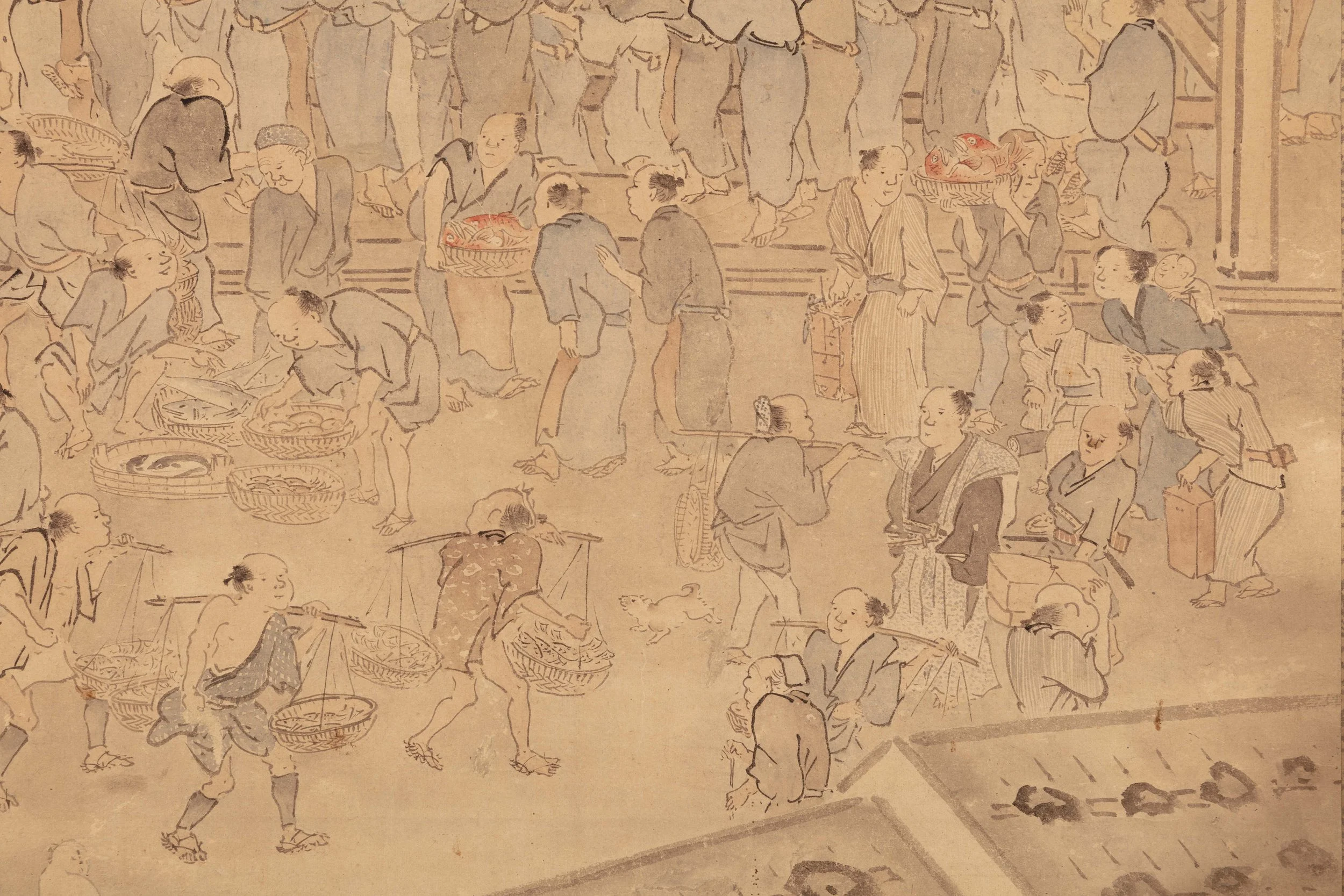
This duality — monumentality and intimacy — is central to their power.
It also reflects a broader cultural moment. The late Edo period saw the maturation of townspeople culture, in which merchants, artisans, and urban workers developed their own forms of taste, patronage, and visual expression. In this context, the fish market was not a marginal subject. It was emblematic of a world in which value was negotiated daily, in public, through skill, knowledge, and exchange.
Hokuba’s approach suggests a deep familiarity with this world.
There is little sense of idealization. The figures are not heroic; they are absorbed in their tasks. The architecture does not dominate; it frames. The emphasis falls instead on process — on the continual unfolding of activity. In this sense, his work aligns less with the theatricality often associated with ukiyo-e, and more with a kind of observational clarity. One might even say that he anticipates, in a distant way, the documentary impulse of much later visual traditions.
Looking again at the painting in my own collection, this quality becomes increasingly apparent.
The composition does not seek a single focal point. Instead, it invites the eye to move — to follow the flow of bodies, the repetition of gestures, the distribution of goods across the space. Baskets of fish punctuate the scene, small concentrations of colour and form that anchor the shifting crowd. There is humour here, certainly, and a lightness of touch, but beneath it lies a sustained attention to how things actually occur.
And this, perhaps, is where the connection to the present becomes most vivid.
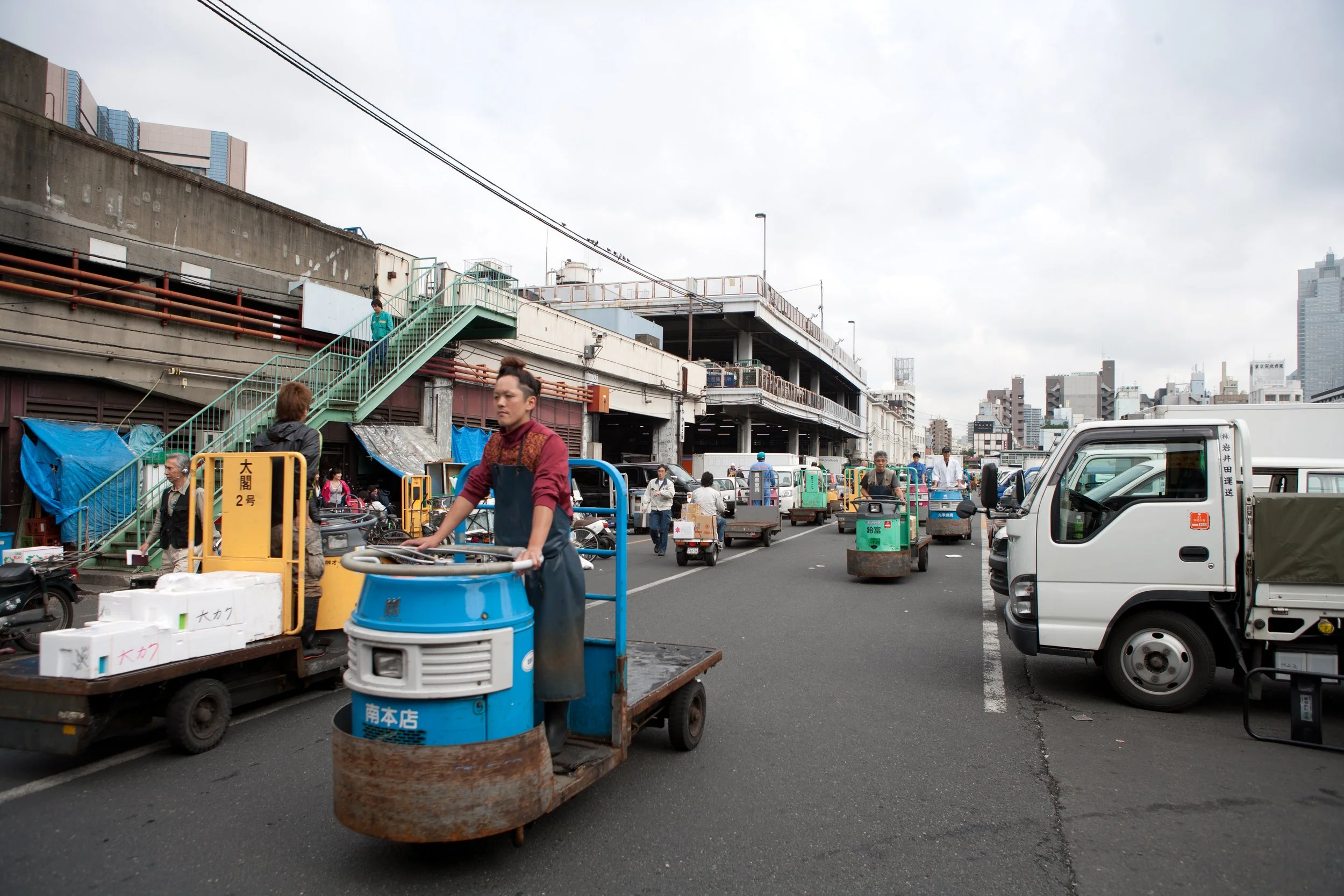
When I visited Tsukiji in 2010, before its closure and relocation, I was struck by how accessible this world still was — how one could stand within it, rather than outside it. There was no barrier between observer and activity. I felt fortunate to witness, at close range, the whirl and rush of humanity, its life and death unfolding continuously within the same space.
The tools have changed, and the infrastructure has expanded, but the underlying choreography remains. The negotiation of space, the calibration of expertise, the physical handling of goods — these continue to define the experience. The market is still a place where knowledge is embodied, where value is determined through proximity and contact.
Fish markets endure because they resist abstraction.
Nothing is hidden. Nothing is deferred. Everything is present — immediate, tactile, and contingent. The world appears not as image, but as process.
It is not difficult to imagine why an artist like Hokuba would have been drawn to such a place.
Here, the city reveals itself most plainly: not in its monuments, but in its movements. Not in its ideals, but in its exchanges. A place where life gathers, disperses, and gathers again — endlessly, attentively, without pause.
In this sense, his paintings are not only records of Edo.
They are acts of attention — sustained, generous, and exact — directed toward the living fabric of the everyday.
4 April 2026
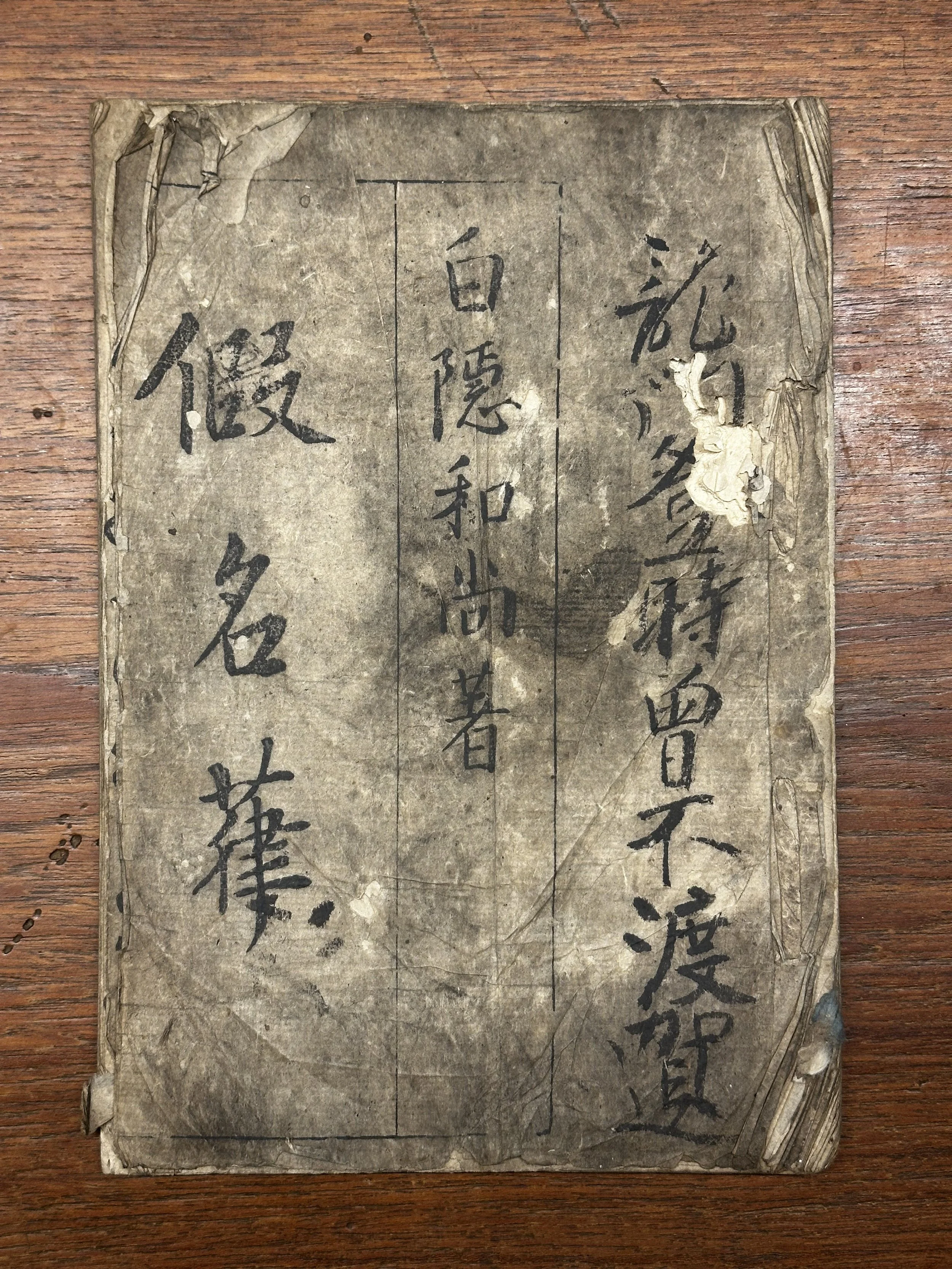
This week I have been reading a small mid-eighteenth-century printed volume from Edo containing the teachings of Hakuin Ekaku — the second volume of what was likely titled Instruction for Beginners. It is, in physical terms, a modest object: paper covers, worn edges, simple woodblock printing. But as an object, it is anything but modest. Over the course of its life, readers did not simply read this book — they wrote in it. A Tokugawa domain lord, a provincial village reader, and a modern owner all left their names and notes directly on its pages, as if each of them, in their own time, wanted to place themselves beside the words that had moved them. The book is therefore not only a printed text from the 1750s; it is also a record of readers across centuries, a small piece of paper history that people quite literally wrote themselves into.
The book itself begins with the enso, the Zen circle, and then turns immediately to the details of everyday life: honesty, greed, contentment, trust, and the quiet accumulation of good and bad actions. Again and again, the message is that heaven and hell are not distant places but conditions of the heart, formed moment by moment through ordinary behaviour. Gold and silver are described as small treasures, while virtue and trust are described as great ones. A person who knows contentment is rich even in poverty; a person who is greedy is poor even in wealth.
What becomes clear is that this little book functions in the same way as Hakuin’s paintings. It is a portable teaching — something to keep nearby, something to open at random, something that does not demand scholarship, only attention. The combination of image, calligraphy, and short moral reflection forms a kind of visual and textual practice — a way of returning, again and again, to the question of how to live. The more time one spends with these materials, the clearer it becomes that Hakuin was not only a painter or a Zen master in the formal sense, but a teacher of everyday conduct. His paintings, his calligraphy, and these printed booklets all seem to serve the same purpose: not to impress, but to guide; not to decorate a room, but to quietly correct the heart.
It is a very Edo-period idea, but also a very timeless one — that the smallest book, or the simplest painting, if it is returned to often enough, can slowly reshape a life.
Abridged Notes, Second Volume, Leaving Appearances
by Hakuin Oshō, 1750s, printed in Edo
This small, worn book is a mid-eighteenth-century printed volume from Edo containing the words of Hakuin Ekaku. Near the end of his life, Hakuin’s teachings circulated widely in printed form. Publishers produced small, affordable booklets containing his sermons, moral writings, and religious reflections so that ordinary people — townspeople, merchants, farmers, and samurai — could read and learn from them. This little book belongs to that world: not the world of temple treasures, but the world of printed teaching, where ideas travelled in paper covers and ink rather than in hanging scrolls.
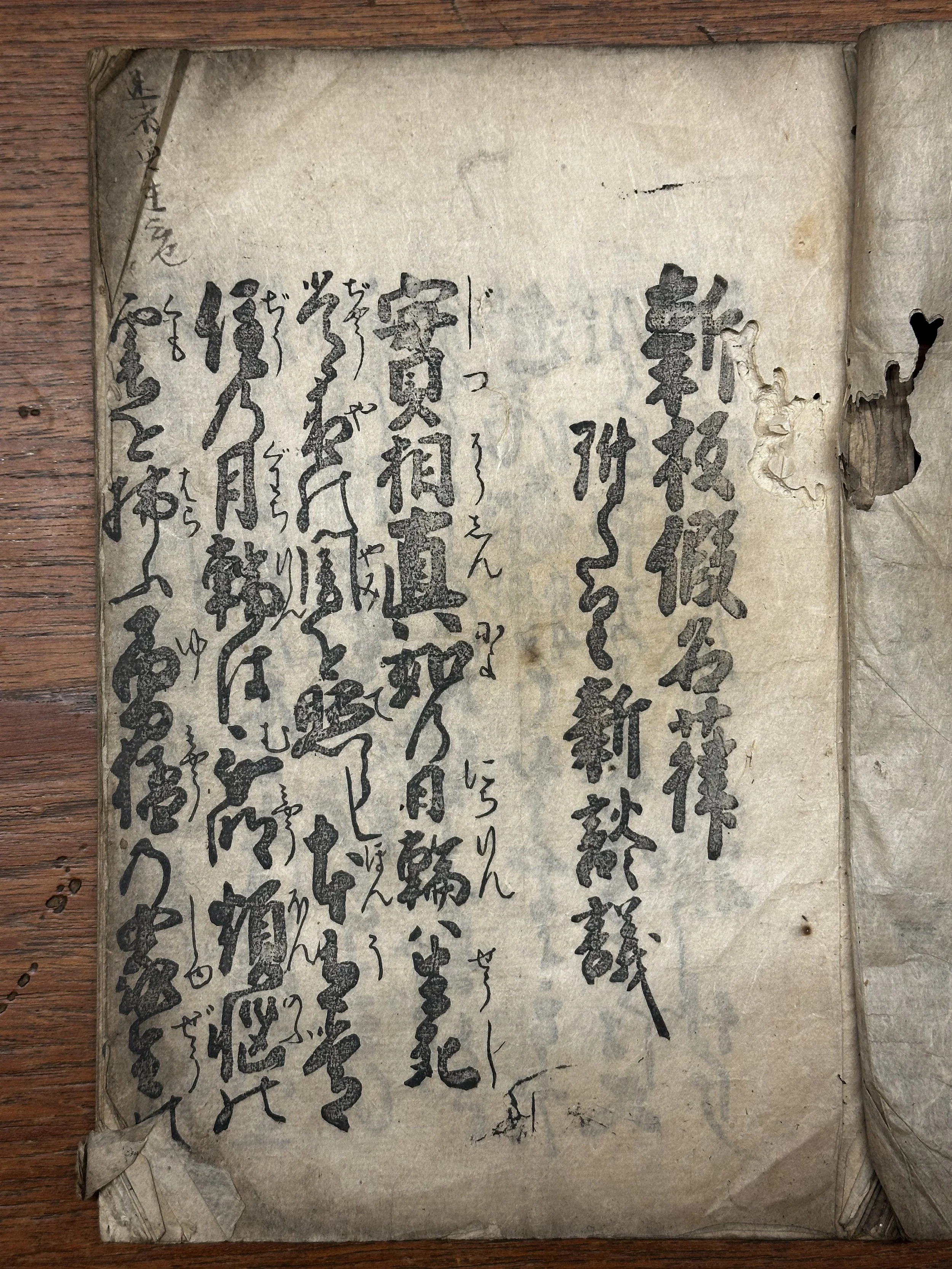
The title on the outer cover is worn and difficult to read in full, but enough remains to suggest that the book was originally presented as a didactic text of the “instruction for beginners” type — a common category in Edo-period publishing. However, a printed title page at the end of the volume appears to read 離相下巻抄 — “Abridged Notes, Lower Volume: Leaving Appearances.” This internal title is more explicitly Buddhist in tone, and suggests that the work may be better understood not simply as elementary instruction, but as a distilled teaching concerned with non-attachment to forms — the letting go of appearances.
When one reads the book itself, this interpretation fits perfectly. Because this is not an abstract Zen treatise. It is a book about how to live.
One of the most striking things about the book is how it begins. It does not begin with a story, or a sermon, or a doctrinal argument. It begins with an explanation of the enso, the Zen circle. The circle is presented as something complete, something without beginning or end, something that contains everything. It is both empty and full. It is a visual teaching rather than a verbal one, and it is a very Hakuin way to begin: with a brushstroke rather than an argument.
But after beginning with the circle — with Zen in its most distilled and abstract form — the book turns immediately toward ordinary life. The pages that follow are filled not with koans or temple regulations, but with discussions of honesty, trust, greed, contentment, virtue, repentance, karma, Amida Buddha, heaven and hell, and the condition of one’s own heart. Again and again, the text returns to the same central idea: small actions accumulate, small thoughts grow, and the state of one’s heart determines the state of one’s life.
There are passages that explain that if you deceive people, you may profit briefly, but you will lose trust; and if you lose trust, you lose your place in the world. There are passages that say gold and silver are small treasures, but virtue is a great treasure. There are passages explaining that a greedy person is never at peace, but a person who knows contentment is always rich, even if they are poor. There are passages explaining that heaven and hell do not begin only after death, but begin in the mind itself. It is, in a sense, a kind of Edo-period moral psychology — a practical handbook for living among other people without destroying your own heart.
This is what makes the book so interesting. It shows Hakuin not only as the great Zen painter and calligrapher we know today, but as a public teacher whose writings were printed and distributed so that ordinary people could read them. It is Zen, Pure Land Buddhism, and Confucian ethics combined into something practical and direct. It is a book about how to live in society while keeping your mind in order.
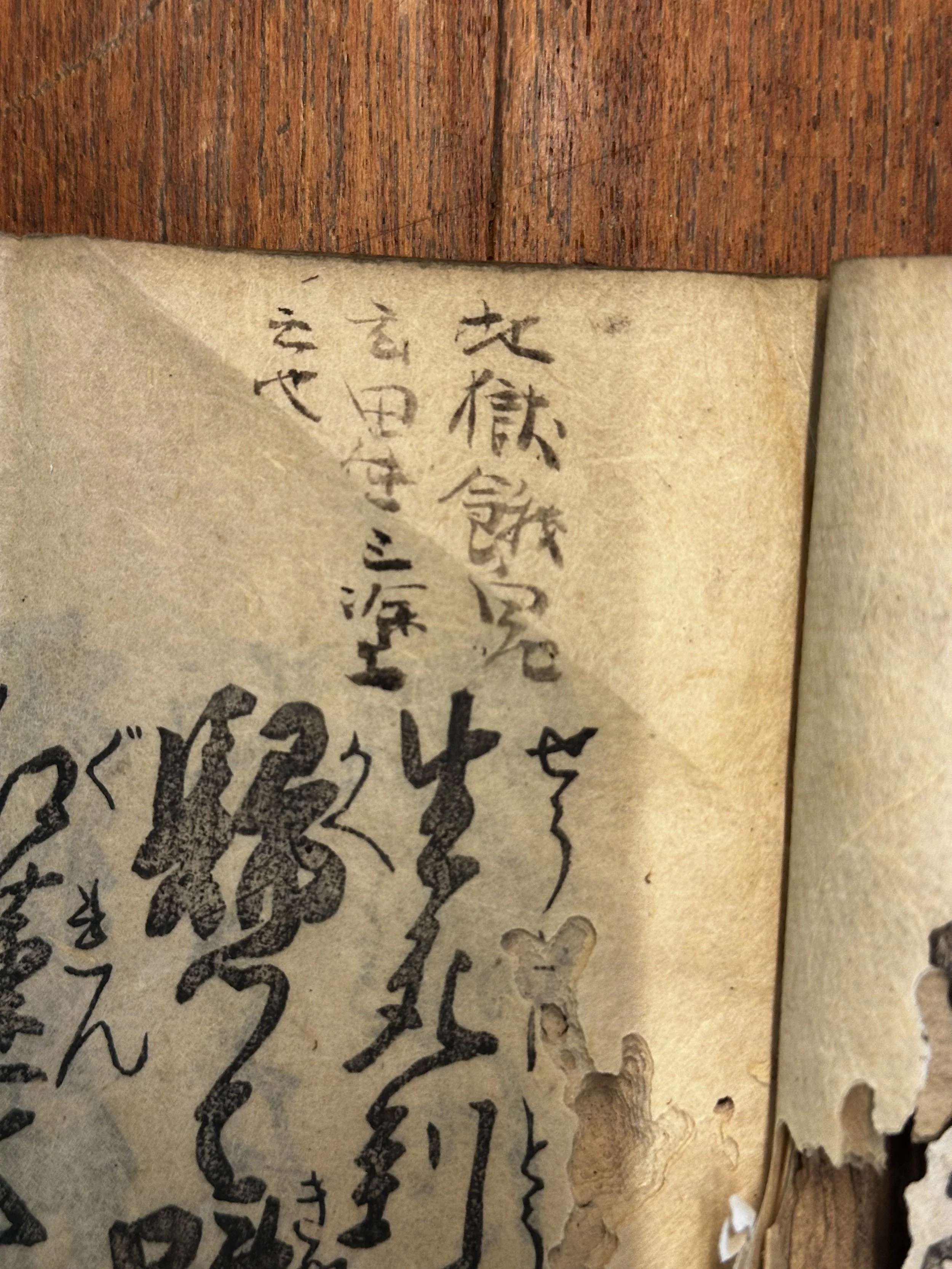
What makes this particular volume even more fascinating are the handwritten notes that were added to it after it was printed. These notes connect the book to real people and real places, and they give the object a social history that extends far beyond the printing house in Edo.
On the very first page, written lightly in the margin, appears a short Zen phrase: 本来無生死 — “Originally there is no birth and death.” It is a concise and profound statement, expressing the idea that at the deepest level, the opposites of life and death do not truly exist as separate realities. It is not an ownership mark, but a reflection — the kind of phrase one writes down when something in a text has been deeply understood.
Further into the book, beside a passage on moral conduct — specifically the dangers of greed and the importance of honesty, humility, and right behaviour — appears a second, more formal annotation. The passage itself speaks about how people become trapped by desire for gold and silver, how winning and losing, profit and reputation, and the pursuit of wealth lead people into moral confusion, and how a person must instead learn to value virtue, honesty, and inner composure. Written beside this is the phrase 死活自在, meaning “freedom in life and death,” or composure and freedom regardless of circumstances. Beneath it appears the signature 紀州徳川家五代 源宗直, identifying the writer as Tokugawa Munenao (1682–1757) of the Kishū Tokugawa house.
The Kishū branch, based in Kii Province (modern Wakayama Prefecture), was one of the three great collateral Tokugawa houses. Munenao appears in Wakayama historical records not merely as a distant name but as an active domain lord: in 1722, the shogun Tokugawa Yoshimune ordered him to send the engineer Izawa Yasobei into shogunal service, reflecting the domain’s expertise in irrigation and civil engineering, and in 1727 he is recorded as dedicating imperial waka manuscripts at Tamatsushima Shrine, showing his participation in the cultural and ceremonial life of Kishū. If this little book was printed in the 1750s, as seems likely, then these notes may belong to the final years of his life.
Taken together, the two inscriptions — “Originally there is no birth and death” and “Free in life and death” — read almost like a paired reflection. They suggest not a casual owner, but a deeply engaged reader, responding to the text in the language of Zen itself. It is tempting to imagine the aging domain lord reading a small moral booklet by Hakuin — a text concerned not with power but with honesty, greed, contentment, and the condition of one’s heart — and responding in the margins not with political commentary, but with distilled expressions of spiritual insight. Whether or not we can know the exact circumstances, the notes read like moments of private reflection rather than official inscriptions.
Elsewhere in the book appears another short handwritten note, also associated with Kishū, which states that the text was “copied in full,” followed by the place name Kishū. This suggests something rather moving: that this was not merely a book that passed through his hands, but a book he valued enough to have copied. In the Edo period, copying a text was not a trivial act — it required time, paper, and skilled labour — and was usually done because a text was considered morally or educationally important. It is therefore possible that this little Hakuin booklet was copied for wider circulation within the Kishū domain, perhaps for retainers, students, or temple networks.
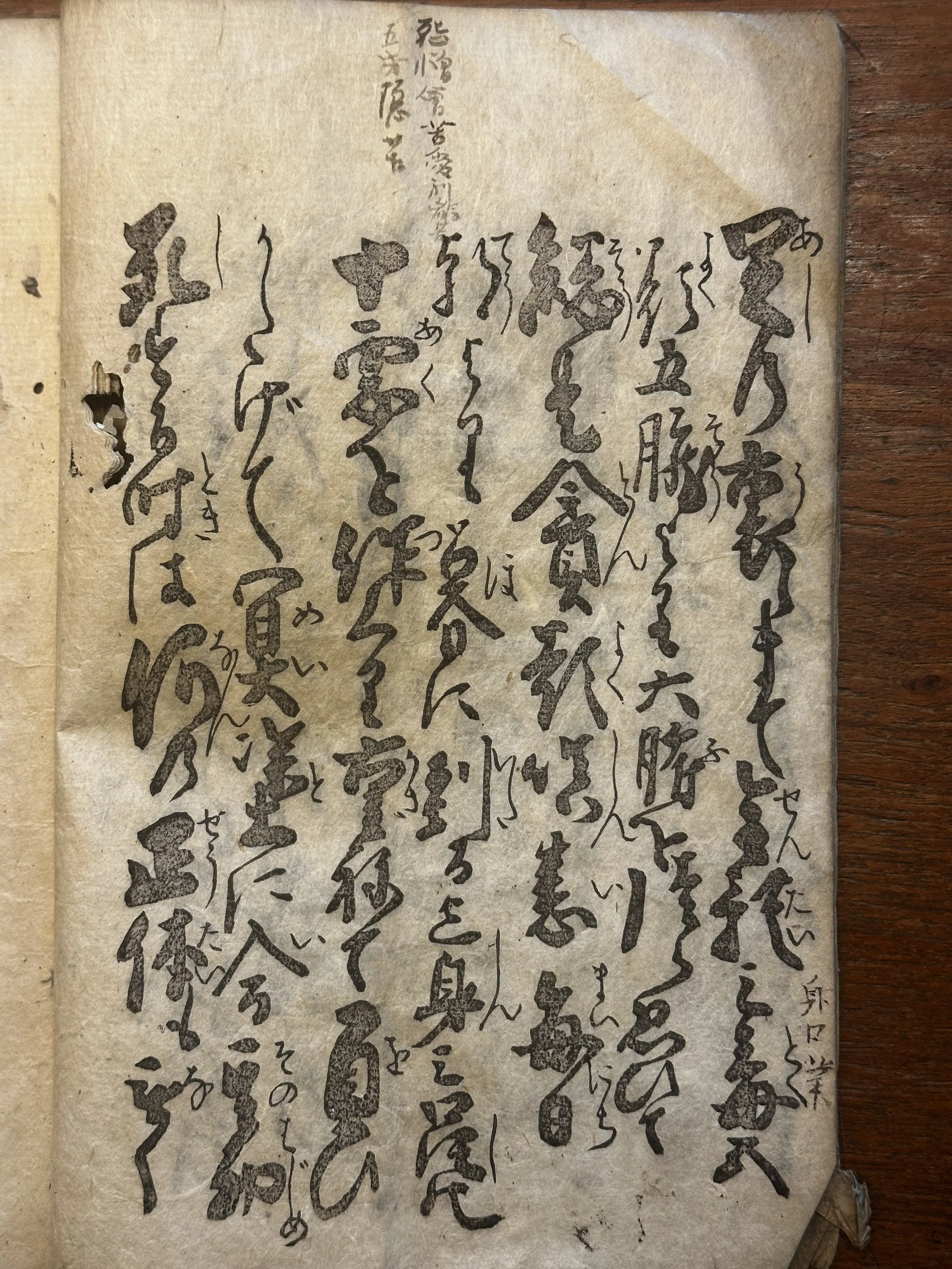
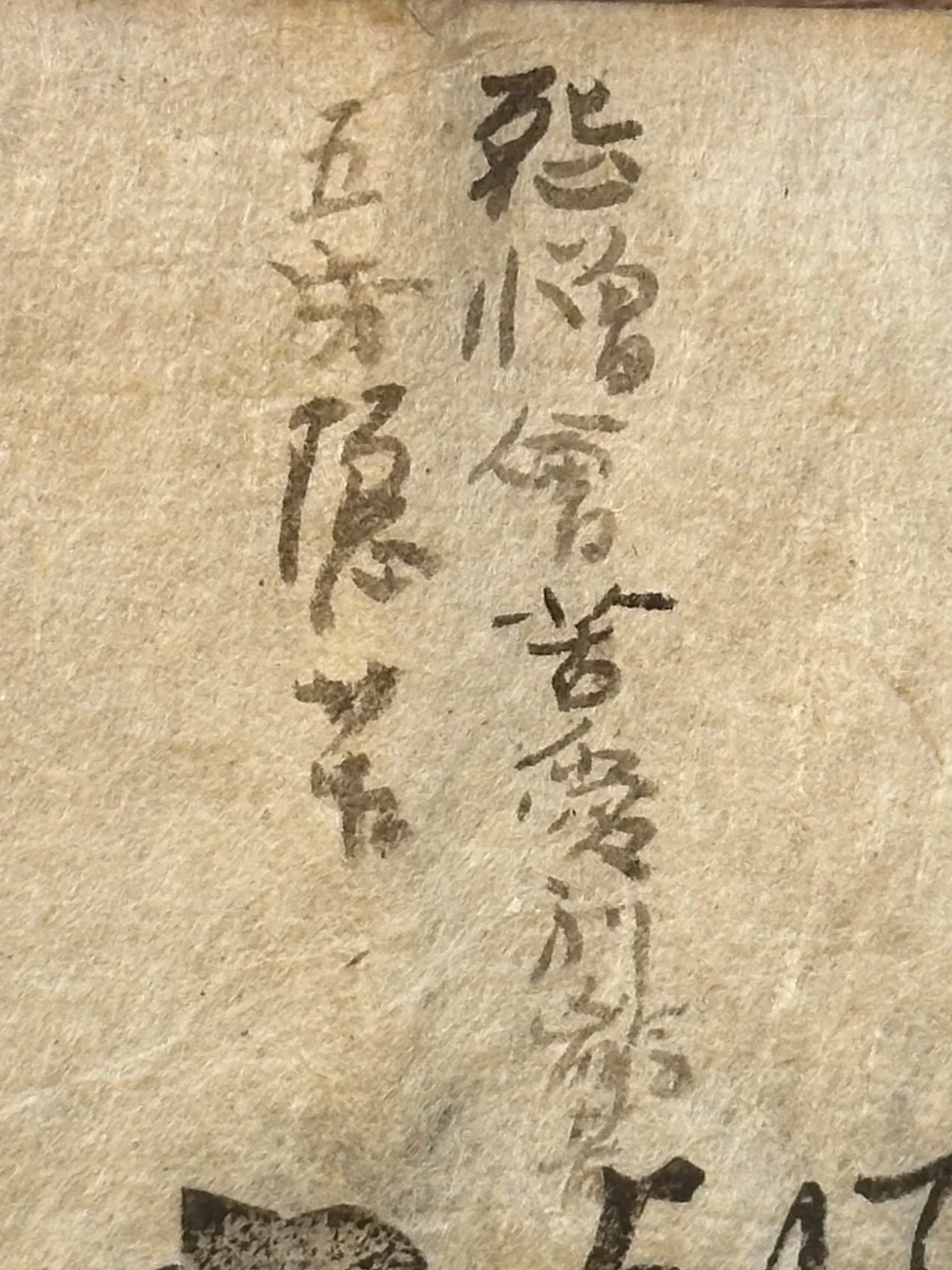
At the very end of the book, there are further handwritten pages that appear to be reflections by a later reader. Written in a flowing cursive hand, they form a continuous note across two pages. The text is difficult, but can be read broadly as follows:
The writer describes examining and reading through the book carefully, noting its content and preserving it with attention. There are references to gathering and recording the material, and to its value as something worth keeping. The text suggests that copies or versions of the work were sought out and brought together, and includes a line indicating movement “down to Edo,” implying either the transmission of the text or its circulation within a wider network. The tone is reflective and appreciative rather than formal — not a colophon, but a personal record of engagement with the book. It reads as the voice of someone who has taken the time to read, consider, and preserve the text, and who wishes to mark that encounter in writing.
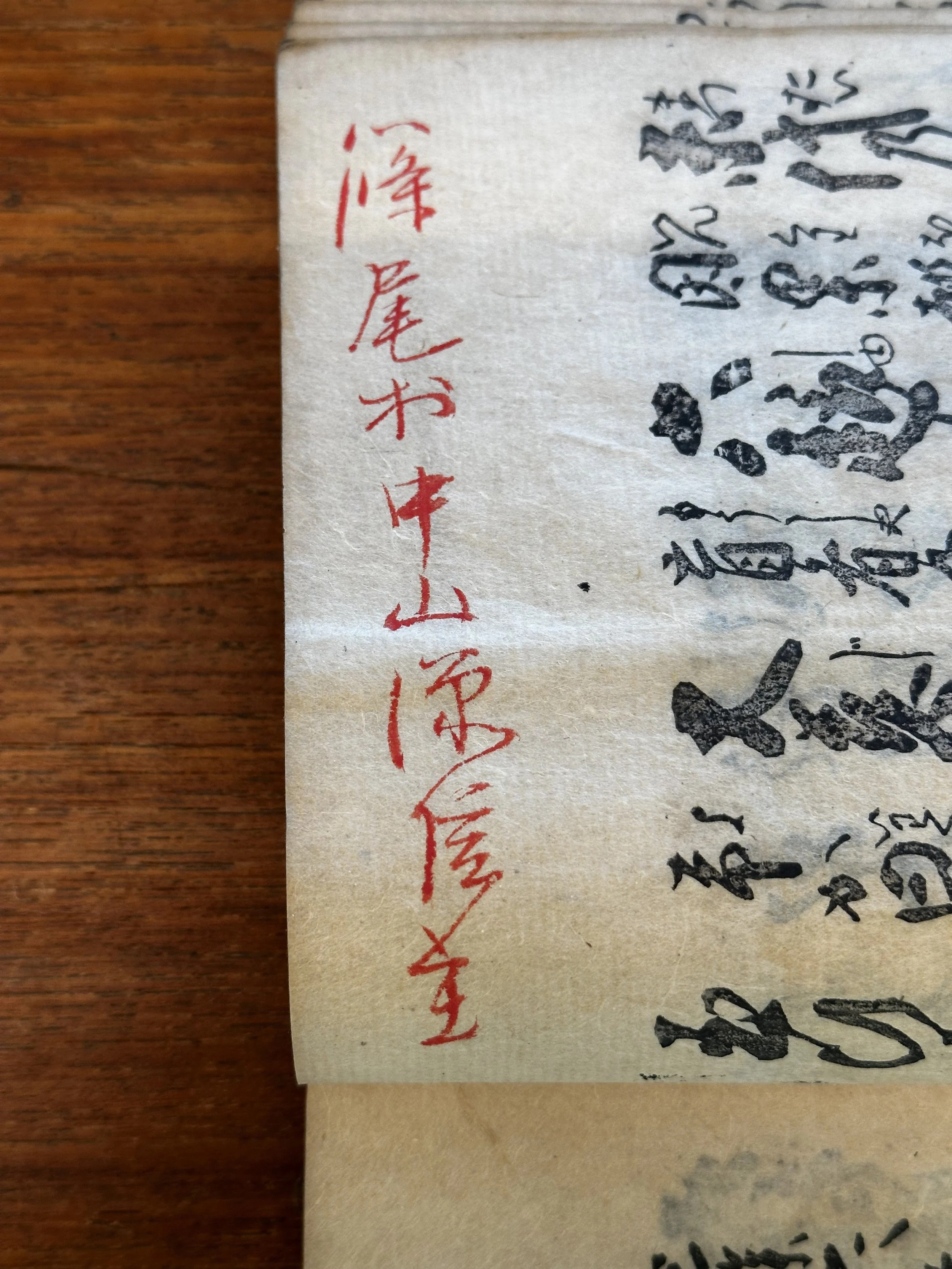
Alongside these pages appears the clearer ownership inscription 平山蔵書 — “From the library of Hirayama” — and a place name identifying a village in Kai Province (modern Yamanashi Prefecture). This tells us that at some point the book belonged to a person or family named Hirayama living in a rural inland region west of Edo. The book thus moved from the world of a major Tokugawa domain to a provincial private library, continuing its life in quieter hands.
What is striking is that each of these readers chose not to keep their distance from the book, but to write directly into it. This is, in a way, quite an extreme act. They did not treat the book as a relic to be preserved untouched; they treated it as a living text. They wanted to place their names and their thoughts beside the words they had read. They wanted, in a sense, to be part of the book — to enter into it. Each reader, in a different century, added their presence beside the text that had moved them. In this way, the book becomes not just a printed object but a record of readers — a small thing that passed from hand to hand across time, carrying Hakuin’s teachings with it, and gathering the traces of those who responded to them.
What I find most beautiful about the book, however, is not only its history but its structure.
It begins with a circle. And then it spends the rest of the book explaining how to live inside that circle.
Not in a monastery, but in ordinary life. Do not lie. Do not cheat people. Do not be greedy. Be content. Value trust. Correct your heart while bad thoughts are still small. Do good quietly. Do not do evil even when no one is watching. Heaven and hell begin in your own mind.
It is a small book, but it contains a complete world. And perhaps that is why Hakuin began with the enso. Because the circle is not just a Zen symbol. It is the shape of a life, if one can learn how to live it properly.
And this little printed volume — Abridged Notes, Second Volume, Leaving Appearances — is, in its quiet way, a guide to how that might be done.
5 March 2026
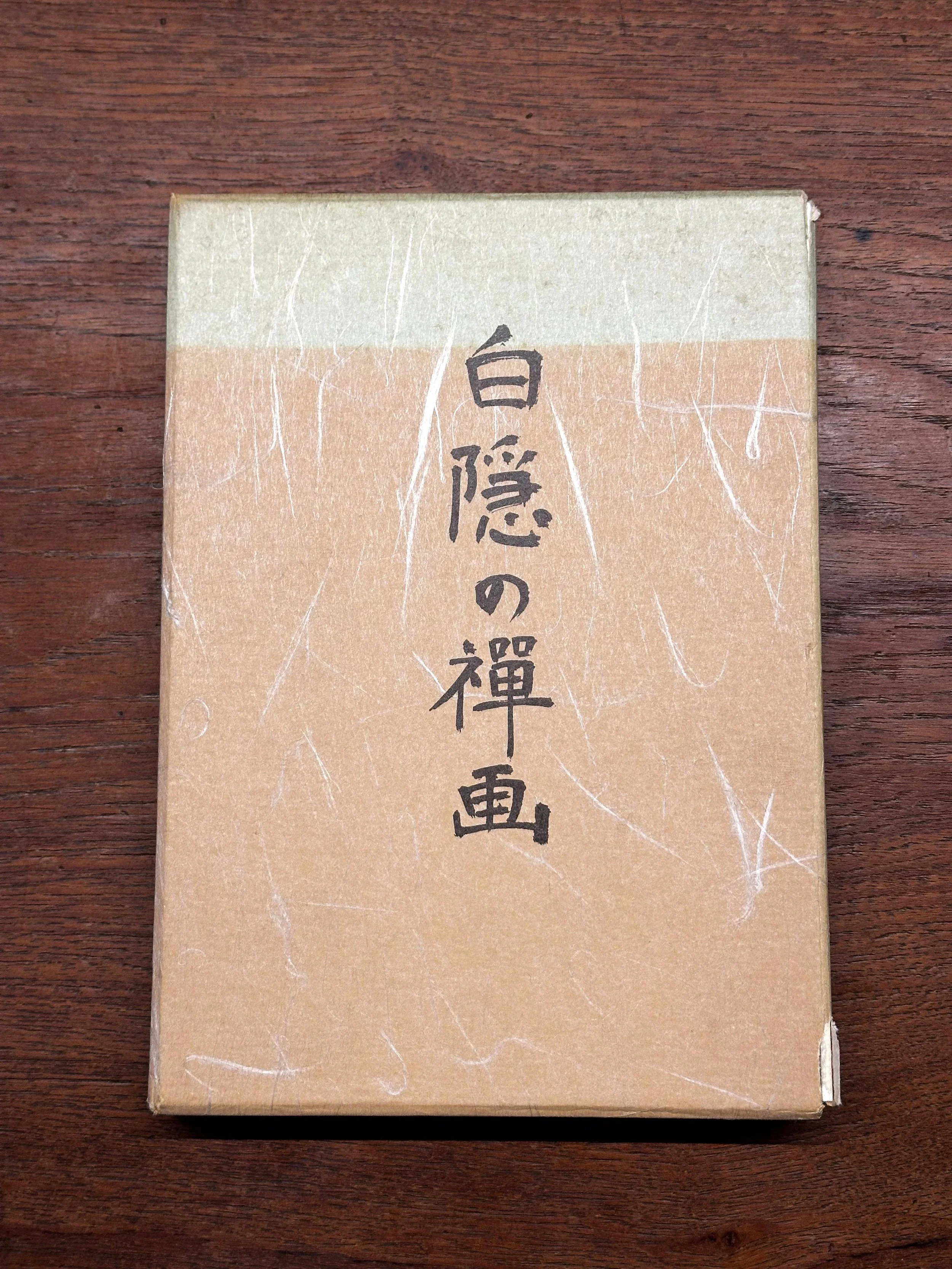
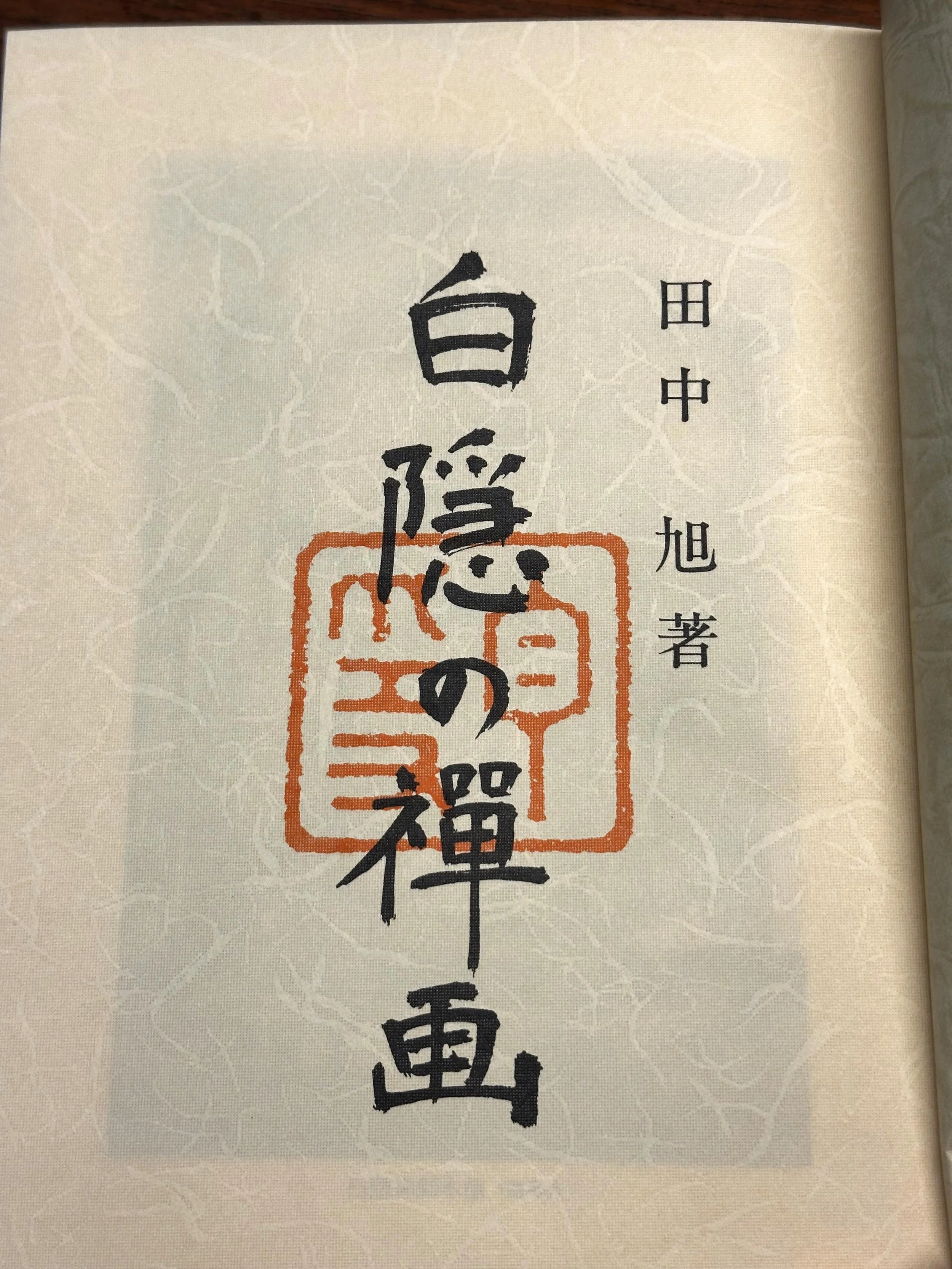
This week’s reading has been the beginning of Hakuin no Zenga, Tanaka Akira’s thoughtful 1983 meditation on Hakuin’s paintings as things to be read, absorbed, and lived with. What emerges is a world of moral parable and visual brevity, where ordinary images — food, weather, errands, gestures — become vehicles for reflection, and where painting and text together form a kind of portable instruction for the heart.
What We Are Meant to Digest
Reading Hakuin no Zenga
After writing recently about authenticity — about proof, authorship, seals, and the uneasy theatre of attribution — I found myself turning, almost with relief, toward a very different kind of question.
Not: Is this genuine?
But: What is this trying to do to me?
This week I have been reading the opening pages of Hakuin no Zenga (Zen Paintings of Hakuin), a small volume by Tanaka Akira, published in 1983. It is beautifully written in a way that now feels increasingly rare: direct without being simplistic, moral without becoming heavy, and full of conviction about what painting can still do in the world.
Tanaka’s central claim is wonderfully unfashionable and therefore all the more refreshing. Hakuin’s paintings, he suggests, are not merely to be admired as cultural artefacts or appreciated as examples of Edo-period brushwork. They are to be read. More than that, they are to be absorbed, digested, and brought into life.
That struck me very strongly.
In my previous note, I was thinking about the fragility of proof — the way Zen painting unsettles the art world’s hunger for certainty. But this book opens another front entirely. It reminds one that Hakuin’s art is not primarily concerned with connoisseurship, however necessary that may be. Its real concern is the human heart: how easily it slips away, how stubbornly it clings, how often it confuses cleverness for understanding, and how patiently image and word might call it back.
What I have loved most in these opening chapters is the form that teaching takes. Hakuin does not retreat into abstraction. He teaches through dumplings roasting by the hearth, through a monkey and a turtle, through a tea ladle, through small domestic and folkloric scenes that seem almost playful at first glance. Yet each image carries an aphorism or parable that opens into something unexpectedly exact. The effect is not unlike a koan softened by humour, then sharpened again by recognition.
One of the most beautiful ideas in the book is Tanaka’s comparison of Hakuin’s paintings to food — specifically to dumplings prepared and offered, waiting to be eaten. A painting is not enough merely to look at. It must be chewed. Digested. Taken inward. Only then can it nourish. It is such a simple metaphor, but it illuminates everything. These works are not passive objects. They are offerings. Their real life begins only when the viewer participates.
That, perhaps, is why they feel so alive.
The combination of picture and phrase gives Hakuin a particular moral force. A line of ink can catch a posture, a weakness, a folly in an instant. A few words beside it can tilt the image from anecdote into instruction. Yet none of this feels sermonising. Hakuin is too earthy, too funny, too alert to the absurdity of human behaviour for that. He does not speak from above. He points. He teases. He exposes. He lets ordinary life become transparent to spiritual fact.
And so these small scenes begin to gather weight. One sees that they are not really about dumplings, or eels, or household errands, or village characters. They are about appetite, distraction, expectation, readiness, presence. They are about what happens when the mind is caught and what happens when it is free. They are about the extraordinary difficulty of being simple.
What moves me is that the book never treats painting and text as separate domains. The lesson does not sit behind the image like a caption, nor does the image merely illustrate a moral already complete in words. Each needs the other. The brush makes the teaching memorable; the phrase makes the image ring. Together they form something closer to a lived instrument of reflection.
It also feels, quietly, like a continuation of the authenticity question — but on another level. In the first piece I wrote that no seal can save a weak painting, and no paperwork can replace the authority of a living brush. Here the matter shifts inward. The question is no longer simply whether the work is authentic, but whether one’s own response is. Whether one is really seeing. Whether one is allowing the work to speak.
That may be the most unsettling demand Zen painting makes. It does not permit the viewer to remain comfortably external. It asks not only for judgment, but for self-implication.
And perhaps that is why this book has felt so companionable to me. Its tone is not institutional. It is not trying to secure Hakuin in a museum vitrine. It is trying to place him back into conversation — as a teacher who still has something exact and useful to say, through pictures that are agile enough to survive the centuries.
At the beginning of this reading, at least, that is what I am reminded of most clearly: that Hakuin’s paintings are not simply artworks that happen to contain teachings. They are acts of teaching in themselves. They use the force of image and the economy of phrase to make moral and spiritual insight briefly visible. They are small, portable awakenings — rustic, humorous, searching, and unexpectedly tender.
The more one reads, the more one suspects that Hakuin knew exactly what he was doing.
He did not paint to decorate Zen.
He painted to smuggle it into ordinary life.
A transcript and English translation of the opening section of Hakuin no Zenga is available in the Research section of this website.
15 February 2026
Authenticity is the art world’s most guarded currency — yet in Zen painting, the deepest proof often lies not in seals or paperwork, but in the unforced clarity of a single line. This essay explores how connoisseurship, cultural difference, and market psychology intersect, and why the strongest works of Hakuin and Jakuchū quietly unsettle the very obsession with certainty that surrounds them.
What Matters Is Authenticity?
Zen Painting and the Fragility of Proof
Authenticity is the great obsession of the art world. It sits at the centre of valuation, scholarship, insurance, inheritance, prestige and price. A work may be visually extraordinary, emotionally devastating, historically profound — and yet without authorship it becomes, in market terms, diminished.
But what if authenticity itself is more fragile than we imagine?
What if the very category wobbles under scrutiny?
Zen painting is uniquely positioned to expose this instability.
Because the greatest works of Zen art do not persuade through documentation. They strike through clarity.
⸻
The Samurai and the Gourd
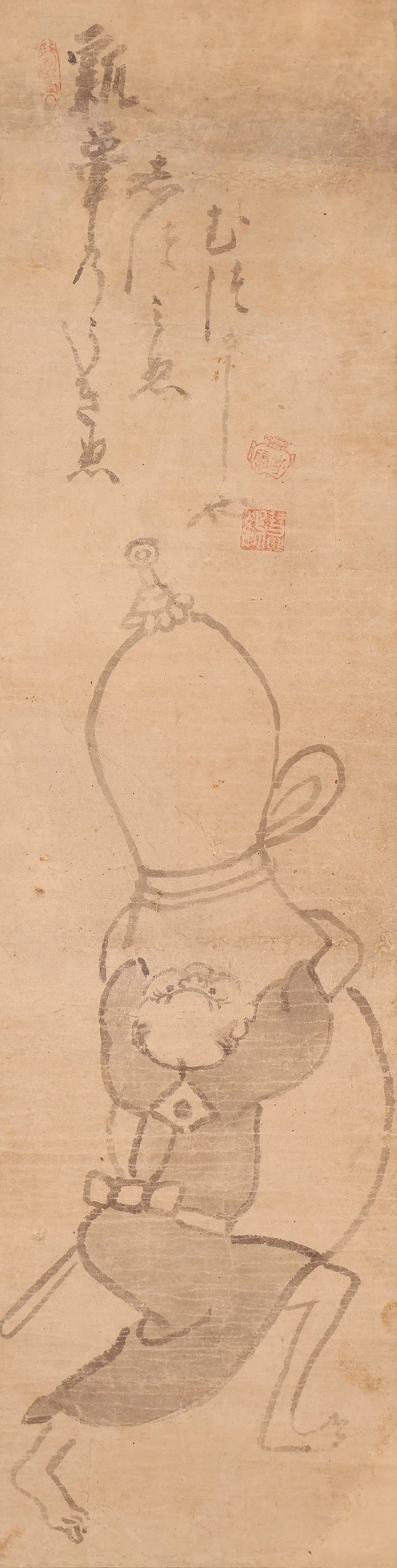
Consider a small hanging scroll depicting a samurai straining upward to grasp a large gourd. His body is twisted, viewed from behind; his head is thrown violently backward at an almost impossible angle. The brow and nose are reduced to a few strokes, yet the psychological state is unmistakable. Effort. Strain. Futility.
Above him, the inscription declares in essence:
Whether one knows or does not know, even if one seeks, it cannot be obtained.
The pairing is devastating.
The warrior — symbol of status, control, and possession — attempts to seize emptiness itself. The gourd, traditionally associated with voidness and spiritual metaphor, becomes a literal object of grasping. The more intensely he clutches, the more absurd the effort appears.
The painting becomes a koan directed not only at aristocratic pride, but at the viewer. It indicts striving itself.
And here the question of authenticity becomes philosophical.
If the painting’s subject is the futility of grasping, then the collector’s anxious grasping for certainty becomes part of the work’s theatre.
⸻
Minor Work Intuition
When an unfamiliar design appears — one not widely published, not easily recognisable, not part of the standard repertoire — it often passes beneath the market’s radar. Recognisable subjects attract competition; obscure ones invite hesitation.
Rarity cuts both ways. It can indicate invention. It can indicate imitation. It proves nothing on its own.
What becomes more telling is micro-syntax:
How a head is constructed.
How the spine twists.
How the brow meets the nose in a single decisive motion.
Whether the line hesitates or lands once and moves on.
Subject matter can be copied.
Reflex cannot.
In Zen painting especially, authorship is often embedded in bodily grammar rather than iconography.
⸻
Seals: Evidence and Distraction
In Japanese painting, seals carry enormous weight. They function as signatures, markers of identity, chronology, studio practice. Their carving, wear, and pressure patterns can become forensic tools.
At their best, seal comparisons can be revelatory. Overlaying impressions from different works — matching voids, edges, micro-defects — can reveal continuity of carved block across decades. In cases such as the comparison between a rooster painting and a securely documented Metropolitan Museum work, cumulative correspondence can become highly persuasive.
And yet seals are not paintings.
As one catalogue entry wisely notes:
Seals can confirm identity, chronology, and habitual practice, but they do not in themselves establish authorship; the primary evidence remains the painting itself — its uncorrected line, economy, and the character of ink and paper.
When the debate collapses entirely into seals, something has shifted. The painting has been treated as silent, and the stamp as the speaker.
Zen painting resists that hierarchy.
If the brushwork lacks inevitability, no seal can redeem it.
If the brushwork possesses inevitability, the seal becomes confirmation rather than crutch.
⸻
Japan and the Obsession with Absolute Authentication
Within the Japanese domestic antique scene, authentication is approached with remarkable conservatism. In the absence of documentary proof — box inscriptions, temple provenance, scholarly publication — works are often heavily discounted. This does not imply dismissal; it implies caution.
A lack of evidence is not evidence of inauthenticity.
It is evidence of silence.
And silence is precisely where connoisseurship must step in.
Connoisseurship, however, is a dangerous instrument. It can be abused. It can become wishful thinking masquerading as insight. It demands discipline, comparative study, and humility. Without it, the category of authenticity becomes brittle — dependent solely on paperwork. Yet when it operates without restraint, it becomes equally fragile, vulnerable to projection.
Japanese dealers tend to privilege certainty over speculation. Western markets often do the opposite. At Sotheby’s, Bonhams, and Christie’s, narrative, exhibition history, and endorsement can elevate prices dramatically. Comparable works of good quality and condition can command sums vastly exceeding their domestic Japanese equivalents.
A particularly instructive case involves a Hotei in a Boat that appeared at a major Western auction house in 2001 catalogued as “Style of Hakuin Ekaku (19th century)”, where it realised USD 7,050. The designation was clear: the work was presented as in the manner of Hakuin, not by his hand. The same object later entered a prominent American university collection and was listed simply as a work by Hakuin Ekaku.
The movement from “Style of” to full attribution is not a minor editorial adjustment; it represents a significant shift in confidence. What this illustrates is not institutional inconsistency, but the interpretive elasticity embedded within attribution itself. Authentication is rarely a fixed verdict delivered once and for all; it is a negotiation shaped by documentation, connoisseurship, internal review, and evolving scholarly judgment.
This discrepancy reflects not ignorance, but difference in risk tolerance and cultural valuation.
In Japan, authenticity must often be proven beyond doubt.
In the West, authenticity is sometimes accepted within a margin of persuasive probability.
⸻
Scarcity and the Illusion of Rarity
There is also a historical misconception at play.
Nineteenth- and early twentieth-century Western collecting focused largely on durable objects — ceramics, bronzes, lacquer. Paper works, calligraphy, and ephemeral scrolls remained overwhelmingly in Japan. As a result, Western markets often perceive Japanese painting as rarer than it truly is.
Japan, uniquely, preserved paper culture at scale.
Temple storehouses, family kura, seasonal display traditions, and box systems allowed scrolls to “sleep” between appearances. The survival rate is internationally unprecedented.
Thus, Western pricing sometimes reflects a sense of rarity that is culturally rather than materially produced.
⸻
When the Painting Speaks First
Ultimately, Zen painting destabilises the entire authentication hierarchy because its primary authority is experiential.
A genuine Hakuin does not persuade through refinement; it persuades through clarity.
A genuine Jakuchū plum branch does not convince through decorative flourish; it convinces through structural inevitability.
In the Shakyamuni descending from the mountain, the ink lands once and does not search. In the Hotei moon-viewing, emptiness is inhabited without strain. These works do not require belief; they require looking.
The paradox is this:
The stronger the painting, the less desperately it needs authentication.
The weaker the painting, the more it clings to it.
This does not make authentication irrelevant. It makes it secondary.
⸻
The Gourd Revisited
The samurai clutches emptiness.
The collector clutches certainty.
Both are understandable gestures.
But Zen art quietly asks:
What is it you are trying to hold?
Authenticity matters. It structures scholarship. It protects history. It anchors value.
Yet in the end, authenticity is a means — not the end itself.
If the brush does not breathe, no seal will save it.
If the brush breathes, the seal becomes an annotation.
Zen painting leaves us in an uncomfortable but fertile position:
Proof is necessary.
Proof is insufficient.
Clarity must be seen.
And the act of seeing cannot be outsourced.
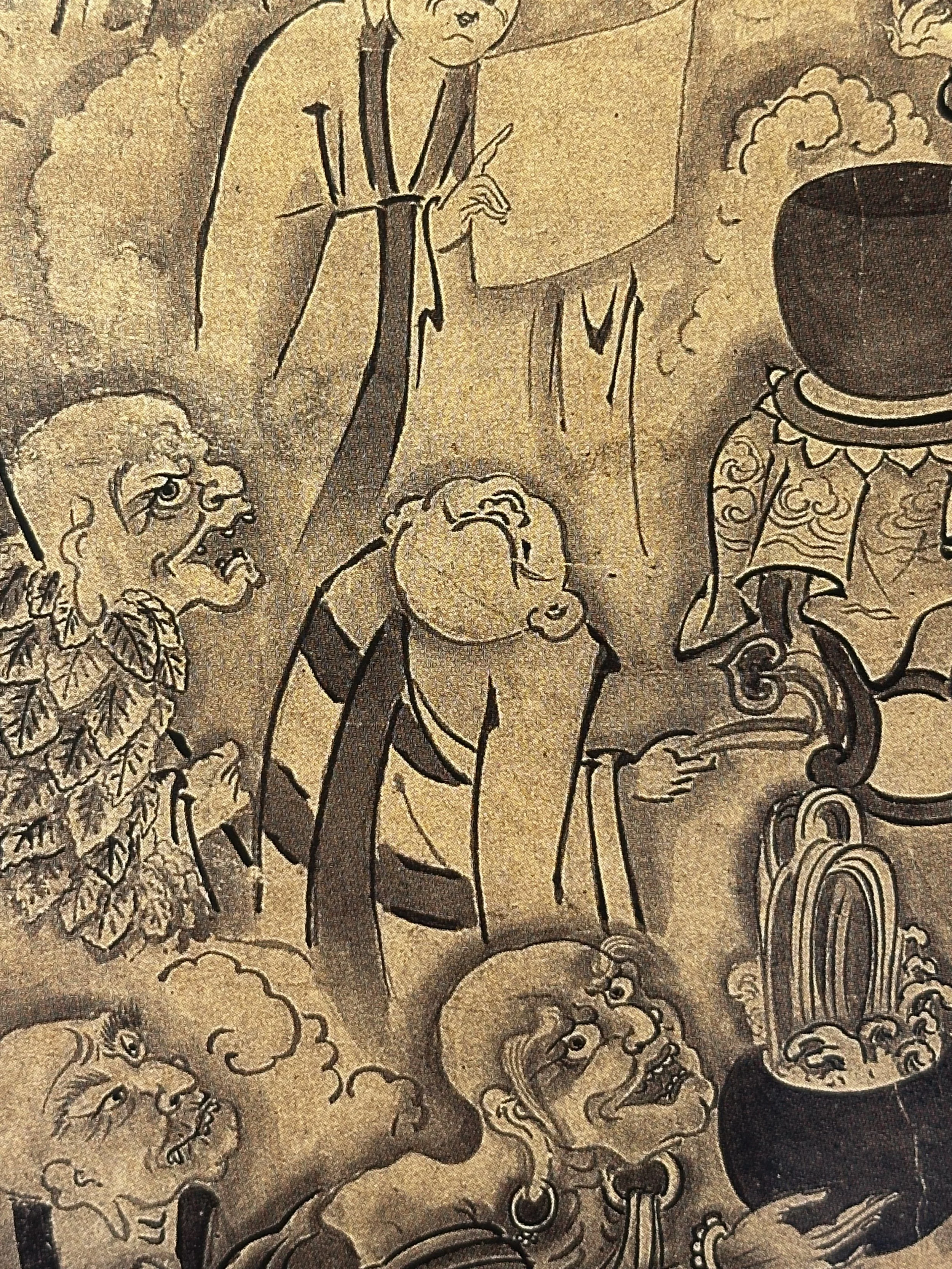
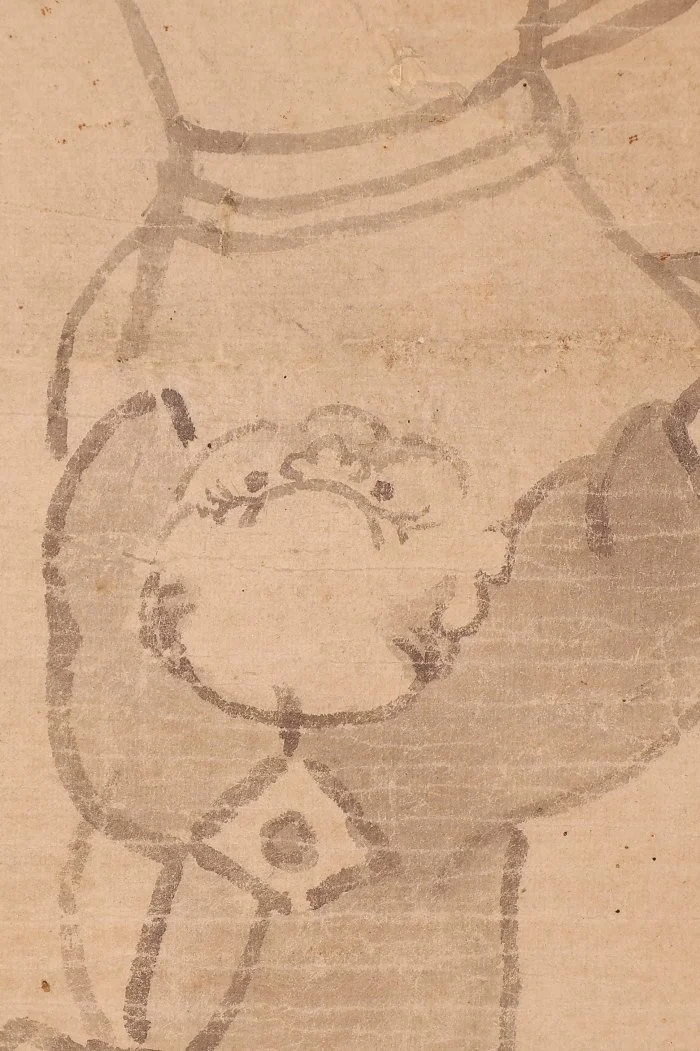
Hakuin Ekaku — Sixteen Arhats (detail), 122.0 × 48.8 cm
From Hakuin Zenga Bokuseki, ed. International Research Institute for Zen Buddhism, Hanazono University, vol. II, p. 219
In this detail from Sixteen Arhats, the shaved head is thrown sharply backward into an extreme upward tilt, the throat exposed, the skull rendered as a clean oval mass. The brow and nose are reduced to a few compressed, decisive strokes — the same economical profile logic seen in the Samurai and Gourd scroll. The structural tension lies almost entirely in that impossible rotation of the head, a reflexive anatomical exaggeration that recurs in Hakuin’s figure grammar.
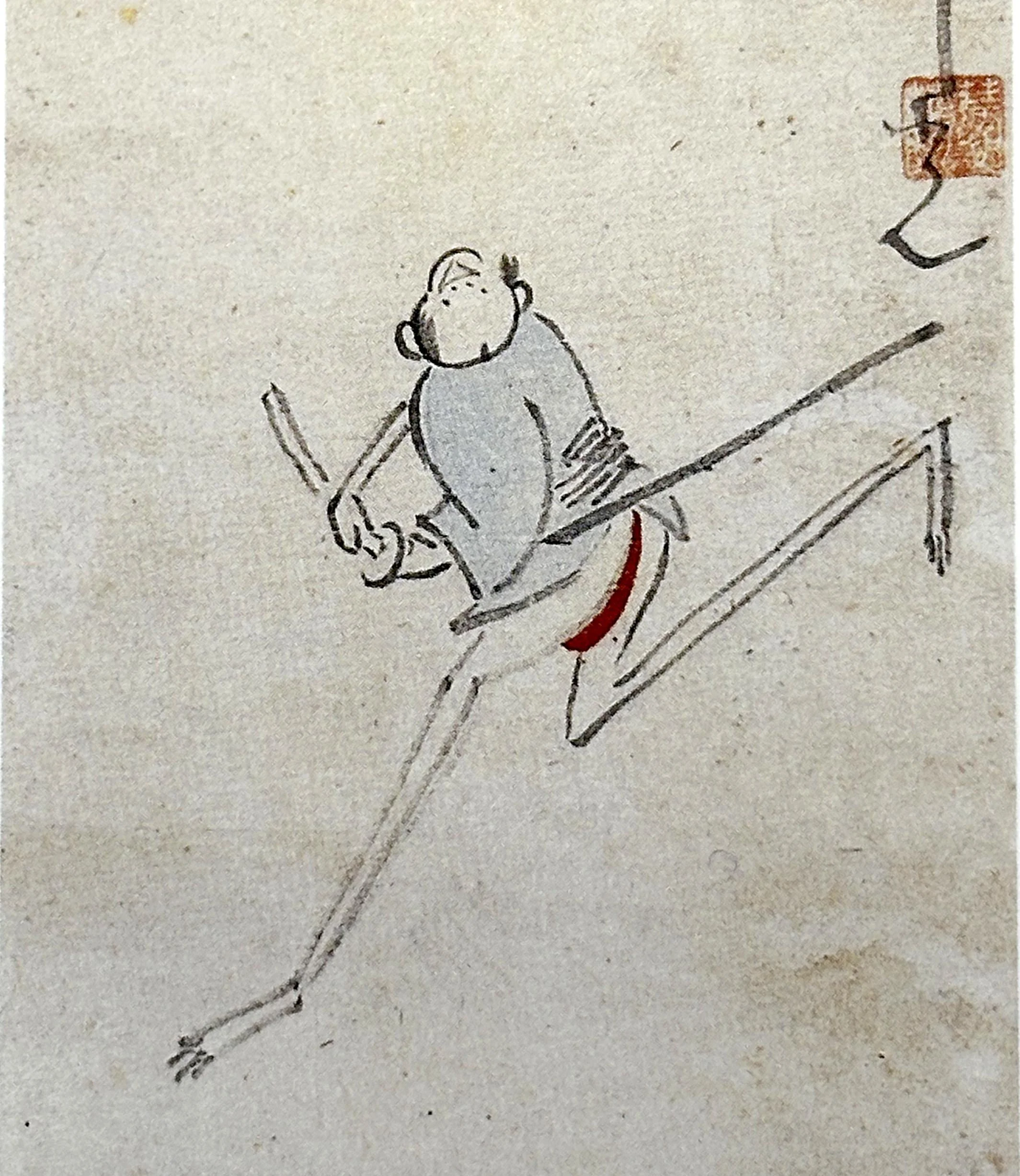
Hakuin Ekaku — Spider and Carp (detail), 112.0 × 16.4 cm
From Hakuin Zenga Bokuseki, ed. International Research Institute for Zen Buddhism, Hanazono University, vol. III, p. 474
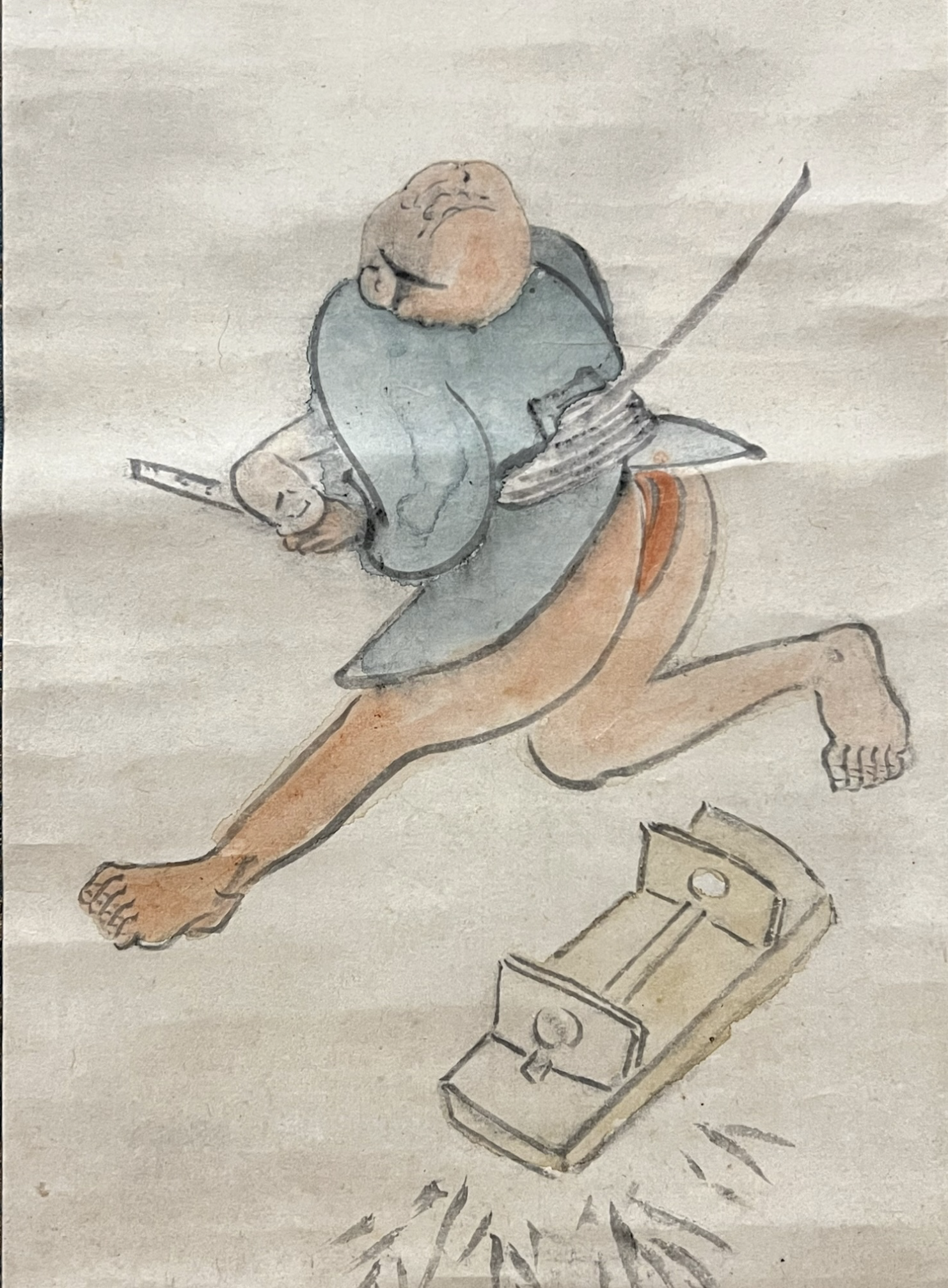
Here again the head is levered backward into an upward stare, constructed with the same minimal brow-and-nose articulation. The skull reads as a single oval unit, while the body twists beneath it in angular tension. The resemblance to the Samurai and Gourd figure extends beyond the head: the strained torso and sharply angled leg create a comparable sense that the entire body is being pulled by the head’s upward thrust.
Matsumoto Shōeidō Gallery
Hakuin Ekaku – Spider and Carp
Hanging scroll
Color on paper
124.6 × 17.5 cm
In this late work, inscribed “Hakuin, aged seventy-nine,” the figure’s head is again levered backward into an upward stare, formed with the same spare brow-and-nose articulation. The skull reads as a single compact oval, while the body twists beneath it in abrupt, almost comic tension. As in the Samurai and Gourd, the narrative undercuts martial seriousness: here the warrior lunges in exaggerated alarm at a descending spider, his posture heroic yet absurd. The strained torso and splayed limbs transform what might be a display of discipline into a quiet satire, suggesting that the true adversary is not external but the mind’s own reflexive fear.
Hakuin Ekaku —
Samurai Straining to Grasp a Gourd
(detail)
The head is forced backward into an extreme upward tilt, the throat exposed and the skull rendered as a single, sealed oval mass. The ear is reduced to a compact hooked form, while the brow and nose are articulated with a few compressed, decisive strokes — an economy identical in logic to the comparative examples above. As in those works, the psychological tension of the figure is concentrated almost entirely in this destabilising rotation of the head, suggesting a reflexive anatomical grammar rather than a copied pose.