Artist Unknown
Mid-Bakumatsu period, circa 1858 (Ansei 5)
Hanging scroll, ink and colour on silk
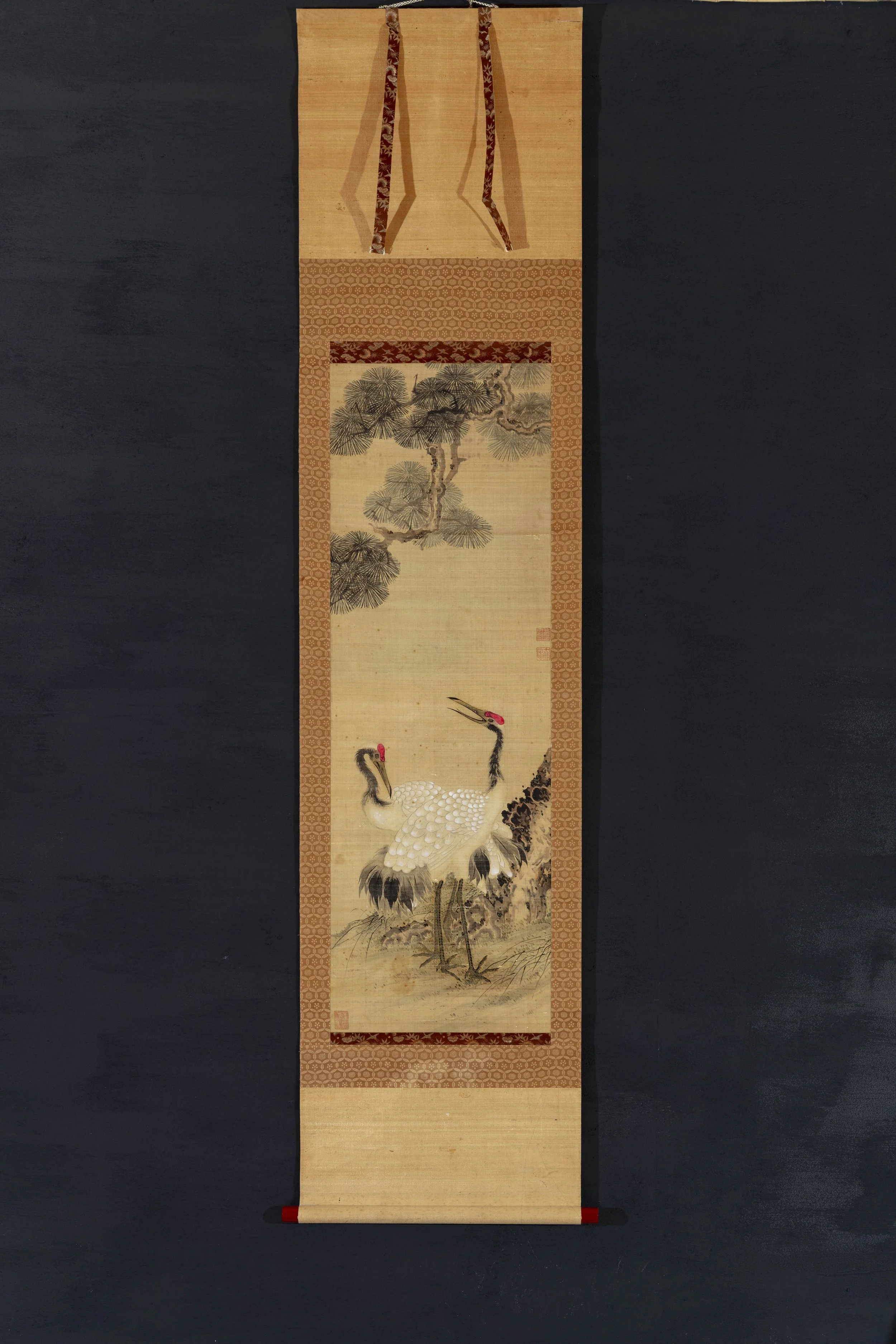
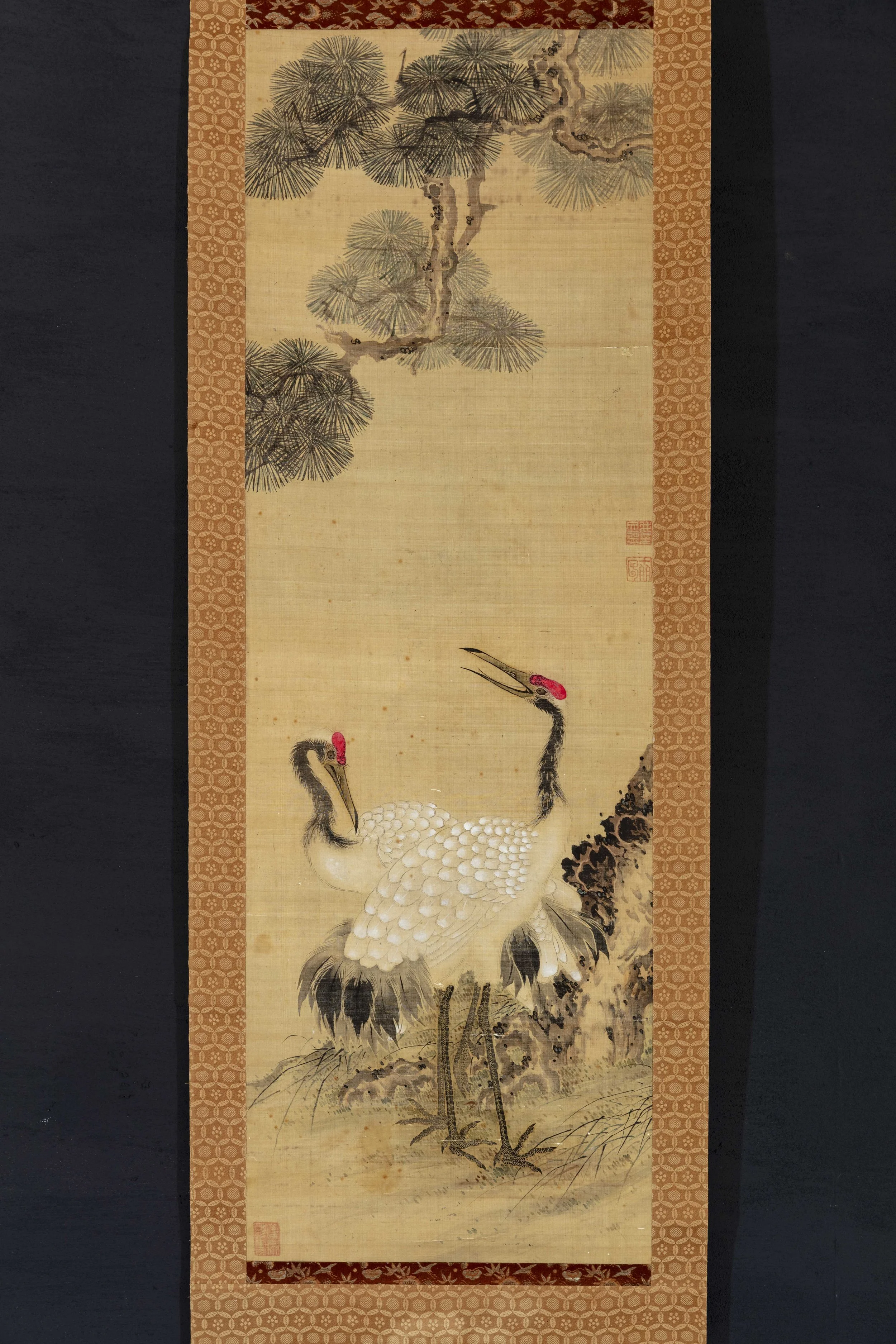
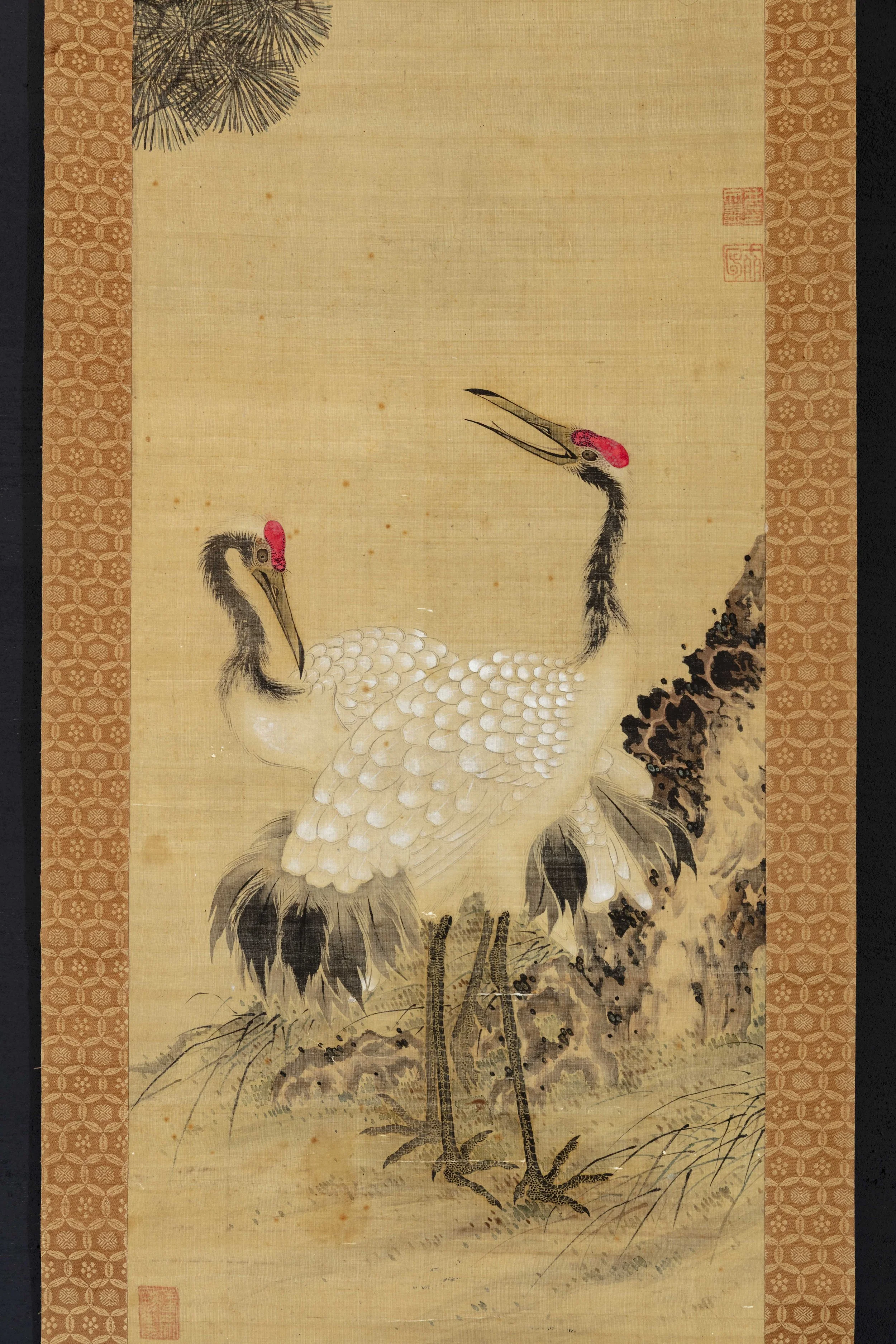
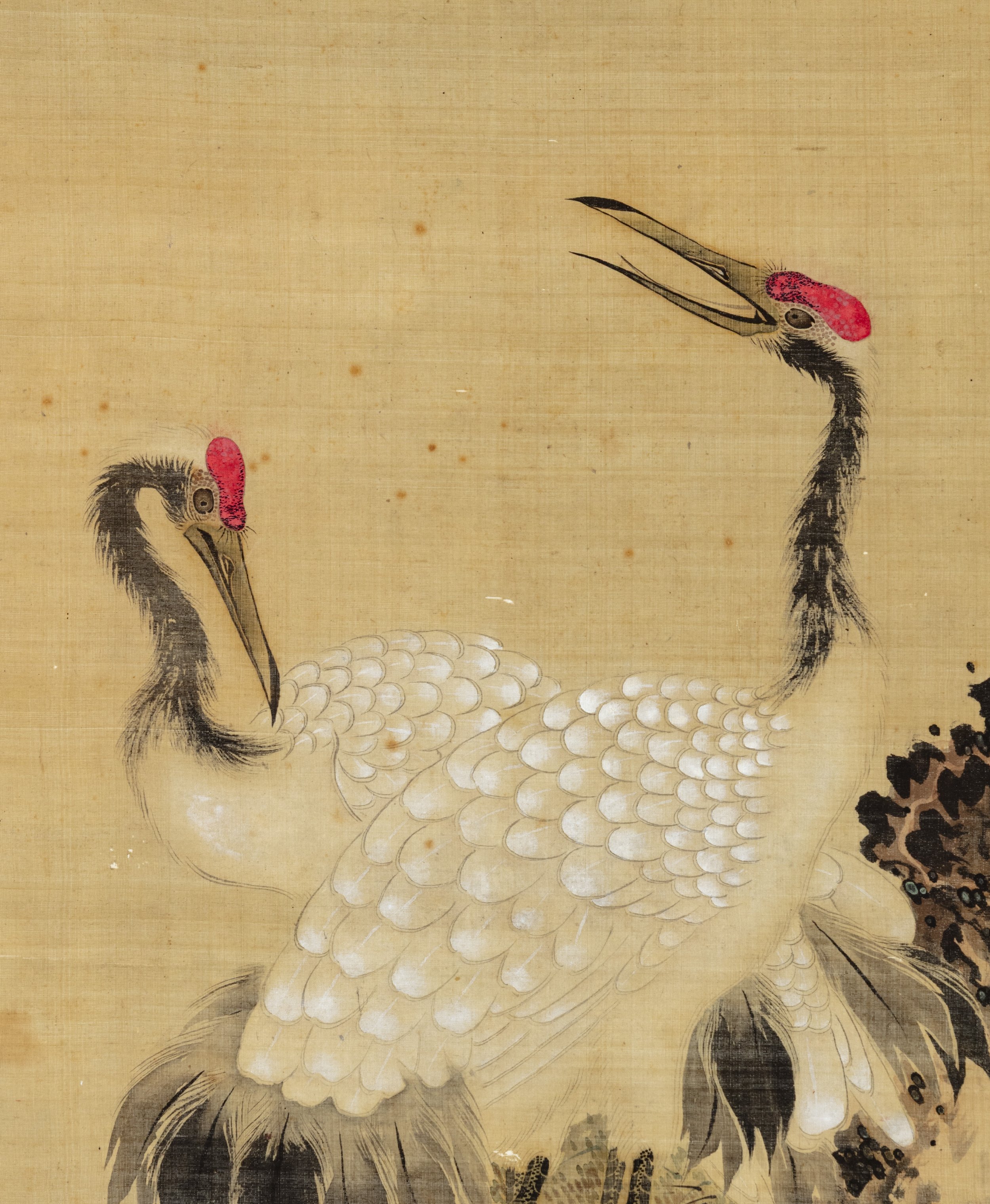
Two red-crowned cranes stand beneath the spreading canopy of an aged pine. One tilts its head upward, beak slightly parted; the other lowers its gaze in quiet repose. Above them, the pine trunk bends in a gentle arc, its needles radiating in clustered bursts across the upper register of the composition.
The cranes are rendered with notable care. Their plumage is built from overlapping, rounded strokes of white pigment, subtly shaded to suggest volume. The black neck feathers are drawn with fine, tapering lines, and the vermilion crowns are applied in a vivid, opaque red that contrasts against the warm silk ground. The legs and talons are handled with attentive detail, revealing a studied observation of form.
By contrast, the pine displays a more schematic treatment — broader washes and less assured transitions in bark modelling. The needle clusters vary in density and pressure, suggesting a provincial copyist working from an established model rather than direct observation. This difference in handling supports an attribution to a mid-19th-century workshop rather than a major Edo master.
The subject of pine and cranes is a longstanding emblem of longevity and auspicious harmony in both Chinese literati and Japanese Edo painting. Pine symbolizes steadfast endurance; cranes, long life and refined presence. The composition preserves this traditional symbolism while reflecting the widespread Bakumatsu demand for decorative, auspicious imagery suitable for domestic display.
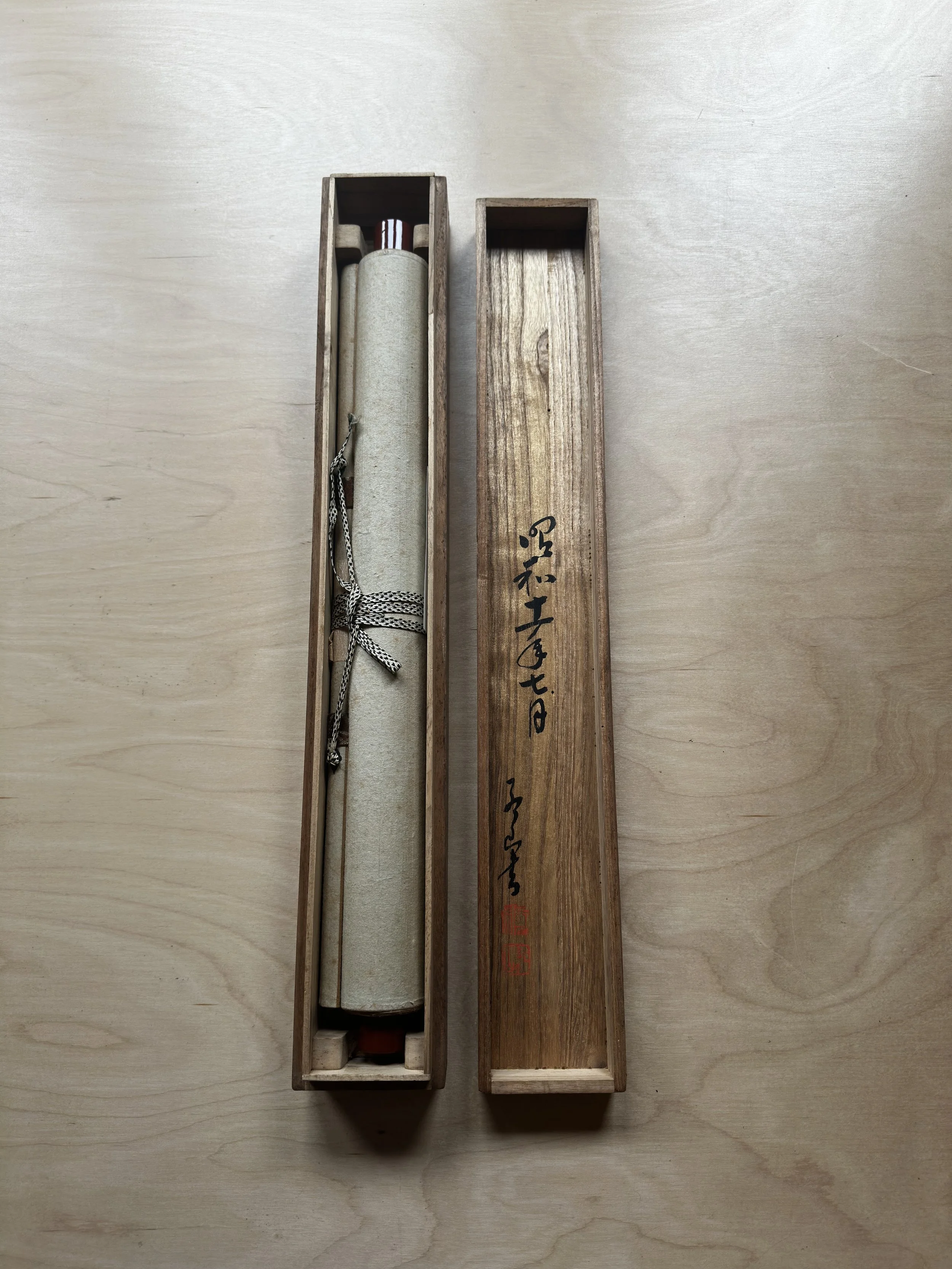
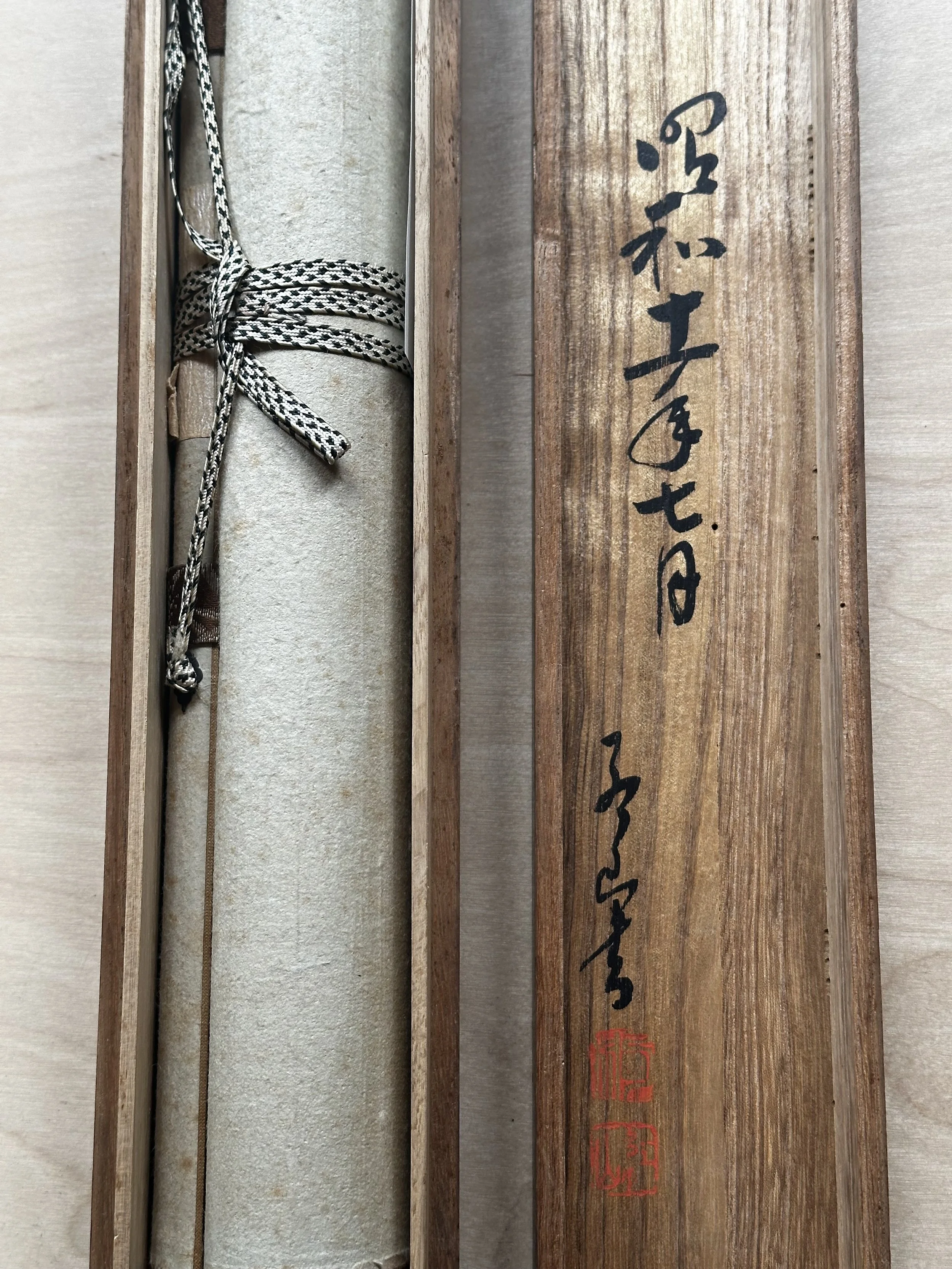
The scroll retains its silk mounting and original wooden storage box bearing a dated inscription corresponding to Ansei 5 (1858), placing its creation at the very close of the Edo period, on the threshold of profound cultural transition. The inscription further records a painter’s name, likely read as Shūgo (習悟), suggesting a studio or provincial hand rather than an established master. Condition is poor, with staining, creasing, insect damage, mounting wear, and areas of repair visible on both silk and backing, consistent with age and material.
Dimensions
Overall (including mounting):
Approximately 186 cm (height) × 43.5 cm (width)
Main painted area (honshi):
Approximately 103 cm × 34 cm
Artist Unknown
Mid-Bakumatsu period, circa 1858 (Ansei 5)
Hanging scroll, ink and colour on silk
Two red-crowned cranes stand beneath the spreading canopy of an aged pine. One tilts its head upward, beak slightly parted; the other lowers its gaze in quiet repose. Above them, the pine trunk bends in a gentle arc, its needles radiating in clustered bursts across the upper register of the composition.
The cranes are rendered with notable care. Their plumage is built from overlapping, rounded strokes of white pigment, subtly shaded to suggest volume. The black neck feathers are drawn with fine, tapering lines, and the vermilion crowns are applied in a vivid, opaque red that contrasts against the warm silk ground. The legs and talons are handled with attentive detail, revealing a studied observation of form.
By contrast, the pine displays a more schematic treatment — broader washes and less assured transitions in bark modelling. The needle clusters vary in density and pressure, suggesting a provincial copyist working from an established model rather than direct observation. This difference in handling supports an attribution to a mid-19th-century workshop rather than a major Edo master.
The subject of pine and cranes is a longstanding emblem of longevity and auspicious harmony in both Chinese literati and Japanese Edo painting. Pine symbolizes steadfast endurance; cranes, long life and refined presence. The composition preserves this traditional symbolism while reflecting the widespread Bakumatsu demand for decorative, auspicious imagery suitable for domestic display.
The scroll retains its silk mounting and original wooden storage box bearing a dated inscription corresponding to Ansei 5 (1858), placing its creation at the very close of the Edo period, on the threshold of profound cultural transition. The inscription further records a painter’s name, likely read as Shūgo (習悟), suggesting a studio or provincial hand rather than an established master. Condition is poor, with staining, creasing, insect damage, mounting wear, and areas of repair visible on both silk and backing, consistent with age and material.
Dimensions
Overall (including mounting):
Approximately 186 cm (height) × 43.5 cm (width)
Main painted area (honshi):
Approximately 103 cm × 34 cm