
Fox Woman (Kitsune)
Okamoto Taisaku (1879–1945)
Meiji–early Shōwa period
Hanging scroll, ink and colour on silk
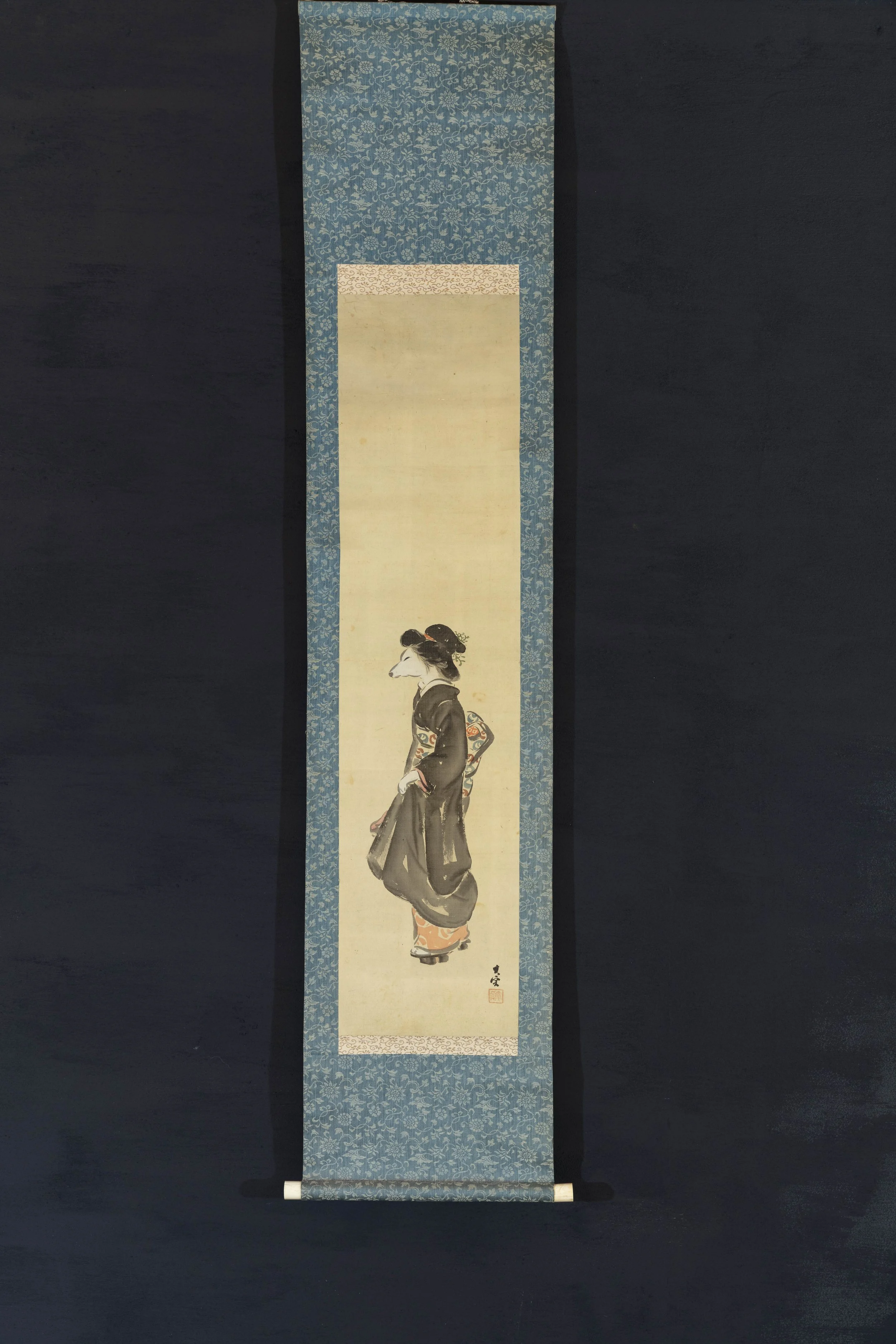
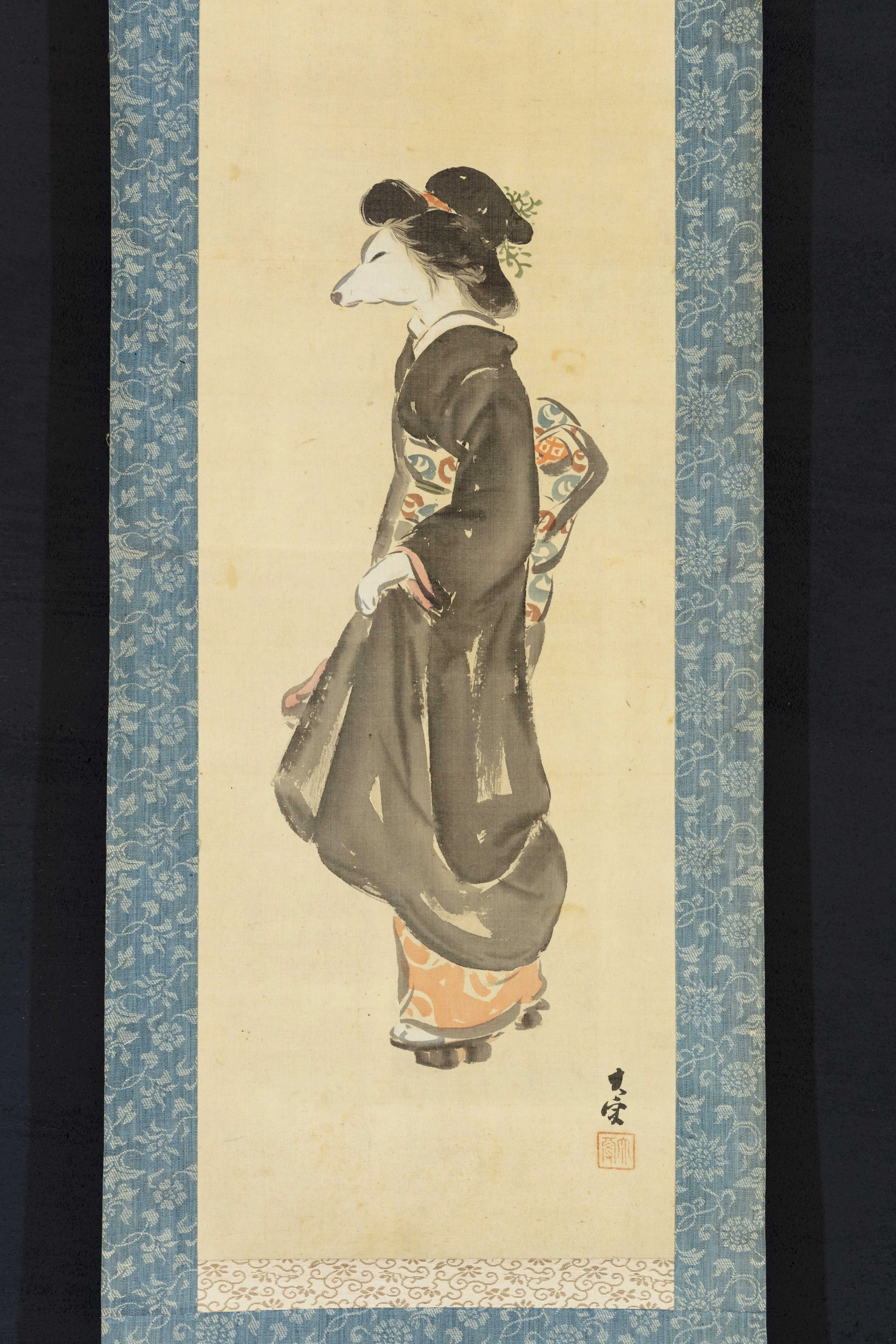
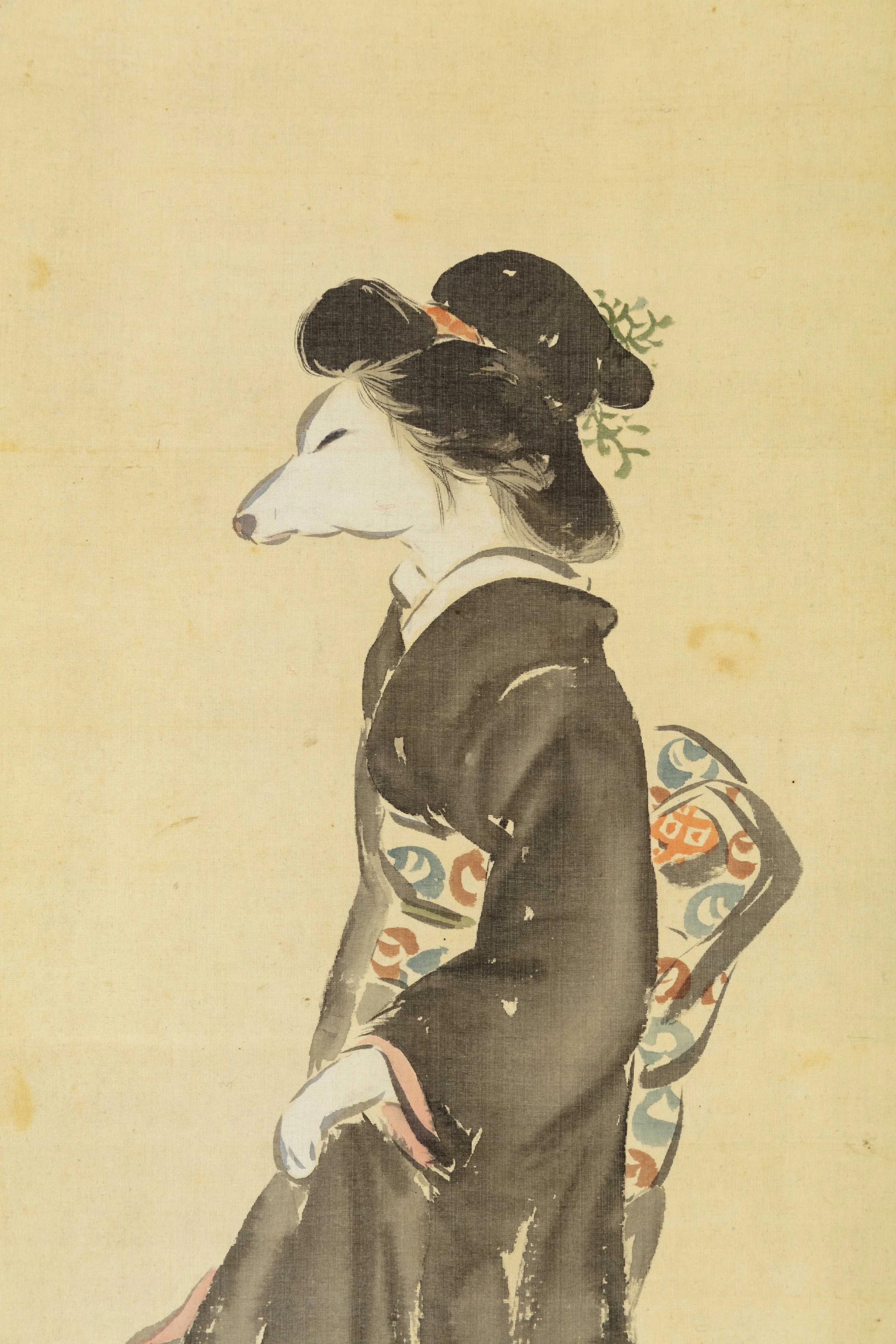
A solitary fox spirit appears in the guise of a woman, shown in quiet profile. Her elongated muzzle and closed eye soften into a gentle, almost introspective expression. She wears a dark kimono patterned with subdued colour accents, her obi decorated with stylised motifs that echo folkloric ornament rather than strict realism.
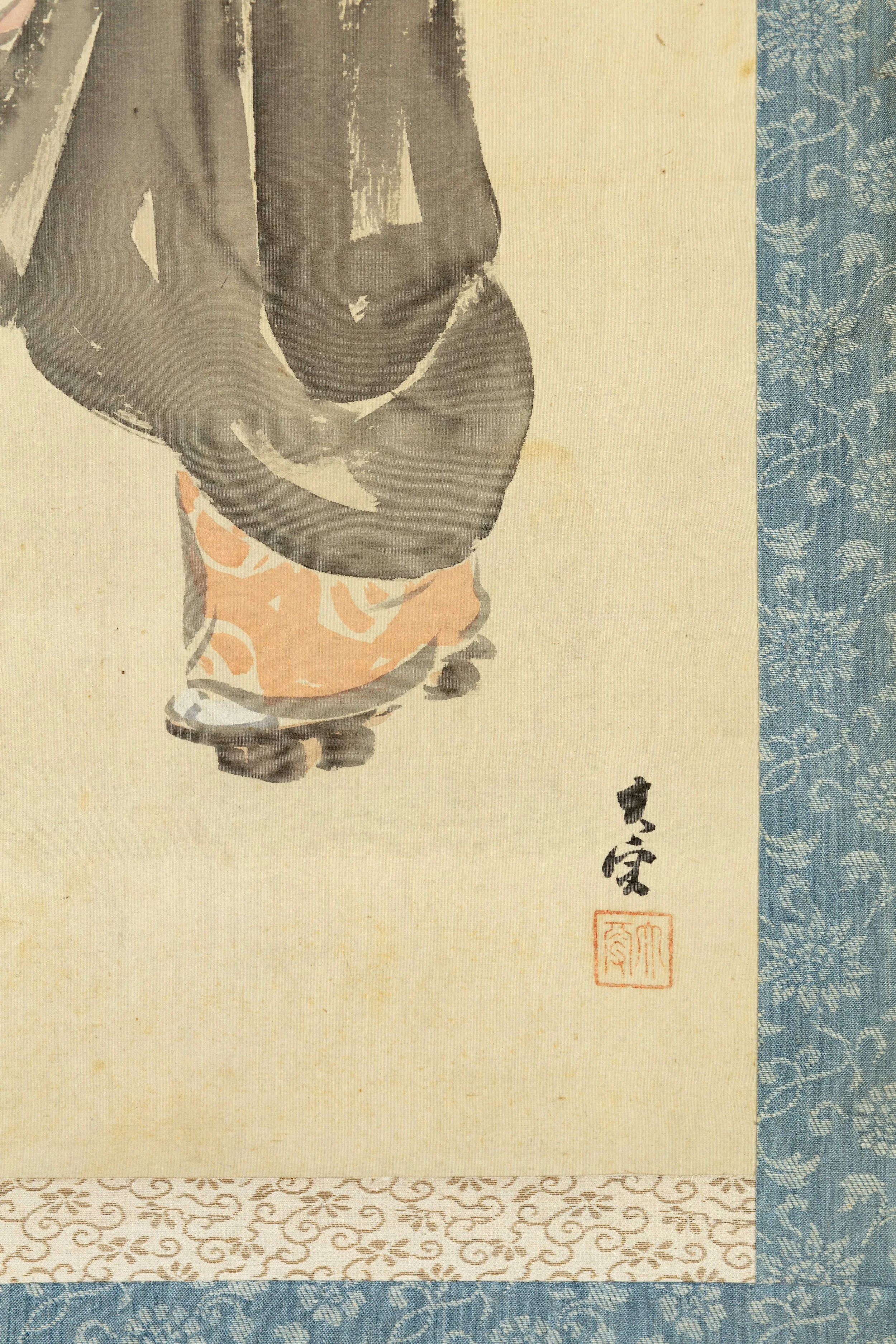
The figure stands against an open silk ground, allowing space and silence to frame her presence. The brushwork is fluid and economical — outlines are assured but never rigid. The muted mineral palette, dominated by charcoal greys and soft earthen tones, lends the figure a dreamlike quality. Rather than theatrical transformation, the work conveys stillness — the fox not as trickster, but as spirit.
In Japanese folklore, the fox (kitsune) occupies a complex position: shapeshifter, messenger of Inari, seductress, guardian, illusionist. By the late Meiji period, artists increasingly explored such subjects not only as narrative illustration, but as psychological or symbolic imagery. This work reflects that shift — less Edo storytelling, more modern interiority.
The scroll retains its silk mounting and paulownia wood storage box. Minor age-related marks are visible, consistent with period and material.
Dimensions
Overall (including mounting):
Approximately 167 cm (height) × 35 cm (width)
Main painted area (honshi):
Approximately 104 cm × 25.5 cm
Artist Biography
Okamoto Taisaku (1879–1945)
Okamoto Taisaku was a Japanese painter active from the late Meiji period through the early Shōwa era. Born in Mie Prefecture, he was largely self-taught and later established himself within the Osaka art world — a regional centre that, in the early twentieth century, balanced traditional Nihonga practice with modernising influences.
Unlike academy-trained Tokyo painters associated with official exhibition circuits, many Osaka artists cultivated independent studio practices and commercial patronage networks. Taisaku appears to have worked within this environment, producing hanging scrolls and figure subjects that combined classical techniques with contemporary sensibilities.
His period — roughly 1900–1945 — was one of profound stylistic transition in Japanese painting. The tension between inherited Edo forms and modern identity often produced works that feel suspended between tradition and reinterpretation. The fox subject here reflects that atmosphere: grounded in folklore, yet rendered with a simplified, almost modern restraint.
Self-taught artists of this generation frequently drew from Kano and Maruyama-Shijō traditions while adapting composition and mood for new audiences. Taisaku’s work suggests confidence in line and compositional economy rather than decorative excess.
Okamoto Taisaku (1879–1945)
Meiji–early Shōwa period
Hanging scroll, ink and colour on silk
A solitary fox spirit appears in the guise of a woman, shown in quiet profile. Her elongated muzzle and closed eye soften into a gentle, almost introspective expression. She wears a dark kimono patterned with subdued colour accents, her obi decorated with stylised motifs that echo folkloric ornament rather than strict realism.
The figure stands against an open silk ground, allowing space and silence to frame her presence. The brushwork is fluid and economical — outlines are assured but never rigid. The muted mineral palette, dominated by charcoal greys and soft earthen tones, lends the figure a dreamlike quality. Rather than theatrical transformation, the work conveys stillness — the fox not as trickster, but as spirit.
In Japanese folklore, the fox (kitsune) occupies a complex position: shapeshifter, messenger of Inari, seductress, guardian, illusionist. By the late Meiji period, artists increasingly explored such subjects not only as narrative illustration, but as psychological or symbolic imagery. This work reflects that shift — less Edo storytelling, more modern interiority.
The scroll retains its silk mounting and paulownia wood storage box. Minor age-related marks are visible, consistent with period and material.
Dimensions
Overall (including mounting):
Approximately 167 cm (height) × 35 cm (width)
Main painted area (honshi):
Approximately 104 cm × 25.5 cm
Artist Biography
Okamoto Taisaku (1879–1945)
Okamoto Taisaku was a Japanese painter active from the late Meiji period through the early Shōwa era. Born in Mie Prefecture, he was largely self-taught and later established himself within the Osaka art world — a regional centre that, in the early twentieth century, balanced traditional Nihonga practice with modernising influences.
Unlike academy-trained Tokyo painters associated with official exhibition circuits, many Osaka artists cultivated independent studio practices and commercial patronage networks. Taisaku appears to have worked within this environment, producing hanging scrolls and figure subjects that combined classical techniques with contemporary sensibilities.
His period — roughly 1900–1945 — was one of profound stylistic transition in Japanese painting. The tension between inherited Edo forms and modern identity often produced works that feel suspended between tradition and reinterpretation. The fox subject here reflects that atmosphere: grounded in folklore, yet rendered with a simplified, almost modern restraint.
Self-taught artists of this generation frequently drew from Kano and Maruyama-Shijō traditions while adapting composition and mood for new audiences. Taisaku’s work suggests confidence in line and compositional economy rather than decorative excess.