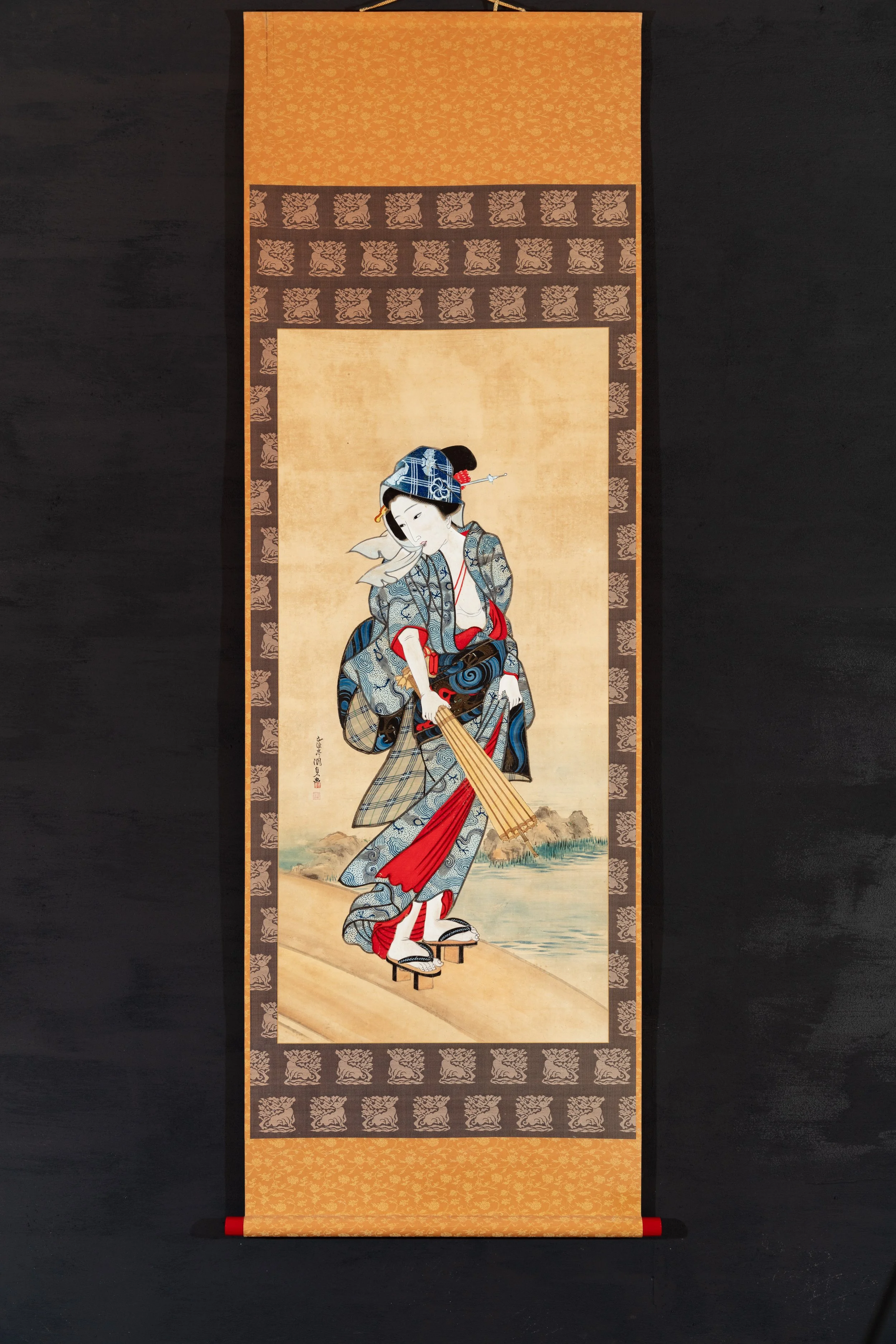
Beauty Crossing a Bridge, In the manner of Utagawa Kunisada c. 1850–1870
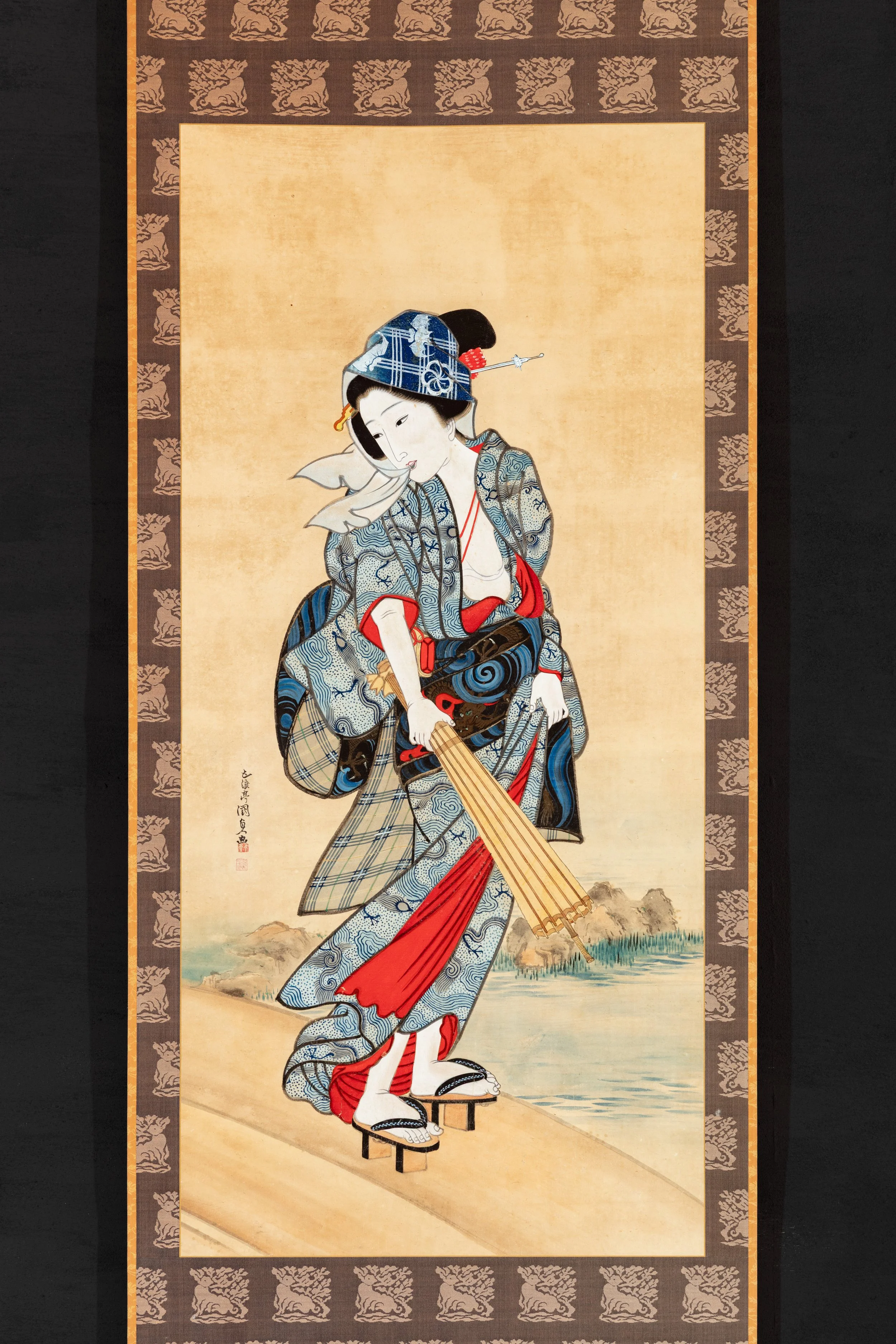
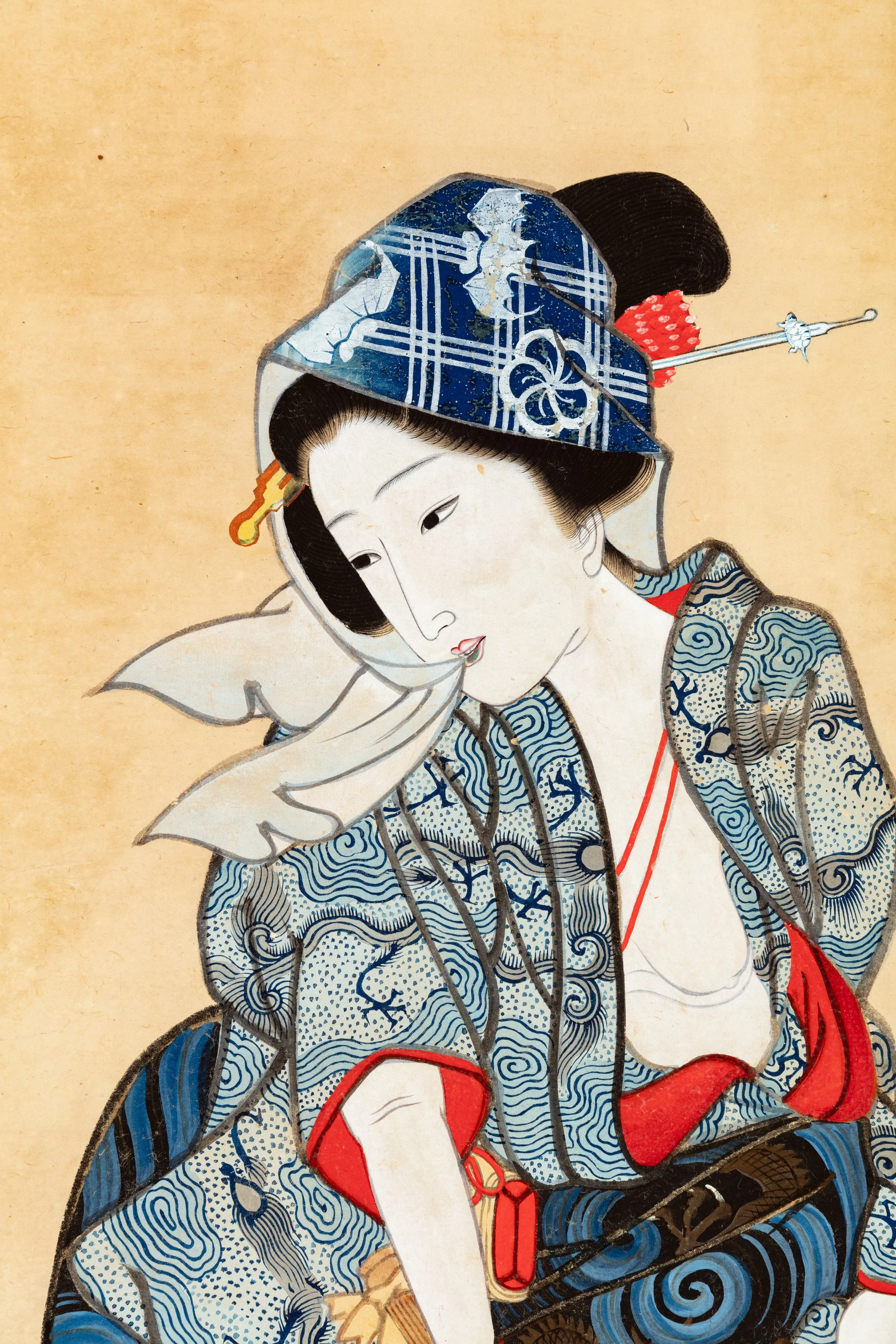
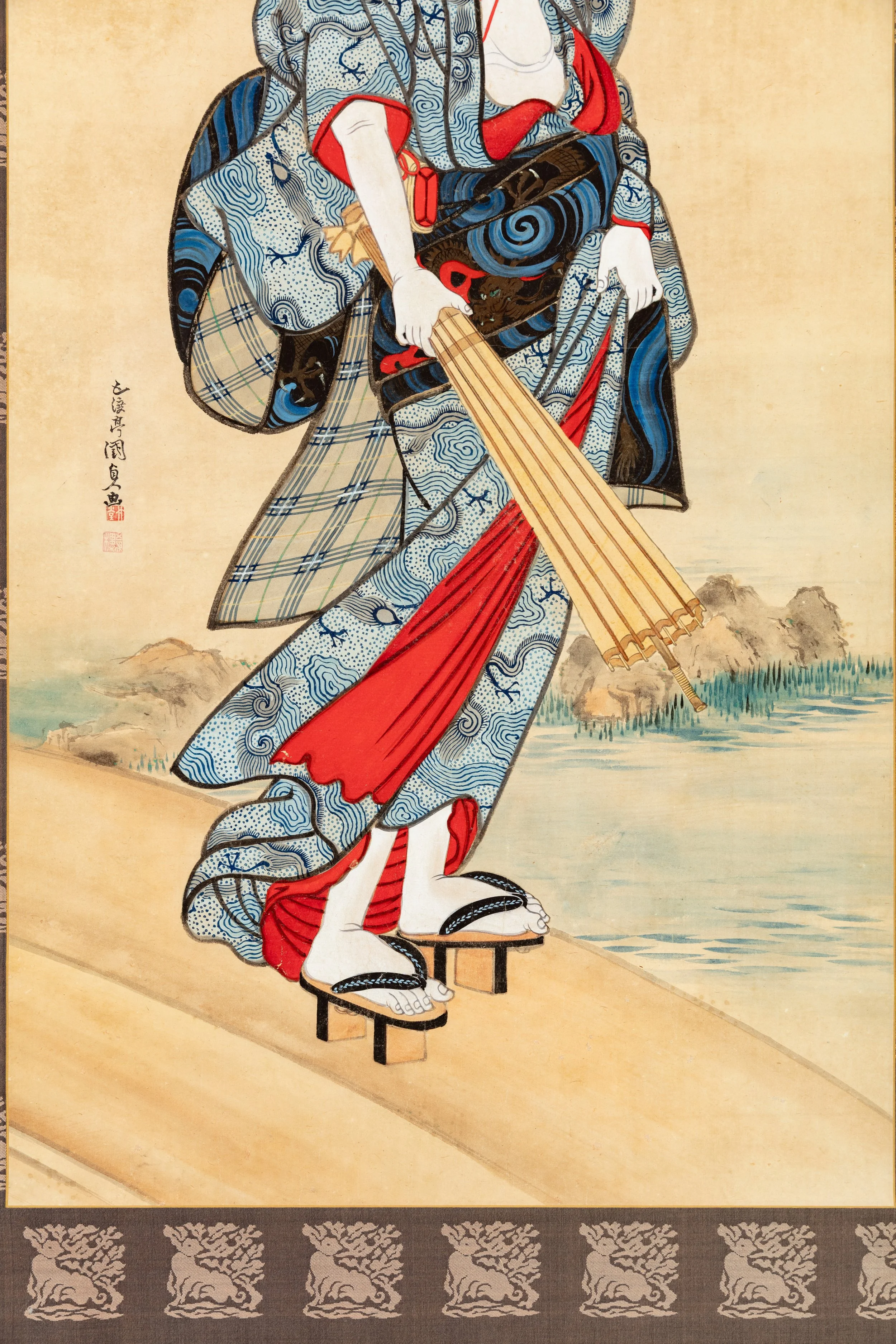
A courtesan steps lightly across a wooden bridge, her body inclined in a subtle arc of motion. One hand gathers her robe; the other steadies a folded umbrella. Beneath her geta sandals the bridge planks form a quiet diagonal, while the river landscape dissolves into pale distance.
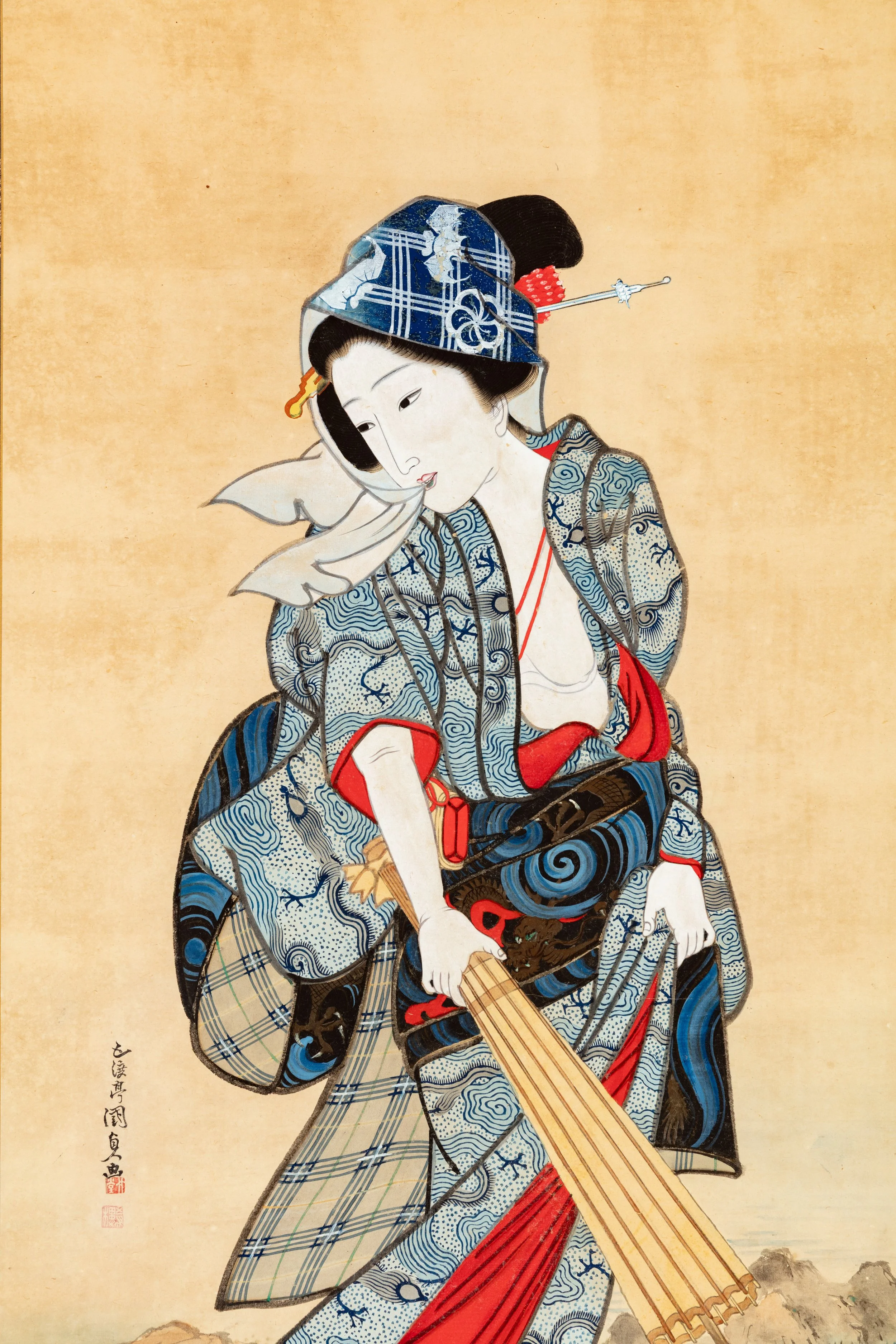
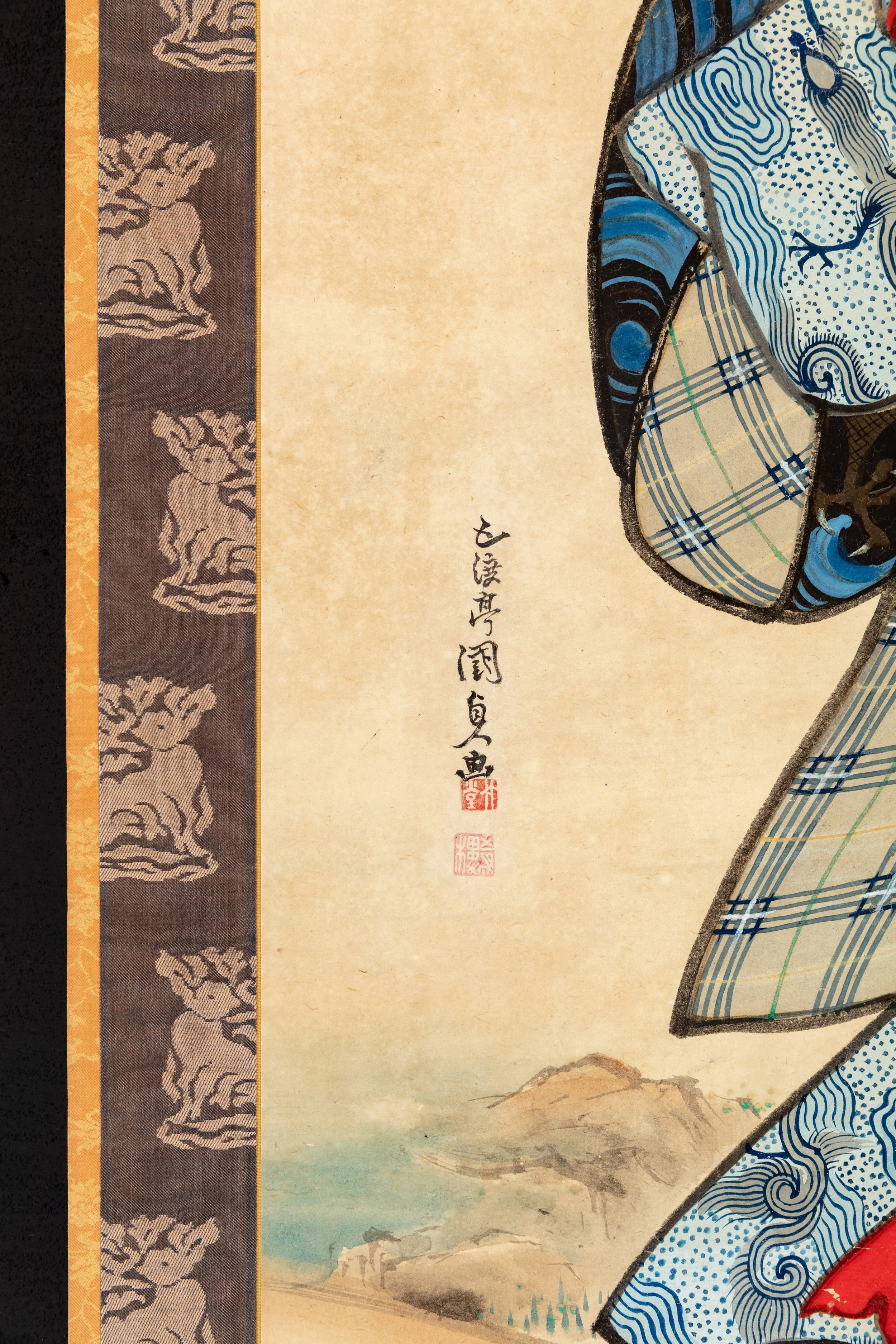
The figure stands firmly within the Utagawa tradition. The elongated oval face, lowered gaze, and delicately arched brows belong unmistakably to the visual language refined by Utagawa Kunisada in mid-nineteenth-century Edo. The handling of line is especially telling: tapering contours shift from firmness to softness within a single stroke, producing a suppleness unattainable in woodblock reproduction.
The garment patterns are richly resolved. Indigo wave motifs, tight geometric grids, and deep blue-black passages unfold against vivid vermilion under-robes. The chromatic structure is controlled rather than theatrical. Colour supports form; it does not overwhelm it. The open ground surrounding the figure allows the composition to breathe, lending the image a sense of poised restraint.
Unlike mass-produced prints, this work is entirely hand-painted. Pigments show subtle modulation and depth. The softly tinted paper support contributes warmth to the overall tonality. Minor wear to the headscarf and light surface abrasions are consistent with age and handling, and do not diminish the compositional integrity of the work.
Box and Shōwa-Period Appraisal
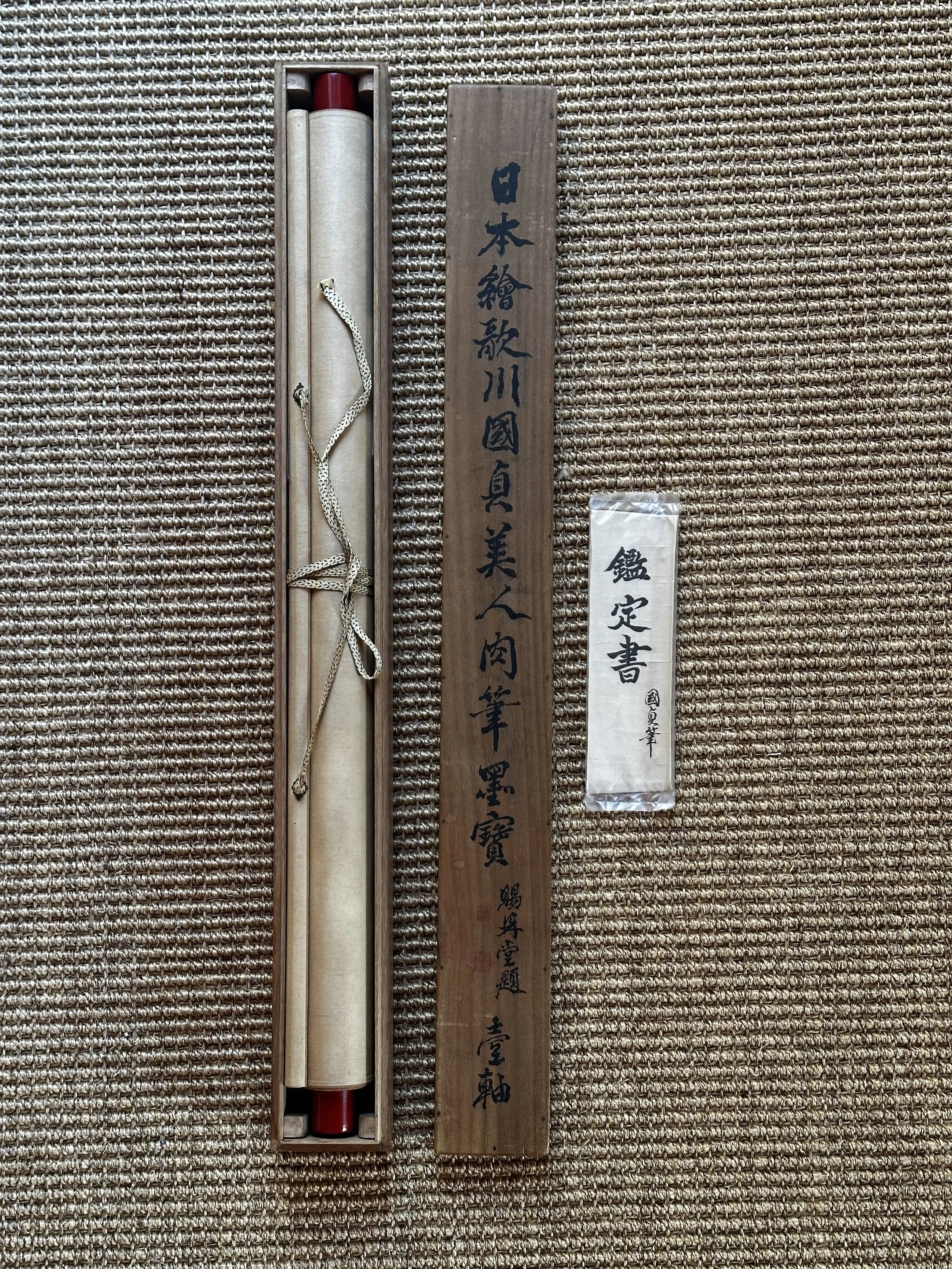
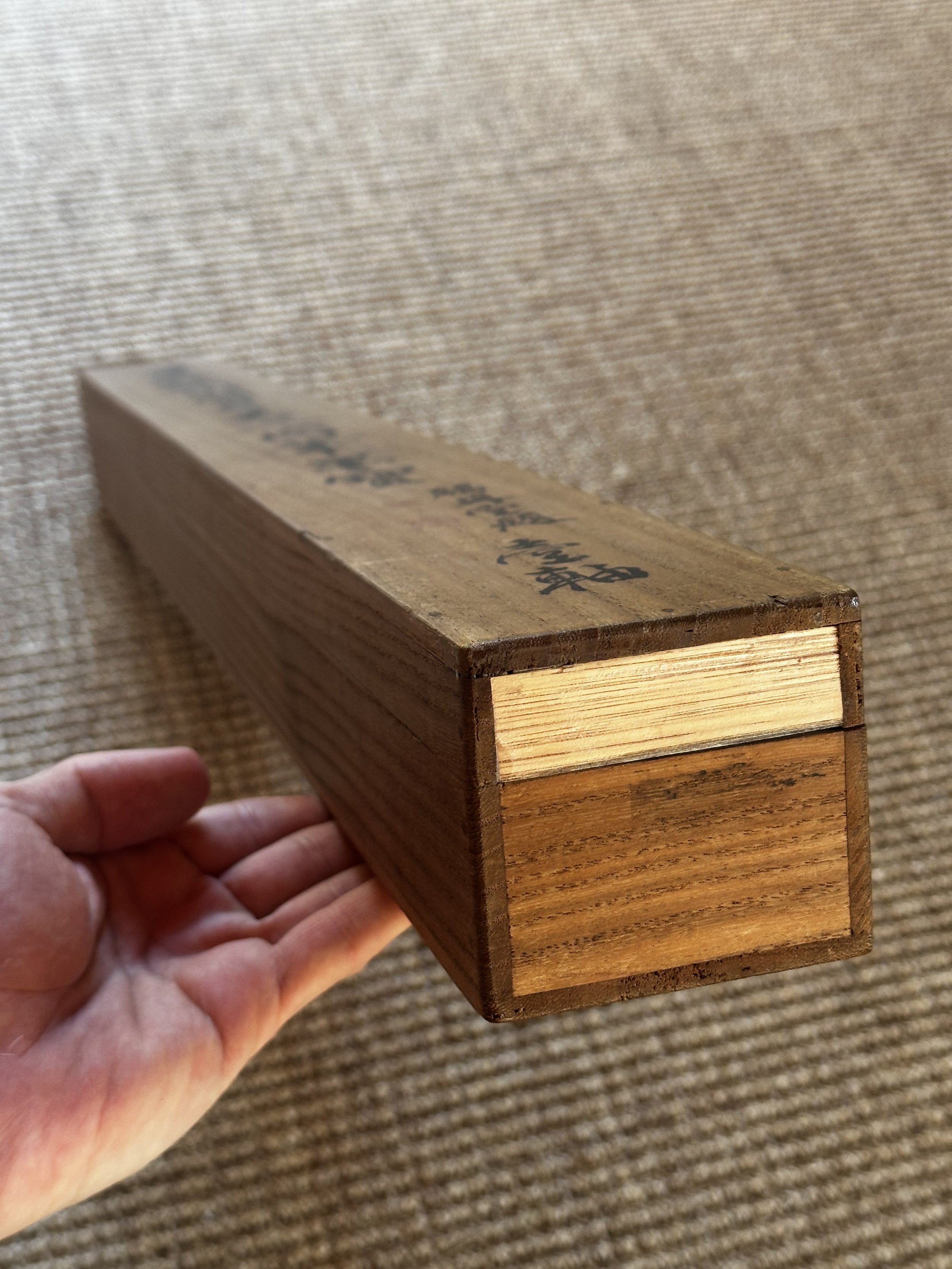
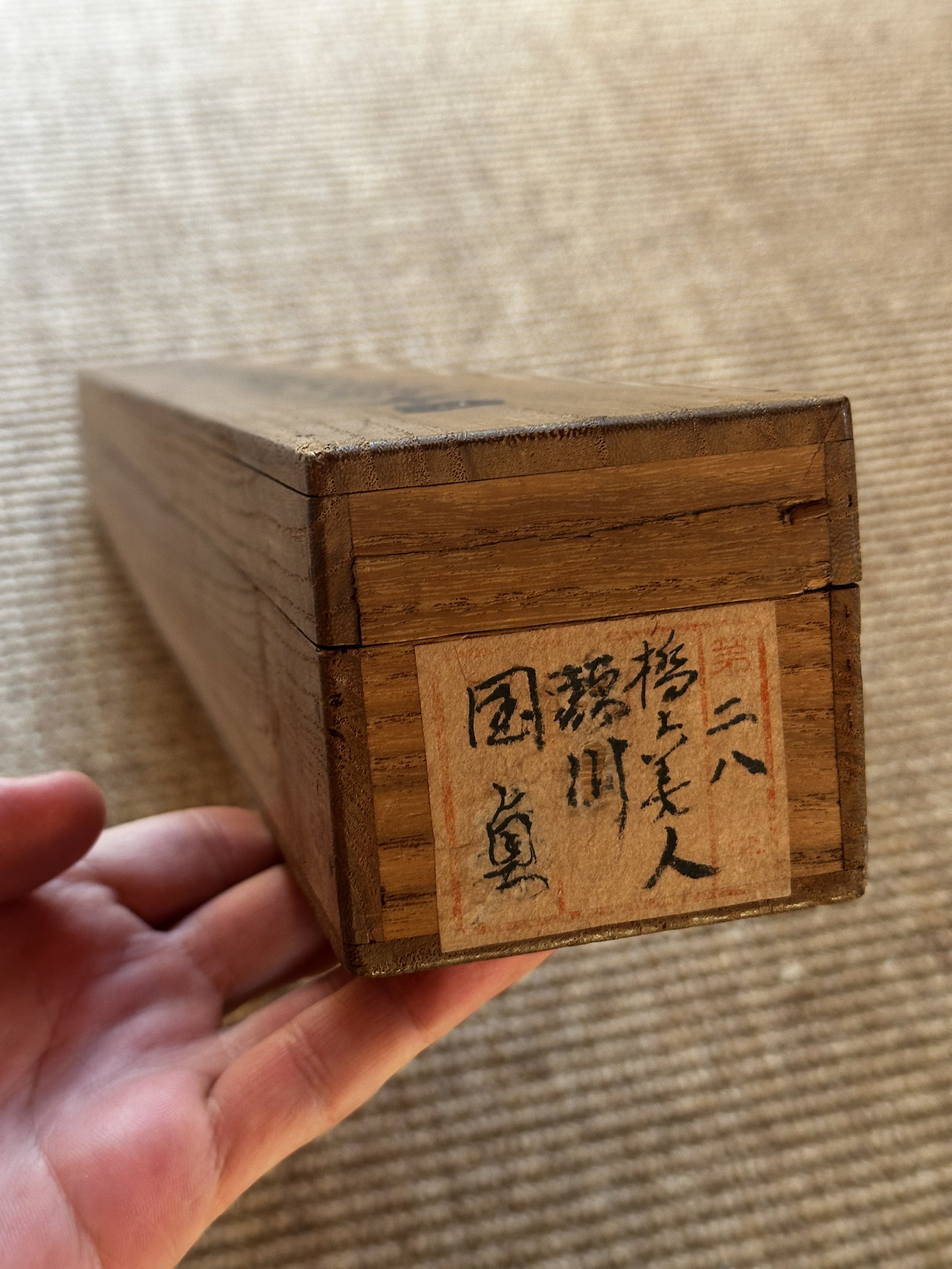
The painting is accompanied by a wooden storage box bearing multiple inscriptions and documentation.
The outer lid identifies the work as:
Japanese painting
Utagawa Kunisada
Beauty (bijin), hand-painted
One hanging scroll
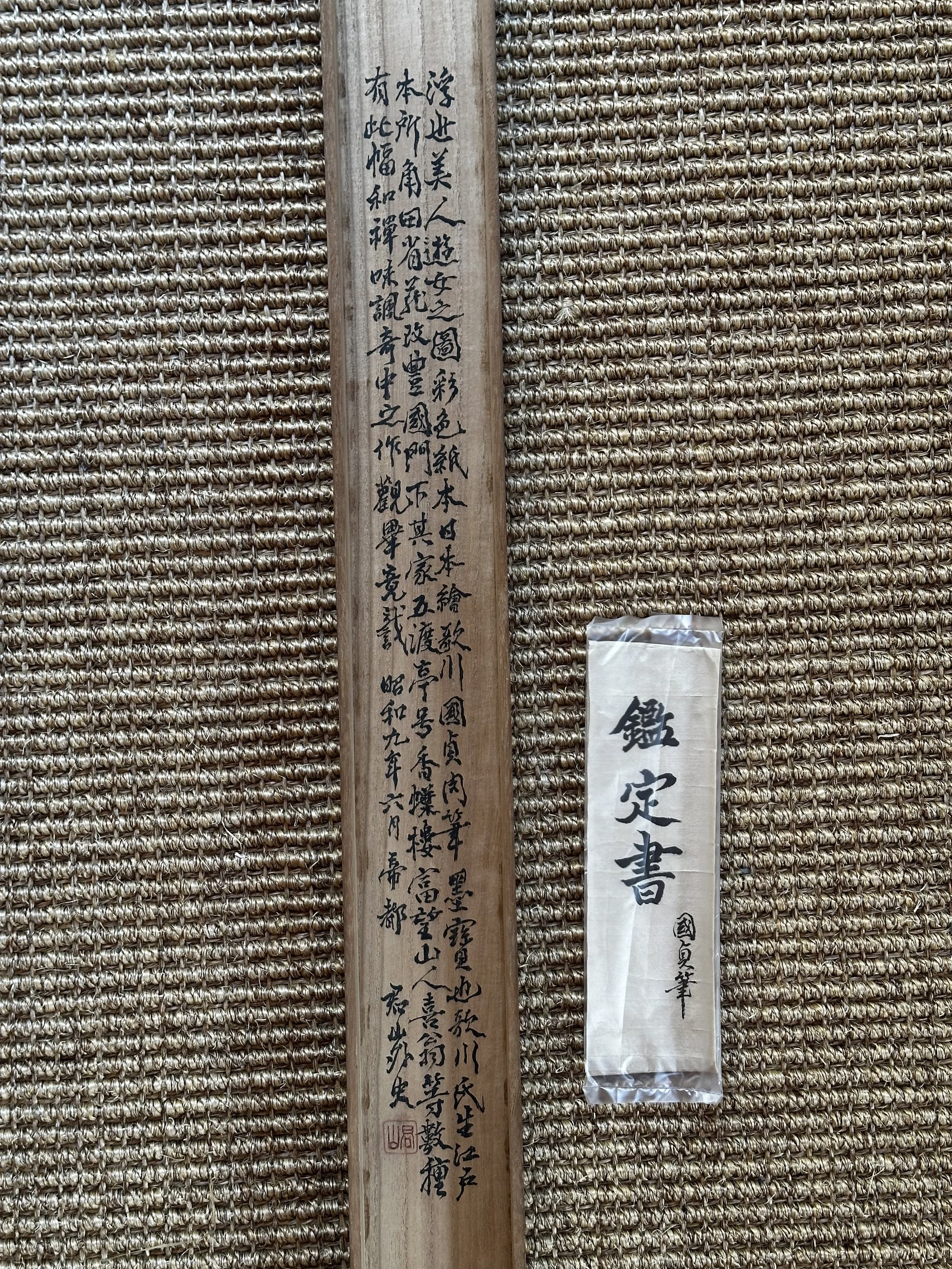
A paper slip enclosed within the box confirms that the work is hand-painted in colour on tinted paper.
Inside the lid appears a dated Shōwa-period inscription (June, Shōwa 9 — 1934). The text describes the painting as:
A picture of an ukiyo beauty, specifically a courtesan.
Hand-painted in colour on tinted paper.
Japanese painting: Utagawa Kunisada.
An ink-painting treasure.
The inscription references Kunisada’s studio names, including Gototei and Kōchōrō, demonstrating familiarity with the artist’s professional nomenclature.
This inscription is signed and sealed by Toyama Gaishi.
In addition, the box is described as a kiwame box (極箱) associated with Fujino Kimiyama (1863–1943), and accompanied by a kiwame authentication slip (極札). In Japanese connoisseurial practice, the term kiwame indicates examination and attribution by a recognized authority. It does not denote ownership, but rather authenticated appraisal.
Fujino Kimiyama was an early twentieth-century cultural scholar, collector, and figure active in the evaluation and circulation of Edo-period painting. His involvement situates the work within the intellectual appraisal culture of the late Meiji, Taishō, and early Shōwa periods — a time when Edo works were systematically studied, attributed, and housed in formal storage boxes bearing scholarly inscriptions.
Together, the dated 1934 inscription by Toyama Gaishi and the kiwame documentation associated with Kimiyama place the painting within a documented early twentieth-century connoisseurial framework. The work was already regarded as worthy of evaluation and preservation nearly ninety years ago.
It should be noted that Shōwa-period box inscriptions reflect the scholarly standards of their time and do not constitute modern institutional certification. Nevertheless, the presence of dated, sealed appraisal materials materially enriches the work’s provenance and provides a tangible record of its earlier scholarly consideration.
Position
The painting is presented in accordance with current academic practice as:
In the manner of Utagawa Kunisada (Toyokuni III)
The stylistic alignment with mid-nineteenth-century Utagawa production is strong, and the connoisseurial documentation adds historical depth. Whether executed within Kunisada’s immediate studio circle or by a close follower, the work demonstrates intimate knowledge of the master’s figural vocabulary and decorative discipline.
This is not a decorative revival piece.
It is a hand-painted Utagawa-school bijin-ga, supported by Shōwa-period documentation and preserved within its appraisal box.
Dimensions
Overall (including mounting): approximately 200 × 65 cm
Image area: approximately 117 × 54 cm
The Artist
Utagawa Kunisada (1786–1865), later known as Toyokuni III, was the dominant figure of late Edo ukiyo-e. A student of Utagawa Toyokuni I, he became the most commercially successful designer of his generation, producing thousands of prints depicting kabuki actors, courtesans, literary scenes, and fashionable urban life.
His bijin-ga works defined nineteenth-century ideals of feminine elegance: elongated forms, elaborate textiles, and psychologically nuanced expressions. Though long dismissed as overly commercial by early Western critics, modern scholarship has re-established Kunisada as a central architect of Edo visual culture.
Workshop production, student copies, and later homages were common during and after his lifetime. These works reflect both the popularity of his designs and the permeability between print and painted formats in nineteenth-century Japan.
A courtesan steps lightly across a wooden bridge, her body inclined in a subtle arc of motion. One hand gathers her robe; the other steadies a folded umbrella. Beneath her geta sandals the bridge planks form a quiet diagonal, while the river landscape dissolves into pale distance.
The figure stands firmly within the Utagawa tradition. The elongated oval face, lowered gaze, and delicately arched brows belong unmistakably to the visual language refined by Utagawa Kunisada in mid-nineteenth-century Edo. The handling of line is especially telling: tapering contours shift from firmness to softness within a single stroke, producing a suppleness unattainable in woodblock reproduction.
The garment patterns are richly resolved. Indigo wave motifs, tight geometric grids, and deep blue-black passages unfold against vivid vermilion under-robes. The chromatic structure is controlled rather than theatrical. Colour supports form; it does not overwhelm it. The open ground surrounding the figure allows the composition to breathe, lending the image a sense of poised restraint.
Unlike mass-produced prints, this work is entirely hand-painted. Pigments show subtle modulation and depth. The softly tinted paper support contributes warmth to the overall tonality. Minor wear to the headscarf and light surface abrasions are consistent with age and handling, and do not diminish the compositional integrity of the work.
Box and Shōwa-Period Appraisal
The painting is accompanied by a wooden storage box bearing multiple inscriptions and documentation.
The outer lid identifies the work as:
Japanese painting
Utagawa Kunisada
Beauty (bijin), hand-painted
One hanging scroll
A paper slip enclosed within the box confirms that the work is hand-painted in colour on tinted paper.
Inside the lid appears a dated Shōwa-period inscription (June, Shōwa 9 — 1934). The text describes the painting as:
A picture of an ukiyo beauty, specifically a courtesan.
Hand-painted in colour on tinted paper.
Japanese painting: Utagawa Kunisada.
An ink-painting treasure.
The inscription references Kunisada’s studio names, including Gototei and Kōchōrō, demonstrating familiarity with the artist’s professional nomenclature.
This inscription is signed and sealed by Toyama Gaishi.
In addition, the box is described as a kiwame box (極箱) associated with Fujino Kimiyama (1863–1943), and accompanied by a kiwame authentication slip (極札). In Japanese connoisseurial practice, the term kiwame indicates examination and attribution by a recognized authority. It does not denote ownership, but rather authenticated appraisal.
Fujino Kimiyama was an early twentieth-century cultural scholar, collector, and figure active in the evaluation and circulation of Edo-period painting. His involvement situates the work within the intellectual appraisal culture of the late Meiji, Taishō, and early Shōwa periods — a time when Edo works were systematically studied, attributed, and housed in formal storage boxes bearing scholarly inscriptions.
Together, the dated 1934 inscription by Toyama Gaishi and the kiwame documentation associated with Kimiyama place the painting within a documented early twentieth-century connoisseurial framework. The work was already regarded as worthy of evaluation and preservation nearly ninety years ago.
It should be noted that Shōwa-period box inscriptions reflect the scholarly standards of their time and do not constitute modern institutional certification. Nevertheless, the presence of dated, sealed appraisal materials materially enriches the work’s provenance and provides a tangible record of its earlier scholarly consideration.
Position
The painting is presented in accordance with current academic practice as:
In the manner of Utagawa Kunisada (Toyokuni III)
The stylistic alignment with mid-nineteenth-century Utagawa production is strong, and the connoisseurial documentation adds historical depth. Whether executed within Kunisada’s immediate studio circle or by a close follower, the work demonstrates intimate knowledge of the master’s figural vocabulary and decorative discipline.
This is not a decorative revival piece.
It is a hand-painted Utagawa-school bijin-ga, supported by Shōwa-period documentation and preserved within its appraisal box.
Dimensions
Overall (including mounting): approximately 200 × 65 cm
Image area: approximately 117 × 54 cm
The Artist
Utagawa Kunisada (1786–1865), later known as Toyokuni III, was the dominant figure of late Edo ukiyo-e. A student of Utagawa Toyokuni I, he became the most commercially successful designer of his generation, producing thousands of prints depicting kabuki actors, courtesans, literary scenes, and fashionable urban life.
His bijin-ga works defined nineteenth-century ideals of feminine elegance: elongated forms, elaborate textiles, and psychologically nuanced expressions. Though long dismissed as overly commercial by early Western critics, modern scholarship has re-established Kunisada as a central architect of Edo visual culture.
Workshop production, student copies, and later homages were common during and after his lifetime. These works reflect both the popularity of his designs and the permeability between print and painted formats in nineteenth-century Japan.