School of Hokusai (Katsushika studio circle), Edo period, c. 1830s–1840s
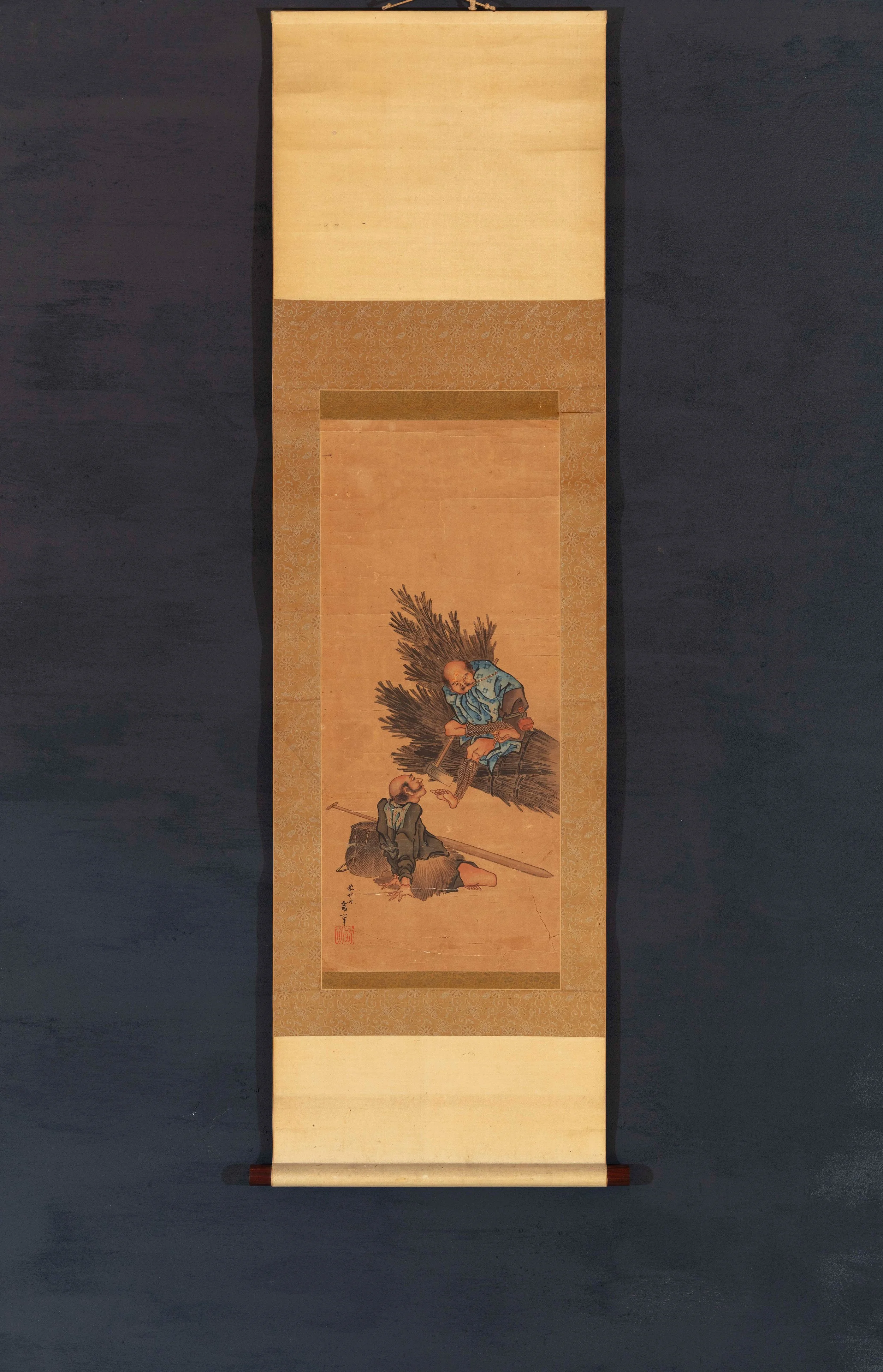
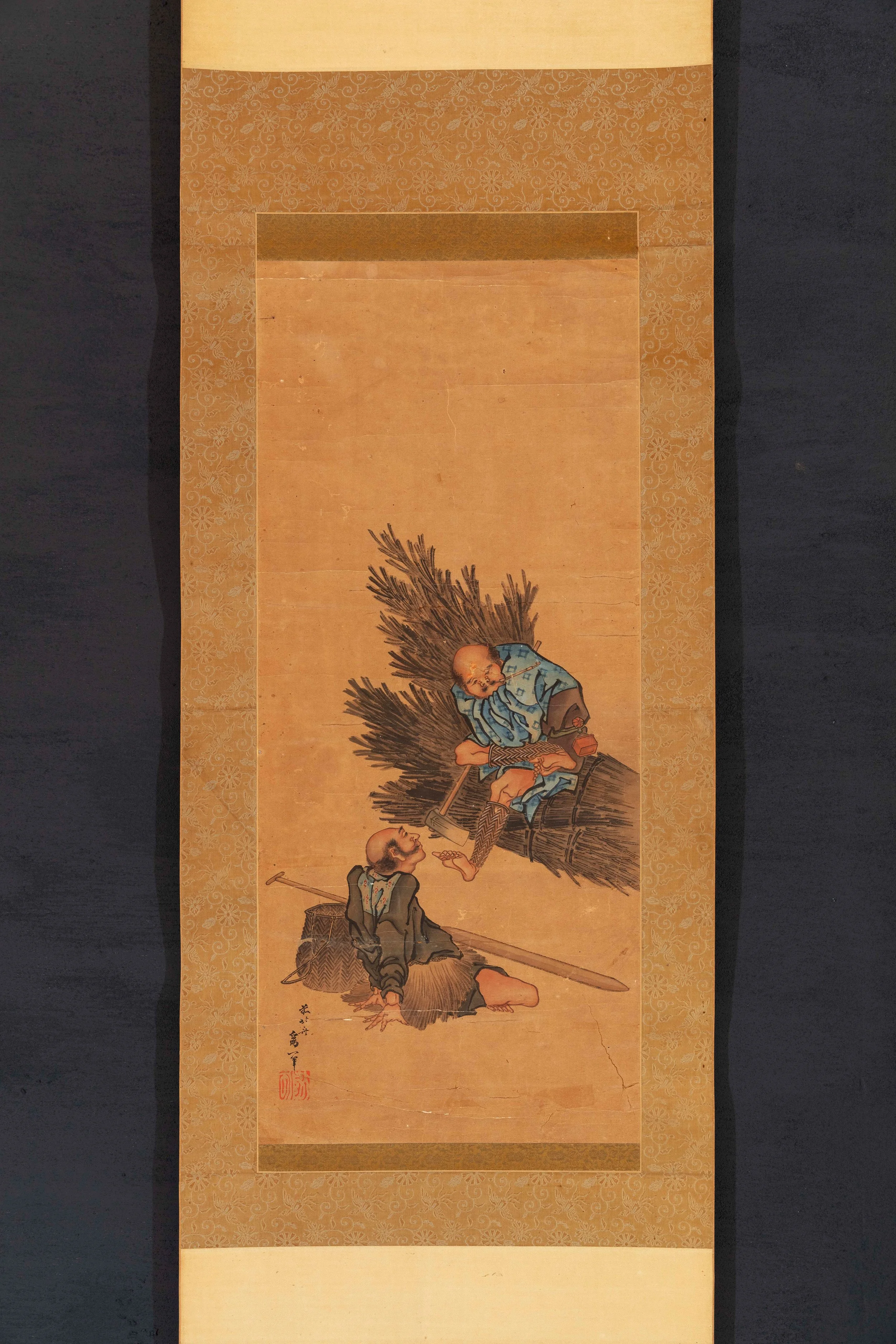
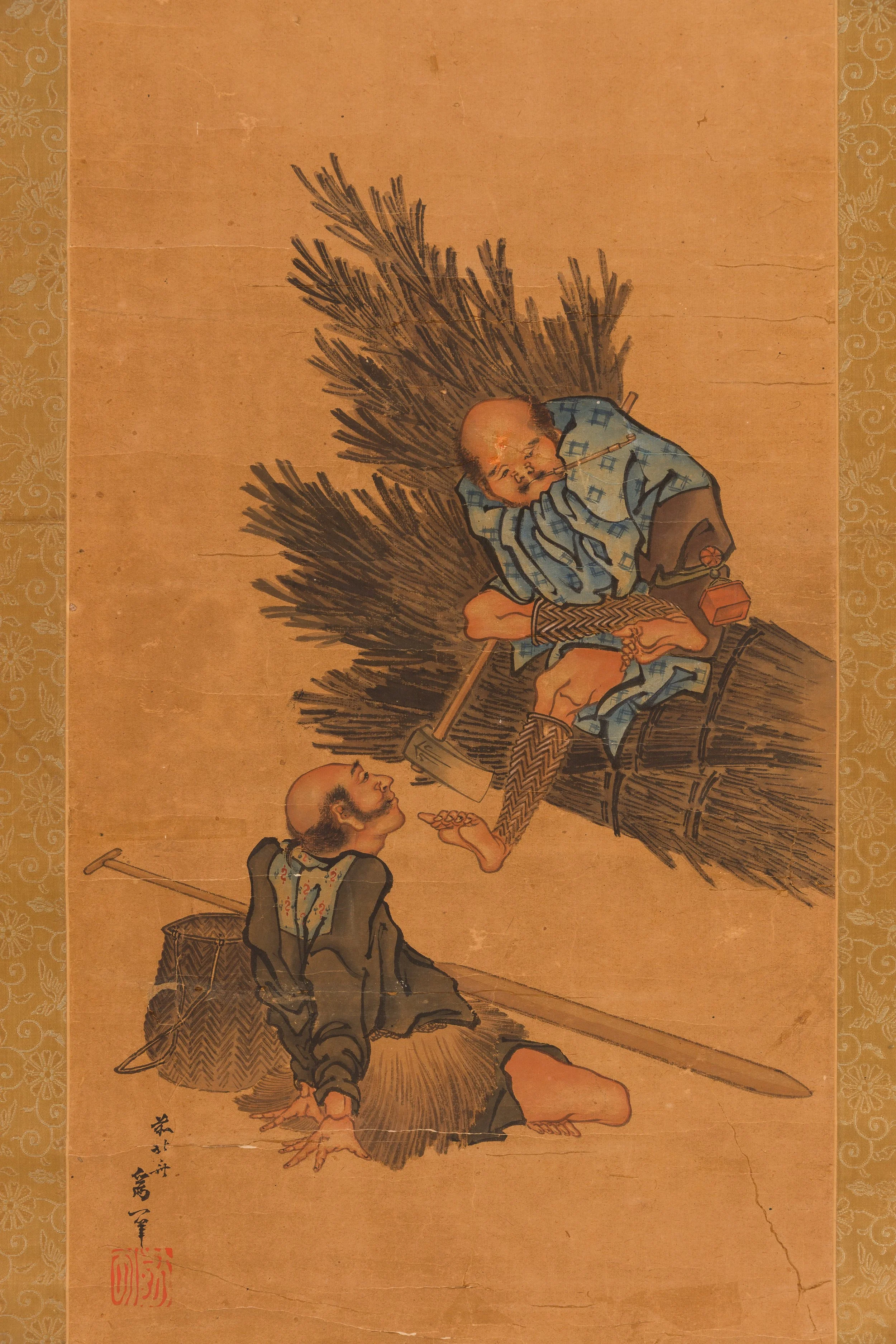
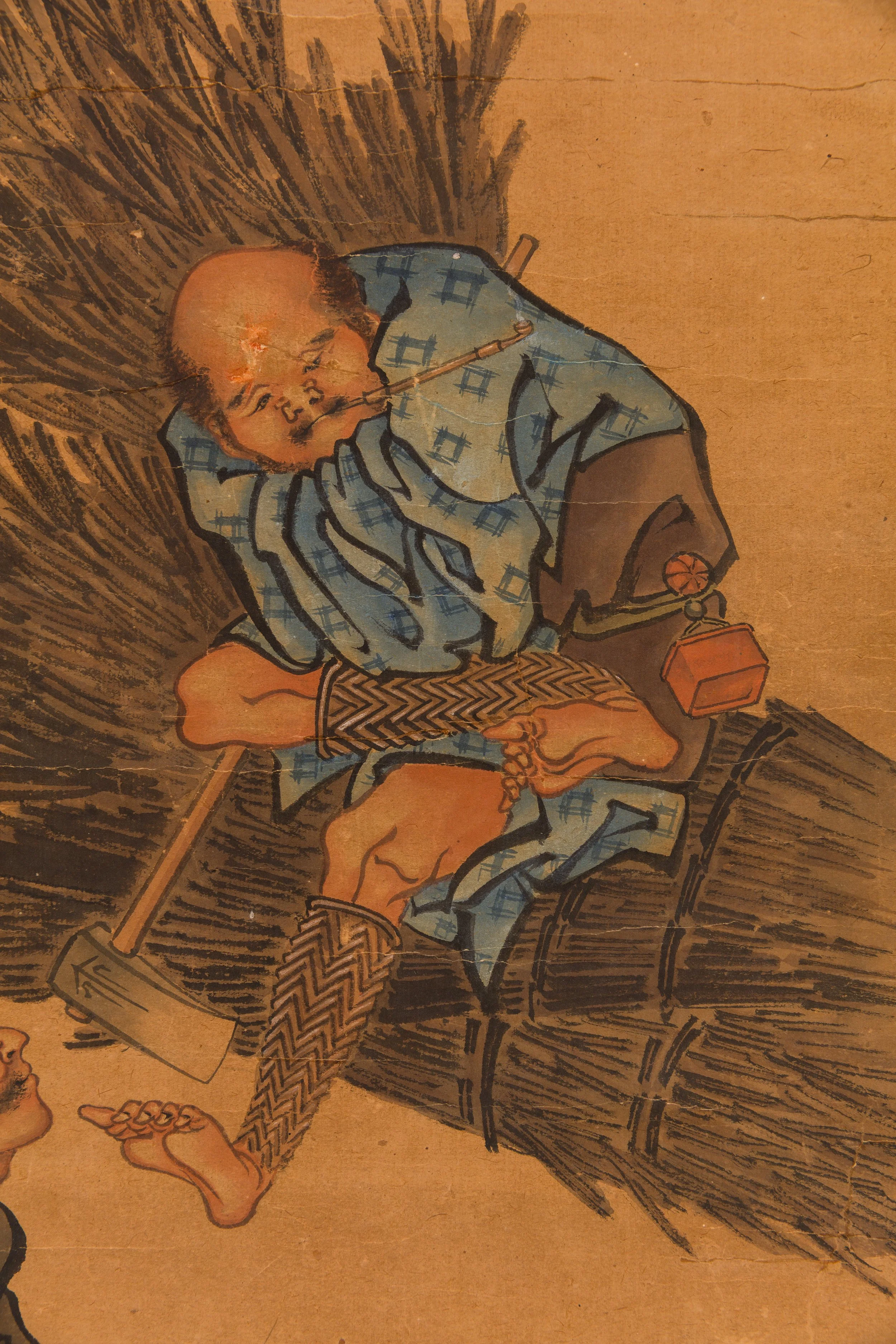
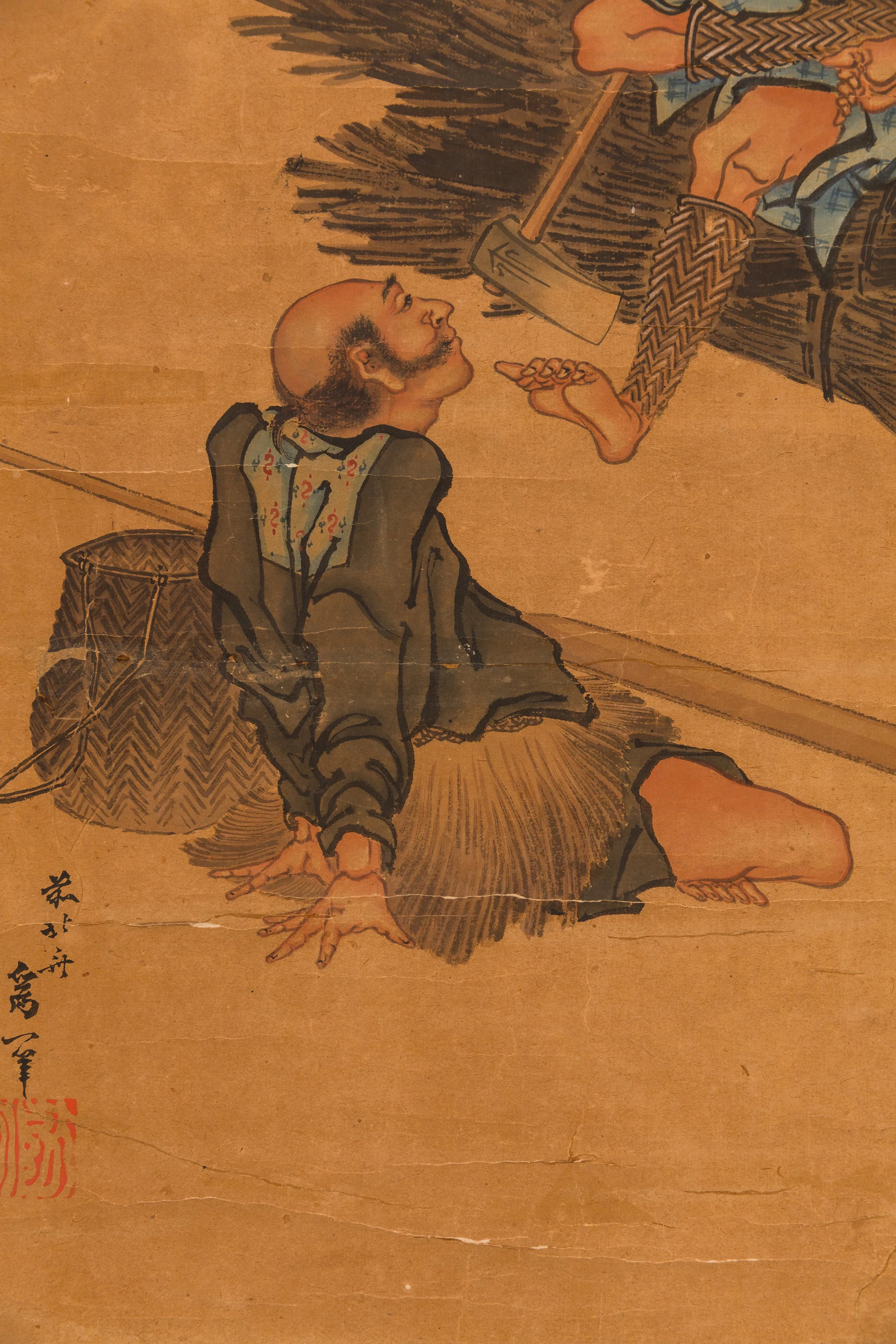
Two rustic figures occupy a suspended world: the woodcutter perched above on his bundle of brushwood, pipe balanced between his lips; below, the fisherman grounds himself with one hand to earth, oar resting before him. Their exchange is quiet, but charged. Mountain above, water below — an elemental dialogue rendered with remarkable sensitivity.
This painting transforms a motif known from Hokusai’s late Manga into something far more resolved and contemplative. Where the printed design compresses and simplifies, this scroll expands and deepens. Flesh is modelled in translucent washes; hair is articulated with dry, rhythmic strokes; the exaggerated toes and tilted heads pulse with the expressive distortions characteristic of the Katsushika idiom. The white highlight along the leggings, the faint breath of smoke from the pipe, the nuanced shading beneath the jaw — these details elevate the scene beyond caricature into psychological presence.
The brush line is confident and elastic, tapering with authority. Colour is restrained yet lyrical, moving through muted blues, earthy browns and soft greys with quiet control. The compositional intelligence suggests intimate familiarity with Hokusai’s Fugaku Hyakkei (One Hundred Views of Mount Fuji) and the experimental vocabulary of his late studio practice. Whether executed by a close disciple, a gifted member of the Katsushika household, or within Hokusai’s immediate circle, the painting reveals a sophisticated internalisation of the master’s mature style — not imitation, but absorption.
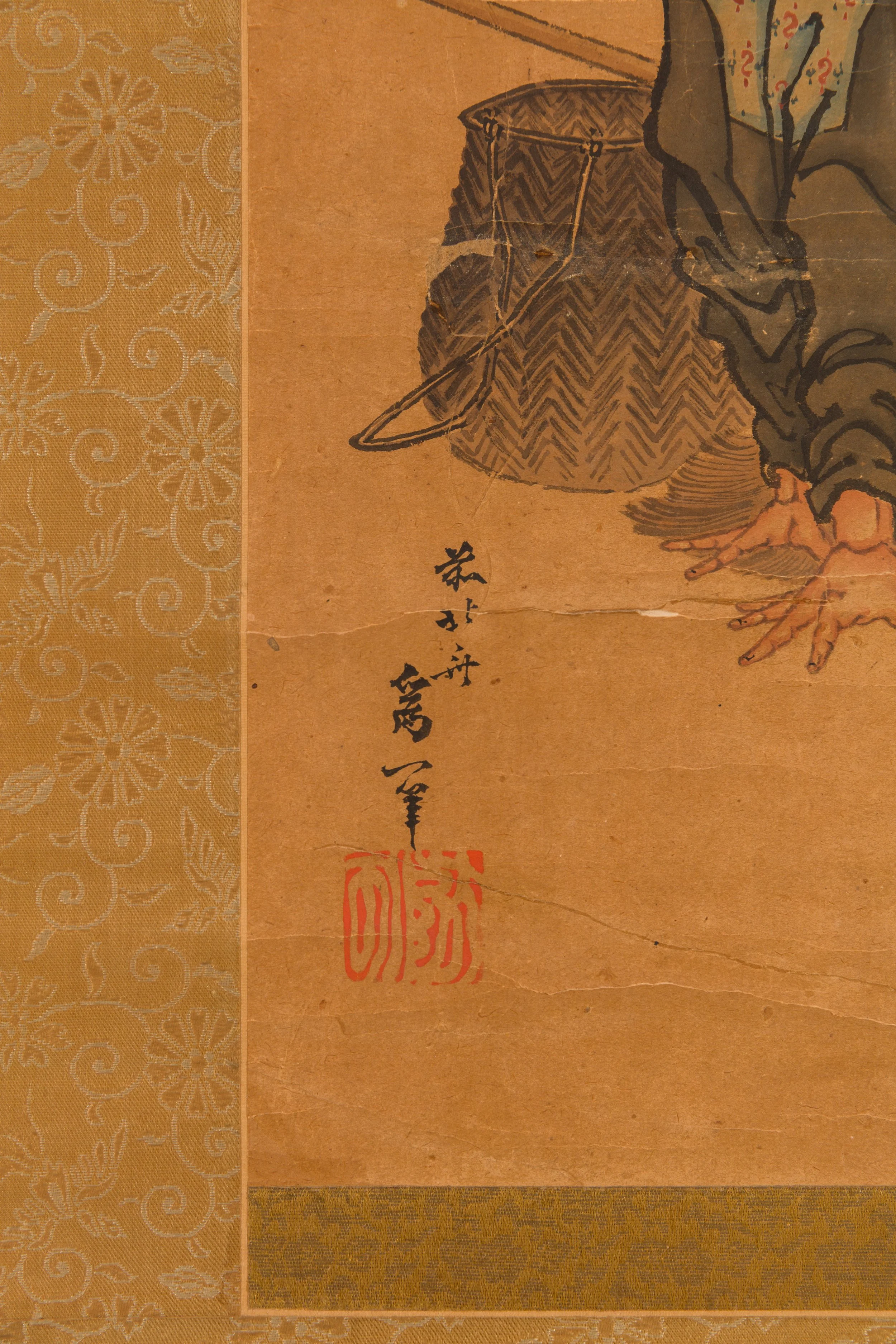
The surface shows age and wear, with areas of thinning pigment and toning consistent with nineteenth-century paper scrolls. Yet this patina enhances rather than diminishes its presence. The work remains visually compelling, its humanity intact — perhaps even intensified — by time.
Image: 72 x 31 cm
Overall: 154 x 44 cm
Shaft tips: wood
About the School of Hokusai
Katsushika Hokusai (1760–1849) stands among the most influential artists of the Edo period, celebrated for his restless innovation across painting and print. By the 1830s–40s, the Katsushika studio operated as a collaborative environment in which pupils and family members, including his daughter Ōi, absorbed and extended his expressive language. Works emerging from this circle often reveal a dynamic interplay of bold contour and sensitive colour wash, reflecting both the master’s authority and the atelier’s shared discipline. Paintings from this orbit offer rare insight into the living transmission of style within one of Japan’s most important artistic lineages.
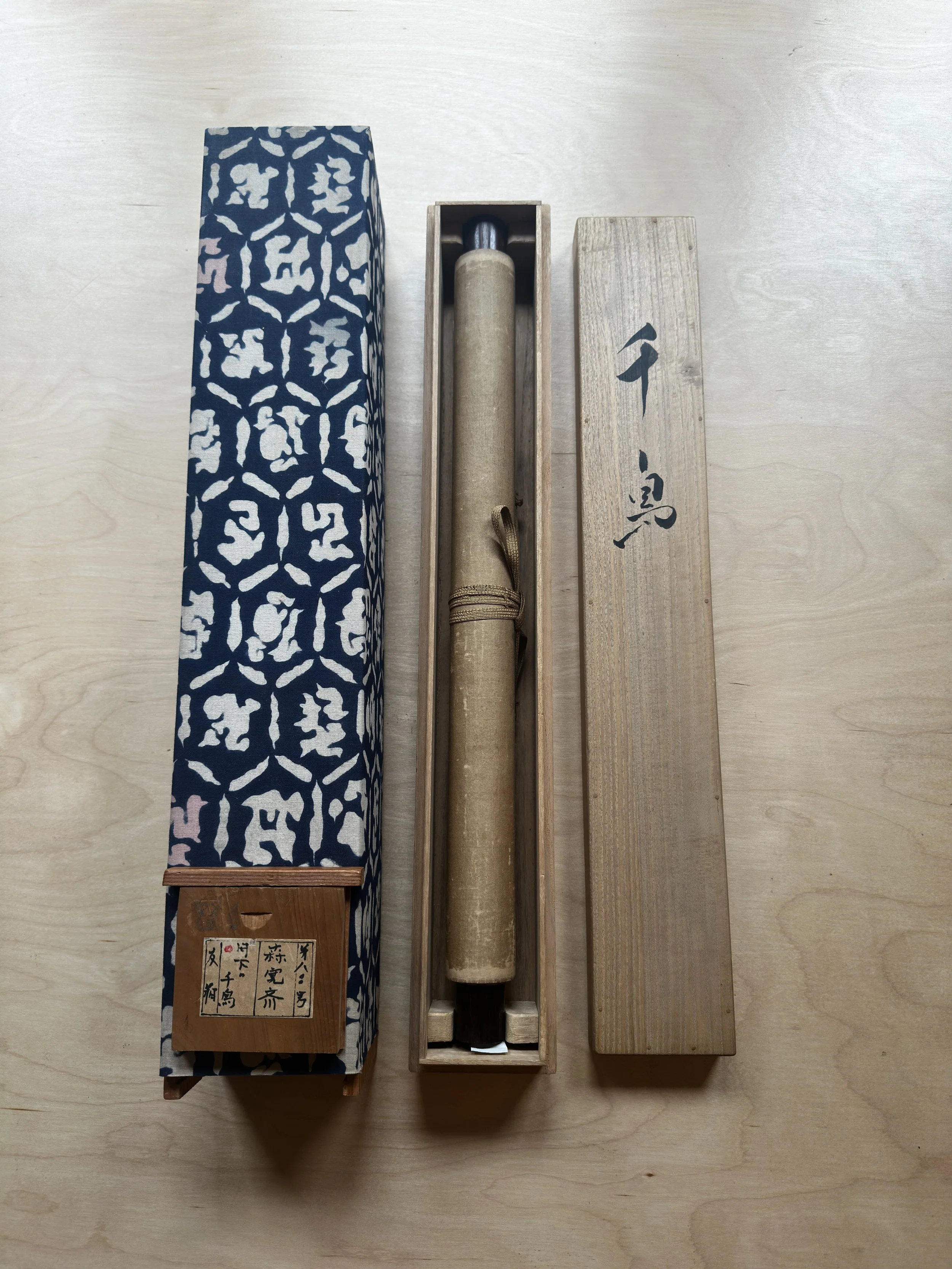
Box included as shown, this is not the original box
School of Hokusai (Katsushika studio circle), Edo period, c. 1830s–1840s
Two rustic figures occupy a suspended world: the woodcutter perched above on his bundle of brushwood, pipe balanced between his lips; below, the fisherman grounds himself with one hand to earth, oar resting before him. Their exchange is quiet, but charged. Mountain above, water below — an elemental dialogue rendered with remarkable sensitivity.
This painting transforms a motif known from Hokusai’s late Manga into something far more resolved and contemplative. Where the printed design compresses and simplifies, this scroll expands and deepens. Flesh is modelled in translucent washes; hair is articulated with dry, rhythmic strokes; the exaggerated toes and tilted heads pulse with the expressive distortions characteristic of the Katsushika idiom. The white highlight along the leggings, the faint breath of smoke from the pipe, the nuanced shading beneath the jaw — these details elevate the scene beyond caricature into psychological presence.
The brush line is confident and elastic, tapering with authority. Colour is restrained yet lyrical, moving through muted blues, earthy browns and soft greys with quiet control. The compositional intelligence suggests intimate familiarity with Hokusai’s Fugaku Hyakkei (One Hundred Views of Mount Fuji) and the experimental vocabulary of his late studio practice. Whether executed by a close disciple, a gifted member of the Katsushika household, or within Hokusai’s immediate circle, the painting reveals a sophisticated internalisation of the master’s mature style — not imitation, but absorption.
The surface shows age and wear, with areas of thinning pigment and toning consistent with nineteenth-century paper scrolls. Yet this patina enhances rather than diminishes its presence. The work remains visually compelling, its humanity intact — perhaps even intensified — by time.
Image: 72 x 31 cm
Overall: 154 x 44 cm
Shaft tips: wood
About the School of Hokusai
Katsushika Hokusai (1760–1849) stands among the most influential artists of the Edo period, celebrated for his restless innovation across painting and print. By the 1830s–40s, the Katsushika studio operated as a collaborative environment in which pupils and family members, including his daughter Ōi, absorbed and extended his expressive language. Works emerging from this circle often reveal a dynamic interplay of bold contour and sensitive colour wash, reflecting both the master’s authority and the atelier’s shared discipline. Paintings from this orbit offer rare insight into the living transmission of style within one of Japan’s most important artistic lineages.
Box included as shown, this is not the original box